
Cash-secured puts are one of the most practical ways to get paid while you wait for a stock to come to your price. In this guide, we'll walk through exactly how the strategy works, show you a full example with real numbers, compare it to covered calls, and flag the mistakes that trip up traders who skip the fundamentals.
What Is a Cash-Secured Put?
Bottom Line: Cash-secured puts work best as a disciplined way to get paid for agreeing to buy a stock you already want at a price you already find fair, not as a shortcut to easy income. The strategy only holds up when strike selection, expiration timing, and volatility checks are set in advance, so assignment never feels like an unwanted surprise.
A cash-secured put involves selling a put option while holding enough cash in your account to buy 100 shares of the underlying stock if you get assigned. The "cash-secured" part is the key distinction: you're not using margin or leverage, the dollars are sitting there, ready to be deployed.
This is different from a naked put, where you sell the put without full cash backing. Naked puts carry more risk and typically require a higher account approval level on most brokerage platforms.
We think of cash-secured puts as a lower-risk, income-generating strategy best suited for traders who already understand options basics. You're essentially getting paid to place a limit order on a stock you already want to own, at a price you already think is fair.
Key Concept: Selling a cash-secured put means agreeing to buy 100 shares at your chosen strike price if the stock falls below it by expiration, and collecting a premium today in exchange for that promise.
How Does a Cash-Secured Put Work?
We teach this strategy as three moving parts: sell a put contract on a stock you'd be comfortable owning, collect the premium immediately, and set aside cash equal to the strike price times 100 shares. If the stock stays above the strike at expiration, you keep the premium outright. If it falls below, you buy the shares at the strike price using the cash you already set aside.
There are three possible outcomes at expiration:
- Stock stays above the strike: The put expires worthless, you keep 100% of the premium, and no shares change hands.
- Stock falls below the strike: You get assigned, buying 100 shares at the strike price using the cash you set aside.
- Stock sits right at the strike: This is the gray zone. Assignment depends on whether the option finishes even slightly in-the-money at the close and on whether the holder chooses to exercise.
The logic behind this strategy is simple: you're selling insurance. The option buyer pays you a premium to transfer the downside risk below the strike price over to you.
Want expert trading insights delivered daily?
Join thousands of traders who rely on Traders Agency for market analysis and trade ideas.
Join Traders AgencyA Cash-Secured Put Example for Income
Let's run through a concrete example using round numbers. Say a stock is trading at $52 and you sell one put contract with a $50 strike, 30 days to expiration, for a $2.00 premium per share.
That premium equals $200 total, since each contract covers 100 shares. To secure this trade, you need $5,000 in cash set aside ($50 strike times 100 shares).
Step-by-Step: Setting Up the Trade
- Step 1: Pick a stock you'd actually want to own. The entire strategy only makes sense if assignment is an outcome you're comfortable with, not a surprise you're scrambling to manage.
- Step 2: Choose your strike and expiration. In this example, that's a $50 strike with 30 days until expiration, set $2 below the current $52 share price.
- Step 3: Confirm your collateral. Set aside the full $5,000 required to buy 100 shares at $50 if assigned. Never sell a cash-secured put without this cash already earmarked.
- Step 4: Sell the put and collect the premium. You receive $200 upfront, which is yours to keep regardless of what happens next.
- Step 5: Monitor the position into expiration. Track the stock price relative to your $50 strike and your $48 breakeven as the days pass.
| Parameter | Value |
|---|---|
| Stock Price | $52 |
| Strike Sold | $50 |
| Premium Collected | $2.00 ($200 total) |
| Cash Required | $5,000 |
| Breakeven Price | $48.00 ($50 strike minus $2 premium) |
| Scenario | Stock Price at Expiration | Outcome |
|---|---|---|
| Best Case | Above $50 | Keep full $200 premium, a 4% return on $5,000 collateral in 30 days |
| Most Likely Case | $48 to $56 | Either keep the premium with no assignment, or acquire shares at a discount |
| Worst Case | $42 (sharp drop) | Assigned at $50, breakeven $48, net unrealized loss of $600 |
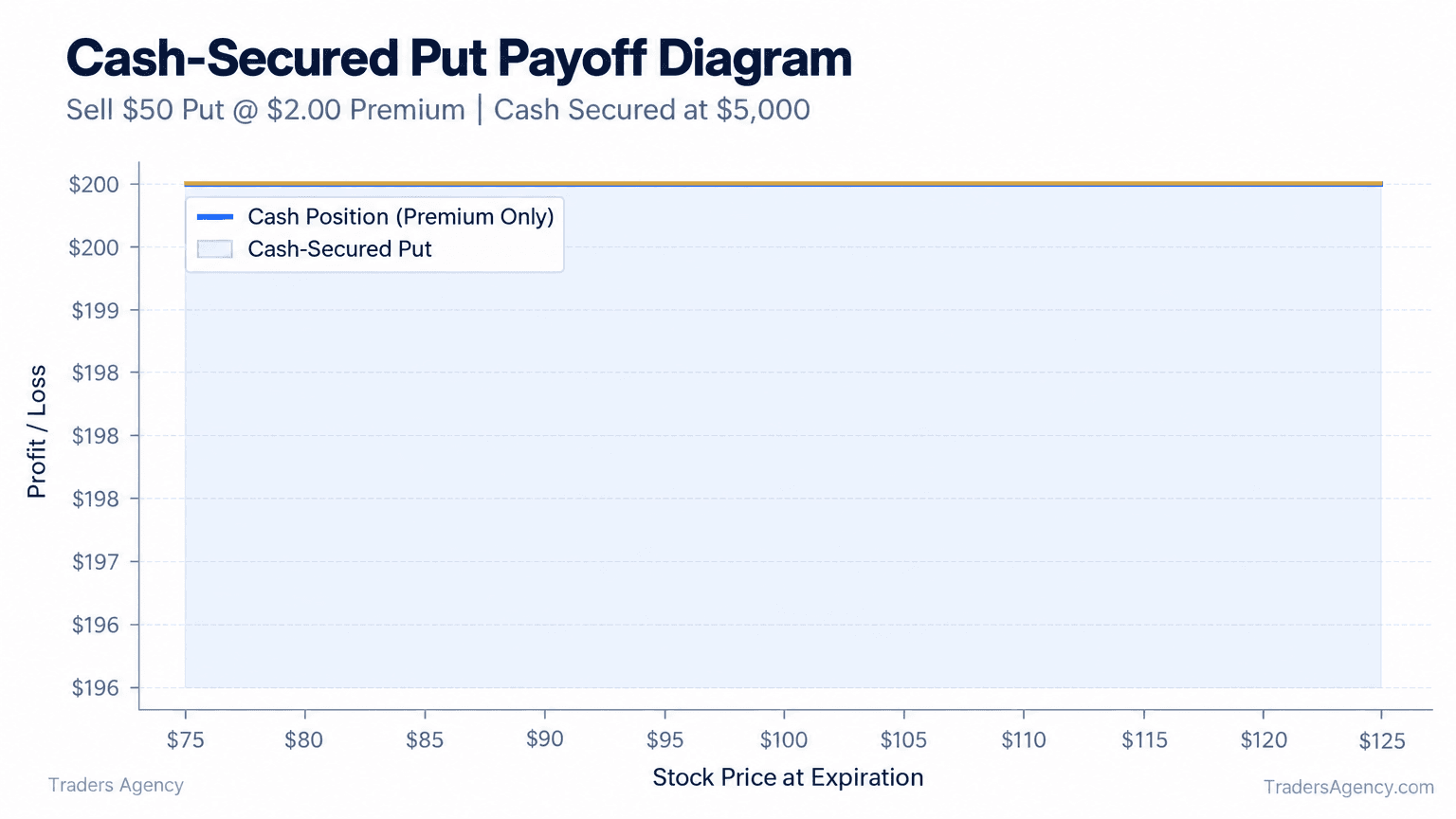
Max gain on this trade is capped at the $200 premium. Max loss, in theory, extends to the strike price minus the premium, times 100, if the stock went to zero. That's why strike selection matters so much.
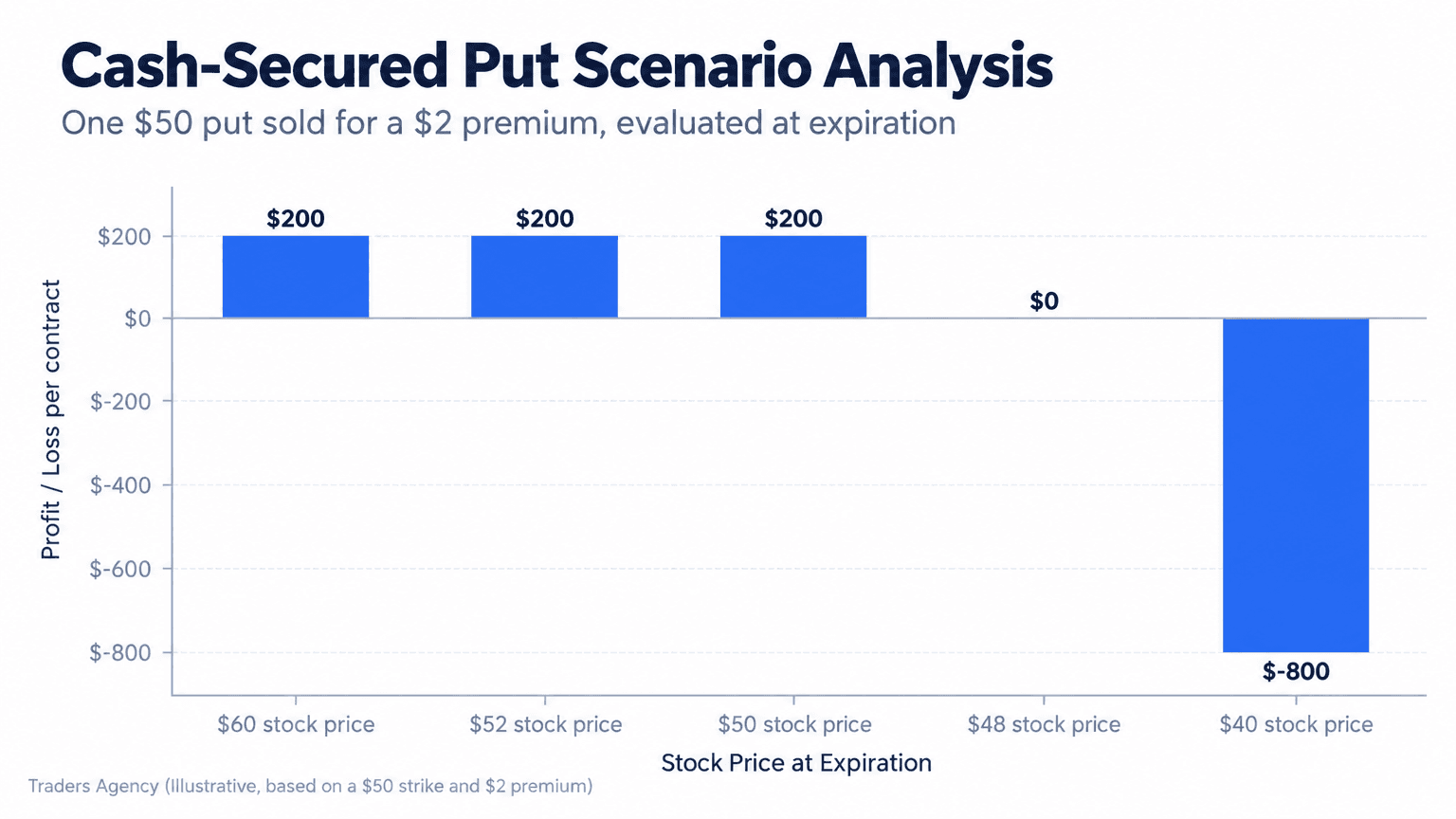
Watch Out: Max loss on a cash-secured put is substantial if the stock drops hard. Always size the position so that worst-case assignment doesn't damage your broader portfolio.
How Do the Greeks Affect Cash-Secured Puts?
The three Greeks that matter most here are delta, theta, and vega. Delta tells you roughly how likely the option is to finish in-the-money. Theta is your friend as a seller because time decay works in your favor. Vega means rising volatility can hurt your position's current value even before expiration.
A put sold at a delta of -0.30 has roughly a 30% chance of finishing in-the-money at expiration, a rough but useful shorthand we use when picking strikes. Lower delta strikes (like -0.15 to -0.20) are more conservative, further from the current price, with smaller premiums.
Theta decay accelerates as expiration approaches, especially in the final two to three weeks. This is why we generally favor 30 to 45 day expirations over weekly options: you capture decent premium while benefiting from the steepest part of the decay curve.
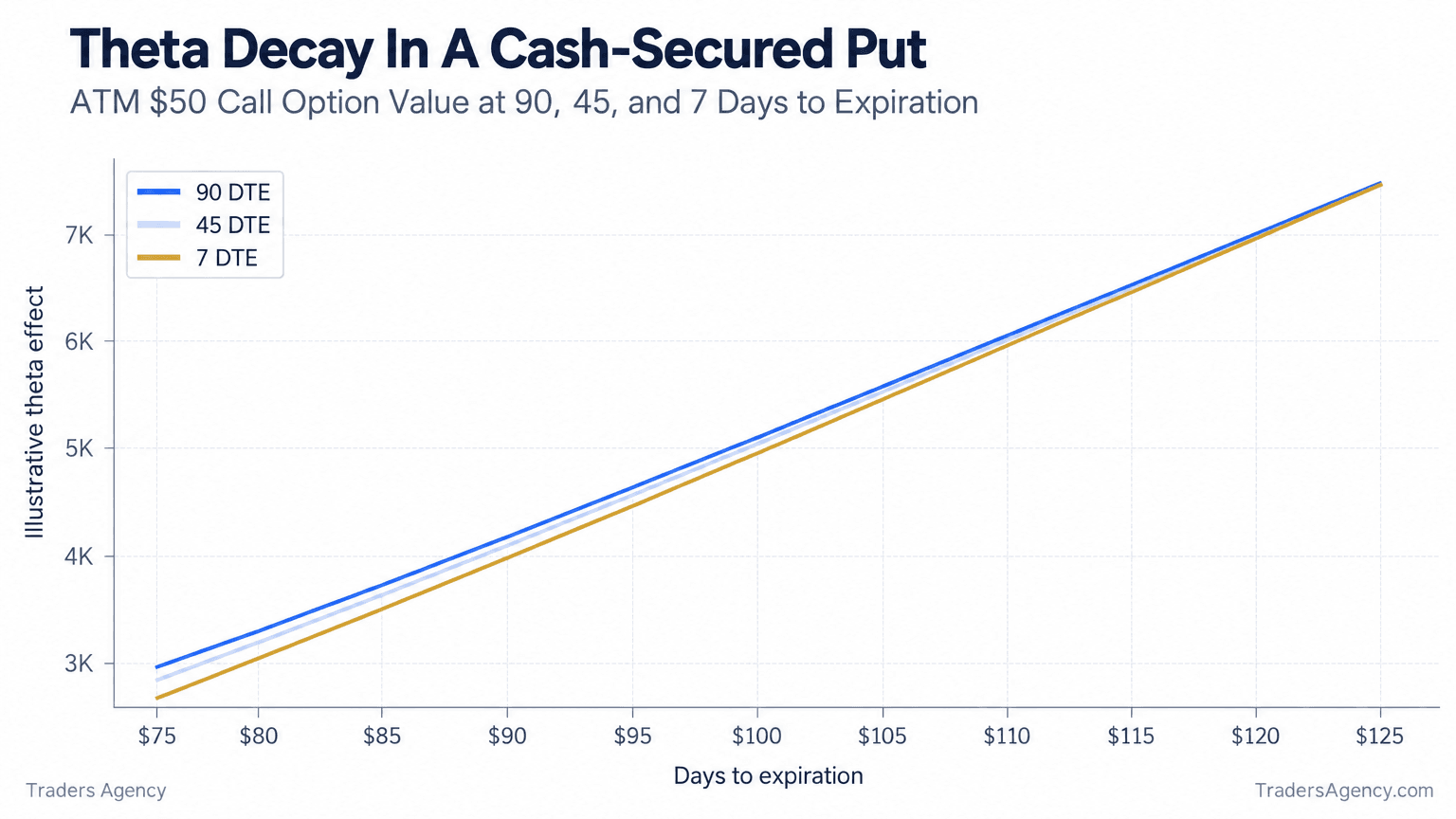
Vega matters because a spike in implied volatility, say during earnings season, inflates the option's premium even if the stock hasn't moved. If you're short the put, that works against your mark-to-market value in the short term, even if you're ultimately fine holding to expiration.
When Should You Sell Cash-Secured Puts?
We recommend selling cash-secured puts when you want to own a stock at a lower price, have the full cash collateral available, and implied volatility is elevated enough to make the premium worthwhile. This strategy fits best in sideways or moderately bullish markets on stocks you've already researched.
We advise avoiding this strategy around earnings announcements unless you specifically want that volatility exposure, since a bad surprise can blow through your strike fast. We also avoid it on stocks we wouldn't actually want to own. Selling puts purely for premium on a company you have no interest holding is one of the most common ways this strategy goes wrong.
How Do Cash-Secured Puts Compare to Covered Calls?
Cash-secured puts and covered calls are often paired together in what's known as the "wheel" strategy. You sell puts to potentially acquire shares at a discount, then once assigned, you sell covered calls against those shares to generate more income while you wait to sell at a higher price.
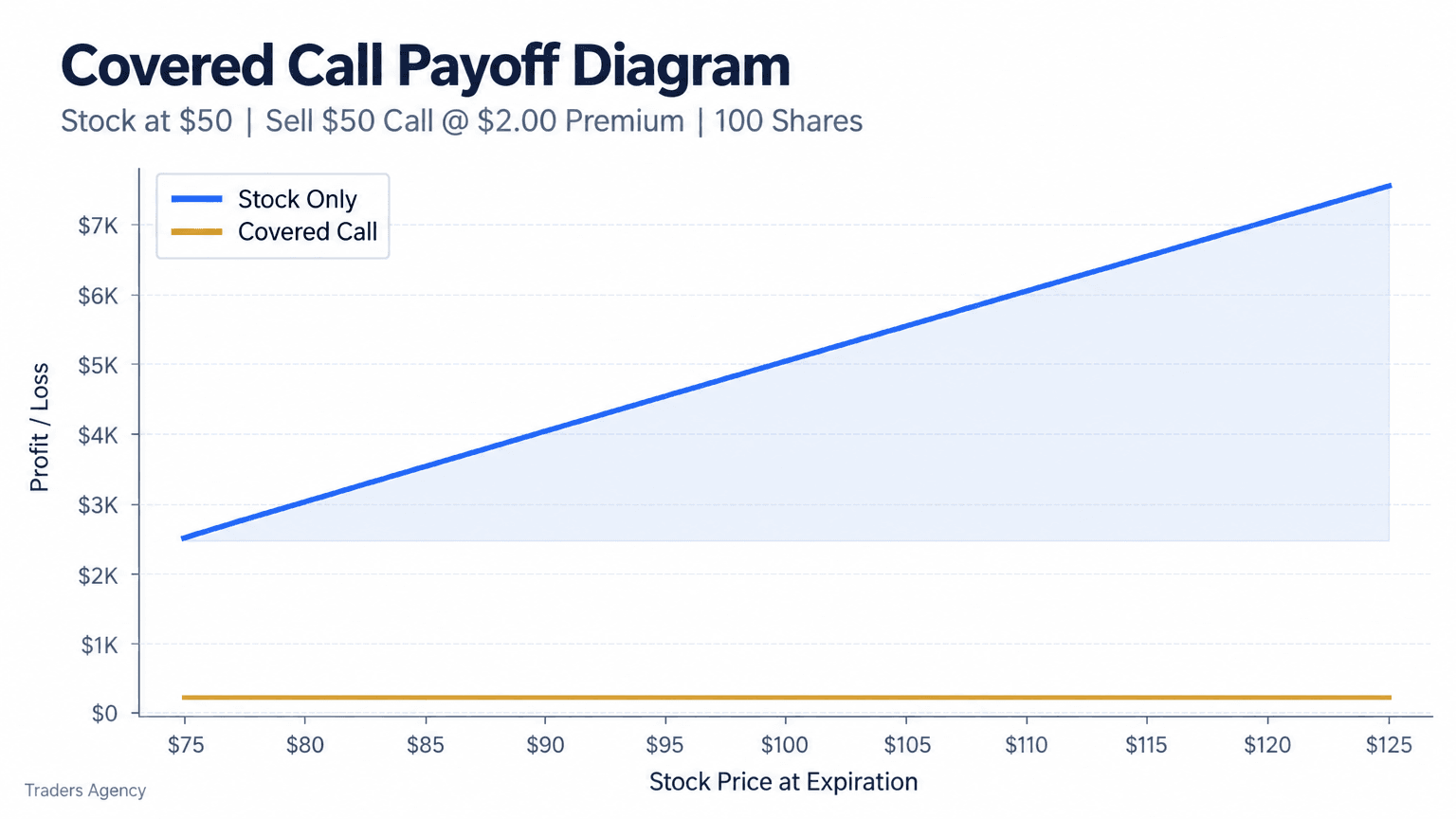
In the cash-secured puts vs covered calls comparison, neither is objectively better. They serve different stages of the same cycle. Puts work when you don't yet own shares, calls work once you do. A related variation swaps cash collateral for existing portfolio margin, which can free up capital but adds leverage risk that intermediate traders should approach carefully.
What Mistakes Should You Avoid With Cash-Secured Puts?
Here are the mistakes we see most often from traders newer to this strategy:
- Selling puts on stocks you don't actually want to own, purely chasing premium
- Using strikes too close to the current price, increasing assignment odds without enough compensation
- Ignoring earnings dates, which can cause sharp volatility and strike breaches
- Not tracking total collateral tied up, over-allocating cash across too many positions
- Rolling losing positions indefinitely, avoiding a loss instead of accepting it
A cash-secured puts calculator, many brokers offer these built in, can help you quickly check required collateral, annualized return, and breakeven before placing a trade.
Are Cash-Secured Puts Worth It?
Cash-secured puts are worth it for traders who want to generate income on cash they'd otherwise hold idle, and who are genuinely willing to buy the underlying stock if assigned. They're not a shortcut to free money, and the premium always reflects real risk being taken on.
This approach scales well beyond retail accounts too. Large, disciplined investors have long used similar strategies on index positions, collecting premium while expressing a genuine willingness to buy at lower levels. The core logic, getting paid to express a buying intention, works the same whether you're trading one contract or a thousand.
For traders who want to go deeper on contract mechanics and margin treatment before placing a trade, the CBOE options education resources are a solid reference point.
How Do You Manage Risk With Cash-Secured Puts?
- Position size: Don't tie up more than a reasonable percentage of your portfolio in any single cash-secured put
- Strike selection: Choose strikes at prices you'd genuinely be happy to own the stock
- Expiration window: 30 to 45 days balances premium collection with theta decay efficiency
- Volatility check: Elevated implied volatility means richer premiums, but also bigger potential moves
- Exit plan: Decide in advance whether you'll let assignment happen or manage/roll the position early
Key Concept: A cash-secured put only makes sense if you're genuinely comfortable owning 100 shares of the underlying at your chosen strike. If assignment would feel like a mistake, the strike or the stock needs to change.
Want expert trading insights delivered daily?
Join thousands of traders who rely on Traders Agency for market analysis and trade ideas.
Join Traders AgencyDISCLAIMER: Traders Agency does not offer financial advice. The information provided is for educational purposes only and should not be considered financial advice. Traders Agency is not responsible for any financial losses or consequences resulting from the use of the information provided. Trading carries inherent risks and may not be suitable for all individuals. You are advised to conduct your own research and seek personalized advice before making any investment decisions, recognizing the potential risks and rewards involved.
See more from Traders Agency on Google
Make us a preferred source and our market analysis will appear more prominently in your Google Search, Top Stories, and AI results.
Add to Preferred Sources