
Every trader eventually faces the same gut-check moment: hold on, or get out? Diamond hands vs paper hands is the shorthand our community uses to describe that split-second decision, but the labels only tell half the story. In this guide, we'll show you what each term actually means, how to tell real conviction from stubborn denial, and how to build an exit plan before emotion ever enters the picture.
This isn't about telling you to always hold or always sell. It's about giving you a framework so your next decision is intentional, not emotional.
What Does Diamond Hands Mean in Trading?
Bottom Line: Diamond hands and paper hands aren't inherently right or wrong strategies, they're labels that only matter if the decision behind them is deliberate. The real skill is building an exit plan and sizing positions before emotion sets in, so holding or selling reflects a thesis rather than panic or peer pressure.
Diamond hands meaning, in short: a trader who holds a position through extreme price swings, often ignoring steep paper losses, because they believe in the long-term thesis. The term suggests something unbreakable, like a diamond, that won't crack under pressure the way a stock chart might.
The diamond hands meme became a cultural symbol during the GameStop (GME) and AMC Entertainment (AMC) trading frenzy of early 2021, when retail traders encouraged each other to hold shares despite massive volatility. Holding wasn't just a strategy there, it became a badge of identity within that community.
What does having diamond hands mean in practice? It means refusing to sell during a drawdown because you're betting the price will recover or move higher later. Sometimes that conviction is backed by real research and a defined thesis. Other times it's closer to gambling dressed up as patience. We'll walk through how to tell the difference below.
What Does It Mean to Have Paper Hands?
What does it mean to have paper hands: it describes a trader who sells a position quickly, often at the first sign of a loss or a small profit, instead of sticking to an original plan. The term implies fragility, as if the trader's resolve is made of paper rather than something durable.
The paper hands meaning carries a slightly negative connotation in retail trading culture. It's frequently used to mock traders who panic-sell during a dip, only to watch the price recover shortly after. The paper hands meme typically shows someone folding under pressure right before a rebound.
Here's what that meme culture usually leaves out: selling early isn't always wrong. If you cut a loss because your original thesis broke, that's risk management, not weakness. "Paper hands" gets thrown around as an insult, but a disciplined exit based on a predefined plan is often the smarter move than holding out of pride.
Key Concept: Neither diamond hands nor paper hands is inherently right. The quality of the decision comes from whether it was planned in advance or reacted to in the moment.
What's the Difference Between Diamond Hands and Paper Hands?
The real difference between diamond hands vs paper hands isn't just about holding versus selling. It's about whether the decision was made with a plan, or made emotionally in the moment.
| Behavior | What It Looks Like |
|---|---|
| Diamond hands | Holds through drawdowns, often tolerating 30%, 50%, or greater unrealized losses, betting on recovery or a long-term thesis. |
| Paper hands | Exits quickly, sometimes within minutes or hours of a dip, often to avoid watching a position go further red. |
| Disciplined trader | Sets an exit point before entering and follows it regardless of emotion, whether that means holding or selling. |
Picture two traders who each buy a stock at $100. The price drops to $92.
| Trader | Decision | Outcome |
|---|---|---|
| Trader A | Sells immediately at $92 | -8% loss, trade closed |
| Trader B | Holds through a swing between $85 and $110 over three months | Position eventually recovers to $118 |
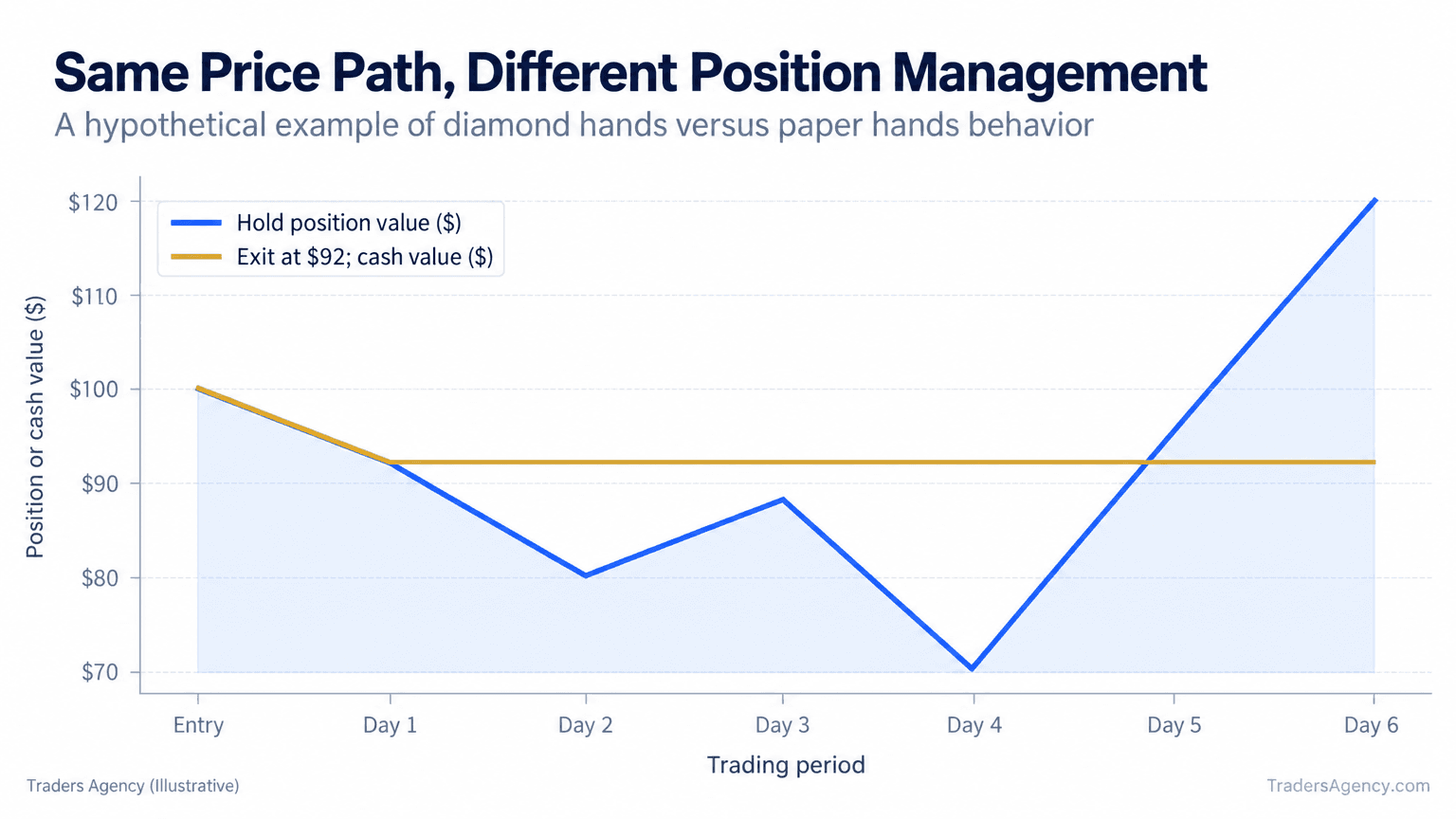
Neither choice is automatically correct. Trader B's outcome looks better here, but in a different scenario the stock could have kept falling to $60. Holding is only as good as the reasoning behind it.
Want expert trading insights delivered daily?
Join thousands of traders who rely on Traders Agency for market analysis and trade ideas.
Join Traders AgencyWhen Is Holding a Position Conviction vs Stubbornness?
Conviction becomes stubbornness the moment you're holding a losing position for reasons that have nothing to do with the original trade thesis. That's the single clearest signal to watch for.
Here's a quick test we teach our members. Ask yourself these three questions when you're sitting on a loss:
- Has the fundamental reason I bought this changed? If a company's earnings, management, or competitive position has shifted, your original thesis may no longer apply.
- Would I buy this position today, at this price, knowing what I know now? If the honest answer is no, holding is often about avoiding regret rather than genuine belief.
- Am I holding because of a plan, or because selling feels like admitting failure? This is the core difference between conviction and stubbornness.
If you answer those honestly and still want to hold, that's conviction. If you're avoiding the questions altogether, that's usually a sign you've drifted into stubborn territory.
The opposite of diamond hands isn't necessarily weakness, it can be discipline. A trader who sells because the thesis broke is doing exactly what they should.
How Do You Build an Exit Plan Before You Buy?
An exit plan is a set of predetermined price levels, or conditions, that tell you when to sell, written down before you enter a trade. Building one before you buy removes emotion from the decision at the exact moment emotion is hardest to control.
Setting Your Levels
We recommend defining three things before any trade:
- Set a stop-loss level: the price at which you'll exit if the trade moves against you, limiting your downside.
- Set a profit target: the price at which you'll consider taking gains, partially or fully.
- Define an invalidation condition: a signal outside your stop-loss, like a changed thesis or a broken support level, that tells you to exit even if your stop hasn't been hit.
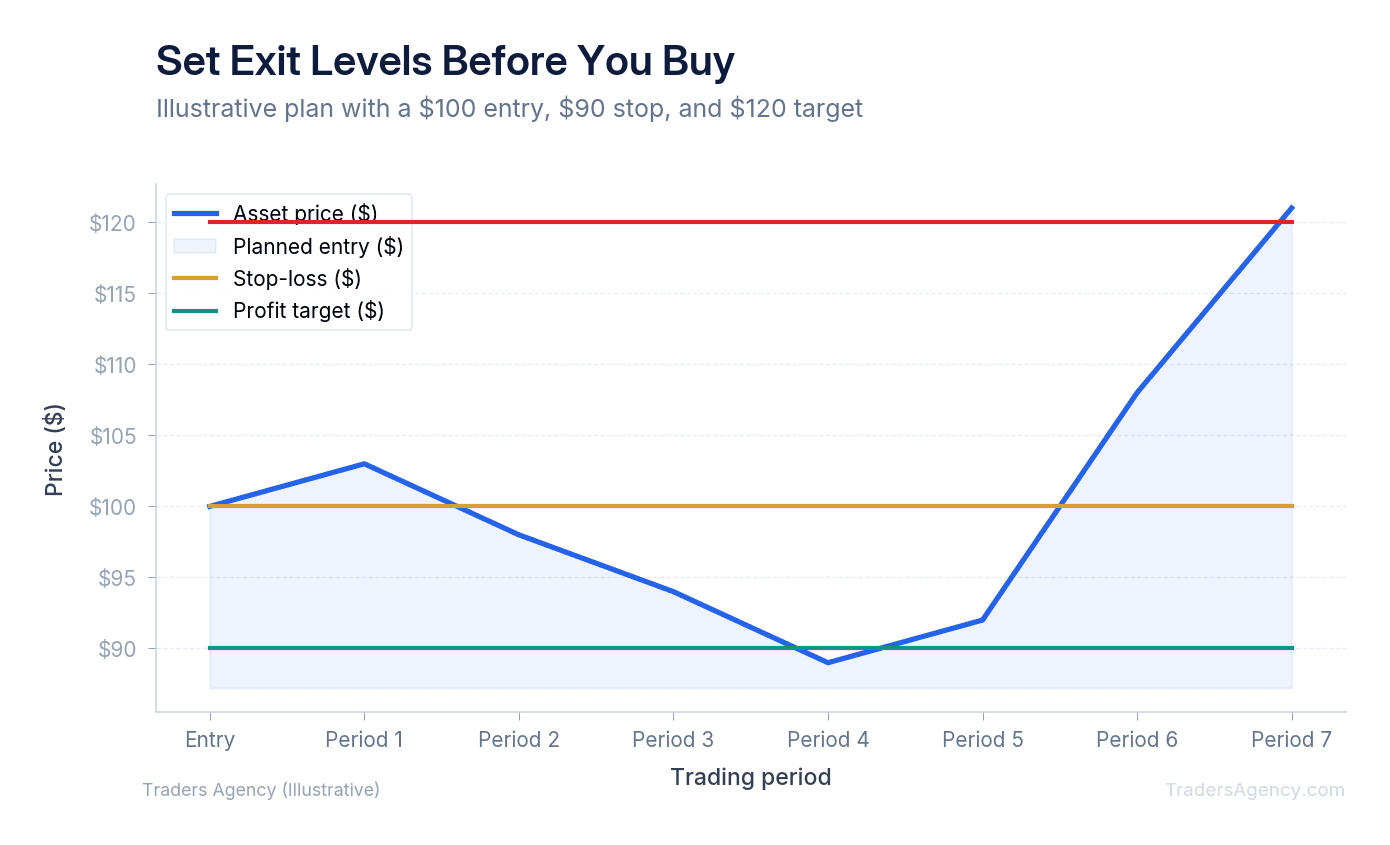
Say you buy a stock at $100. You might set a stop-loss at $90 (a 10% drawdown) and a profit target at $120 (a 20% gain). The chart below shows what that plan might look like as price moves around your entry.
Journaling the Trade
Write down why you entered, where your exits are, and what would change your mind. After the trade closes, go back and check whether your original reasoning held up.
This single habit is what separates traders who improve over time from traders who repeat the same mistakes. It also gives you honest evidence of whether your past "diamond hands" moments were justified conviction or lucky stubbornness.
Key Concept: An exit plan written before you enter a trade is the single best defense against both panic-selling and stubborn holding.
Why Do Traders Hold Losing Positions Too Long?
Loss aversion is a well documented behavioral bias where the pain of losing money feels roughly twice as powerful as the pleasure of gaining the same amount. This bias is a major reason traders hold losing positions far past the point a rational plan would call for an exit.
The math behind this bias makes holding too long even riskier than it feels in the moment. A 10% loss only needs an 11.1% gain to break even. But a 50% loss needs a full 100% gain just to get back to where you started.
| Loss Incurred | Gain Required to Break Even |
|---|---|
| 10% | 11.1% |
| 20% | 25% |
| 30% | 42.9% |
| 50% | 100% |
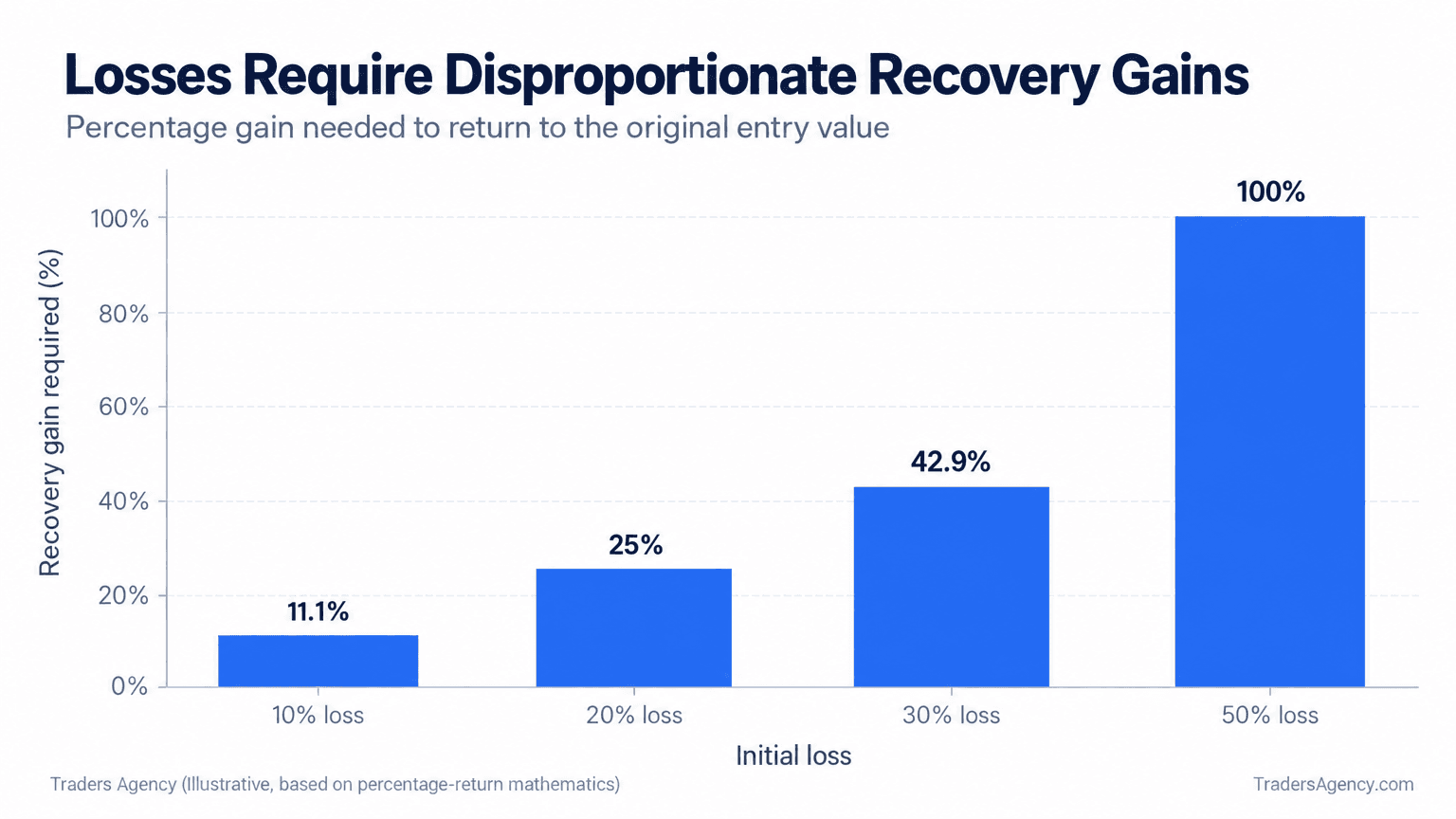
This is why cutting a loss early, even though it feels like admitting defeat, often protects your capital far better than waiting and hoping. The deeper a position falls, the harder the math works against recovery.
Risks of Diamond Hands and Paper Hands Strategies
Both approaches carry real risk, and retail trading culture often glosses over this. Extreme diamond-hands behavior, especially in heavily hyped meme stocks, has led traders to hold through losses of 70% or more with no exit plan at all.
Extreme paper-hands behavior carries its own cost: selling every small dip means you may never give a legitimate long-term thesis the time it needs to play out.
A few guardrails we teach our members:
- Never risk more than you're prepared to lose entirely on a single speculative position.
- Avoid sizing a position so large that watching it drop triggers panic decisions.
- Treat social media hype, including diamond hands and paper hands memes, as entertainment, not analysis.
- Revisit your thesis on a schedule, not just when the price moves sharply.
Watch Out: The U.S. Securities and Exchange Commission has published investor alerts specifically warning about the risks of trading based on social media sentiment rather than fundamental research. The loudest voices online aren't always the most reliable ones.
Want expert trading insights delivered daily?
Join thousands of traders who rely on Traders Agency for market analysis and trade ideas.
Join Traders AgencyDISCLAIMER: Traders Agency does not offer financial advice. The information provided is for educational purposes only and should not be considered financial advice. Traders Agency is not responsible for any financial losses or consequences resulting from the use of the information provided. Trading carries inherent risks and may not be suitable for all individuals. You are advised to conduct your own research and seek personalized advice before making any investment decisions, recognizing the potential risks and rewards involved.
See more from Traders Agency on Google
Make us a preferred source and our market analysis will appear more prominently in your Google Search, Top Stories, and AI results.
Add to Preferred Sources