
You've probably seen this happen: two stocks trade at nearly the same share price, but one company is worth ten times more than the other. How is that possible, and which one is actually the "bigger" business? The answer comes down to market capitalization, one of the most basic yet most misunderstood numbers in investing.
By the end of this guide, you'll know exactly what market capitalization is, how to calculate it, where to find the data you need, and how we teach our members to use it when sizing up a potential investment. We'll also show you how market cap shapes entire index funds, why a $50 billion company isn't automatically "safer" than a $500 million one, and what to watch for across different sectors.
What Is Market Capitalization?
Bottom Line: Market cap tells you what size category a company falls into, not whether it's a good investment. A high market cap doesn't automatically mean lower risk, so investors still need to check fundamentals before assuming a bigger company is a safer one.
Market capitalization (usually shortened to "market cap") is the total dollar value of a company's outstanding shares of stock. It tells you what the market currently thinks a company is worth, not what its factories, patents, or cash in the bank are worth on paper.
In plain language, market cap answers one question: if you multiplied every single share of a company by its current price, how much would the whole business be worth? That's it. No debt, no revenue, no profit margins baked in directly. Just price times shares.
This matters because market cap is how investors and index providers classify company size. A $10 stock could belong to a company worth $200 million or $200 billion depending on how many shares exist. Price alone tells you nothing about size. Market cap does.
Key Concept: Share price measures the cost of one slice. Market capitalization measures the size of the whole pie. Two stocks can trade at the same price and represent wildly different businesses.
How Do You Calculate Market Capitalization?
The market capitalization formula is one of the simplest in finance:
Market Cap = Current Share Price × Total Outstanding Shares
Outstanding shares are all the shares a company has issued that are currently held by investors, including institutions, insiders, and the general public. Here's how we find that number:
- Step 1: Pull the latest filing – Look up the company's most recent quarterly or annual report filed with the U.S. Securities and Exchange Commission. The share count sits on the cover page of the 10-Q or 10-K.
- Step 2: Grab the current share price – Use a live quote, not yesterday's close, if you want an accurate figure.
- Step 3: Multiply – Price times shares gives you market cap. Most free screeners and brokerage quote pages display both inputs and the finished number for you.
- Step 4: Sanity-check the share count – Compare it against the prior two or three filings. A share count that keeps climbing tells you something important about dilution.
A Market Capitalization Example
Let's walk through it with real numbers:
| Company | Share Price | Shares Outstanding | Market Cap |
|---|---|---|---|
| Company A | $25 | 20 million | $500 million |
| Company B | $180 | 2.8 billion | $504 billion |
Company B's share price is higher, but that tells you almost nothing about its size relative to Company A. Company B is roughly 1,000 times larger by market cap despite a share price only seven times higher.
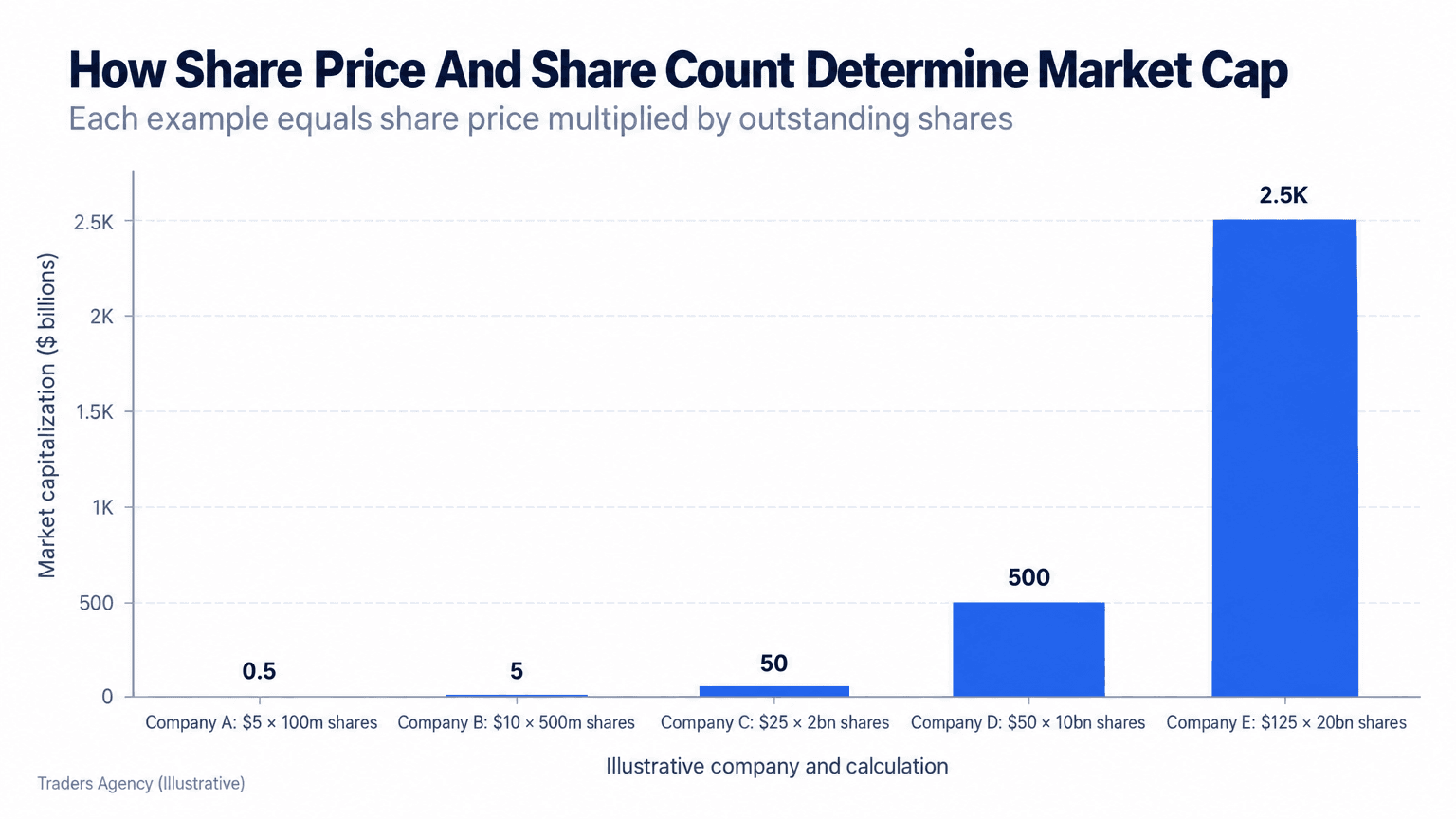
This is the point we hammer home with our members: never judge a company's size by share price alone. Always check the market cap first.
Market Capitalization for a Private Company
A private company doesn't have shares trading on a public exchange, so there's no live market price to multiply. Analysts estimate value instead, using recent funding rounds, comparable company analysis, or revenue multiples. That estimated figure is usually called a valuation rather than a true market cap, since no public market is setting the price in real time.
Want expert trading insights delivered daily?
Join thousands of traders who rely on Traders Agency for market analysis and trade ideas.
Join Traders AgencyWhy Does Market Capitalization Matter?
Market cap signals a company's size, growth stage, and risk profile all at once. Larger market caps tend to carry lower volatility and more analyst coverage. Smaller market caps often carry higher growth potential alongside higher risk.
That's the heart of why this number matters for portfolio construction. A retirement account loaded entirely with tiny, speculative companies behaves very differently than one anchored in established giants. Market cap gives you a quick, standardized way to measure that exposure across your entire portfolio.
Market Cap Segments: Mega, Large, Mid, Small, and Micro
Companies generally get sorted into five buckets based on market capitalization. These ranges aren't written into law, but they're the conventions used across the industry:
- Mega-cap – roughly $200 billion and above
- Large-cap – roughly $10 billion to $200 billion
- Mid-cap – roughly $2 billion to $10 billion
- Small-cap – roughly $300 million to $2 billion
- Micro-cap – below $300 million
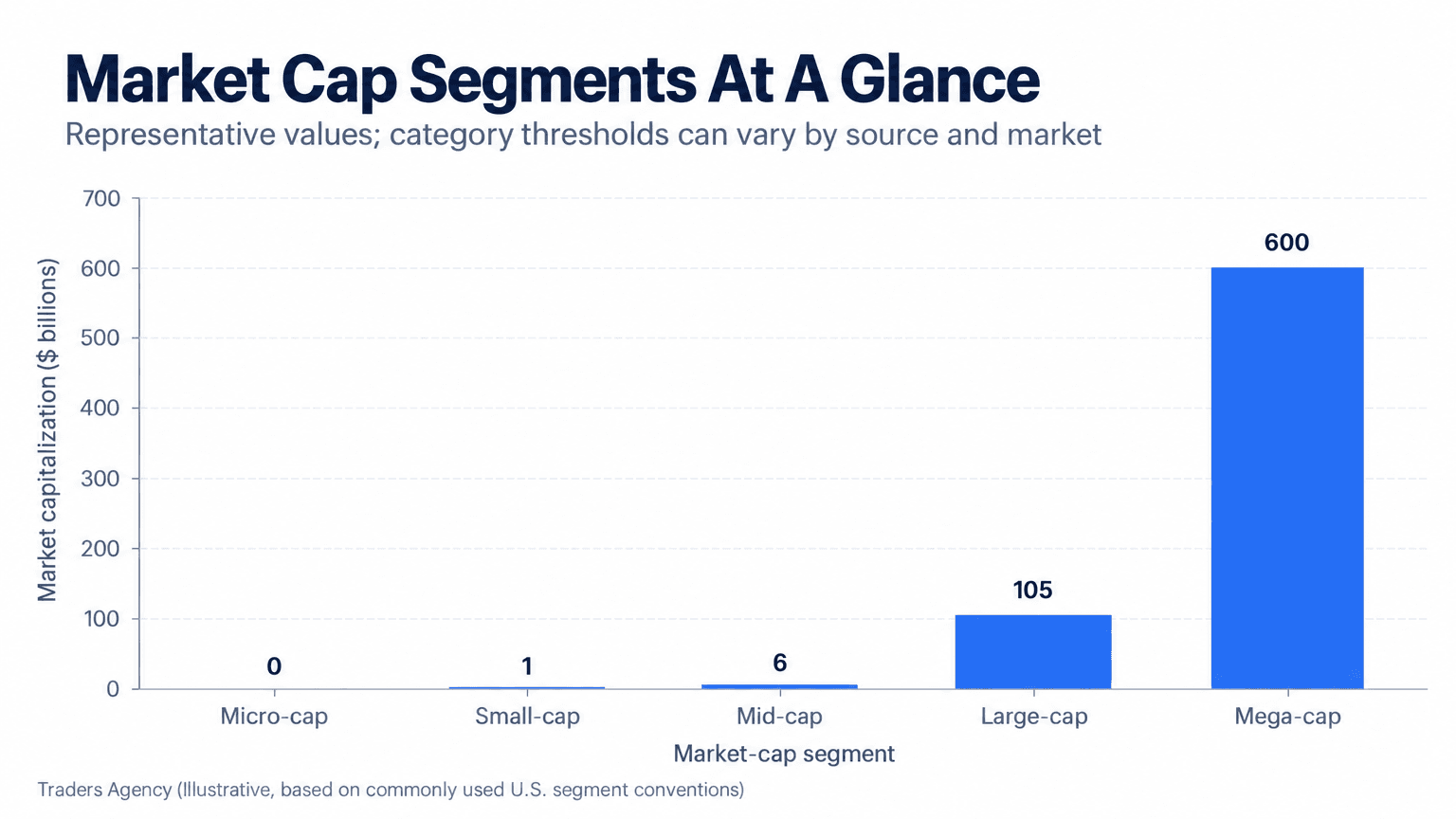
What counts as "good" varies heavily by sector. A $15 billion utility company is a solid, established large-cap. A $15 billion tech company might still be viewed as mid-sized next to mega-cap tech names valued in the trillions. So a "good" market cap always depends on what you're comparing it against within the same industry.
Is a High Market Capitalization Good?
A high market cap generally signals stability, liquidity, and lower day-to-day volatility. It is not automatically "good" for every investor or every goal, though. It depends on whether you're prioritizing growth potential, income, or capital preservation.
Large and mega-cap companies tend to have deeper trading volume, so it's easier to buy and sell shares without moving the price much. They've also typically survived multiple economic cycles, which many investors find reassuring. But that same size can mean slower growth. A company already worth $2 trillion has a much harder time doubling than one worth $200 million.
What Moves a Company's Market Cap?
Market cap changes constantly because share price changes constantly. Earnings reports, interest rate decisions, sector-wide news, broad market sentiment, and company-specific events like mergers can all push the number up or down within minutes of the open.
Outstanding shares can also change independently of price. A company that issues new shares to raise capital increases its share count, which can dilute existing shareholders even if the price stays flat. A stock buyback does the opposite: it reduces shares outstanding, which can lift the value attached to each remaining share even without new buyers stepping in.
Watch Out: A flat share price does not mean a flat ownership stake. If a company keeps issuing new shares, your slice of the business shrinks quietly in the background. Check the share count trend across the last several filings before you commit capital.
What's the Difference Between Market-Cap Weighted and Equal-Weight Indexes?
Most popular stock market indexes, including the broad benchmarks you see quoted every day, are market-cap weighted. Larger companies make up a bigger percentage of the index and carry more influence over its daily movement.
An equal-weight index gives every company the same allocation regardless of size. If an equal-weight index tracked five companies, each one would represent exactly 20% of the fund, whether it was worth $50 billion or $500 billion.
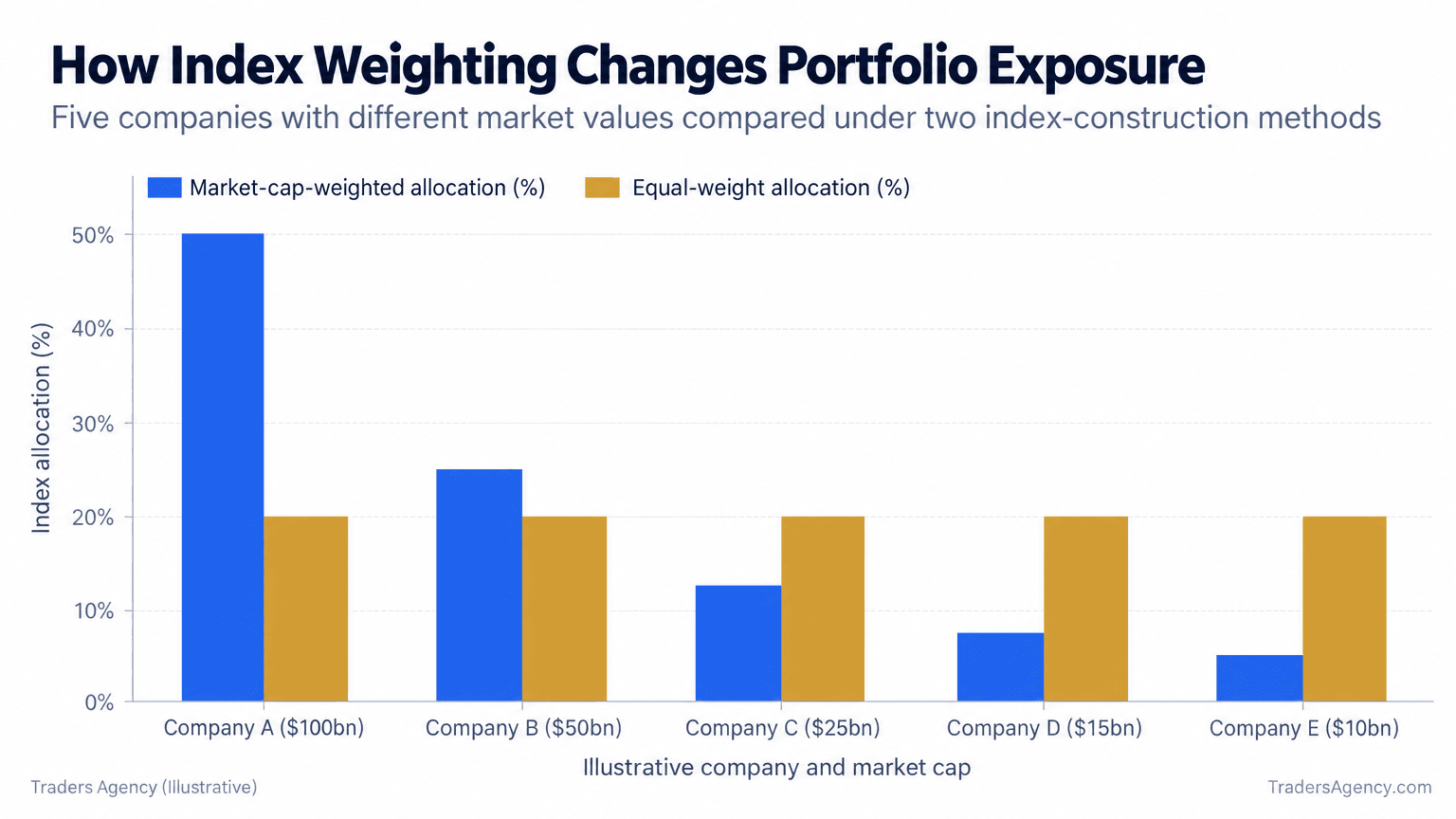
In a market-cap weighted index, a handful of mega-cap companies can drive most of the performance even if dozens of smaller companies barely move. That concentration is one reason some investors choose equal-weight funds instead.
Worth knowing alongside this: the 7% rule is a risk-management guideline some investors use that calls for selling a stock once it falls 7% to 8% below the purchase price, capping the damage any single position can do.
How We Use Market Cap in an Investment Decision
We teach our members to treat market cap as a starting filter, not a final verdict. Before you research anything else about a company, market cap tells you roughly what risk category and growth stage you're dealing with.
Our Practical Checklist
- Compare within the same sector. A $5 billion biotech and a $5 billion bank carry very different risk profiles despite identical market caps.
- Track the share count trend. Rising share counts over several quarters may signal dilution worth investigating.
- Balance across segments. Mixing mega-cap stability with select small-cap growth exposure is a common approach, though it does increase overall volatility.
- Know that crypto market cap works differently. It's calculated as price times circulating supply, but token supply schedules and unlocks can shift fast, making direct comparisons to stock market cap imperfect.
- Never use market cap alone. Pair it with revenue, earnings, and debt levels before making any decision.
Market Value vs. Market Capitalization
Market value can refer broadly to what any asset is worth in the open market, including real estate, bonds, or entire private businesses. Market capitalization is the specific term for a publicly traded company's value calculated by multiplying share price by outstanding shares. Market cap is one type of market value, not a separate concept.
Remember This: Market cap is a sizing tool, not a quality score. It tells you what category of risk you're in. The fundamentals tell you whether the company deserves your money.
Want expert trading insights delivered daily?
Join thousands of traders who rely on Traders Agency for market analysis and trade ideas.
Join Traders AgencyDISCLAIMER: Traders Agency does not offer financial advice. The information provided is for educational purposes only and should not be considered financial advice. Traders Agency is not responsible for any financial losses or consequences resulting from the use of the information provided. Trading carries inherent risks and may not be suitable for all individuals. You are advised to conduct your own research and seek personalized advice before making any investment decisions, recognizing the potential risks and rewards involved.
See more from Traders Agency on Google
Make us a preferred source and our market analysis will appear more prominently in your Google Search, Top Stories, and AI results.
Add to Preferred Sources