
China's central bank is examining a shift in its main policy rate to the overnight reverse repurchase rate, replacing the seven-day reverse repo rate that has anchored policy since 2024, according to a report from whtc.com citing state media on Oct. 19. People's Bank of China Governor Pan Gongsheng raised the prospect at a financial forum in Beijing, framing it as an effort to sharpen the central bank's control of short-term interest rates.
What Pan Gongsheng Said
According to central bank-run Financial News, as relayed by whtc.com, Pan told the forum: “Currently, the interbank overnight repo rate has effectively become the target rate for the PBOC's monetary policy. It sensitively reflects the supply and demand for short-term liquidity and has shown greater stability in recent years.” Pan said the change would make interest rate control more precise, but the report did not specify a firm timeline or conditions for implementation.
The remarks follow earlier signalling. At the Lujiazui Forum in Shanghai in June, Pan said the PBOC would improve its adjustment of short-term interest rates and expand its suite of overnight reverse repo operations “at an appropriate time,” according to the Business Times. At that same forum, Pan said temporary overnight reverse repo and repo operations would be priced 25 basis points above and below the seven-day reverse repo rate, narrowing the interest-rate corridor to 50 basis points from 70 basis points previously, the Business Times reported.
Money-Market Rates and Bond Yields
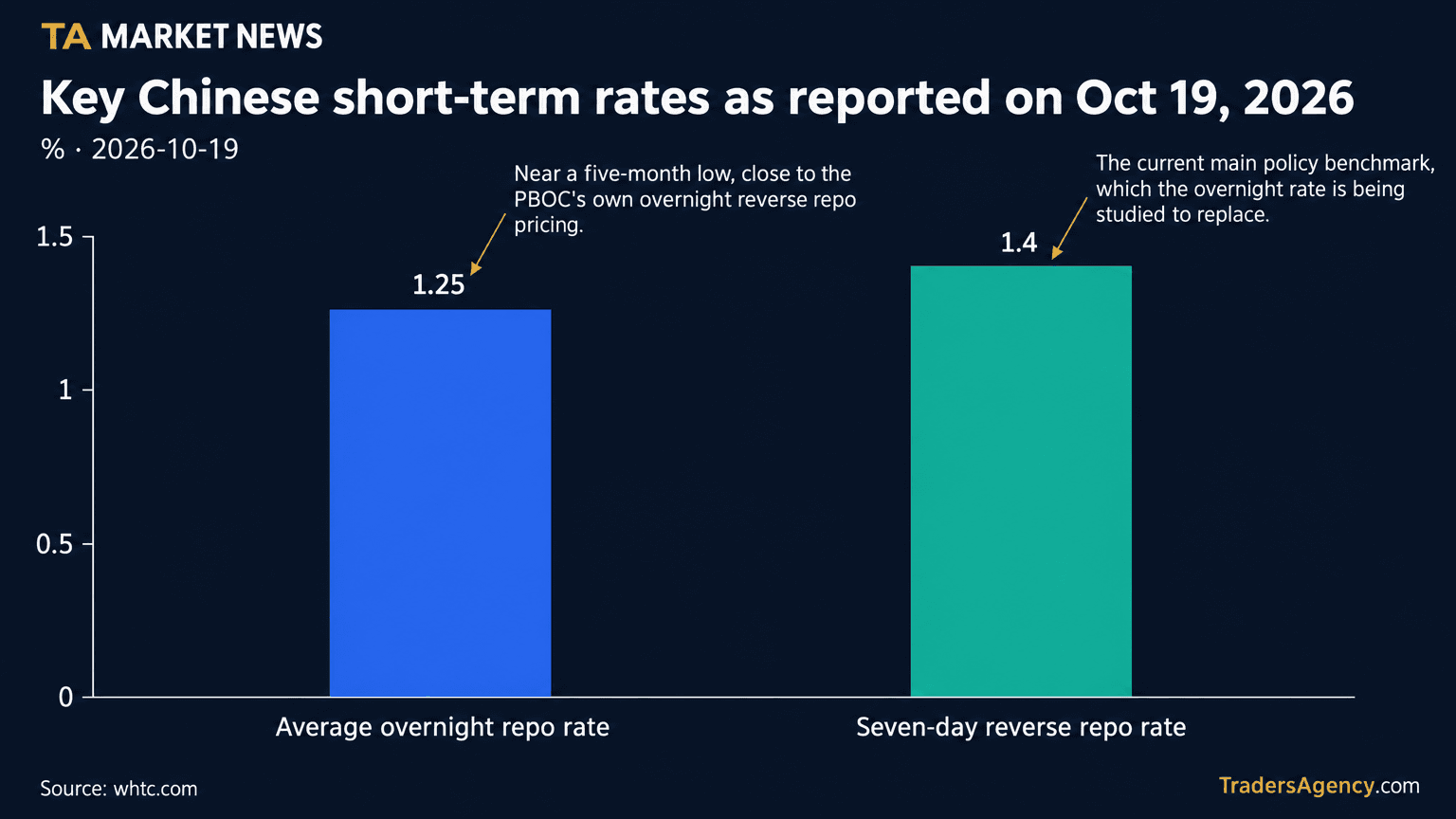
Market pricing already shows the overnight rate trading close to where the PBOC's own overnight reverse repo operations are priced. Per whtc.com's report, the average rate of overnight repos stood near a five-month low of around 1.25%, broadly in line with the reported cost of the central bank's overnight reverse repo operations, and below the seven-day reverse repo rate of 1.4%. Using those two figures, our calculation shows a gap of 1.25% minus 1.4%, or -0.15 percentage points, a relative difference of roughly -10.7%. That is a snapshot of where the two benchmarks stood on the day of the report, not a forecast of where either rate will settle once the overnight rate is formally adopted.
Golden Credit Rating International chief macro analyst Wang Qing, cited by whtc.com, said the actual operating rate for overnight reverse repos will be announced only when the central bank makes the switch, and cautioned that the change does not amount to a rate cut. China's 30-year government bond yield fell more than 1 basis point after the announcement, whtc.com reported. In our reading, that marginal move sits alongside Wang's point that the step is a technical reframing of the policy rate rather than a change in the stance of policy itself.
Expanded Liquidity Tools for Non-Banks
Pan also said the PBOC will widen the range of institutions eligible to use its Standing Lending Facility and will set up a new liquidity support tool specifically for non-bank financial institutions, according to whtc.com's report. The measures are aimed at strengthening liquidity support for non-bank institutions, including insurers and fund managers, and are intended as a backstop during periods of severe market stress rather than a tool for routine liquidity management.
Loan Pricing Reform and the LPR's Role
Separately, Pan said the central bank will issue policy guidance to push forward reform of loan pricing benchmarks, moving lending away from a relatively narrow reliance on the loan prime rate toward a more diversified set of benchmarks, whtc.com reported. Some financially strong companies could choose either the interbank overnight repo rate or the LPR as the benchmark for floating-rate loans, after consulting with financial institutions, according to Pan's remarks as reported. The report did not detail how quickly this option would be rolled out or which borrowers would qualify.
How Analysts Read the Shift
Zhou Hao, chief economist at Guotai Junan International, said the change would bring China's monetary policy framework in line with overseas practice and would make it smoother to promote yuan internationalisation, whtc.com reported. Standard Chartered's head of China macro strategy, Becky Liu, said in June, as reported by the Business Times, that the PBOC would likely gradually move toward a new monetary policy corridor framework with the overnight repo rate as the likely new de facto policy rate, adding that China's interbank rates would likely become even less volatile ahead. These are analyst expectations rather than confirmed PBOC commitments, and the central bank has not laid out a detailed transition timetable in the reporting reviewed here.
Broader Context
whtc.com's report noted that overnight reverse repo operations debuted in late June as the newest addition to the PBOC's toolkit, and that overnight transactions account for more than 80% of repo turnover in China's interbank money market. The Business Times reported in June that the overnight interbank rate accounts for the bulk of cash transactions in China's financial markets, as expectations of a shift in the policy-rate framework grew. whtc.com's report also framed the shift as consistent with changes in China's financial structure, where direct financing via bonds and equities has surpassed traditional bank lending as a key source of new funding, with credit allocation gradually moving away from credit-intensive sectors such as property. Official data released the same day, per whtc.com, showed China's economic growth rebounded to 4.5% year-on-year in the third quarter, beating expectations and easing pressure on policymakers to deliver more aggressive stimulus to meet the annual growth target of 4.5% to 5%.
Bottom Line
Pan Gongsheng has confirmed the PBOC is studying a move to make the overnight reverse repo rate its main policy benchmark, a step analysts say would align China's framework more closely with global peers and could reduce interbank rate volatility. The central bank has paired this with plans for wider access to its Standing Lending Facility, a new backstop tool for non-bank institutions, and a push to diversify loan pricing benchmarks beyond the LPR. The initial market reaction, a marginal dip in long-dated bond yields, was modest, and the actual operating rate for the overnight benchmark has not yet been set, leaving the precise mechanics and timing of the transition still to be spelled out.
DISCLAIMER: Traders Agency does not offer financial advice. The information provided is for educational purposes only and should not be considered financial advice. Traders Agency is not responsible for any financial losses or consequences resulting from the use of the information provided. Trading carries inherent risks and may not be suitable for all individuals. You are advised to conduct your own research and seek personalized advice before making any investment decisions, recognizing the potential risks and rewards involved.
- whtc.com: China’s central bank studies making overnight rate its main policy rate · accessed Oct 19, 2026
- www.facebook.com: 1.1K views · 45 reactions | The People's Bank of China (PBOC), the country's central bank, will continue to implement a moderately loose monetary policy in 2026, and utilize tools such as reserve requirement ratio (RRR) cuts and interest rate reductions to ensure liquidity remains sufficient, according to its governor Pan Gongsheng. #ChinaEconomy #Economy https://www.cctvplus.com/news/20260124/8463023.shtml#!language=1 | CCTV+ · accessed Oct 19, 2026
- www.youtube.com: - YouTube · accessed Oct 19, 2026
- www.centralbanking.com: Client Challenge · accessed Oct 19, 2026
- x.com: Bloomberg (@business) on X · accessed Oct 19, 2026
- www.businesstimes.com.sg: China's central bank hints at shift towards overnight policy rate to match global peers · accessed Oct 19, 2026
- english.www.gov.cn: China central bank reform plan targets high-level financial opening-up · accessed Oct 19, 2026
- www.centralbanking.com: People’s Bank of China (PBoC) · accessed Oct 19, 2026
See more from Traders Agency on Google
Make us a preferred source and our market analysis will appear more prominently in your Google Search, Top Stories, and AI results.
Add to Preferred Sources