
Synopsys and OpenAI announced on September 30, 2026 a multi-year agreement to jointly build GPT-Synopsys, a specialized AI model designed to operate Synopsys' electronic design automation (EDA) tools for semiconductor engineering workflows, according to a joint release from Synopsys and a Seeking Alpha Market News report. The companies describe themselves as "preferred partners" on the project, and the financial terms disclosed so far are limited to a revenue-sharing arrangement and a joint go-to-market plan, with no dollar figure, compute commitment or contract duration made public.
What GPT-Synopsys Is Supposed to Do
Per the Synopsys release, GPT-Synopsys will run on OpenAI-hosted infrastructure and is built to interoperate with customer agent-harness systems, while integrating with Synopsys.ai and the company's new Autopilot agentic AI platform. Synopsys frames the technical ambition as a step beyond today's agentic setups, where general-purpose models are simply wired to EDA tools. The goal instead is a model trained to be an expert operator of those tools, interpreting outputs and iteratively optimizing chip designs the way an experienced engineer would, according to the Synopsys announcement.
In the intended workflow, Synopsys says engineers would delegate objectives, such as power-performance-area optimization or verification closure, and let agents run the tools, interpret results, implement changes and iterate toward outcomes that a human engineer then reviews. Notably, the agreement also makes OpenAI itself a licensee: the release states OpenAI will license Synopsys' EDA tools for the model's development, effectively turning the AI lab into a customer of the EDA vendor whose software it is helping automate.
On timing, Synopsys says only that "early technology engagements are underway with leading semiconductor customers," and the release explicitly labels statements about the model's capabilities, timing and availability as forward-looking. No general-availability date or pricing for GPT-Synopsys has been disclosed.
Revenue Sharing, Not a Disclosed Price
Beyond the revenue-sharing and go-to-market language, the companies have not published deal economics. Synopsys says the joint offering will bundle compute, the model and tool licenses together rather than selling them as separate line items, and that customer design data used within the system will not train the model, will be encrypted at rest and in transit, and will be governed by configurable retention, audit and permission controls, according to the company's release.
Synopsys CEO Sassine Ghazi said the agreement "will expand access to Synopsys' advanced design capabilities and the underlying, ground-truth engineering tools required to bring increasingly complex chips to market." OpenAI president and co-founder Greg Brockman framed the tie-up in terms of AI's own hardware needs, saying, "We're using our most advanced technology to improve the systems that power AI. With Synopsys, we're bringing that work to chip design, helping engineers explore more designs and get to a working chip faster," per the same release.
Part of a Broader Agentic Push
The OpenAI tie-up lands two days after Synopsys unveiled its Autopilot Platform and AgentEngineer portfolio of long-horizon agents on September 28, spanning verification, system validation, implementation, analog/mixed-signal, manufacturing and simulation domains, according to Synopsys' AgentEngineer announcement and a Tom's Hardware report. Synopsys says more than 50 customer engagements are underway across that platform, with general availability planned for the end of 2026, and cites "demonstrated results by market leaders" including up to 50x faster verification closure, 20% higher coverage, a 30% productivity boost and 2x better token efficiency. One interpretive caveat: those are Synopsys' own disclosed figures, and each measures a different thing, so the 20% coverage number and the 30% productivity number describe separate metrics rather than a single benchmark and should not be read as directly comparable.
The Autopilot Platform itself is pitched as model-agnostic, letting customers choose commercial, open-source or fine-tuned language models and deploy on Synopsys Cloud, their own cloud or on-premises infrastructure, per Tom's Hardware and Synopsys' own materials, which places the OpenAI-hosted GPT-Synopsys alongside, rather than in place of, that broader multi-model architecture.
This is not Synopsys' first route to OpenAI's technology. The company introduced Synopsys.ai Copilot in November 2023 through a Microsoft collaboration that integrated Azure OpenAI Service, initially for early-access customers, and in that announcement Shankar Krishnamoorthy, general manager of the Synopsys EDA Group, cited a projected 15% to 30% workforce gap for chip design engineers by 2030 as the rationale for AI-assisted design tools, according to Synopsys' 2023 announcement. Synopsys has separately said Copilot users saw up to 10x faster response times for information retrieval and script creation tasks, per a company-linked LinkedIn post.
The Pricing Question Sell-Side Analysts Are Watching
Synopsys has already signaled it expects its monetization model to shift from pure per-seat subscription licenses toward a "subscription plus consumption" structure for agent usage, according to Futurum Research, which notes that under such a model the revenue driver becomes not just human seats but compute-driven tool usage tied to training and inference cycles. Futurum flags a strategic risk in that shift: customer pushback if Synopsys' value capture rises faster than provable productivity gains, particularly among cost-sensitive design teams.
Synopsys has publicly argued that agentic tools will augment rather than replace human engineers, saying some teams may use productivity gains to accelerate design cycles while others tackle more complexity or build more products with the same headcount, according to the company's commentary. Synopsys' Anand Thiruvengadam told Tom's Hardware that approval checkpoints will remain human-driven, though the outlet noted no vendor has yet described when its agents stop retrying or escalate to an engineer. Named customer endorsements so far are mixed in specificity: Fujitsu reported a 10% to 30% productivity boost in RTL code generation using Synopsys' verification agents, while Intel, MediaTek, Samsung, Nvidia, TSMC and AheadComputing offered supportive statements without quantified results, per Synopsys' release and Tom's Hardware's reporting.
Financial Backdrop
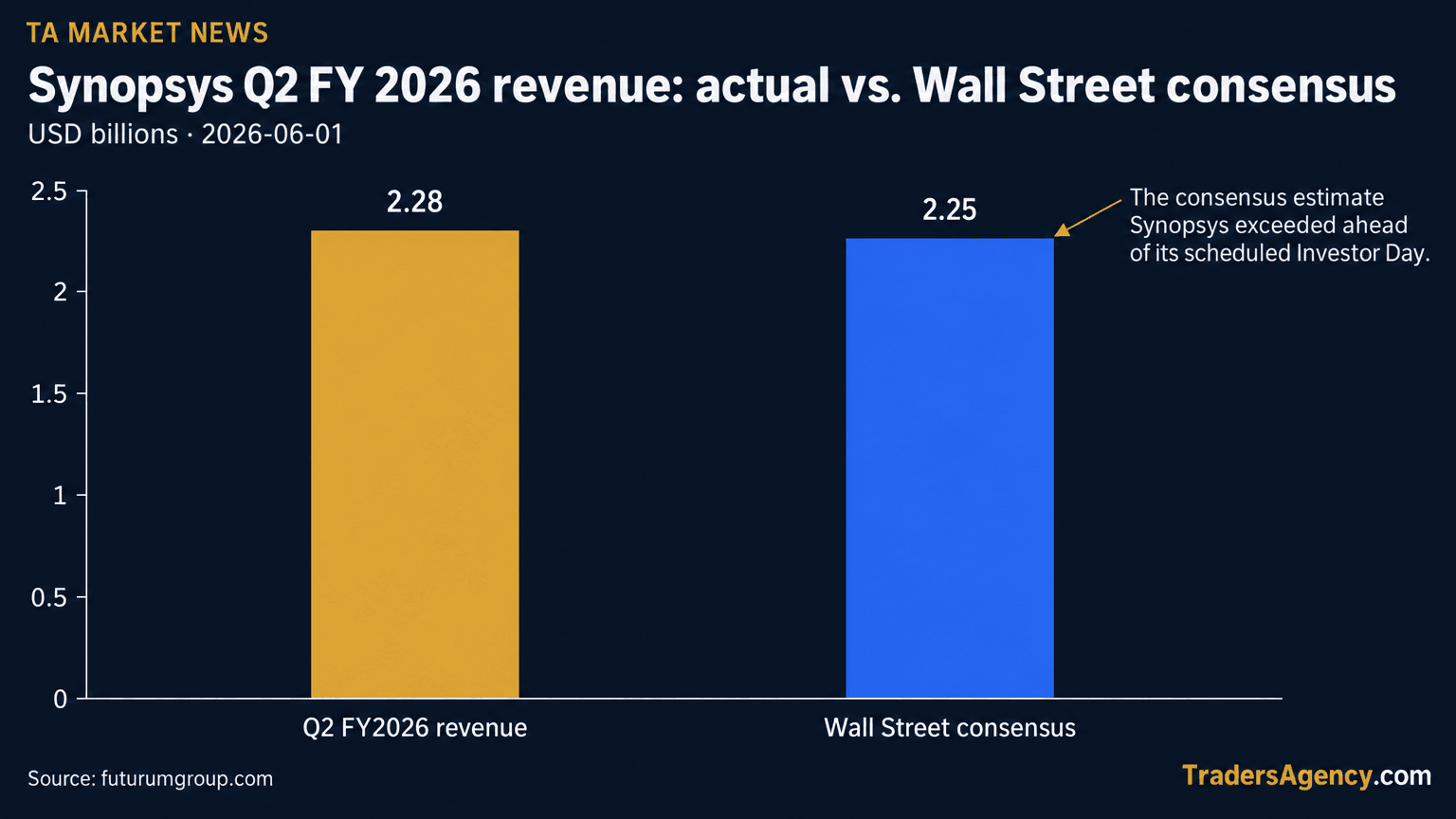
The OpenAI announcement coincided with Synopsys' scheduled Investor Day, per Futurum Research. Synopsys reported Q2 FY2026 revenue of $2.28 billion, up 42% year over year and above Wall Street consensus of $2.25 billion — a beat of about $30 million, or roughly 1.3%, calculated from those two reported figures ($2.28B − $2.25B, divided by $2.25B). Design Automation revenue rose 62% year over year to $1.82 billion, while Design IP revenue fell 5.8% to $454.2 million. Synopsys raised its FY2026 revenue guidance to $9.625 billion to $9.705 billion and non-GAAP EPS guidance to $14.72 to $14.80, targeting a midpoint non-GAAP operating margin of 41%, according to Futurum's reporting.
Bottom Line
The GPT-Synopsys partnership pairs OpenAI's frontier models with Synopsys' EDA software under a revenue-sharing structure that both companies have chosen not to price publicly, with customer rollout still described as early-stage engagements rather than a shipped product. The more consequential open question, flagged by Futurum Research, is whether Synopsys can shift EDA monetization from per-seat subscriptions toward usage-based pricing for AI agents without triggering the kind of customer pushback that occurs when cost rises faster than demonstrated productivity.
DISCLAIMER: Traders Agency does not offer financial advice. The information provided is for educational purposes only and should not be considered financial advice. Traders Agency is not responsible for any financial losses or consequences resulting from the use of the information provided. Trading carries inherent risks and may not be suitable for all individuals. You are advised to conduct your own research and seek personalized advice before making any investment decisions, recognizing the potential risks and rewards involved.
- Seeking Alpha Market News: OpenAI and Synopsys partner to develop GPT-Synopsys for chip design · accessed Sep 30, 2026
- news.synopsys.com: OpenAI and Synopsys Announce GPT-Synopsys: Frontier Intelligence to Revolutionize Chip Design · accessed Sep 30, 2026
- www.prnewswire.com: Synopsys Advances Agentic AI Chip Design with AMD and Microsoft · accessed Sep 30, 2026
- www.synopsys.com: Agentic AI for Autonomous Engineering · accessed Sep 30, 2026
- futurumgroup.com: Synopsys Q2 FY 2026: AI-Driven Chip Design Demand Lifts Outlook · accessed Sep 30, 2026
- www.linkedin.com: Advancing Chip Design with AI: Synopsys AI Collaboration Featured at Microsoft Build · accessed Sep 30, 2026
- www.tomshardware.com: Synopsys debuts Autopilot platform for developing chips autonomously using AI - New AgentEngineer platform is poised for 'general availability' by the end of 2026 | Tom's Hardware · accessed Sep 30, 2026
- www.stocktitan.net: Synopsys, TSMC broaden AI chip-design partnership · accessed Sep 30, 2026
- news.synopsys.com: Synopsys Announces Synopsys.ai Copilot, Breakthrough GenAI Capability to Accelerate Chip Design · accessed Sep 30, 2026
- news.synopsys.com: Synopsys Powers Autonomous Engineering with a Broad Portfolio of Long-Horizon Agents and Autopilot Platform · accessed Sep 30, 2026
- www.synopsys.com: EDA Tools, Semiconductor IP & Systems Verification · accessed Sep 30, 2026
See more from Traders Agency on Google
Make us a preferred source and our market analysis will appear more prominently in your Google Search, Top Stories, and AI results.
Add to Preferred Sources