
Micron Technology reported fiscal fourth-quarter revenue of $54.23 billion and adjusted earnings of $33.42 per share, beating Wall Street estimates on both lines, and guided fiscal first-quarter results above consensus as a global memory supply crunch continues to lift prices and demand for chips used in artificial intelligence hardware, according to CNBC and Seeking Alpha.
Fiscal Q4 Results Beat Estimates
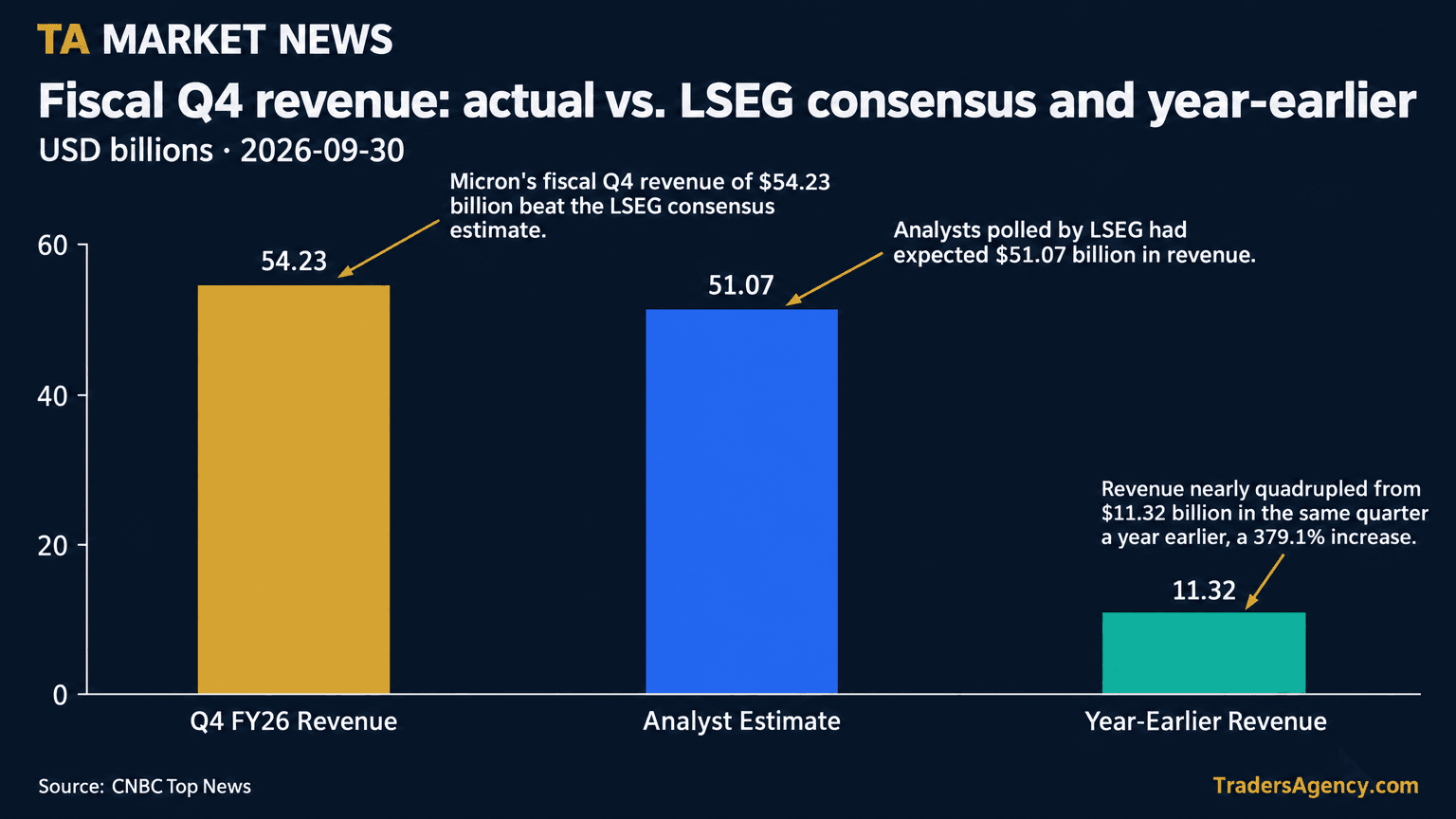
Micron's adjusted earnings of $33.42 per share came in $1.81 above the LSEG consensus estimate of $31.61, while revenue of $54.23 billion exceeded the $51.07 billion analysts had projected, CNBC reported. Based on those figures, the earnings beat amounted to 5.73% above consensus and revenue landed 6.19% above the forecast (our calculation: (33.42 - 31.61) / 31.61 * 100; (54.23 - 51.07) / 51.07 * 100). Seeking Alpha, measuring against its own consensus, characterized the print as an EPS beat of $1.60 and a revenue beat of $2.76 billion.
Revenue almost quadrupled from $11.32 billion a year earlier, a 379.1% year-over-year increase as reported by Seeking Alpha. Net income climbed to $37.7 billion, or $32.87 per share, from $3.2 billion, or $2.83 per share, in the year-ago quarter, according to CNBC.
DRAM revenue for the quarter rose 343% year over year to $39.8 billion, representing 73% of total sales, CNBC reported. For full fiscal 2026, Micron posted revenue of $133.19 billion, up from $37.38 billion the prior year, a difference of $95.81 billion, or a 256.31% increase (our calculation: 133.19-37.38; (133.19-37.38)/37.38*100), alongside GAAP net income of $84.97 billion, per Seeking Alpha.
Fiscal Q1 Guidance Tops Consensus
For the fiscal first quarter, Micron guided to revenue of about $61.5 billion and adjusted earnings per share of $38.15, according to CNBC. That compares with LSEG consensus estimates of $57 billion in revenue and $35.40 in adjusted earnings per share. The revenue guidance sits $4.5 billion above consensus, a 7.89% premium, and the EPS guidance is $2.75 above consensus, a 7.77% premium (our calculation: 61.5-57, (61.5-57)/57*100; 38.15-35.40, (38.15-35.40)/35.40*100).
CNBC reported that executives were scheduled to discuss the results with analysts on a conference call beginning at 4:30 p.m. ET, meaning additional management commentary on demand drivers, pricing dynamics or supply commitments had not yet been made public at the time of the report.
Memory Shortage and HBM Context
CNBC attributed the results to a worldwide memory supply crunch that has driven up chip costs and raised prices for consumer electronics such as Apple's iPads and MacBooks. The outlet also noted that advanced graphics and central processors from chipmakers including Nvidia and AMD require growing amounts of high-bandwidth memory, or HBM, for AI workloads, and that the world's leading providers cannot keep pace with demand.
Micron is the only U.S.-based maker of HBM, which is built from stacked general-purpose DRAM, according to CNBC. The company is investing $250 billion to build two new HBM campuses, with the largest breaking ground in Clay, New York, in January and its first new fab in Boise, Idaho, scheduled to come online next year, per the same report. SK Hynix and Samsung, described by CNBC as the HBM market leaders, are separately building out their own HBM capacity in South Korea. CNBC reported that Micron holds the smallest HBM market share of the three suppliers, even as its market capitalization has topped $1.2 trillion.
Stock Reaction
Micron shares rose only slightly in extended trading following the report, CNBC said, a muted move relative to the scale of the earnings and guidance beat. The outlet noted that the stock has soared more than 500% over the past year, a run it attributed to the worldwide supply crunch tied to historic AI-driven demand for memory chips. A modest after-hours reaction following such a large prior run-up suggests, as an interpretation rather than a reported fact, that much of the current quarter's strength may already have been priced in by investors ahead of the release.
CNBC also reported that Micron CEO Sanjay Mehrotra participated in a summit on AI regulation hosted by President Donald Trump on Tuesday, days after attending a White House dinner with Chinese President Xi Jinping during his first U.S. visit in more than a decade. The report did not link these appearances directly to the earnings results.
Bottom Line
Micron's fiscal fourth-quarter results and above-consensus first-quarter guidance reflect a company benefiting from an acute global memory shortage tied to AI infrastructure demand, with DRAM revenue and overall sales climbing sharply from year-ago levels, according to CNBC and Seeking Alpha. The muted after-hours stock reaction, set against a 500%-plus one-year gain, suggests — as an interpretation of the reported figures rather than a reported fact — that investors had already built substantial optimism into the shares heading into the print, even as CNBC reported that demand for HBM and DRAM continues to outstrip supply.
DISCLAIMER: Traders Agency does not offer financial advice. The information provided is for educational purposes only and should not be considered financial advice. Traders Agency is not responsible for any financial losses or consequences resulting from the use of the information provided. Trading carries inherent risks and may not be suitable for all individuals. You are advised to conduct your own research and seek personalized advice before making any investment decisions, recognizing the potential risks and rewards involved.
- CNBC Top News: Micron (MU) Q4 earnings report 2026 · accessed Sep 30, 2026
- Seeking Alpha Market News: Micron in charts: NAND revenue skyrockets 526% Y/Y in Q4 · accessed Sep 30, 2026
- Seeking Alpha Market News: Micron Non-GAAP EPS of $33.42 beats by $1.60, revenue of $54.23B beats by $2.76B · accessed Sep 30, 2026
See more from Traders Agency on Google
Make us a preferred source and our market analysis will appear more prominently in your Google Search, Top Stories, and AI results.
Add to Preferred Sources