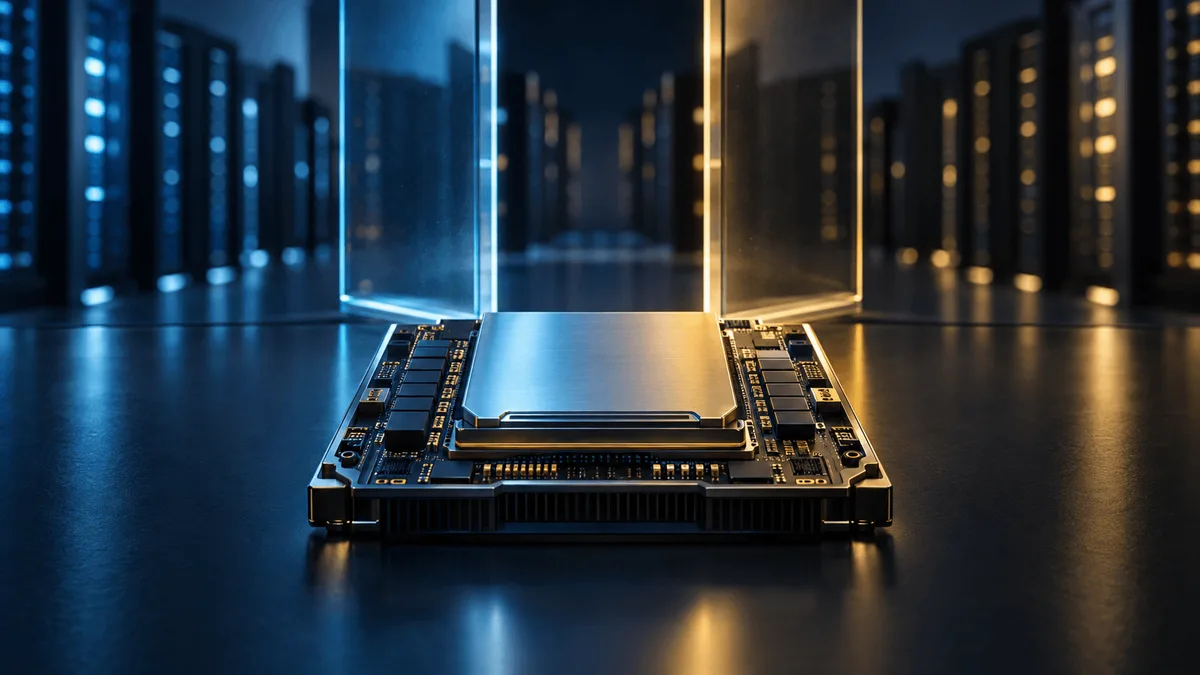
Chinese regulators have gathered representatives from Alibaba, ByteDance and Tencent to gauge their demand for Nvidia's H200 AI chip, and are considering allowing a restricted quantity of purchases, according to a report from The Information, cited by Reuters. The deliberation follows a U.S. decision to permit export of the chip and comes with numerous open questions about scale, timing and Beijing's own domestic-chip priorities.
What The Information Reported
According to The Information, as relayed by Reuters, Chinese officials convened representatives from Alibaba, ByteDance and Tencent Holdings to assess their appetite for the H200, and told the companies they would be informed of Beijing's decision soon. Wccftech, citing the same underlying report, said the figure under consideration is around 200,000 chips, which it described as less than half of what the companies had requested. Possible beneficiaries named in The Information's reporting include ByteDance, Alibaba and DeepSeek.
Separately, Reuters reported that ByteDance and Alibaba have already approached Nvidia about buying the H200 and are keen to place large orders if Beijing gives the green light, though the companies remain concerned about supply and are seeking clarity from Nvidia, according to people briefed on the matter.
The U.S. Side: Trump's H200 Decision
The trigger for this deliberation, per Reuters, was President Trump's decision to permit export of the Taiwan-manufactured H200 to China. Before that announcement, the most advanced AI semiconductor that could legally be sent to China was the H20, and supplying an H200 would have violated federal export-control law. Reuters said the H200 is almost six times as powerful as the H20.
The policy shift has created what Reuters characterized as an unusual situation: older, less powerful Nvidia chips popular in China, the A100 and H100, remain formally under U.S. export controls even though the newer H200 does not.
Notably, accounts of the H200's status diverge across the available reporting. Reuters describes it as a Taiwan-manufactured part whose export to China was previously unlawful, while Wccftech characterizes it as a China-specific chip Nvidia developed to comply with U.S. export-control law. That discrepancy remains unresolved in the sourcing.
How Any Approval Might Work
Reuters reported that Chinese companies anticipate a case-by-case review process, in which authorities may examine purchase requests and require firms to supply intended use cases. That expectation reflects Beijing's balancing act: weighing the benefits of H200 imports against its parallel push to encourage adoption of domestically produced AI chips from Huawei and Cambricon, the people told Reuters.
Any reversal would undo restrictions China itself imposed in recent months, which barred government-funded data centers and Chinese tech companies from buying Nvidia AI chips and, according to Reuters, hit Nvidia's market share in the country.
No Chinese government agency has confirmed the plan. Reuters said Beijing had not given a clear answer to Trump's H200 announcement, and China's foreign ministry, when asked about the chip, said only that the country values cooperation with the United States, declining to comment further.
A later Reuters report on Huawei's chip plans said the H200 had received approval from Chinese authorities, though it remained unclear when the chips would be allowed into the country, and noted that the U.S. greenlight came with a number of conditions that could limit the volumes sold. Supply is a separate constraint: two people familiar with Nvidia's supply chain told Reuters that very limited quantities of the H200 are currently in production, as the company has focused instead on its Blackwell and upcoming Rubin lines.
Bottom Line
On the available evidence, little is settled. The reporting describes deliberations rather than a published Chinese policy, and The Information's roughly 200,000-chip figure was characterized as less than half of what the companies requested. Interpreting that reporting, any limited approval would sit alongside Beijing's parallel push for domestic parts: Reuters has separately reported that ByteDance and Alibaba plan to order Huawei's new 950PR chip, with Huawei planning to ship around 750,000 units this year and mass production due to begin the following month. Reuters later reported that the H200 had received Chinese approval, but with timing still unclear and production volumes limited, the practical scale of any purchases remains an open question.
DISCLAIMER: Traders Agency does not offer financial advice. The information provided is for educational purposes only and should not be considered financial advice. Traders Agency is not responsible for any financial losses or consequences resulting from the use of the information provided. Trading carries inherent risks and may not be suitable for all individuals. You are advised to conduct your own research and seek personalized advice before making any investment decisions, recognizing the potential risks and rewards involved.
- www.youtube.com: - YouTube · accessed Sep 27, 2026
- finance.yahoo.com: Exclusive-ByteDance, Alibaba keen to order Nvidia H200 chips after Trump green light, sources say · accessed Sep 27, 2026
- www.linkedin.com: China tells Alibaba, ByteDance, Baidu to stop buying Nvidia AI chips · accessed Sep 27, 2026
- wccftech.com: China Weighs Reversing Its Own NVIDIA Ban, May Let Alibaba, ByteDance & Others Buy 200,000 H200 Chips · accessed Sep 27, 2026
- www.youtube.com: - YouTube · accessed Sep 27, 2026
- www.cnbc.com: ByteDance, Alibaba planning to order Huawei's new AI chip: Reuters · accessed Sep 27, 2026
- blogs.nvidia.com: NVIDIA to Acquire Hugging Face · accessed Sep 27, 2026
- blogs.nvidia.com: Sparks Fly: NVIDIA Accelerates Local AI at IFA 2026 · accessed Sep 27, 2026
See more from Traders Agency on Google
Make us a preferred source and our market analysis will appear more prominently in your Google Search, Top Stories, and AI results.
Add to Preferred Sources