Novo Nordisk has struck a licensing agreement with Chinese drugmaker Hengrui Pharma for HRS-1596, a Phase 1-ready GLP-1/GIP dual receptor agonist that the companies say could eventually be dosed orally once a week, according to a joint announcement carried by PRNewswire. The deal, reported by Reuters via Euronext, carries a potential total value of up to $2.6 billion.
Deal structure and terms
Under the agreement, Novo will pay Hengrui $300 million upfront, with the Chinese drugmaker eligible for up to $2.3 billion more in development, regulatory and commercial milestones, Hengrui told the Hong Kong stock exchange, as reported by Reuters via Euronext. Hengrui is also eligible for royalties on net sales of HRS-1596 within the licensed territory, though neither company disclosed a royalty rate, according to PRNewswire and StockTitan.
Novo obtains exclusive rights to develop, manufacture and commercialize HRS-1596 globally, excluding mainland China, Hong Kong, Macao and Taiwan, per the PRNewswire release. The transaction still requires clearance under the U.S. Hart-Scott-Rodino Antitrust Improvements Act and the satisfaction of other customary closing conditions, with closing expected in the fourth quarter of 2026, according to Yahoo Finance and StockTitan.
What HRS-1596 is designed to do
HRS-1596 is described by Novo as working through multiple mechanisms, including appetite suppression, stimulation of insulin secretion and improved insulin sensitivity, positioning it for potential use in obesity, type 2 diabetes and other metabolic diseases, according to the Yahoo Finance release. The companies say the candidate has potential for once-weekly oral administration, which Novo said would "substantially reduce dosing frequency and improve convenience compared with current offerings," per Yahoo Finance and a separate report from WDEZ.
That distinction matters because the currently marketed oral GLP-1 benchmarks, Novo's own oral Wegovy and Eli Lilly's Foundayo, are both once-daily pills, Reuters noted via Euronext. HRS-1596 is Phase 1-ready, meaning no human efficacy data for the compound itself has been disclosed in connection with this deal.
Novo R&D chief Martin Holst Lange said the company continuously looks to advance its oral pipeline "through our strong internal capabilities and leading external innovation" and wants to "explore its potential to raise the bar for convenience in the field," according to the Yahoo Finance release. Hengrui Chief Strategy Officer Frank Jiang said HRS-1596 "reflects this commitment in metabolic diseases, with the potential to offer the convenience of once-weekly oral administration," per PRNewswire.
Second China deal, pipeline pressure
Reuters, via Euronext, described the agreement as Novo's second GLP-1 treatment deal with a Chinese partner and framed it as an effort to shore up Novo's competitive position against rivals such as Eli Lilly, noting that several of Novo's patents are set to expire in the next decade. The same Reuters reporting said Novo's shares have tumbled more than 70% from record highs amid Lilly's competition. Novo CEO Mike Doustdar told Reuters this month that the company is preparing for a market in which pills play a much larger role, according to the Euronext report.
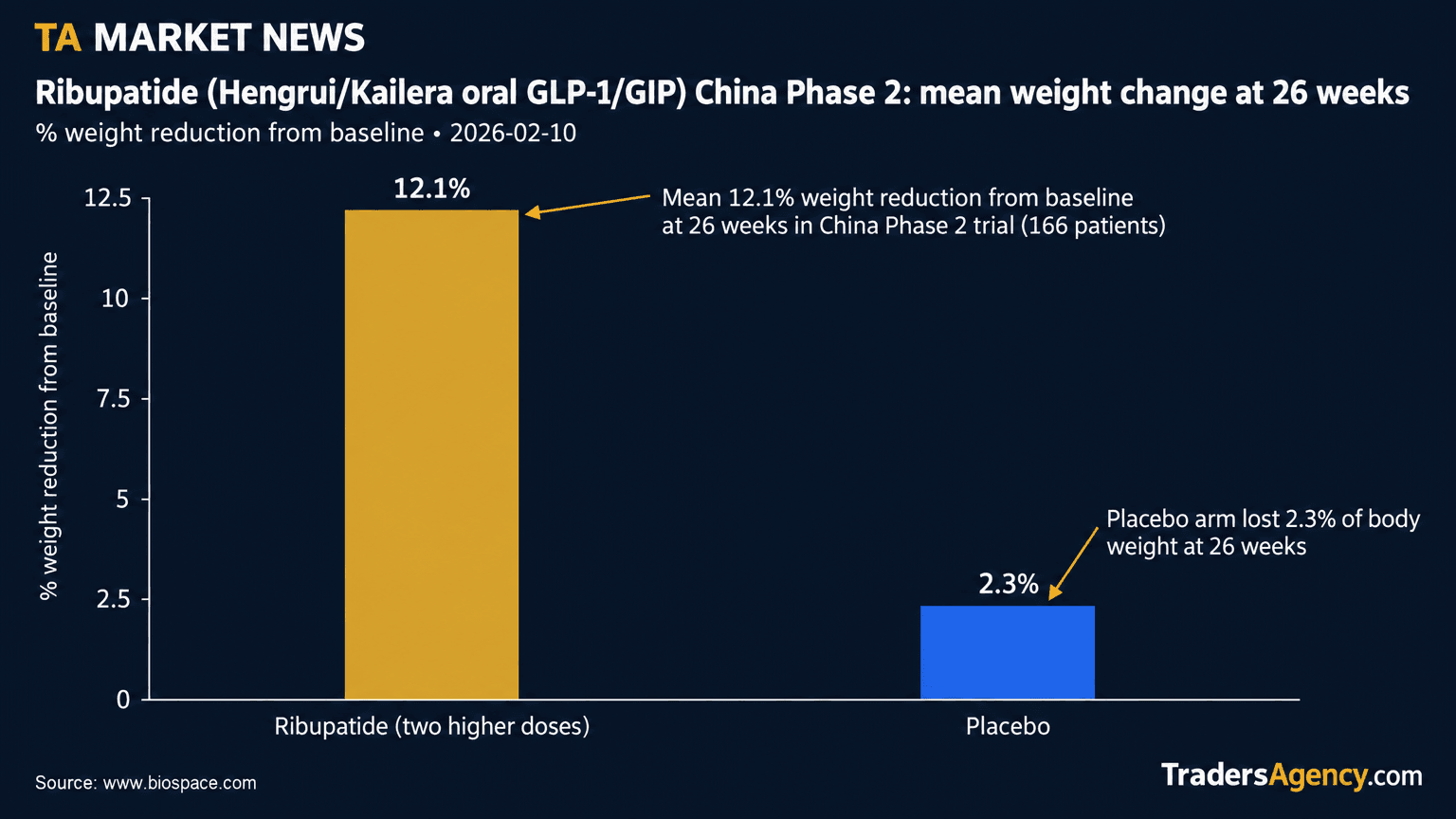
Hengrui separately has an oral GLP-1/GIP dual agonist called ribupatide, licensed to Kailera Therapeutics, which is a different molecule from HRS-1596. In a 166-patient China Phase 2 trial, the two higher ribupatide doses produced a mean 12.1% weight reduction from baseline at 26 weeks versus 2.3% for placebo, a gap of 9.8 percentage points (12.1 minus 2.3, our calculation), according to BioSpace. Ribupatide is designed for once-daily oral dosing, with a weekly injectable version also in development, per BioSpace. That earlier deal illustrates Hengrui's broader dual-agonist portfolio but is not the asset covered by this Novo licensing agreement.
Market and analyst reaction
Shares of Hengrui rose about 2% in Hong Kong after the news, according to Reuters reporting carried by Euronext. A Novo spokesperson also told Reuters that the company would plan global trials with the asset but declined to provide timelines, per the Euronext report.
Markus Manns, a portfolio manager at Union Investment, told Reuters the deal was a positive for Novo but said the company needs larger deals with more advanced compounds to change market perception after its shares fell on lost market share to rivals, per the Euronext report. BMO Capital Markets analyst Evan Seigerman wrote in a note, also cited by Euronext, that the transaction is unlikely to shake up near-term competition but that the candidate could serve as an attractive longer-term pipeline option for Novo.
A broader wave of China licensing
Data provider Pharmcube counts nearly 250 Chinese GLP-1 candidates in development, and Reuters reported that AstraZeneca, Merck and Pfizer have also struck rights deals with Chinese developers, according to the Euronext report. Analysts estimate the global GLP-1 market could generate about $100 billion in annual sales within the next decade, a figure cited in the WDEZ report on the deal.
Bottom Line
Novo Nordisk is paying $300 million upfront and is on the hook for up to $2.3 billion more in development, regulatory and commercial milestones for a Phase 1-ready compound rather than a clinically validated one, betting that once-weekly oral dosing could eventually differentiate it from today's once-daily pills, oral Wegovy and Foundayo. Analysts quoted by Reuters framed the step as positive but limited: Union Investment's Markus Manns said Novo needs larger deals with more advanced compounds to change market perception, while BMO's Evan Seigerman said the deal is unlikely to shake up near-term competition even as the candidate could become an attractive longer-term pipeline option. That reading is interpretation of the attributed analyst comments, not a forecast of the program's outcome.
DISCLAIMER: Traders Agency does not offer financial advice. The information provided is for educational purposes only and should not be considered financial advice. Traders Agency is not responsible for any financial losses or consequences resulting from the use of the information provided. Trading carries inherent risks and may not be suitable for all individuals. You are advised to conduct your own research and seek personalized advice before making any investment decisions, recognizing the potential risks and rewards involved.
- Hengrui Pharma: Hengrui Pharma and Novo Enter Exclusive License Agreement for Once-Weekly Oral GLP-1/GIP Dual Receptor Agonist HRS-1596 · accessed Sep 29, 2026
- live.euronext.com: Novo to pay up to $2.6 billion to China's Hengrui for rights to weight-loss pill · accessed Sep 29, 2026
- www.stocktitan.net: Novo Nordisk-Hengrui license deal could reach $2.6B · accessed Sep 29, 2026
- www.thepharmaletter.com: Novo signs Hengrui deal worth up to $2.6 billion for weekly oral drug · accessed Sep 29, 2026
- www.biospace.com: Kailera, Hengrui Push Oral GLP-1/GIP Pill to Phase 3 After Clearing Mid-Stage China Study · accessed Sep 29, 2026
- www.linkedin.com: Hengrui Leads Oral GLP-1, Shanghai New Cell Therapy Policy: China biotech Weekly Roundup · accessed Sep 29, 2026
- www.novonordisk.com: R&D pipeline · accessed Sep 29, 2026
- uk.finance.yahoo.com: Novo and Hengrui Pharma enter exclusive license agreement for once-weekly oral GLP-1/GIP dual receptor agonist HRS-1596 · accessed Sep 29, 2026
- wdez.com: Novo to pay up to $2.6 billion to China’s Hengrui for rights to weight-loss pill · accessed Sep 29, 2026
- www.novonordisk.com: Press releases · accessed Sep 29, 2026
- www.novonordisk.com: Novo Nordisk · accessed Sep 29, 2026
See more from Traders Agency on Google
Make us a preferred source and our market analysis will appear more prominently in your Google Search, Top Stories, and AI results.
Add to Preferred Sources