
Viking Therapeutics shares surged about 30% in Tuesday morning trading after the company reported topline data showing that patients who switched from weekly to less frequent, lower dosing of its experimental obesity drug VK2735 retained as much as 97% of the weight they had already lost, according to Reuters via KSL.com. Shares of rivals Eli Lilly and Novo Nordisk fell on the news, according to Yahoo Finance/Investors.com, though the size of those declines was not detailed in the available reporting.
Induction Phase: Up to 19% Weight Loss Before Randomization
Per Viking's news release, participants began on weekly VK2735 with doses escalated every two weeks starting in Week 3 until reaching final weekly doses of 15.0 mg, 17.5 mg, 20.0 mg or 22.5 mg. After 21 weeks of this induction dosing, weight loss ranged from approximately 16% to 19% across cohorts, compared with roughly 0% for placebo, with the company reporting p<0.0001 versus both baseline and placebo in all cohorts.
Maintenance Phase: Every-Other-Week Dosing Preserved Up to 97% of Losses
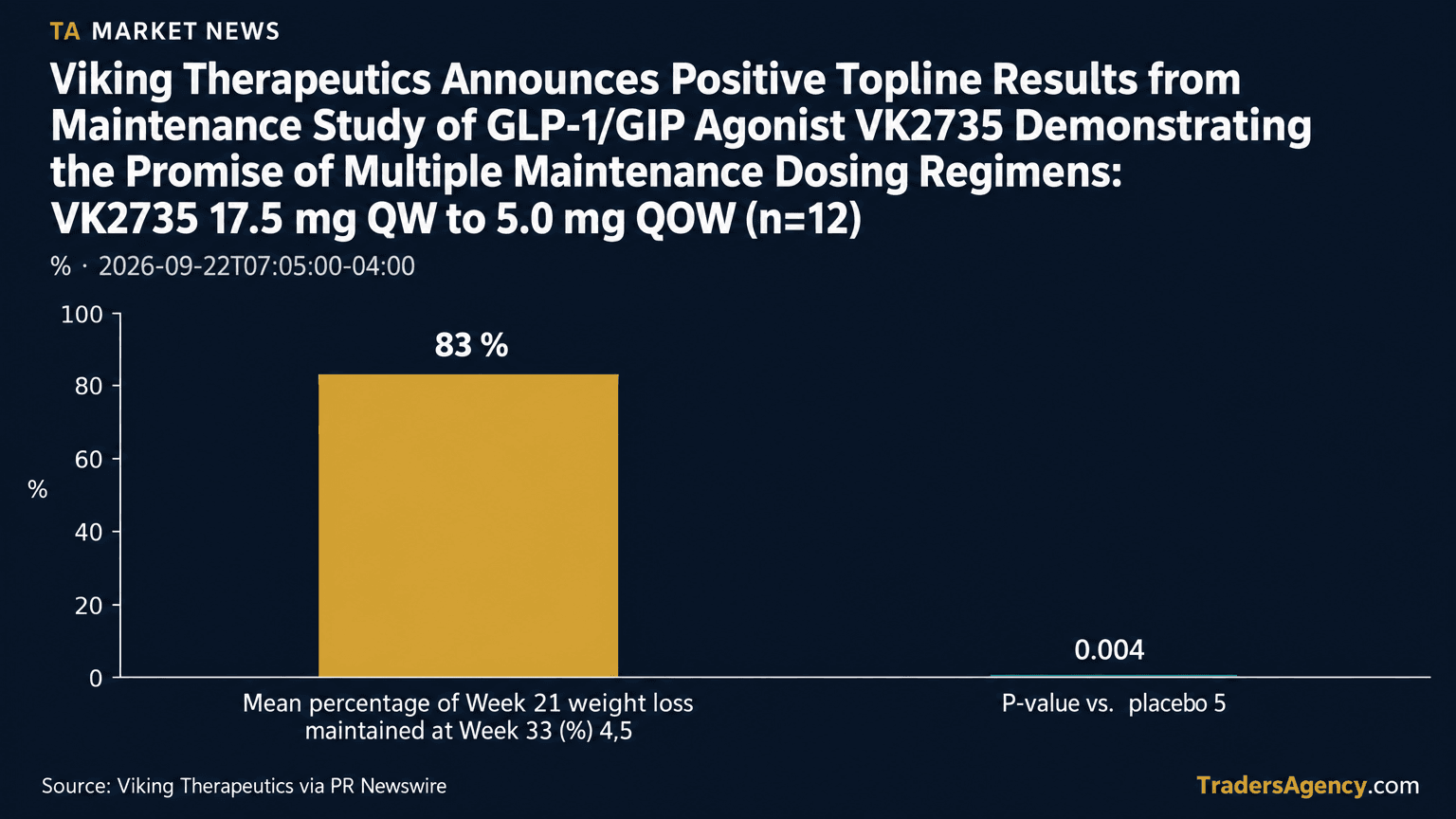
After induction, patients were re-randomized to placebo or to reduced, less frequent maintenance dosing. The combined every-other-week (QOW) group, comprising 37 patients across three dose levels, maintained a mean 90% of its Week 21 weight loss by Week 33, versus 61% for the 27-patient placebo group, per the release. Within that group, patients titrated from 17.5 mg weekly to 10.0 mg every other week (n=12) maintained 97% of prior loss (p<0.0001 vs. placebo), the highest figure reported. Patients on 15.0 mg weekly to 7.5 mg every other week (n=13) maintained 90% (p<0.0001), and those on 17.5 mg weekly to 5.0 mg every other week (n=12) maintained 83% (p=0.004).
A combined monthly (QM) dosing group of 65 patients across five dose levels maintained a mean 85% of prior weight loss, with individual cohorts (ranging from 10 to 16 patients each) reporting maintenance between 82% and 90%, all with p-values below 0.005 versus placebo, according to the release. Separately, an exploratory control cohort of 13 patients who remained on weekly 17.5 mg dosing through Week 33 showed mean weight loss of 21.7% from baseline (p<0.0001 vs. baseline), compared with a 0.3% weight gain in the placebo group, with Viking noting no plateau was observed in that cohort.
Small Cohorts and Exploratory Endpoints
Viking's release states the study's stated objectives were to evaluate VK2735's safety, tolerability and pharmacokinetic profile; body-weight change from baseline and from Week 21 to Week 33 were listed as exploratory endpoints, using a two-sided t-test with a mixed model for repeated measures. The release does not specify whether the maintenance comparisons were statistically powered or how multiplicity across the many dose arms was handled. In our reading, that framing, combined with arm sizes as small as 10 to 16 patients, means the percentages above are best treated as descriptive signals from an early study rather than confirmatory efficacy findings.
On safety, Viking said rates of gastrointestinal adverse events such as vomiting, nausea, diarrhea and constipation during the 12-week maintenance window were not meaningfully different from placebo. The release also reported that one subject, or 1% of participants, discontinued VK2735 during the induction period due to an adverse event; no separate discontinuation rate specific to the maintenance phase was disclosed.
Market Reaction and Analyst Commentary
Leerink Partners analyst Thomas Smith said the data reinforce VK2735's differentiated profile and competitive positioning, describing the drug's safety and tolerability as "impressively clean," according to Reuters via KSL.com. Louis Aronne, a former president of The Obesity Society who is also a paid consultant to Viking, said less frequent dosing could help patients stay on obesity medicines longer, and Viking's release quoted him saying the results support keeping patients within a margin of maintaining 75% or more of their weight loss through either monthly or every-other-week dosing.
Viking CEO Brian Lian said the company believes "long-term weight management will not follow a standard one-size-fits-all approach," adding that patients will need a range of options to personalize treatment over time, and that the tolerability seen in this study "may provide an opportunity to evaluate additional higher doses and raises the possibility of exploring both maintenance and induction weight loss with less frequent dosing regimens." Reuters, via KSL.com, also cited analyst expectations that the obesity drug market, currently dominated by Novo Nordisk and Eli Lilly, could reach $100 billion in annual sales by 2030.
For context on how VK2735 compares with an approved rival, The Motley Fool has noted that Eli Lilly's tirzepatide posted peak weight loss of 20.9% in the Phase 3 SURMOUNT-1 trial over 72 weeks, versus a 14.7% peak for VK2735 in the Phase 2 VENTURE trial over 13 weeks. By our calculation, that is a 6.2 percentage-point gap (20.9% minus 14.7%), though the two figures come from different trial phases, dosing schedules and durations, so the comparison is illustrative rather than apples-to-apples.
What's Next for VK2735
Viking's release states the company plans to explore oral maintenance dosing regimens in an upcoming second part of the same study. Separately, Viking announced the initiation of its Phase 3 obesity program with subcutaneous VK2735 in June 2025; per the company's investor relations announcements, enrollment in the Phase 3 VANQUISH-1 trial was completed in November 2025 and enrollment in VANQUISH-2 was completed in March 2026. Viking also announced completion of enrollment in the maintenance-dosing trial in January 2026. The available release does not state that this maintenance data has changed Viking's planned regulatory filing timeline or the dosing strategy for the ongoing Phase 3 program.
Bottom Line
Viking's maintenance data offer an early, small-sample signal that lower and less frequent VK2735 dosing can preserve a large share of prior weight loss, and the market reacted sharply, sending Viking shares up roughly 30% while pressuring Eli Lilly and Novo Nordisk. But the endpoints were exploratory, the cohorts were modest, and the company itself has not indicated any change to its Phase 3 timeline or label strategy based on this readout.
DISCLAIMER: Traders Agency does not offer financial advice. The information provided is for educational purposes only and should not be considered financial advice. Traders Agency is not responsible for any financial losses or consequences resulting from the use of the information provided. Trading carries inherent risks and may not be suitable for all individuals. You are advised to conduct your own research and seek personalized advice before making any investment decisions, recognizing the potential risks and rewards involved.
- Yahoo Finance: Viking Stock Skyrockets On Obesity Drug Data; Eli Lilly, Novo Fall · accessed Sep 22, 2026
- Viking Therapeutics via PR Newswire: Viking Therapeutics Announces Positive Topline Results from Maintenance Study of GLP-1/GIP Agonist VK2735 Demonstrating the Promise of Multiple Maintenance Dosing Regimens · accessed Sep 22, 2026
- Reuters via KSL.com: Viking Therapeutics' obesity drug shows durable weight-loss benefit, shares surge · accessed Sep 22, 2026
- Viking Therapeutics: Viking Therapeutics Announces Completion of Enrollment in Maintenance Dosing Clinical Trial of VK2735 in Obesity · accessed Sep 22, 2026
- Viking Therapeutics: Viking Therapeutics Announces Initiation of Phase 3 Obesity Clinical Program with GLP-1/GIP Agonist VK2735 · accessed Sep 22, 2026
- Viking Therapeutics: Viking Therapeutics Announces Completion of Enrollment in Phase 3 VANQUISH-1 Trial of VK2735 · accessed Sep 22, 2026
- Viking Therapeutics: Viking Therapeutics Announces Completion of Enrollment in Phase 3 VANQUISH-2 Trial of VK2735 · accessed Sep 22, 2026
- The Motley Fool: Wall Street Sees a Huge Rebound for Viking Therapeutics. Here's Why Analysts Are So Optimistic. · accessed Sep 22, 2026
See more from Traders Agency on Google
Make us a preferred source and our market analysis will appear more prominently in your Google Search, Top Stories, and AI results.
Add to Preferred Sources