Eli Lilly CEO Dave Ricks told CNBC that roughly 700,000 new seniors have started GLP-1 treatments since Medicare began covering obesity drugs on July 1, and that about 70% of those patients are taking Lilly medicines, according to CNBC's report and a GuruFocus summary of the same remarks. The figures, if borne out, would mark one of the first concrete uptake numbers from the Medicare GLP-1 Bridge demonstration, a temporary program that opened weight-loss drug coverage to eligible Part D beneficiaries this summer.
What Ricks Told CNBC
Per CNBC, Ricks said that of the roughly 700,000 new seniors who began GLP-1 therapy since July, about seven in ten are on Lilly products. On the oral side, Ricks told CNBC that one-third of new GLP-1 pill patients are taking Lilly's Foundayo, in a pill segment CNBC describes as currently led by Novo Nordisk. Ricks characterized Lilly's position in the oral market by saying, according to CNBC, "We're confident long term."
These are Ricks' own figures as relayed by CNBC rather than enrollment data published by CMS, and no response from CMS or Novo Nordisk to the specific 700,000 and 70% numbers has been reported.
How the Numbers Stack Up Against Prior Market Share
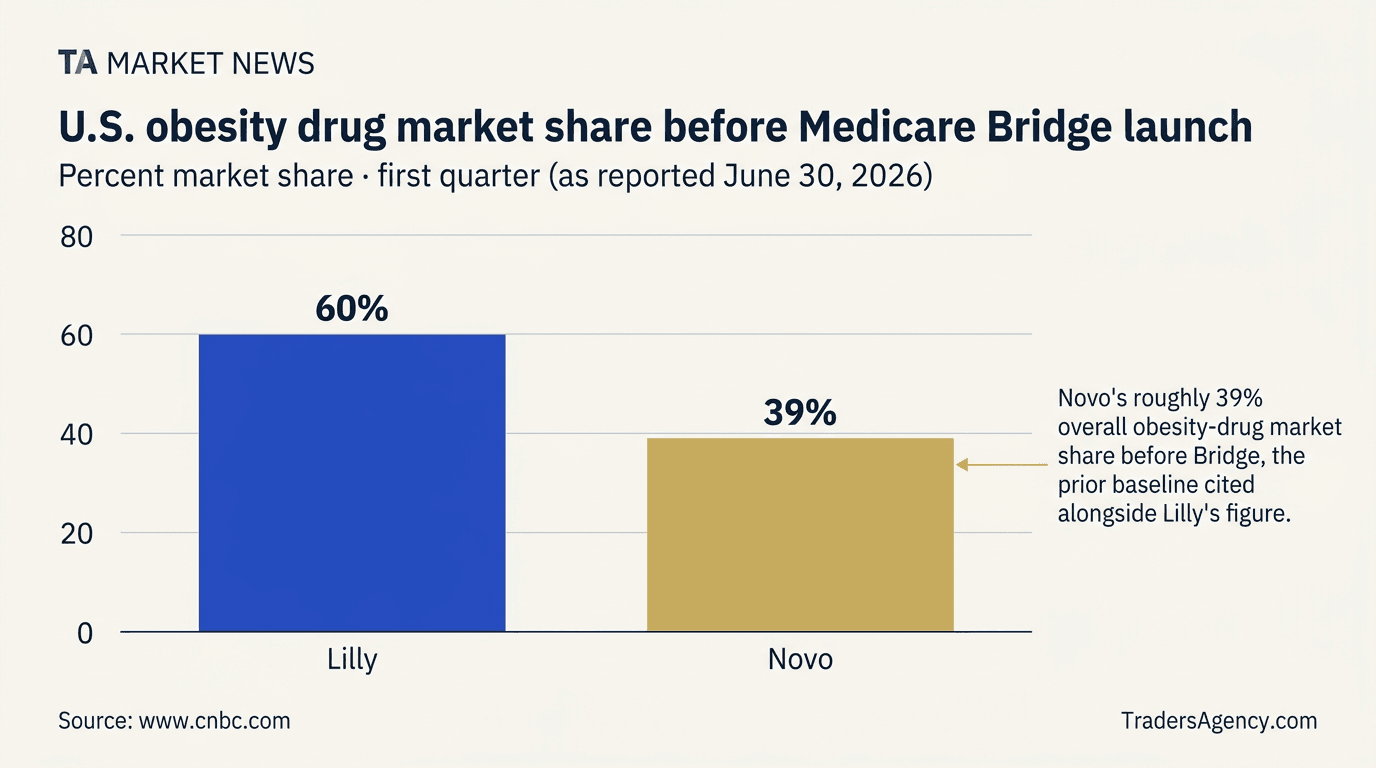
Before the Bridge program launched, Lilly held roughly 60% of the U.S. obesity drug market compared with Novo's 39% as of the first quarter, according to CNBC's June 30 coverage. That is a 21-percentage-point gap, or a Lilly share about 53.8% larger than Novo's on a relative basis (our calculation: 60 minus 39 equals 21; 21 divided by 39 equals roughly 53.8%). Interpreting the two figures together, Ricks' reported 70% share of new Medicare starts would sit above Lilly's pre-Bridge overall market share — but the two measures are not like-for-like, because no comparable breakdown of Lilly's share of new patients before July has been reported, so the comparison should be read with that limitation in mind.
Inside the Bridge Program's Rules
The Bridge demonstration, which CNBC reported took effect July 1, requires a provider to certify that a patient meets clinical criteria: a BMI of 35 or higher, or a lower BMI paired with a related condition such as prediabetes, a prior heart attack or stroke, or blocked arteries in the arms or legs. Each prescription also triggers a prior authorization request that providers submit to Humana, which CMS contracted to process Bridge approvals; CMS has said it expects those requests processed within 72 hours, per CNBC's reporting.
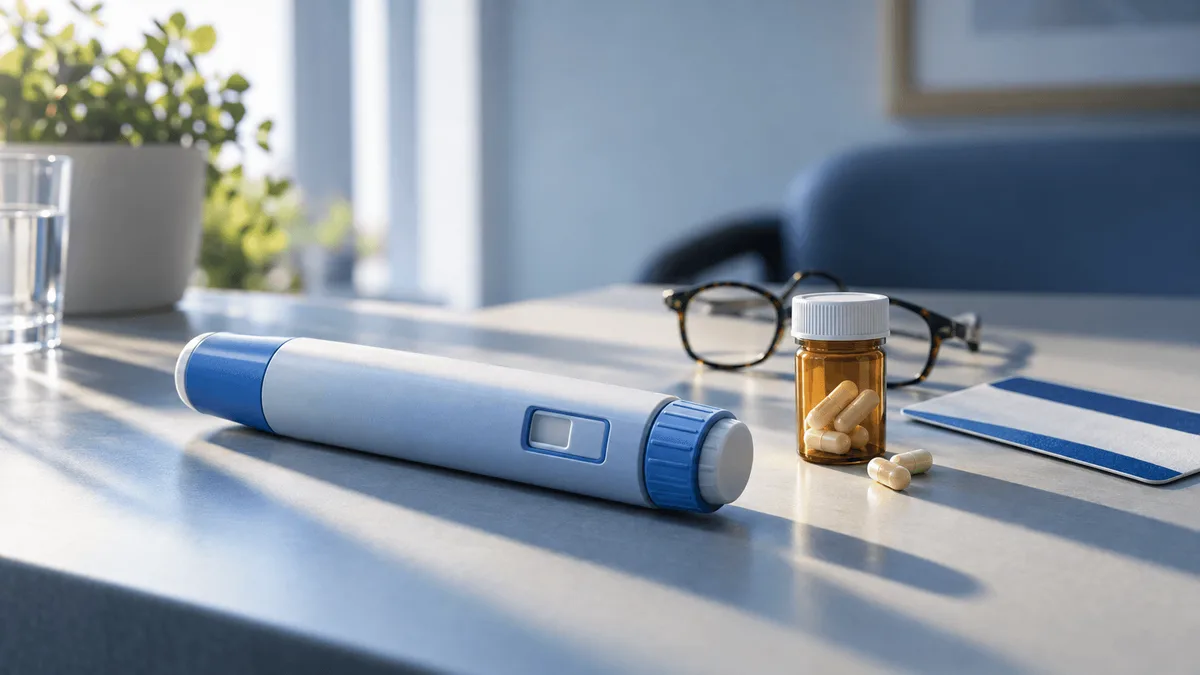
Coverage is limited to specific products: Novo's Wegovy injection and tablet, and Lilly's Foundayo pill and Zepbound in the KwikPen formulation. Lilly chose the KwikPen version because it holds a month's worth of doses in one pen, Ilya Yuffa, president of Lilly USA and global customer capabilities, told CNBC. Patients who already receive a GLP-1 through their Part D plan for another covered use, such as Type 2 diabetes, cardiovascular risk reduction or sleep apnea, do not qualify for Bridge, a restriction that narrows the pool of eligible new starts.
Sizing the Eligible Population
CMS Medicare director and deputy administrator Chris Klomp said at the Aspen Ideas Festival that "several million" of Medicare's more than 69 million beneficiaries are expected to access the drugs through Bridge, CNBC reported. Novo and Lilly have separately estimated that roughly 15 million to 20 million older adults in Medicare would qualify for weight-loss drugs. Against that backdrop, 700,000 new starts would represent an early fraction of the addressable population as estimated by the companies.
The Oral Pill Race
Novo's Wegovy pill surpassed 3 million prescriptions in its first five months on the market, while Lilly launched Foundayo in April, according to CNBC. At the highest dosages, Novo's daily Wegovy pill costs $299 a month compared with Foundayo's $349, a $50 gap that leaves Wegovy's pill priced roughly 14.3% below Foundayo on a relative basis (our calculation: 299 minus 349 equals negative 50; negative 50 divided by 349 equals roughly negative 14.3%). Jamey Millar, Novo's executive vice president of U.S. operations, told CNBC the Medicare population represents "the next opportunity for a jump ball" between the two companies, citing Novo market research that found 75% of seniors prefer a daily pill over a weekly injection.
Analyst and Company Expectations
Leerink Partners analyst David Risinger said before the program launched that Bridge could generate more than $1 billion in annual revenue for each company, with "rapid adoption" expected in the second half of the year, but he did not expect major shifts in market share, according to CNBC. Neither Lilly nor Novo has disclosed revenue projections tied specifically to Bridge, CNBC reported. GuruFocus, reviewing Ricks' comments, noted that Lilly's Zepbound injection appears to be driving much of the current Medicare demand while Foundayo is starting to broaden its reach, and that sustaining Lilly's lead will depend on prescription trends, supply, pricing and continued adoption of the newer pill.
What Could Limit Further Uptake
Lilly's Yuffa told CNBC before launch that uptake would depend on patient and physician awareness and how smoothly the healthcare system handles demand, adding that building that awareness would take time. The Bridge demonstration itself is temporary, scheduled to expire at the end of 2027; CNBC reported that insurers including CVS and UnitedHealthcare declined to voluntarily join a planned successor program called Balance, leaving open questions about whether beneficiaries who start treatment under Bridge will be able to continue it long term. Lilly has also promoted the coverage directly to patients, stating on social media that obesity medicine for eligible Medicare Part D patients "is now covered through the Medicare GLP-1 Bridge program."
Bottom Line
Ricks' figures as reported by CNBC offer an early company-level snapshot of Medicare Bridge uptake, but they come from a single executive interview rather than CMS-published data. The program's temporary end-2027 expiration, prior-authorization requirements and narrow eligibility rules leave genuine uncertainty about how the 700,000-patient base grows from here, or whether Lilly's reported 70% share holds as Novo pushes its own pill and injection into the same Medicare population.
DISCLAIMER: Traders Agency does not offer financial advice. The information provided is for educational purposes only and should not be considered financial advice. Traders Agency is not responsible for any financial losses or consequences resulting from the use of the information provided. Trading carries inherent risks and may not be suitable for all individuals. You are advised to conduct your own research and seek personalized advice before making any investment decisions, recognizing the potential risks and rewards involved.
- CNBC: 5 things to know before the stock market opens Tuesday · accessed Sep 22, 2026
- x.com: CNBC on X: "Eli Lilly CEO says 700,000 new seniors have started GLP-1s after Medicare coverage, and 70% are on Lilly drugs https://t.co/kSjddgK3kY" · accessed Sep 22, 2026
- www.cnbc.com: Medicare obesity drug GLP-1 coverage starting July 1 · accessed Sep 22, 2026
- www.facebook.com: 8.2K views · 80 reactions | Obesity medicine for eligible Medicare Part D patients is now covered through the Medicare GLP-1 Bridge program. Because medicine only matters if the people who need it can get it. #WeAreLilly | Eli Lilly and Company · accessed Sep 22, 2026
- www.gurufocus.com: Eli Lilly Just Got a Big Boost From Medicare's GLP-1 Expansion · accessed Sep 22, 2026
- www.facebook.com: 52K views · 122 reactions | Novo Nordisk and Eli Lilly are preparing for millions of seniors with Medicare to become eligible for GLP-1 drugs for weight loss for $50 a month starting July 1. CNBC’s Angelica Peebles has the details. Read more: cnb.cx/43iIfCh | CNBC · accessed Sep 22, 2026
See more from Traders Agency on Google
Make us a preferred source and our market analysis will appear more prominently in your Google Search, Top Stories, and AI results.
Add to Preferred Sources