
The 30-year Treasury bond yield pushed above 5.6% during Tuesday's session, touching its highest intraday level since June 2002, according to CNBC. The move at the long end of the curve rippled through equities, with the S&P 500 and Dow Jones Industrial Average both closing lower for a second straight session as traders raised the odds of another Federal Reserve rate increase in October.
Long-end yields hit multi-decade highs
Reports on the size of Tuesday's move varied slightly by source. CNBC said the 30-year yield traded more than 2 basis points higher at 5.585% after an intraday jump to just above 5.6%, a level CNBC said had not been seen since June 2002, when the long-dated bond yield hit 5.644%. Seeking Alpha reported the 30-year yield rose 5 basis points on Tuesday to 5.60%, also describing it as the highest level in more than two decades.
The 10-year Treasury note yield, the benchmark for mortgage and auto-loan rates, traded about 1 basis point higher at 5.253% and topped 5.29% at its session high, per CNBC. By contrast, Reuters described Monday's move as pushing 30-year yields to their highest since mid-May 2004 and 10-year yields to their highest since mid-June 2007 before those gains were pared. The differing historical benchmarks reflect separate day-over-day readings from the two outlets rather than a single confirmed record.
Curve flattens as short-end rate bets firm
The selloff was concentrated in longer maturities. The 2-year Treasury yield, which tracks Fed policy expectations most closely, fell more than 3 basis points to 4.891% on Tuesday even as long-end yields climbed, CNBC reported. Reuters noted that 2-year yields had still risen more than 50 basis points during September, the largest monthly increase since February 2023, as traders priced in additional Fed hikes. That advance has narrowed the 2-year yield's discount to the 10-year to around 31 basis points, down from roughly 40 basis points a month earlier, a flattening Reuters attributed to shifting rate expectations.
Traders were pricing a more than 72% probability of another Fed rate increase at the October meeting as of Tuesday, according to the CME FedWatch tool cited by CNBC, up from a roughly 70% chance implied on Monday per Reuters' separate reading of the same tool. The moves follow a 12-0 Federal Open Market Committee vote earlier in September to raise the benchmark rate by 25 basis points, CNBC reported — the Fed's first hike since 2023, according to Reuters.
Deficits, energy costs and AI capex cited as pressure points
JoAnne Bianco, senior investment strategist at BondBloxx Investment Management, told CNBC that investors remain focused on inflation and are increasingly worried about U.S. fiscal deficits and the volume of Treasury supply. "All of those things make them think there needs to be more term premium," Bianco said.
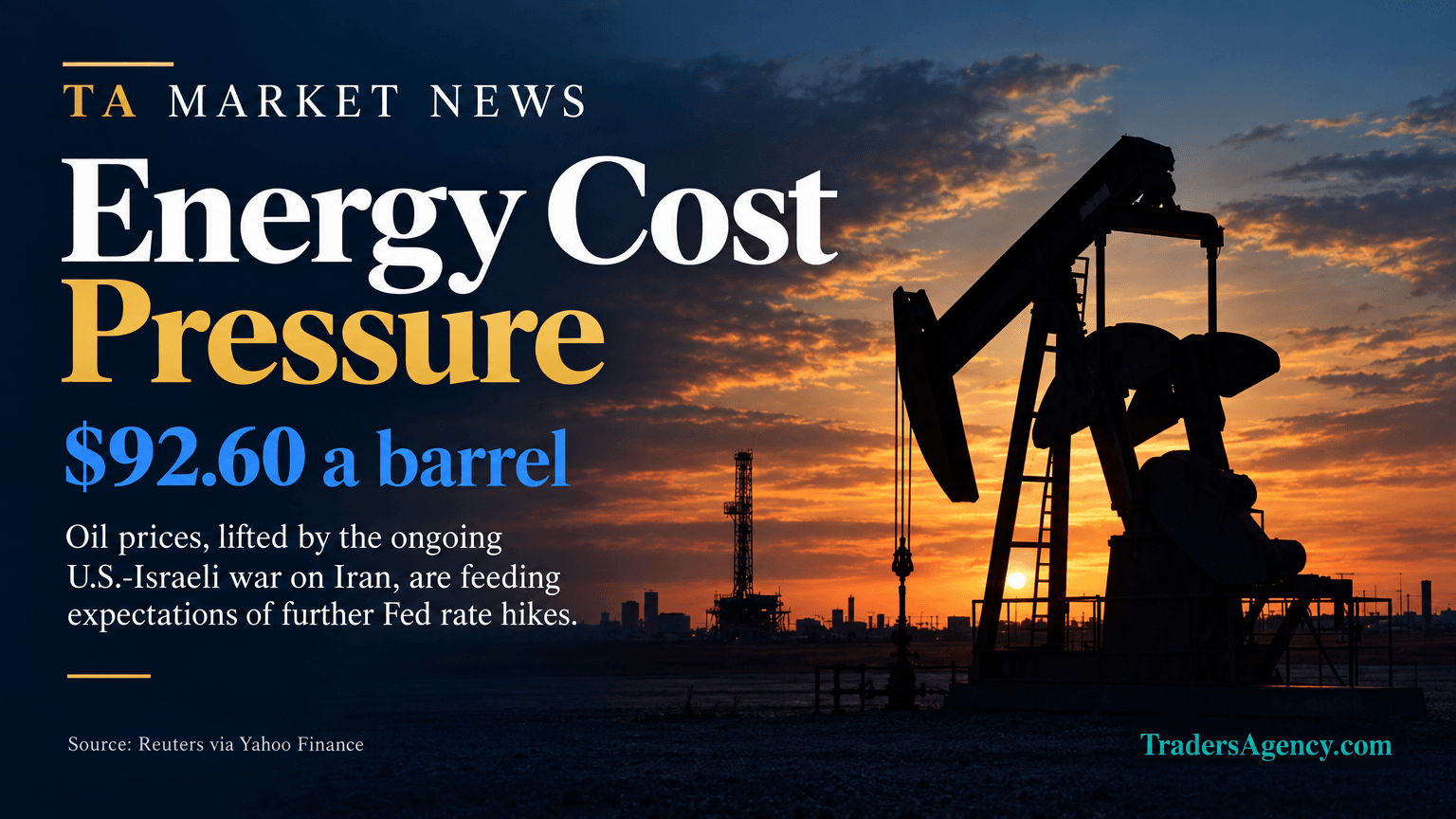
CNBC also linked the pressure to energy markets, noting the seven-month U.S.-Israeli war on Iran continues to weigh on oil prices and feed expectations of further Fed tightening. Reuters reported U.S. crude settled Monday at $92.60 a barrel and Brent at $105.28, both up modestly on the session.
Separately, Reuters flagged that rising capital costs are emerging as a risk to AI-linked companies, particularly hyperscalers whose heavy borrowing and spending have supported global equity markets. That is an attributed observation from Reuters rather than a confirmed earnings impact, and it did not tie the AI-financing risk directly to Tuesday's specific yield move.
Stocks slip as bank shares lead decliners
Equities fell for a second consecutive session as yields hit their highs. The Dow lost 131.59 points, or 0.26%, to close at 51,349.92; the S&P 500 slipped 0.16% to 7,670.84; and the Nasdaq Composite eased 0.09% to 26,797.54, according to CNBC. For the month, the S&P 500 was down 0.2% and the Dow off 3.5%, a decline that would snap the Dow's five-month winning streak, while the Nasdaq had advanced more than 1% month to date, CNBC reported.
Rate-sensitive bank stocks were among the session's laggards. CNBC reported that JPMorgan Chase, Morgan Stanley and Bank of America all declined, and the Financial Select Sector SPDR ETF (XLF) closed lower.
Jeff Klingelhofer, managing director and portfolio manager at Aristotle Pacific Capital, told CNBC that markets are betting inflation will fall through demand destruction under Fed Chairman Kevin Warsh. "That's why equities are down [and] that's why rates are up," he said, describing a shift in belief that Warsh has a path to that resolution.
Oliver Pursche, senior vice president and advisor at Wealthspire Advisors, offered a more measured read to Reuters, saying the prevailing narrative of "higher yields for longer" is pressuring equities but that current yields "shouldn't be overly disruptive" if jobs data and corporate earnings remain robust. That is a qualified, forward-looking view from Pursche rather than a certainty, and it hinges on data that has not yet been reported.
What to watch next
Reuters noted that markets get another read on the jobs and inflation trajectory this week with the scheduled release of the September U.S. payrolls report and the monthly personal consumption expenditures price index. Either report could reinforce or challenge the current pricing for an October Fed hike, though neither outlet offered a specific forecast for how yields would react.
Bottom Line
Tuesday's move pushed the 30-year Treasury yield to its highest level in roughly two decades, with dealers pointing to fiscal deficits, Treasury supply and energy-driven inflation worries as the main drivers of the long-end selloff, even as short-end yields eased on the day. The resulting curve flattening and equity weakness left strategists divided: some framed the move as markets pricing a deliberate, Fed-driven disinflation path, while others cautioned that the impact on stocks will depend heavily on upcoming labor-market and inflation data.
DISCLAIMER: Traders Agency does not offer financial advice. The information provided is for educational purposes only and should not be considered financial advice. Traders Agency is not responsible for any financial losses or consequences resulting from the use of the information provided. Trading carries inherent risks and may not be suitable for all individuals. You are advised to conduct your own research and seek personalized advice before making any investment decisions, recognizing the potential risks and rewards involved.
- Seeking Alpha Market News: U.S. 30-year Treasury yield tags 5.6%, its highest reading since 2002 · accessed Sep 29, 2026
- Reuters via Yahoo Finance: Stocks fall; oil prices off highs amid renewed hopes for Middle East negotiations · accessed Sep 29, 2026
- CNBC Top News: 30-year Treasury bond yield scales to highest level since 2002 · accessed Sep 29, 2026
- CNBC Top News: Stock market news for Sept. 29, 2026 · accessed Sep 29, 2026
See more from Traders Agency on Google
Make us a preferred source and our market analysis will appear more prominently in your Google Search, Top Stories, and AI results.
Add to Preferred Sources