
We're watching Merck & Co., Inc. (MRK) closely today after the company delivered a split-screen earnings report: a raised revenue outlook powered by new drug sales, paired with a steep profit guidance cut driven by acquisition charges. The stock, currently trading at $130.20, is caught between two competing narratives, and traders need clarity on which one wins.
The latest Merck news creates a genuinely complex setup for the merck revenue outlook 2026. The company is spending aggressively to acquire biotech firms, absorbing significant short-term losses now to secure long-term pipeline growth. Our analysis breaks down what that trade-off means for the stock.
What Changed in Merck's Revenue Outlook for 2026?
Merck now expects full-year revenue between $66.3 billion and $67.3 billion, an increase from the prior guidance range of $65.8 billion to $67 billion. That upgrade follows a strong quarter: the company posted $16.61 billion in second-quarter revenue, beating expectations of $16.36 billion.
Revenue climbed 5% from the same period a year earlier. But the bottom line tells a different story. Merck posted a net loss of $1.34 billion, or 54 cents per share, for the quarter. That's a sharp reversal from the net income of $4.43 billion, or $1.76 per share, in the year-earlier period.
The Number: Excluding acquisition and restructuring costs, Merck's adjusted loss came in at 13 cents per share, beating the expected loss of 27 cents. The underlying business is stronger than the headline loss suggests.
Why Did Merck Cut Its Profit Guidance?
The profit guidance cut comes down entirely to one-time acquisition charges. Merck now expects adjusted earnings between $2.66 and $2.76 per share, down sharply from the previous range of $5.04 to $5.16 per share.
The revised numbers include a $5.7 billion charge, equal to $2.31 per share, tied to the acquisition of Terns Pharmaceuticals. They also include a $9 billion charge, or $3.62 per share, related to the January acquisition of Cidara Therapeutics. These buyouts are part of a broader effort to replenish the drug pipeline before key patents expire.
What Is Merck's Most Popular Drug?
Keytruda remains the most popular and lucrative drug in the company's portfolio. The blockbuster immunotherapy generated $8.37 billion in sales for the second quarter, a 5% increase from a year ago and ahead of estimates of $8.27 billion.
A meaningful chunk of those sales, $463 million, came from a new injectable version of Keytruda. This more convenient form is central to the company's plan to offset revenue declines once the original intravenous version loses patent protection.
Want expert trading insights delivered daily?
Join thousands of traders who rely on Traders Agency for market analysis and trade ideas.
Join Traders AgencyHow Are New Pipeline Drugs Performing?
New pipeline products are showing strong growth across the board. Winrevair, a treatment for a rare lung condition, generated $588 million in sales, jumping 75% year over year and beating the $565 million expectation.
Other segments are outperforming too. The pneumococcal vaccine Capvaxive booked $184 million in sales, up 42% from a year earlier. The animal health business posted $1.78 billion in sales, beating estimates. The company is also counting on newly approved treatments, including the first PCSK9 pill designed to lower bad cholesterol, approved in July, to fuel future growth.
Market Implications for Merck Stock
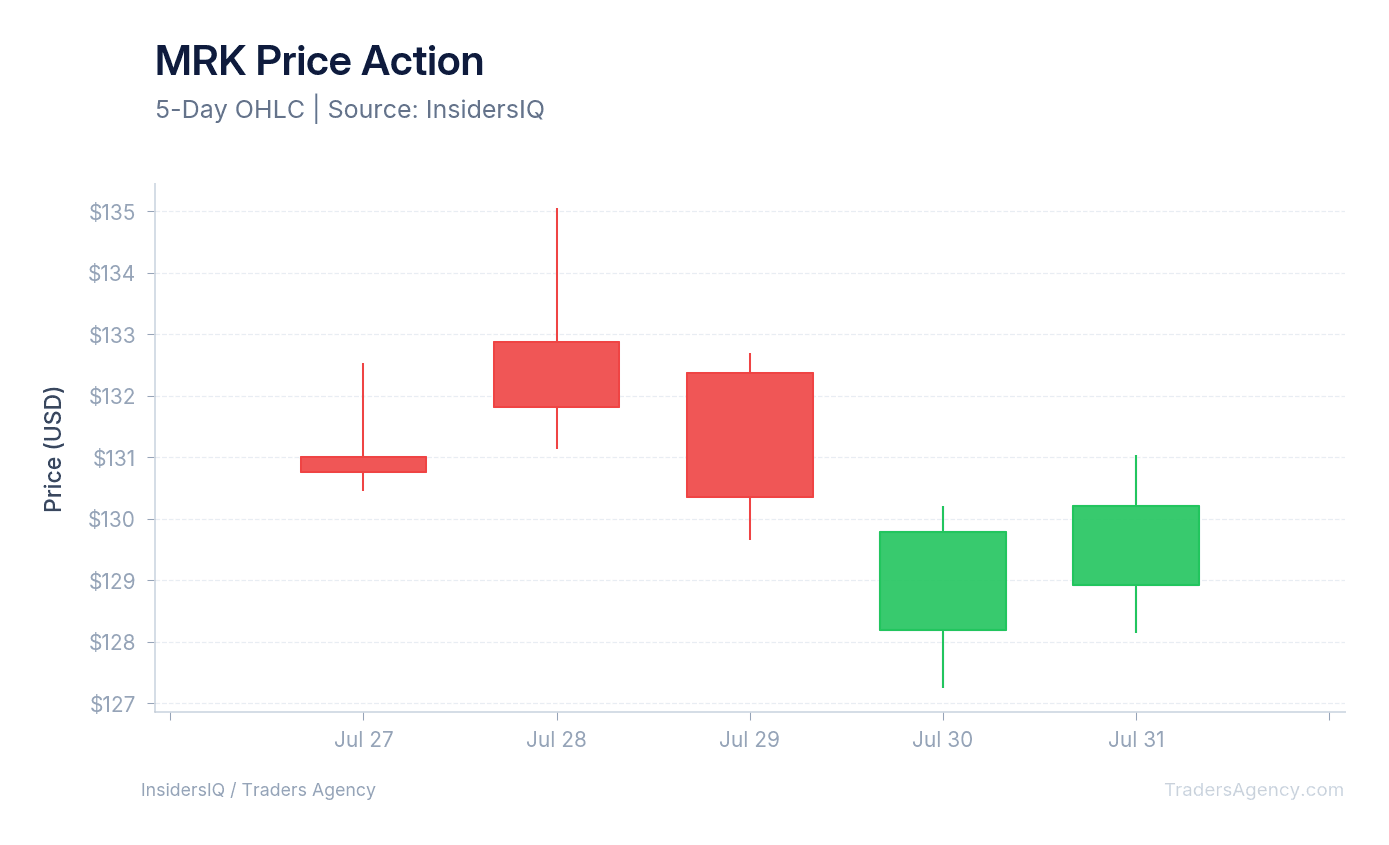
The immediate reaction to the raised revenue outlook has been muted because of the profit cuts. Our data shows a clear divergence between the stock and the broader market:
- MRK current price: $130.20
- MRK 10-day price change: -0.43%
- SPY 10-day price change: +1.07%
We're tracking insider activity alongside these price movements, specifically a Form 4 filed on July 1, 2026 by company insiders. The large acquisition charges are keeping buyers hesitant despite the top-line revenue beat. Data sourced from InsidersIQ.
What Should Traders Watch Next With Merck Stock?
The focus has shifted to these Q2 results and the upcoming third-quarter report. We're monitoring three specific developments.
1. The Keytruda Patent Expiration
The original intravenous version of Keytruda goes off patent in 2028. We're watching the sales growth of the new injectable version to see whether it can bridge the revenue gap that's coming.
2. Diabetes Drug Competition
Generic competition arrives later this year for the Type 2 diabetes medications Januvia and Janumet. The source notes Merck has been on a buying spree to offset this generic competition.
3. Acquisition Integration
The charges from Terns Pharmaceuticals and Cidara Therapeutics have hammered current profit margins. We're watching how quickly these acquisitions start generating new revenue streams.
The Bottom Line
Our read is a company spending aggressively to secure its future. The revenue outlook is strong, but the short-term profit hit from the Terns and Cidara deals is suppressing the stock price. We're watching the $130.20 level closely to see whether strong sales from Keytruda and Winrevair can pull buyers back in ahead of the next earnings call.
Want expert trading insights delivered daily?
Join thousands of traders who rely on Traders Agency for market analysis and trade ideas.
Join Traders AgencyKey Takeaways
- Merck raised its full-year 2026 revenue guidance to $66.3B-$67.3B, up from the prior range of $65.8B-$67B, after Q2 revenue of $16.61B beat estimates of $16.36B.
- Despite the revenue beat, Merck posted a net loss of $1.34B ($0.54/share) for the quarter, a sharp reversal from net income of $4.43B ($1.76/share) in the same period last year.
- The adjusted loss of $0.13/share beat the expected loss of $0.27/share, signaling the core business is outperforming even as acquisition charges distort the headline numbers.
- Acquisition charges from Terns Pharmaceuticals and Cidara Therapeutics are the primary driver of the profit collapse, making this a short-term accounting hit rather than an operational breakdown.
- MRK is trading at $130.20, caught between a credible revenue growth story and suppressed near-term earnings, with Keytruda and Winrevair sales the key variables to watch into the next earnings call.
DISCLAIMER: Traders Agency does not offer financial advice. The information provided is for educational purposes only and should not be considered financial advice. Traders Agency is not responsible for any financial losses or consequences resulting from the use of the information provided. Trading carries inherent risks and may not be suitable for all individuals. You are advised to conduct your own research and seek personalized advice before making any investment decisions, recognizing the potential risks and rewards involved.
See more from Traders Agency on Google
Make us a preferred source and our market analysis will appear more prominently in your Google Search, Top Stories, and AI results.
Add to Preferred Sources