
Market capitalization is the total dollar value of a company's outstanding shares, calculated by multiplying the current share price by the number of shares available. It's the fastest way to answer one question: how big is this company in the eyes of the market? By the end of this guide, you'll know how to calculate it, where to find it, and how to use it when deciding what to trade.
We get a version of the same question from new traders constantly: "This stock is $8 and that one is $400, so the $400 one must be the bigger company, right?" Not necessarily. Share price alone tells you almost nothing about a company's actual size.
That's where market capitalization comes in. It's one of the first numbers we teach new members to check before they look at anything else, including price charts or news headlines.
What Is Market Cap?
Bottom Line: Market capitalization, not share price, is the real measure of a company's size and should be the first number checked before looking at charts or news. Used alongside other metrics, it helps traders gauge risk, volatility, and how a stock may behave relative to its sector or an index.
What is market capitalization in simple words? Market cap is simply the price tag the stock market puts on an entire company. It answers one question: if you bought every single share, what would the whole company cost you today?
A company with a $50 share price and 10 million shares outstanding has a smaller market cap than a company with a $20 share price and 500 million shares outstanding. The first is worth $500 million. The second is worth $10 billion. Share price by itself is almost meaningless without knowing how many shares exist.
This matters because market capitalization is how most professional investors, index providers, and screeners sort and compare companies. When someone says a stock is "large cap" or "small cap," they're talking about this number, not the share price.
Key Concept: Market Cap = Current Share Price x Total Shares Outstanding. It tells you the size of the company, not whether the stock is cheap or expensive.
How Do You Calculate Market Cap?
The market cap formula is one of the simplest calculations in investing: Market Cap = Current Share Price x Total Shares Outstanding.
Shares outstanding means every share currently held by all shareholders, including company insiders, institutions, and everyday investors. You can find this number on a company's most recent quarterly or annual report filed with the SEC, or on nearly any stock screener or brokerage platform next to the ticker symbol.
A Walkthrough Example
Let's say a company has 100 million shares outstanding:
| Share Price | Shares Outstanding | Market Cap |
|---|---|---|
| $2 | 100 million | $200 million |
| $4 | 100 million | $400 million |
| $6 | 100 million | $600 million |
Notice that the share count never changed. Only the price moved, and market cap moved right along with it.
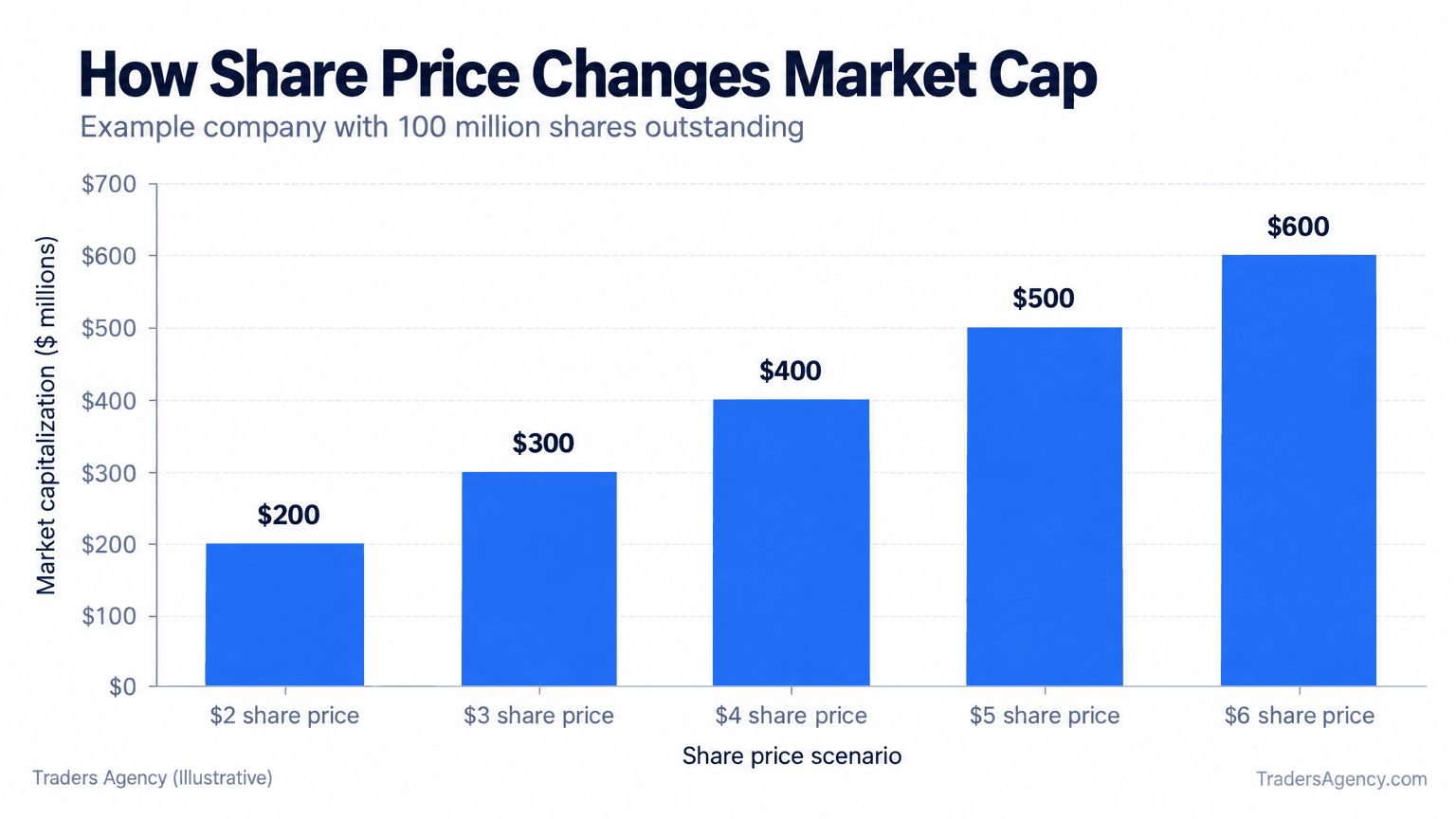
This simple relationship is exactly why "what is market capitalization in stock market" terms is such a common beginner search. It's a moving number, recalculated every time the stock trades.
Does Market Cap Mean Company Worth?
Does market cap mean company worth? Not exactly. Market cap reflects what investors are currently willing to pay for shares, not the company's actual book value, debt load, or liquidation value.
A company can have a high market cap while carrying heavy debt, or a low market cap while sitting on a pile of cash. That's why we always pair market cap with other fundamentals, like revenue, debt levels, and earnings, before drawing conclusions about a company's financial health.
Why Is Market Capitalization Important?
Why is market cap important? It helps traders quickly gauge a company's size, risk level, and liquidity, which in turn affects how volatile the stock is likely to be and how easily you can buy or sell it without moving the price.
Bigger companies tend to be more stable and heavily traded. Smaller companies can offer more growth potential but usually come with bigger price swings and wider bid-ask spreads. Knowing where a stock falls on the market cap spectrum helps you size positions appropriately and set realistic expectations for volatility.
Want expert trading insights delivered daily?
Join thousands of traders who rely on Traders Agency for market analysis and trade ideas.
Join Traders AgencyWhat are the different market cap segments?
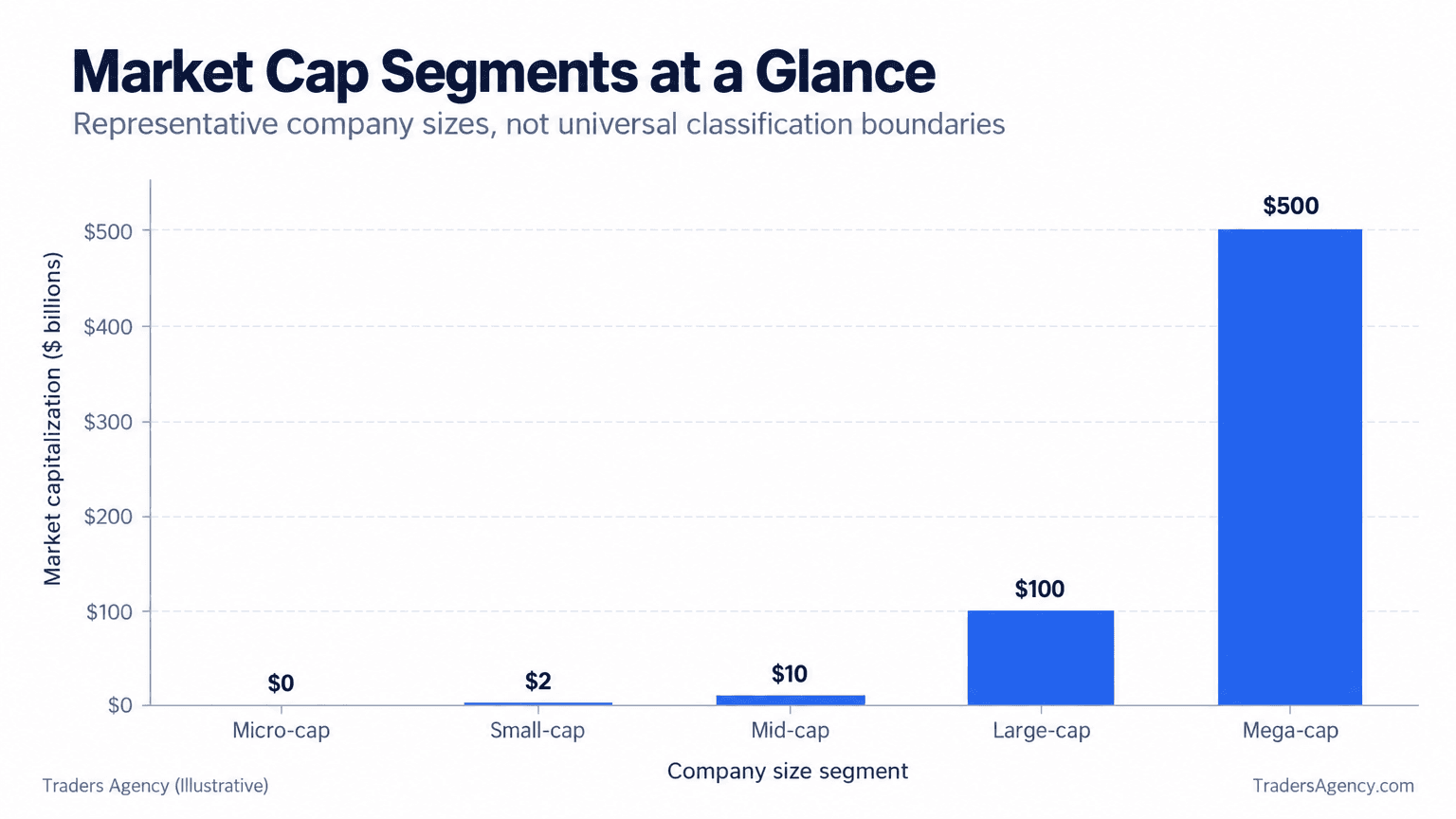
Companies get grouped into size categories based on market capitalization, and we teach these ranges to every new member because they shape risk expectations:
- Mega-cap: roughly $200 billion and above (think of the handful of companies that dominate major indexes)
- Large-cap: roughly $10 billion to $200 billion
- Mid-cap: roughly $2 billion to $10 billion
- Small-cap: roughly $300 million to $2 billion
- Micro-cap: roughly under $300 million
These bands shift slightly depending on the source, but the general ranges are widely used across brokerages and screeners.
Is $2 Billion a Good Market Cap?
A $2 billion market cap sits right at the boundary between small-cap and mid-cap. Whether that's "good" depends entirely on what you're looking for.
For a growth-focused trader hunting for companies with room to expand, $2 billion can be an attractive entry point before a company potentially moves into mid-cap or large-cap territory. For a conservative investor prioritizing stability, it may feel too small and too volatile. There's no universal answer. Context always matters.
What is a good market cap really depends on your goals, not a fixed number. Large-cap stocks generally suit traders who want steadier returns, while small-cap and mid-cap stocks suit those comfortable with more volatility in exchange for growth potential.
What is the difference between market cap and free-float market cap?
Standard market cap includes every outstanding share, even shares locked up by founders, executives, or governments that rarely trade. Free-float market cap only counts shares actually available for public trading.
This distinction matters because many major indexes, including the S&P 500, use float-adjusted calculations rather than total market cap. A company might have a huge total market cap on paper, but if most shares are held tightly by insiders, the free-float version can be considerably smaller and more representative of what's actually tradable.
What is the difference between market cap weighted and equal weight indexes?
Here's a point we think gets glossed over too often: how market cap affects the index funds many traders already own.
In a market-cap-weighted index, like the standard S&P 500, bigger companies get a bigger slice of the pie. If one company's market cap is ten times larger than another's, it gets roughly ten times the weighting in the fund, meaning its price moves have a much bigger impact on the overall index.
In an equal-weight index, every company gets the same allocation regardless of size. A fund with five companies would give each one roughly 20%, whether it's a mega-cap giant or a small-cap newcomer.
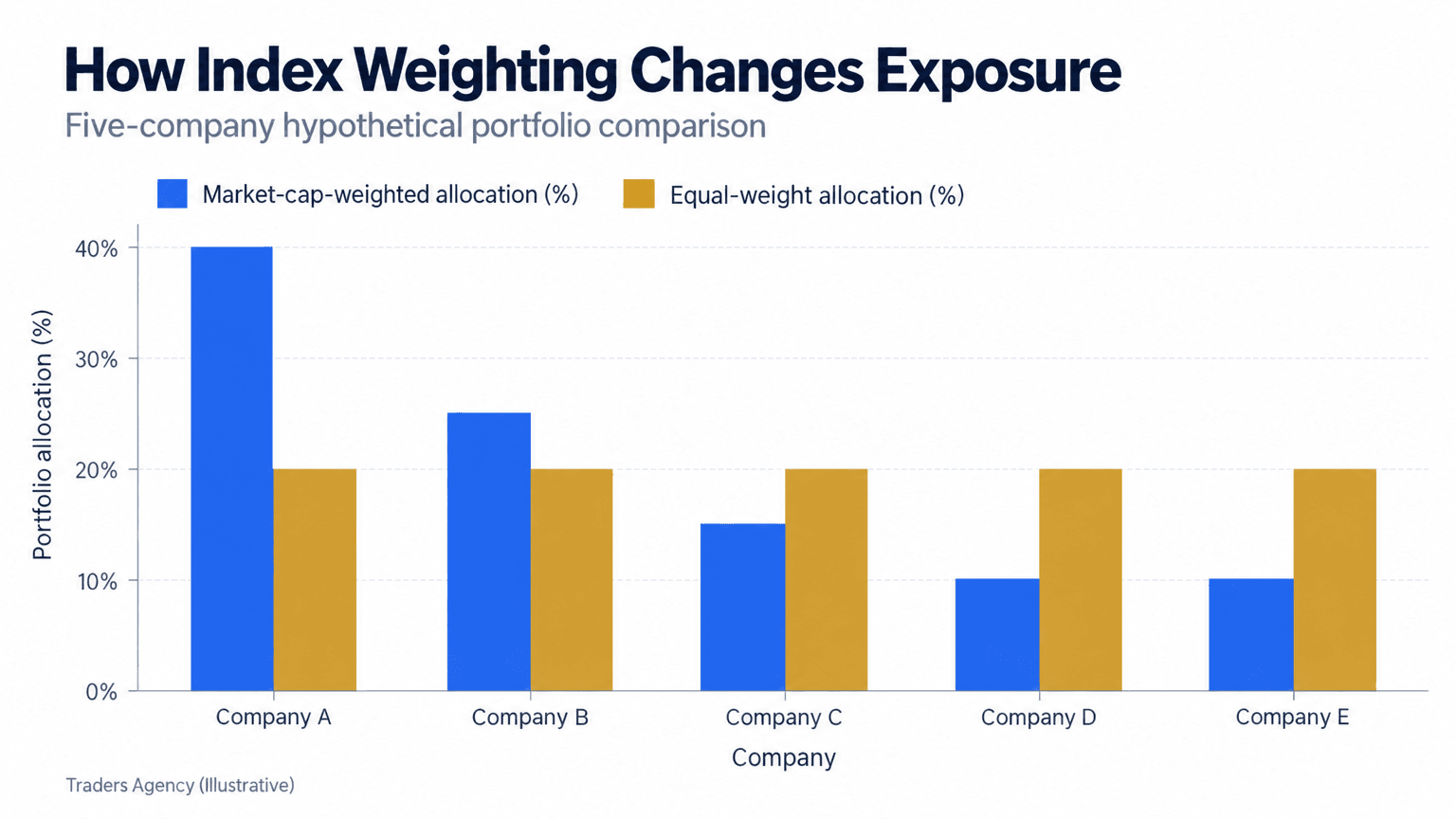
Understanding this helps explain why a handful of mega-cap stocks can single-handedly drag a market-cap-weighted index up or down on any given day, while an equal-weight version of the same index might barely move.
What Could Impact a Company's Market Cap?
Market cap changes constantly because share price changes constantly during trading hours. A few common drivers we flag for members:
- Earnings reports: strong or weak results can swing share price and market cap significantly in a single session
- Share buybacks: reduce shares outstanding, which gives each remaining share a larger claim on the company, though total market cap also falls by the cash spent unless the share price rises to offset it
- New share issuance: increases shares outstanding, which can dilute existing shareholders
- Broad market sentiment: fear or optimism across the market cap spectrum can lift or drag entire size categories together
Market Capitalization for Private Companies
Market capitalization for a private company can't be calculated the standard way, since there's no public share price to multiply. Private company valuations instead come from funding rounds, investor negotiations, or appraisals, producing a valuation rather than a true market cap.
What Is Market Cap in Crypto?
What is market cap in crypto works almost identically: current coin price multiplied by circulating supply. The same size logic applies. Larger crypto market caps generally suggest more established, liquid assets, while smaller ones can be thinner and more volatile.
Is a High Market Cap Always Good?
Is high market capitalization good? Not automatically. A high market cap usually signals stability and liquidity, but it doesn't guarantee future growth, and it says nothing about whether a stock is fairly priced relative to its earnings or revenue.
We've seen plenty of mega-cap companies trade sideways for years while smaller companies with much lower market caps delivered stronger percentage gains. A high market cap mostly tells you the company is large and established, not that it's a good value at today's price.
What Is the 7% Rule in Stocks?
The 7% rule is a risk management guideline some traders use, suggesting you sell a stock if it drops about 7% to 8% below your purchase price to limit losses. It's unrelated to market cap directly, but it's worth knowing as a separate risk control technique, especially when trading smaller, more volatile market cap segments where swings can be sharper.
Practical Application: Using Market Cap in Your Trading
We don't treat market cap as a standalone buy or sell signal. We use it as a filter and a risk gauge.
Before researching any new stock, check where it falls on the market cap spectrum. If you're risk-averse, lean toward large-cap and mega-cap names where price swings tend to be smoother. If you're comfortable with more volatility in exchange for growth potential, small-cap and micro-cap stocks might fit, but size your positions smaller to account for the added risk.
A few practical rules we teach:
- Never size a micro-cap position the same way you'd size a mega-cap position. The volatility is not comparable.
- Always pair market cap with revenue, earnings, and debt figures before deciding anything.
- Check free-float market cap when researching companies with heavy insider ownership.
- Use stock screeners or brokerage platforms (most display market cap directly next to the ticker) rather than calculating it by hand every time.
Watch Out: A low share price does not mean a stock is "cheap" or undervalued. Ignoring shares outstanding, or treating market cap as the only metric that matters when picking a trade, are two of the most common mistakes we see from newer traders.
Want expert trading insights delivered daily?
Join thousands of traders who rely on Traders Agency for market analysis and trade ideas.
Join Traders AgencyDISCLAIMER: Traders Agency does not offer financial advice. The information provided is for educational purposes only and should not be considered financial advice. Traders Agency is not responsible for any financial losses or consequences resulting from the use of the information provided. Trading carries inherent risks and may not be suitable for all individuals. You are advised to conduct your own research and seek personalized advice before making any investment decisions, recognizing the potential risks and rewards involved.
See more from Traders Agency on Google
Make us a preferred source and our market analysis will appear more prominently in your Google Search, Top Stories, and AI results.
Add to Preferred Sources