
The United States and China each released lists on Monday recommending reduced tariff treatment on $30 billion worth of the other country's goods, a combined $60 billion in two-way trade, following the Trump-Xi summit in Washington. The lists, titled the U.S.-China Board of Trade "30-for-30" lists, cover everything from American corn and wheat to Chinese toys and household goods, but China's list notably excludes soybeans — described by Seeking Alpha as "the key U.S. farm export" — according to CNBC and Reuters via ThePrint.
What the lists actually say
The official White House release frames the documents as products the two governments "will consider" for reduced tariff treatment, delivered reciprocally and "consistent with their respective domestic laws and processes," according to the White House. That language is notably conditional: no implementing order, Federal Register notice, or State Council tariff commission announcement has been published alongside the lists, and CNBC reported that it was "not immediately clear when lower tariffs would take effect, and by how much the duties would go down." In other words, both lists are recommendations pending each side's own legal and administrative process, not tariff changes now in force.
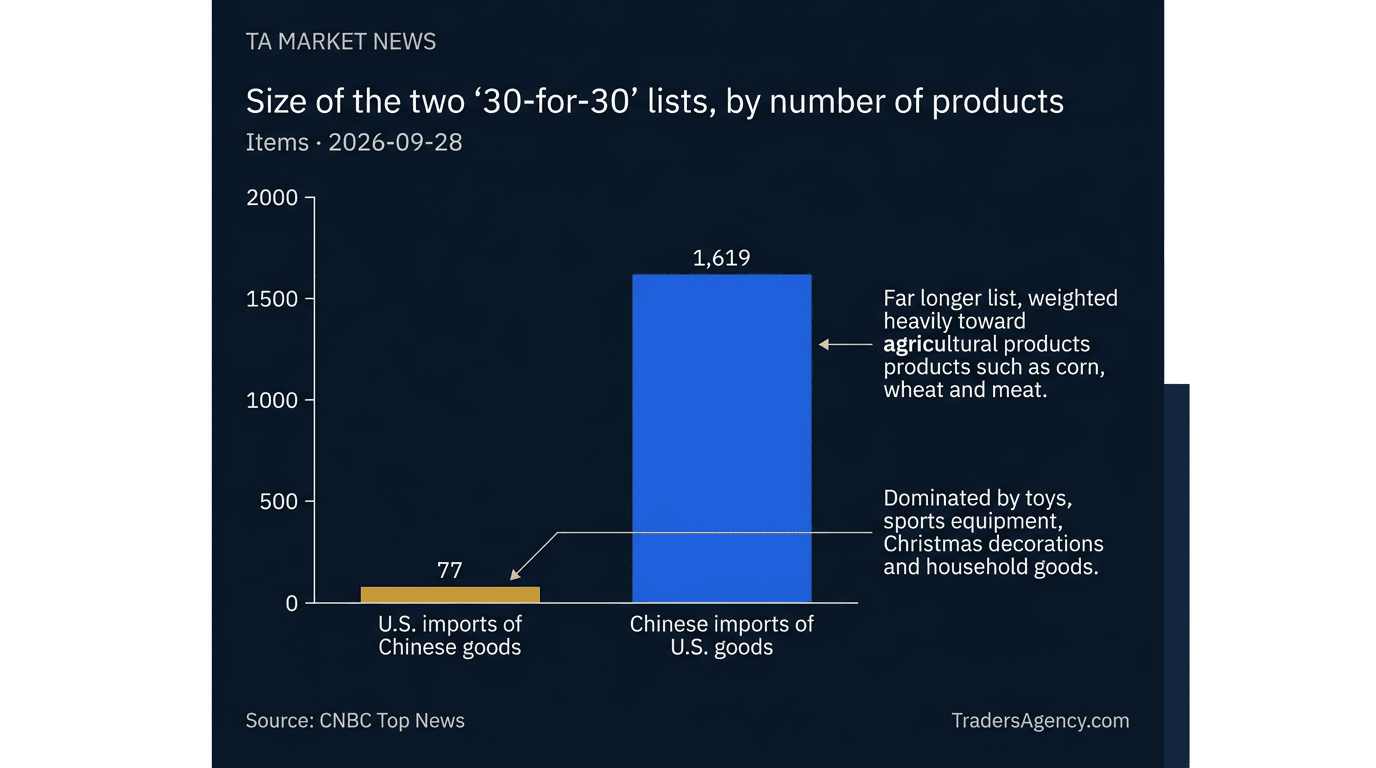
The two lists differ sharply in scope. The U.S. list runs to 77 items, according to CNBC, dominated by toys, sports equipment, Christmas decorations, and household goods such as fireworks, tableware, blankets, microwave ovens, Christmas-tree lamps and highchairs; toys that connect via WiFi or Bluetooth are explicitly excluded. China's list is far longer at 1,619 items, weighted heavily toward agricultural products including corn, wheat, sorghum, meat, dairy, vegetable oils and meals, plus fish and seafood, logs and wood products, cosmetics and medical devices. Calculated from those CNBC item counts, China's list is 1,542 items longer than the U.S. list (1,619 − 77), meaning the U.S. list is about 95% shorter ((77 − 1,619) / 1,619 × 100 = −95.2%) — an arithmetic comparison of the two counts, not a measure of the dollar value involved. U.S. Trade Representative Jamieson Greer said in a Sunday statement, as reported by Reuters via ThePrint, that the arrangement unlocks "improved market access" for about 30% of U.S. exports to China.
Soybeans left off China's list
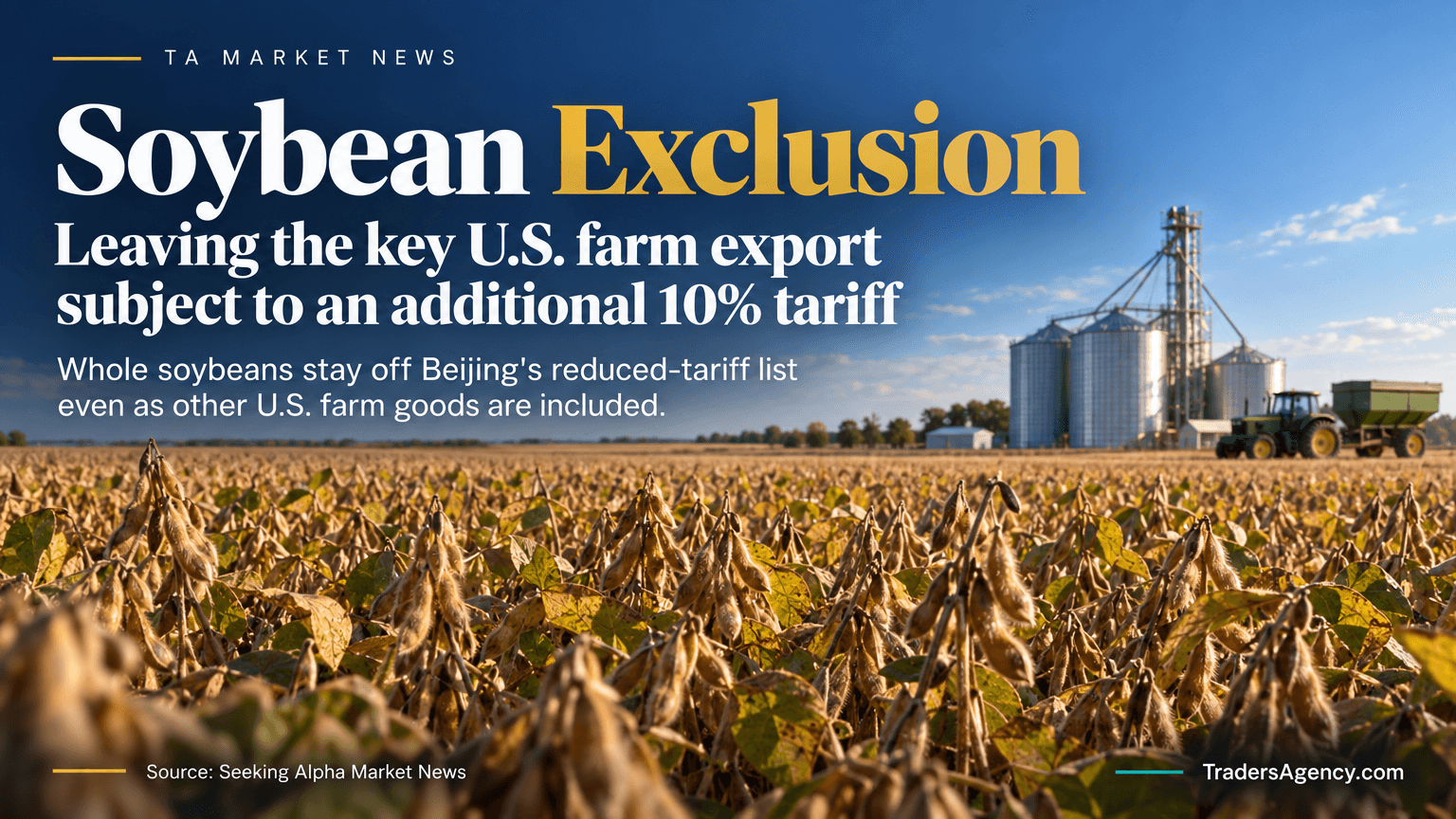
Soybeans are conspicuously absent from Beijing's tariff-reduction list. Seeking Alpha reported that with soybeans excluded, "the key U.S. farm export" remains subject to an additional 10% Chinese tariff. CNBC's detailed breakdown of China's list shows that soybeans for seed and soybean flour and meal are included, but whole soybeans themselves are not. Reuters via ThePrint offered context: China's product selection appears designed to help Beijing meet what the White House says is a $17-billion agricultural purchase commitment, and China has already resumed large-scale U.S. soybean buying under a deal struck last year to buy 25 million metric tons annually. Neither release published Monday set out a reason for keeping whole soybeans off the list.
Reaction so far
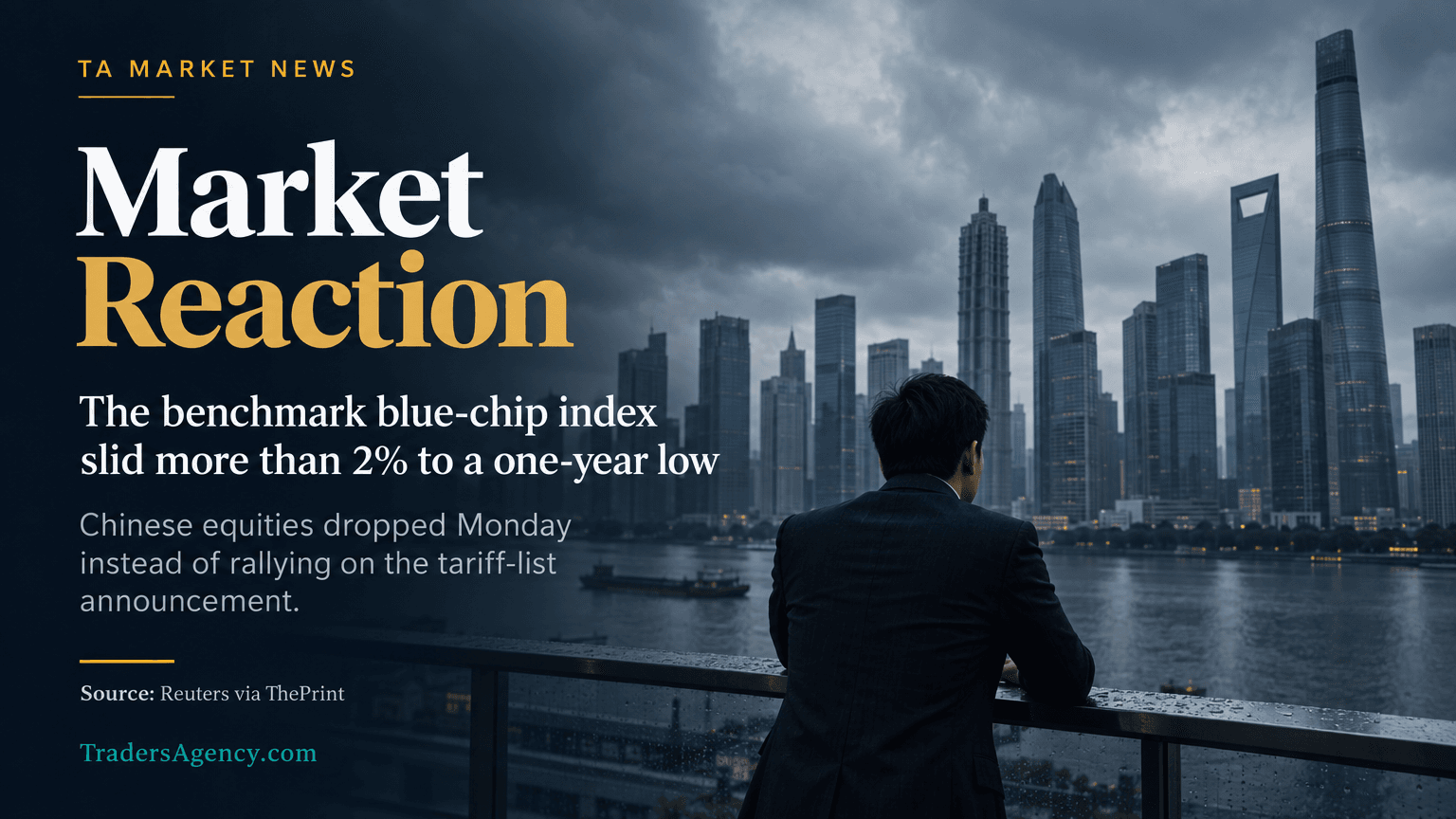
Chinese equities did not rally on the announcement. Reuters via ThePrint reported that the benchmark blue-chip index fell more than 2% to a one-year low on Monday, with technology stocks pressured by a bipartisan U.S. push to ban Chinese components from data centres, and investors having "few concrete details to cheer" from the summit.
Business voices quoted by CNBC offered qualified, forward-looking views tied to implementation timing rather than the announcement itself. Jacob Cooke, CEO of WPIC, said, "If we see the tariff cuts actually implemented before the holiday season, it could provide a welcome boost to U.S. consumption and to retailers," adding that Beijing's list includes fast-growing categories such as hair care and packaged pet food where "every percentage point counts for price competitiveness and preserving margin." Separately, Ryan Zhao, director of Jiangsu Green Willow Textile, told CNBC he expects second-half sales to grow 30% from a year earlier if the tariff cuts are implemented. Both comments are framed as expectations contingent on implementation, not confirmed outcomes.
Wider context
The tariff lists sit within a broader truce extension. China's commerce ministry said, per Reuters via ThePrint, that a two-month extension of the trade truce runs through January 10, a timeline Treasury Secretary Scott Bessent had flagged the previous week, according to CNBC. The two sides also agreed to form a U.S.-China Board of Trade with officials from both governments meeting at least quarterly, and an agriculture working group holding its first meeting before year-end. Separately, the summit produced an agreement for China to import 10 million metric tons of U.S. coal annually in 2027 and 2028, roughly 2% of China's annual coal imports, while liquefied natural gas and oil were not included. Existing baseline tariffs remain steep: last year the U.S. and China imposed effective import tariffs of over 40% and more than 30%, respectively, on each other, per CNBC, against a U.S. goods trade deficit with China of more than $202 billion last year.
Bottom Line
Monday's lists mark a negotiated framework, not an enacted tariff cut. Both governments still need to translate "recommended" treatment into domestic legal action, and neither side has published an effective date. China's exclusion of soybeans from its agricultural list stands out given the crop's size in bilateral trade, even as Beijing continues separate large-volume purchases under last year's agreement. Investors watching this story should note that the underlying market reaction so far, a sharp Monday decline in Chinese equities, ran counter to any straightforward relief-rally narrative, underscoring how much implementation detail is still missing.
DISCLAIMER: Traders Agency does not offer financial advice. The information provided is for educational purposes only and should not be considered financial advice. Traders Agency is not responsible for any financial losses or consequences resulting from the use of the information provided. Trading carries inherent risks and may not be suitable for all individuals. You are advised to conduct your own research and seek personalized advice before making any investment decisions, recognizing the potential risks and rewards involved.
- CNBC Top News: U.S., China to lower tariffs on $60 billion of goods. Here's what qualifies · accessed Sep 28, 2026
- Seeking Alpha Market News: China eases tariffs on U.S. farm goods, keeps soybeans out · accessed Sep 28, 2026
- The White House: U.S.-China Board of Trade · accessed Sep 28, 2026
- Reuters via ThePrint: China, US agree tariff cuts on $60 billion of goods including agriculture, household items · accessed Sep 28, 2026
See more from Traders Agency on Google
Make us a preferred source and our market analysis will appear more prominently in your Google Search, Top Stories, and AI results.
Add to Preferred Sources