
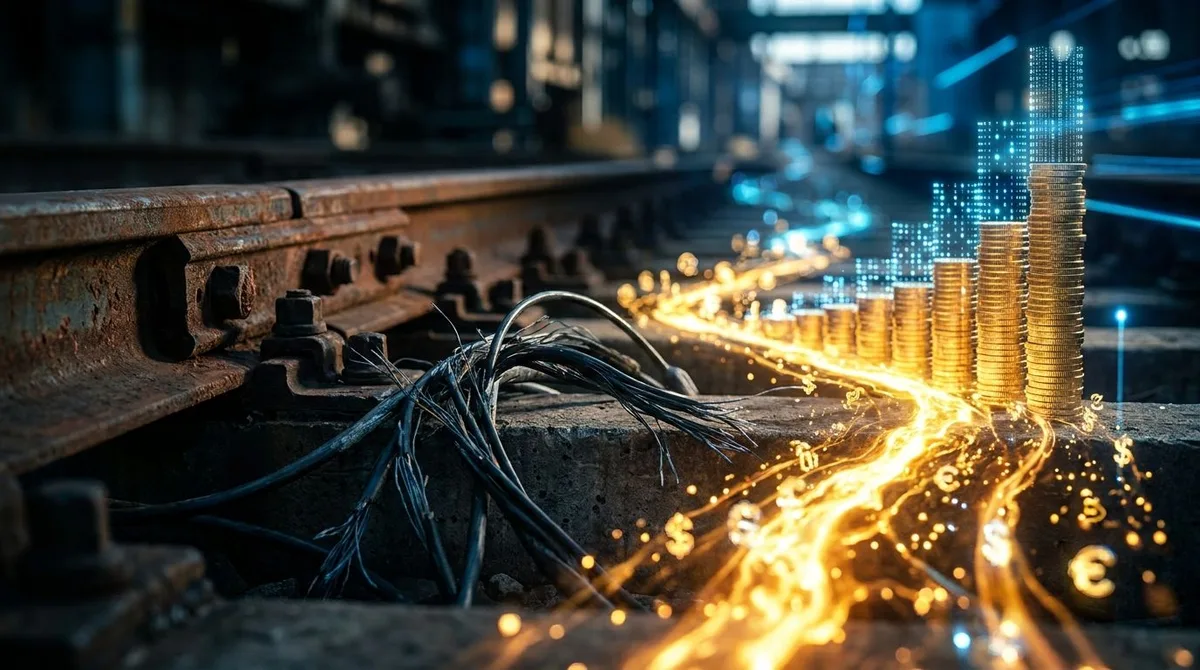
The great wealth transfer is not some mysterious future event. It is a predictable rotation of capital, moving from the companies that build new technology to the companies that use it.
We are watching the biggest one of the decade unfold right now, and it revolves entirely around artificial intelligence.
There is a pattern that has repeated with every great technology for 150 years. A company builds something enormous, and it never works out the way investors expect. The stocks in the building group get crushed. The stocks in the user group soar.
This same shift caused the dot-com implosion 25 years ago. It will eventually happen with AI stocks. The only question is whether it is happening right now.
What Is the 150-Year Pattern Behind the Great Wealth Transfer?
Bottom Line: The great wealth transfer is a capital rotation, not a technology story. Every major infrastructure cycle for 150 years has ended the same way: builders go broke servicing debt while users compound returns on top of a cheaper, already-built network. The actionable conclusion is to position in companies that own the customer, the data, or the standard, and avoid confusing exposure to AI infrastructure with exposure to AI profits.
More than a century of precedent for how AI ends
The technology always works. That is never the question. The question is who gets paid for it, and the answer is almost never the people who built it. It is the people who use it.
The mechanism is simple. Watch it play out in three moves.
1. The Builders Take the Risk
A country builds a big, expensive network. Everybody piles in.
2. The Debt Crushes the Builders
Competition drives the price of using the network down. Obsolescence eats the equipment. The people who borrowed money to build it cannot cover their debt at the new lower prices. They hand the keys to the bank.
3. The Users Take the Profit
The one riding on top never borrowed a dime. He owns the customer, the data, or the standard. He keeps every bit of the profit, and his costs just went down because the network got cheaper. This is the heart of every great wealth transfer.
Why Did the Railroads Build America and Then Go Broke?
Start with the railroads, the most important thing America built in the 19th century.
Between 1866 and 1873, 35,000 miles of track were laid. It worked. It connected a continent. Then the financial fallout arrived.
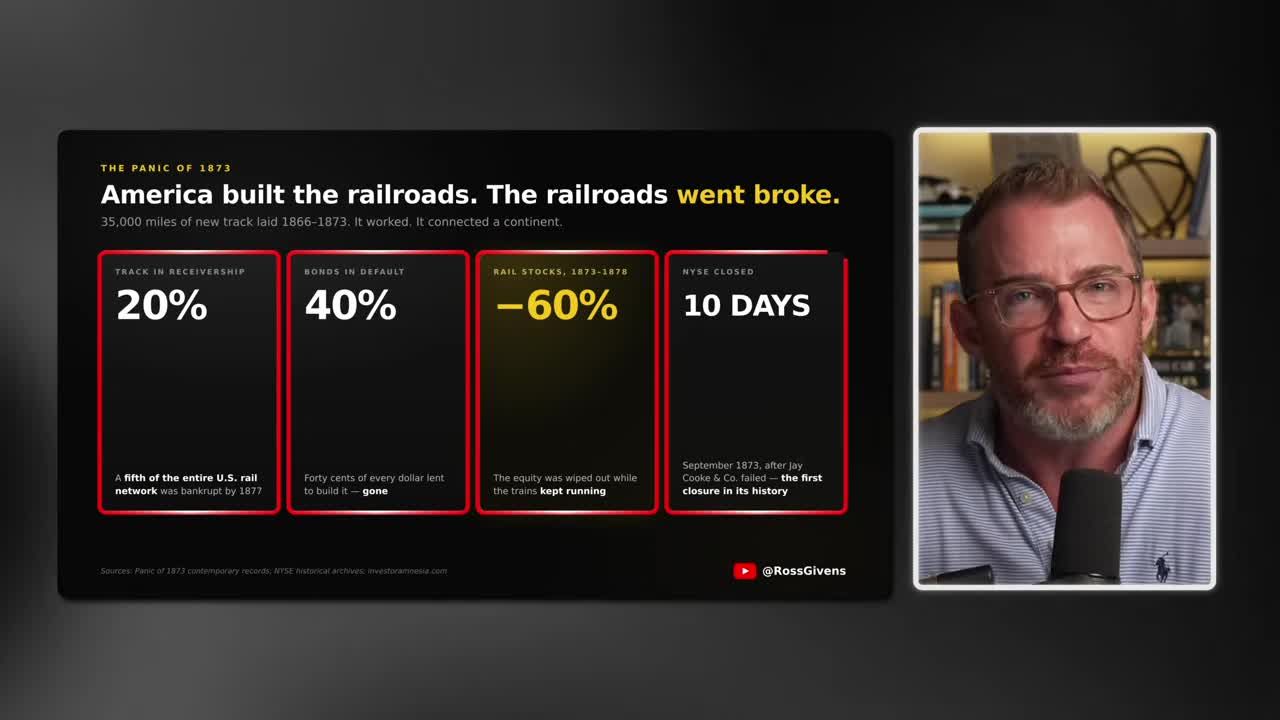
When Jay Cooke & Company went under in September of 1873, the New York Stock Exchange closed for 10 days for the first time in history.
Fiber Optics and Airlines
Why the builders always go broke
Fast forward a hundred years, to the internet and fiber optics.
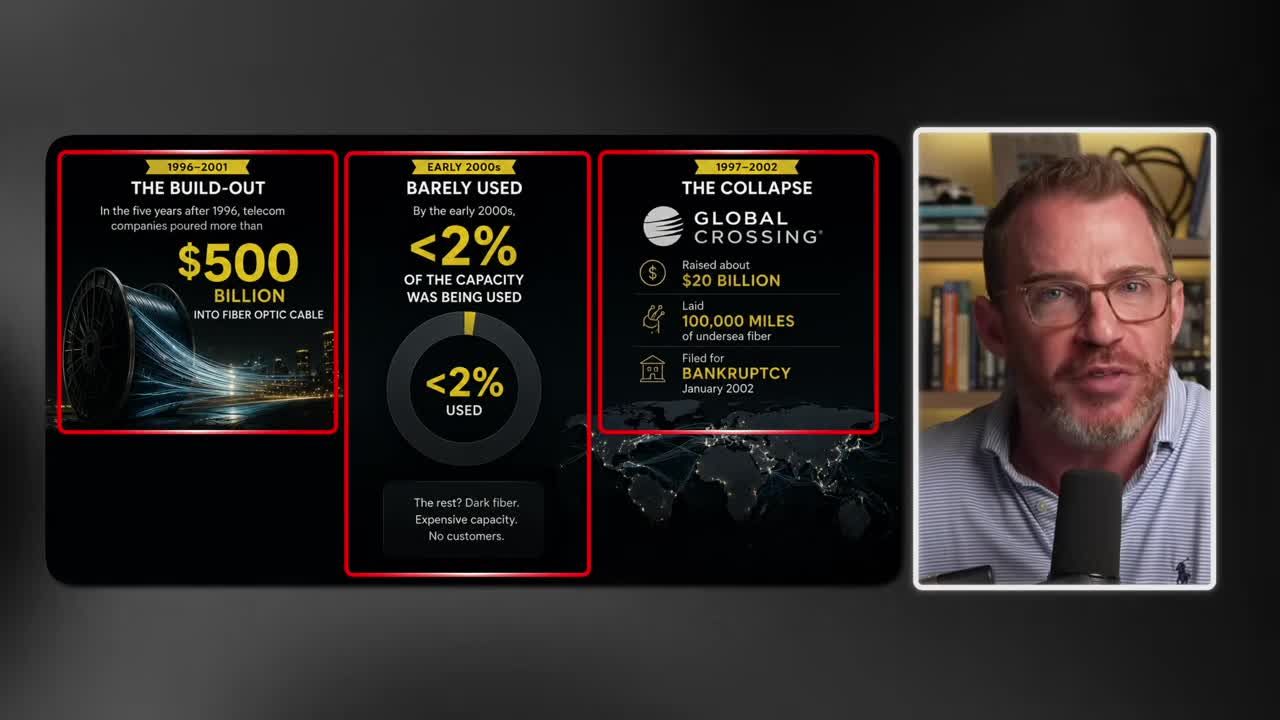
In the five years after 1996, telecom companies poured more than $500 billion into cable. By the early 2000s, less than 2% of it was being used. Global Crossing raised about $20 billion, laid 100,000 miles of undersea fiber, and filed for bankruptcy in January of 2002. Its assets sold for pennies on the dollar compared to what it cost to build.
So who got rich off all that fiber?
Google. Amazon. Netflix. Companies that never laid a single mile of cable. They built their empires on bandwidth that was practically free because somebody else had already gone broke providing it.
The airlines tell the same story. The airplane might be the most transformative machine of the 20th century, yet Warren Buffett noted that as of 1992, all the money made by every airline company in this country since the dawn of aviation added up to zero. Absolutely zero.
From 2000 to 2008, they lost another $60 billion. This year, the industry's own forecast shows it earning about 6.8% on capital that costs 8.2%. Right now, in 2026, the airline industry is still losing money for the people who fund it.
The Handoff Began in July
The semiconductor index fell almost 29% from its June peak. Money rotated out of the infrastructure builders and straight into software companies. The technology still worked. The capital structure decided who got paid.
Consider two lists of stocks from July. The first is what the smartest AI investor on Wall Street owned. The second is the stocks he was betting against.
Over four weeks, the first list got cut nearly in half. The second list went straight up. Same month. Same market. Same AI story. The S&P 500 was sitting near all-time highs.
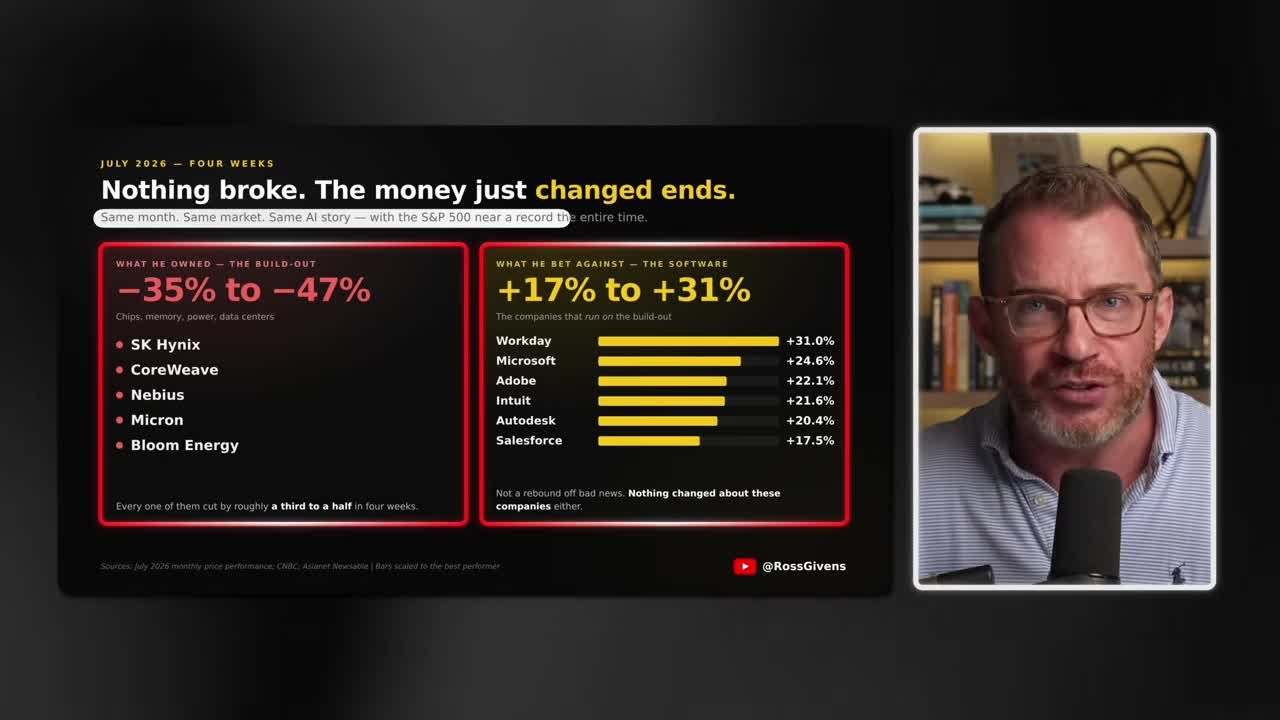
This was not an AI crash. Nothing broke. Nothing changed about these companies. The money simply walked out of one end of the AI trade and into the other.
The Fall of a Wall Street Wonder Boy
Leopold Aschenbrenner is a 25-year-old who graduated from Columbia as valedictorian at 19. He worked at OpenAI, wrote an essay called "Situational Awareness," and started a hedge fund.
He had never managed money before in his life. And at first, he was spectacular at it. Up 439% net in the first half of this year alone. Up more than 1,000% since inception after fees.
At the start of July, the fund had roughly $45 billion. Then the AI infrastructure trade rolled over. His brokers at Goldman, JP Morgan, and BofA started calling. The book was levered about 4 to 1.
On Thursday, July 30th, before the opening bell, he sold his entire public stock portfolio to Ken Griffin's Citadel in a single block trade. By that afternoon, the fund was down to around $10 billion.
Most people assume he lost because of the leverage. The leverage is why this happened in 20 trading days instead of two years. But it is not why it happened. Leverage is just a magnifying glass. He lost because he was wrong.
Get an entire year of live weekly mentoring sessions, my newsletter, indicators, bonus reports, tons more. Click the link and I'll see you in the next live session.
Join my Black Ops Trading ClubWhat Is the Fatal Mistake Investors Make During a Wealth Transfer?
Transformative technology does not guarantee a return
Porter Stansberry laid this out in a piece on X over the weekend, and it explains the whole thing. Aschenbrenner assumed that because a technology is transformative, the money that builds it earns a return.
There is no relationship between those two things. There never has been.
Look at the capital being burned right now.
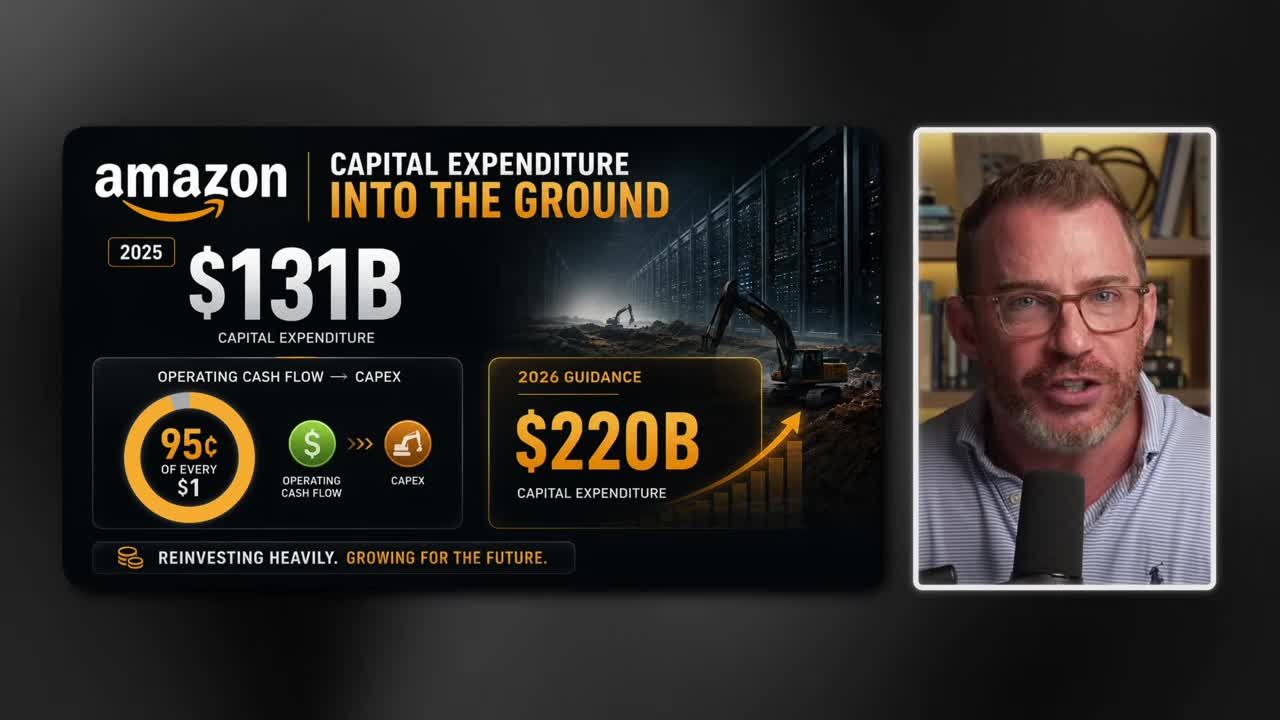
Amazon spent $131 billion in capital expenditures in 2025. Roughly 95 cents of every dollar the business generated in operating cash poured straight into the ground. This year they are guiding to $220 billion, almost double.
Oracle's cash flow went negative while its long-term debt nearly doubled. CoreWeave, one of Aschenbrenner's biggest positions, is carrying term loans at 11% to 15% interest in 2026, on a business that burns cash.
And the hyperscalers are trying to hide the problem. They stretched out how long they say a server lasts, going from three years to four, then four to six. These are accounting tricks to inflate their profits.
The only exception is Amazon. In January of last year, Amazon shortened the useful life of their servers. They disclosed it in their official 10-K filing. It cost them $1.4 billion of extra depreciation and $1 billion of net income. Notice that the stock peaked on January 25th.
Amazon has run data centers longer and harder than anybody alive. They are telling us the hardware wears out faster than everybody's spreadsheets assume.
Two Flawed Ideas
Aschenbrenner bet his entire multi-billion dollar fund on two ideas.
Idea One: The physical buildout of AI is the trade of the decade. He bought the chips, the memory, the power, and the data centers. He owned CoreWeave, Nebius, Micron, Bloom Energy, and SK Hynix.
Idea Two: Application software was going to be destroyed by AI. Not disrupted. Obliterated.
He said it out loud on a podcast in 2024. He was bearish on the wrapper companies because they were betting on stagnation, and AI was going to, in his words, "sonic boom" them. Buy the compute, short everything that runs on the compute. That was the whole fund.
The market had a name for it. They called it the SaaS apocalypse. Adobe was down 31% on the year going into July. But it is turning around fast, and investors are waking up to the mistake in the logic.
The Enterprise Software Moat
A company selling enterprise software is selling the work the software performs. The flawed theory says that if an AI model can do that work, the company is worth nothing.
Nobody who has ever run a business believes that.
Take Veeva. 19 of the top 20 drug companies on Earth run their regulatory paperwork on Veeva's system. Every clinical record, every FDA submission, every signature, validated under federal regulations. When an FDA inspector walks in the door, that audit trail is the company's entire legal defense.
Investors thought software was dead. The stock fell 50% in the first half of this year. Look at the actual numbers.
Nobody rips out a working system to save one percent. Nobody revalidates a decade of regulated records in front of a federal regulator on an untested platform to save a rounding error. No executive on Earth signs that.
That is a moat. These companies are not getting eaten by AI. They are selling it.
Microsoft crossed 30 million paid Copilot seats. Salesforce's Agentforce went from $800 million in annual recurring revenue to over $1.2 billion in a single quarter. Veeva is giving its AI agents away free through 2030, which tells you everything. Veeva knows its moat was never the intelligence. It was the record.
Who Actually Got Rich Off the Railroads
While a fifth of the railroads were in receivership, there was a company called Adams Express. Incorporated in 1854, it did not own one single mile of track. Not one. It bought space on other men's trains and moved packages, money, and valuables.
By 1866, it was paying an 8% dividend quarterly. It paid an unbroken dividend from 1869 forward, straight through the depression that bankrupted the railroads underneath it.
Adams Express turned itself into a closed-end fund in 1929, and it still trades today under the ticker ADX. The company that rented space on the trains outlived nearly every railroad it ever rode.
Pullman tells the same story. Organized in 1867 with a million dollars, it did not own track either. It owned the sleeping cars and leased them to the railroads. It put up a million dollars of equity and earned about a million a year, riding on a network that cost other people billions and bankrupted a third of them.
It happened in 1874. It happened in 2004. It started happening again in July.
The Three-Question Test
How to spot the user stocks before the shift
Is this really the end of the AI infrastructure trade that has powered the market for the last four years? Nobody knows the exact timeline. The railroads ran for years after nobody could do the math. Fiber took about five. These handoffs grind. They do not happen on a random Tuesday.
You do not have to call the date. You only have to know which side of it you are standing on. When the shift comes, it does not ask permission. It does not wait for an earnings report. It just took a fund managing $45 billion down to $10 billion in 20 trading sessions.
Run this test against every AI stock you own.
- Do they own the customer? The customer, the data, and the standard, or are they renting out a commodity anybody else can also rent?
- Do they grow for free? Does the business need to borrow massive amounts to grow, or does it grow for free?
- Does cheaper compute help them? When compute gets cheaper, does that hurt the company or make it cheaper to run?
The leveraged neoclouds fail all three. The Bitcoin miners with retrofitted substations fail all three. Memory has never once earned its cost of capital through a full cycle. That fails too.
The companies that own the customer and the record pass all three.
The Great Wealth Transfer Is Here
If every stock you own is on the building side of this equation, you are in danger. If you own the chips, the memory, the data centers, and the power, but you own nothing on the side that uses them, you are not diversified. You have one position ten different ways. This is exactly how the great wealth transfer catches investors on the wrong side.
The technology never decides who gets paid. The capital structure does.
Who owns the customer? Who owns the data? Who owns the standard? That was true in 1874. It was true in 2004. I would bet a lot of money it is still true today.
Position yourself on the side of the users, and let the builders fight over the scraps.
Get an entire year of live weekly mentoring sessions, my newsletter, indicators, bonus reports, tons more. Click the link and I'll see you in the next live session.
Key Takeaways
- The great wealth transfer follows a 150-year pattern: builders take on debt to construct the network, competition collapses their margins, and users who never borrowed a dime capture the profit.
- The dot-com crash 25 years ago followed this exact script, with infrastructure builders getting wiped out while companies owning the customer relationship survived and thrived.
- Owning multiple AI chip or infrastructure stocks is not diversification. It is a single concentrated bet expressed ten different ways.
- The capital structure, not the technology itself, determines who gets paid. The decisive questions are: who owns the customer, the data, and the standard.
- The thesis is that capital is rotating right now from AI builders to AI users, and investors positioned on the builder side risk being caught in the same trap that crushed railroad and fiber-optic investors before them.
DISCLAIMER: Traders Agency does not offer financial advice. The information provided is for educational purposes only and should not be considered financial advice. Traders Agency is not responsible for any financial losses or consequences resulting from the use of the information provided. Trading carries inherent risks and may not be suitable for all individuals. You are advised to conduct your own research and seek personalized advice before making any investment decisions, recognizing the potential risks and rewards involved.
See more from Traders Agency on Google
Make us a preferred source and our market analysis will appear more prominently in your Google Search, Top Stories, and AI results.
Add to Preferred Sources