
Theta decay is the rate at which an option loses value purely because time is passing. Every day a contract sits in your account, it sheds a slice of its extrinsic value, and that erosion accelerates as expiration closes in. If you have ever watched an option you bought hold flat on price while the position quietly bled money, you have already felt theta at work.
That frustrating experience is exactly what we want to fix. In this guide, we will show you why theta decay happens, when it hits hardest, and how experienced traders structure positions to collect that decay instead of paying it.
By the end, you will be able to read theta in plain terms, spot the days-to-expiration windows where decay accelerates, and apply two theta-based strategies with real numbers attached.
What Is Theta Decay in Options?
Bottom Line: Theta decay in options accelerates as expiration nears, so the same dollar amount of decay means something different depending on position size and max loss. Judge theta relative to risk, not as a standalone number, and match the decay rate to how long you actually plan to hold the trade.
Theta decay describes the daily loss in an option's price attributed solely to the passage of time, independent of any stock price movement. It is one of the "Greeks," the risk measures options traders use alongside delta, gamma, and vega. Theta is almost always expressed as a negative number for option buyers, because time works against them.
Here is the way we teach it: an option is a lease with an expiration date attached. The longer the lease has left, the more someone will pay for the flexibility it offers. As the lease runs out, that flexibility premium shrinks toward zero, even if nothing else about the deal has changed.
This is why two identical options on the same stock, at the same strike price, can be worth very different amounts if one expires in 60 days and the other in 5 days. Contract specifications and expiration schedules for listed options are published by the exchanges, including Cboe, and every one of those expiration dates is a deadline that theta counts down to.
Key Concept: Theta is the dollar amount an option is expected to lose per day from time alone, assuming the stock price and implied volatility stay unchanged. Buyers pay theta. Sellers collect it.
How Does Time Decay Actually Work?
Time decay works because an option's price is built from two components, and one of them shrinks automatically as expiration nears. Every contract loses a portion of its extrinsic value each day it is held, and that daily loss is theta.
We like to describe theta as rent. The option seller collects the rent. The buyer pays it, whether or not the stock moves at all.
A Simple Theta Example
Say a stock trades at $100 and you are looking at a $100 strike call expiring in 45 days, priced at $3.50. If the option's theta is listed at -0.04, the contract is expected to lose about $0.04 of value tomorrow, or $4 per contract, if the stock price and volatility hold steady.
That sounds trivial. The catch is that theta is not constant. It grows as expiration approaches, and that acceleration is where most traders get hurt.
Intrinsic Value, Extrinsic Value, and the Shape of the Decay Curve
An option's price has two parts: intrinsic value (what it is worth if exercised right now) and extrinsic value (everything else, driven by time and implied volatility). Theta eats away at extrinsic value only. It never touches intrinsic value.
A deep in-the-money option is mostly intrinsic value, so theta barely registers. An at-the-money option is almost entirely extrinsic value, which makes it the most exposed position on the board when it comes to decay.
And this decay is not a straight line. It curves.
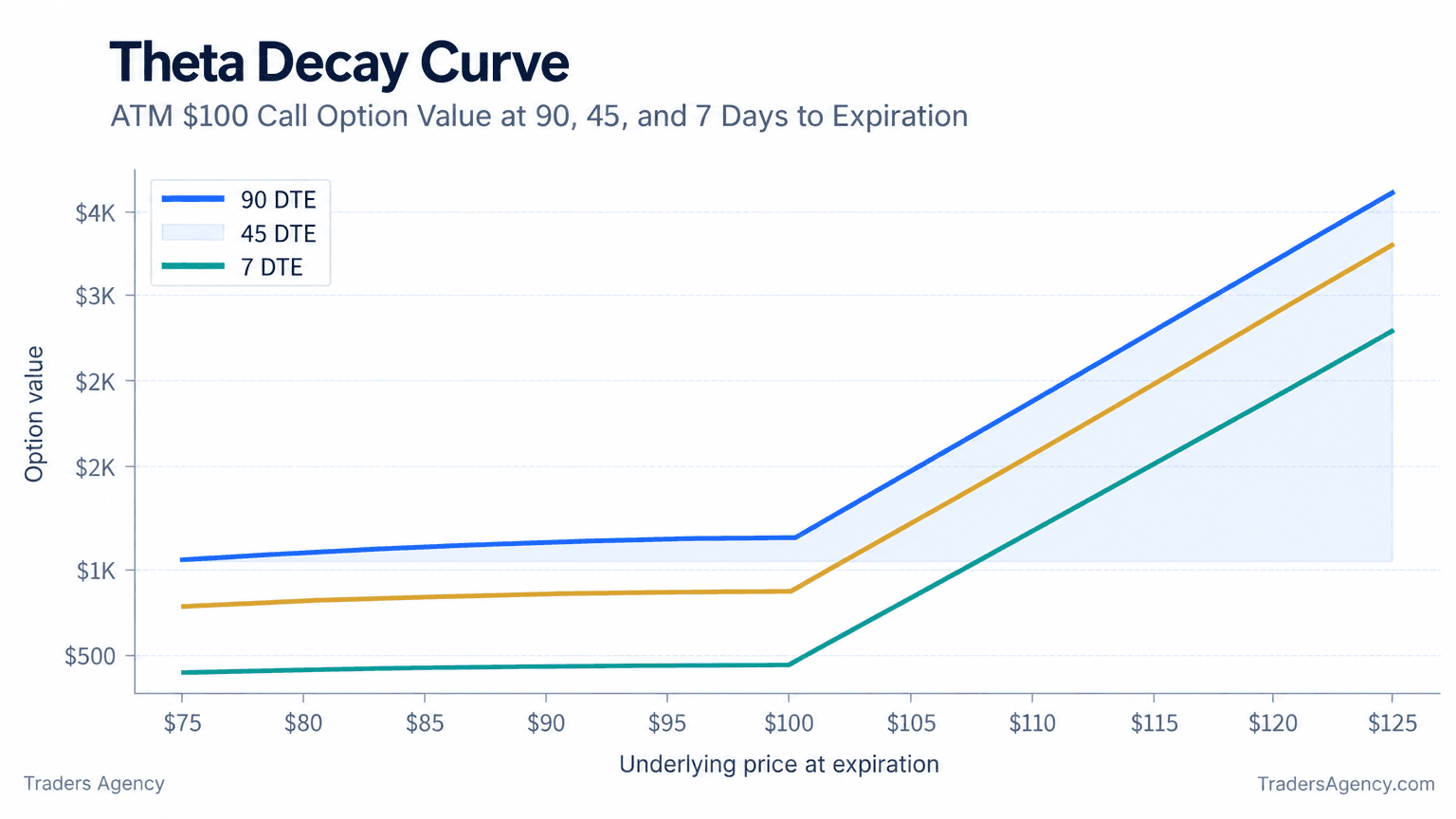
In the early weeks of an option's life, theta chips away slowly. In the final 7 to 14 days, that same option can lose more value in a single session than it lost over an entire week earlier in its life. This nonlinear curve is the single most important idea behind every theta-based strategy we teach.
Buyer vs. Seller: The Same Trade, Two Outcomes
Picture an at-the-money option priced at $4.00 with 30 days left. The stock does not move at all for the entire month. At expiration, that option is worth $0.
| Position | Entry | Value at Expiration | Result |
|---|---|---|---|
| Buyer | Paid $4.00 | $0.00 | -$400 per contract |
| Seller | Collected $4.00 | $0.00 | +$400 per contract |
The seller keeps the full $400, assuming the short position is held to expiration without early assignment.
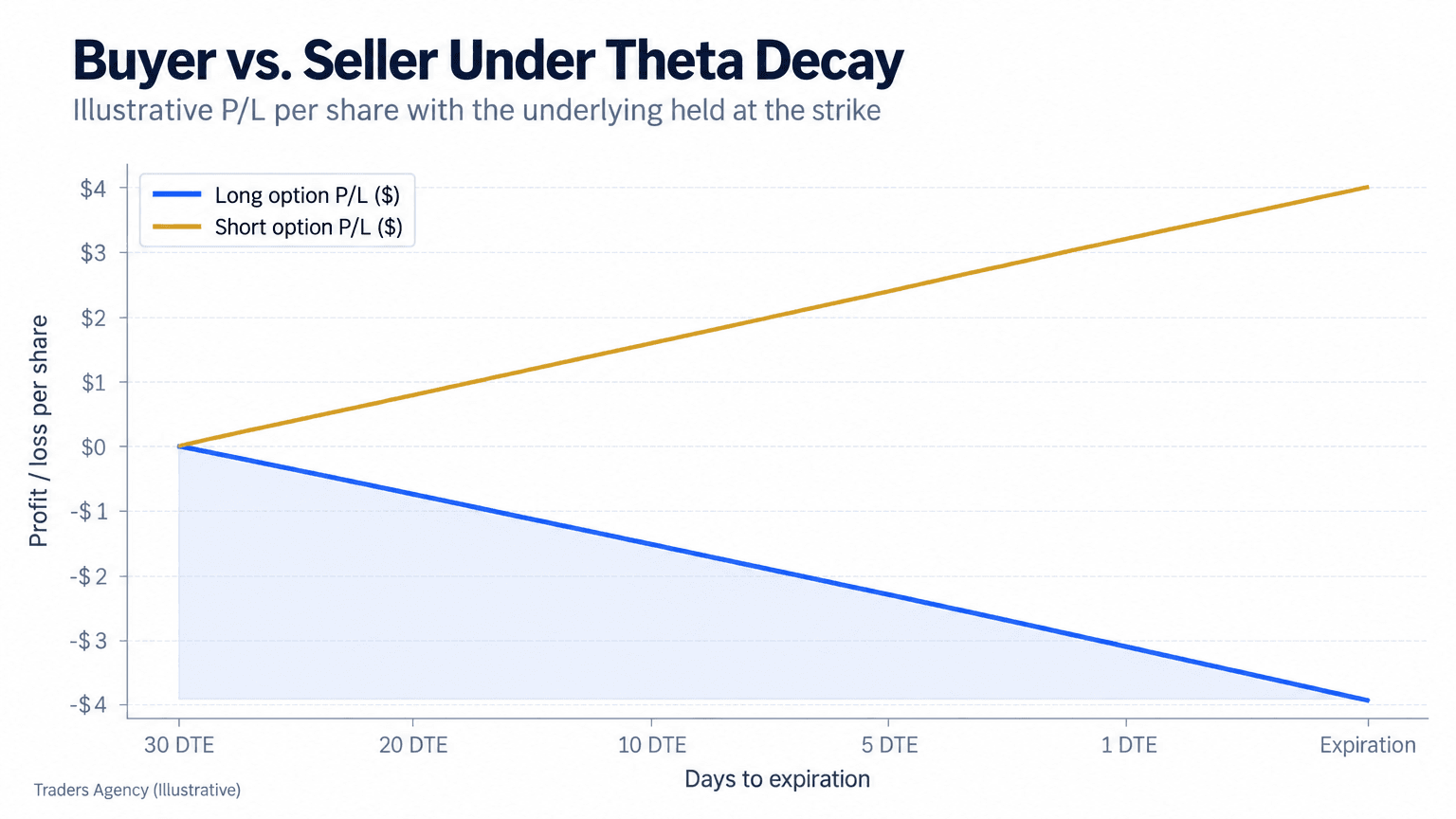
That mechanic is the engine behind most premium-selling strategies. If the stock stays roughly where it is, time alone pays the seller.
Want expert trading insights delivered daily?
Join thousands of traders who rely on Traders Agency for market analysis and trade ideas.
Join Traders AgencyWhen Is Theta Decay Highest?
Theta decay is highest for at-the-money options in the final 2 to 3 weeks before expiration. That is where the extrinsic value curve steepens the most, meaning the dollar amount lost per day accelerates sharply compared with earlier in the contract's life.
Far out-of-the-money and deep in-the-money options behave differently, simply because they carry less extrinsic value to begin with. Implied volatility matters too: a volatility spike can temporarily mask theta by inflating the option's price even while time value erodes underneath.
Knowing where that acceleration window sits helps you time entries. As sellers, we generally want to be in the position before the steep part of the curve begins, so we hold through the fastest decay rather than showing up late for it.
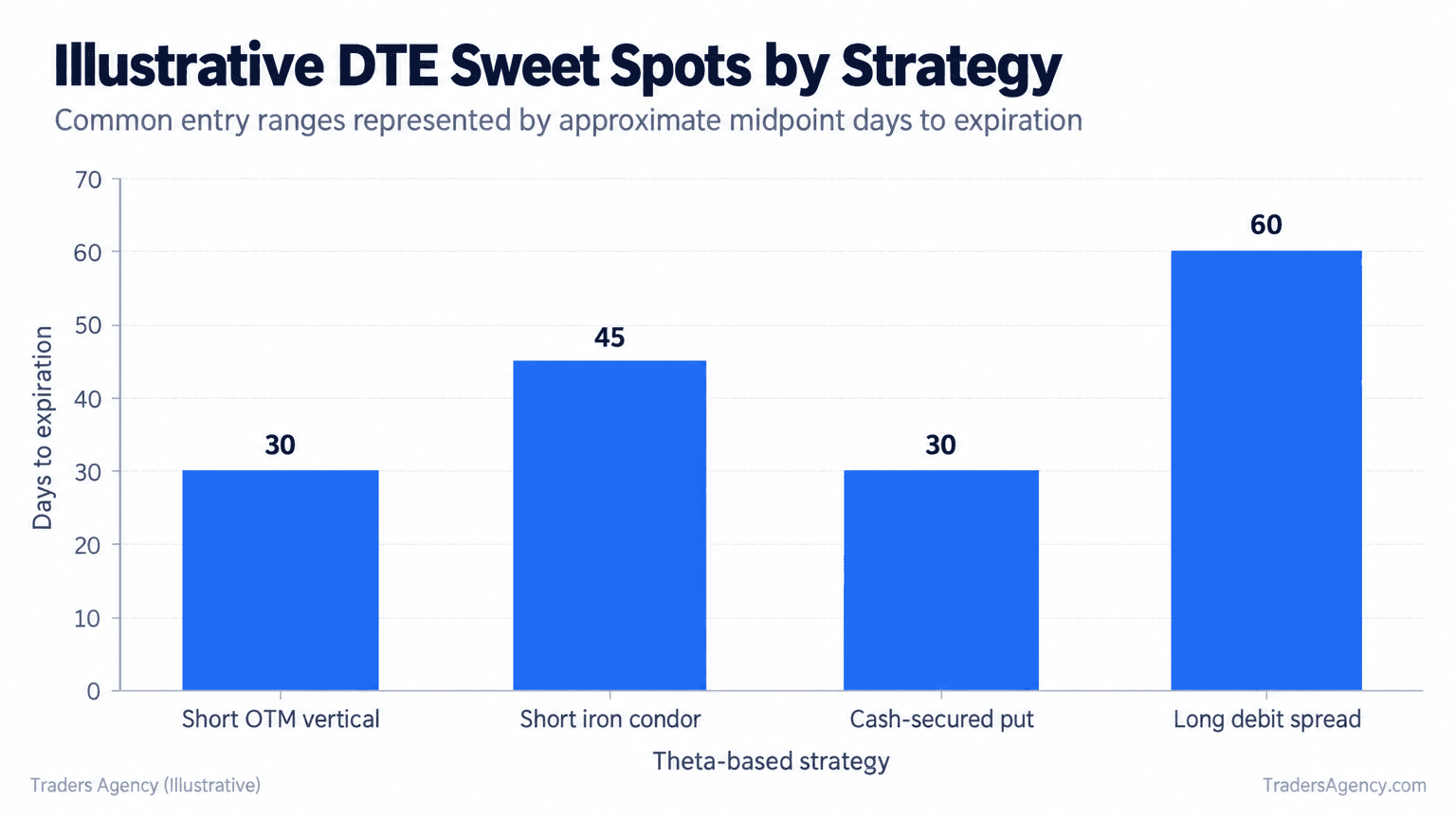
Here are the days-to-expiration (DTE) entry windows we use as general guidelines:
- Short vertical spreads: typically opened around 30 to 45 DTE
- Short iron condors: typically opened around 35 to 45 DTE
- Cash-secured puts: often opened around 30 to 45 DTE
- Long debit spreads: usually opened further out, 45 to 60 DTE, to reduce theta's drag on the long leg
What Are Two Theta-Based Strategies Worth Learning?
Strategy #1: Short Out-of-the-Money Vertical Spread
A short OTM vertical spread means selling one option and buying another further out-of-the-money in the same expiration. You collect premium, and the long leg caps your risk.
Here is how we would walk through the trade step by step:
- Step 1: Identify the setup Find a stock you expect to hold above a clear support level over the next month, with implied volatility elevated relative to its own recent range.
- Step 2: Choose the strikes With the stock at $50, sell the $45 put below support and buy the $40 put as protection, both in the same 35 DTE cycle.
- Step 3: Execute for a net credit Enter the spread as a single order so both legs fill together, never one at a time.
- Step 4: Manage the position Consider closing once you have captured a meaningful share of the credit, or exit if the stock breaks the level that defined your thesis.
| Parameter | Value |
|---|---|
| Stock Price | $50 |
| Put Sold | $45 strike for $1.20 |
| Put Bought | $40 strike for $0.40 |
| Days to Expiration | 35 |
| Net Credit | $0.80, or $80 per spread |
| Max Gain | $80, if the stock stays above $45 |
| Max Loss | $420 ($5 strike width minus the $0.80 credit, times 100) |
| Breakeven | $44.20 |
As long as the stock holds above $45, net time decay works in your favor, because the short $45 put carries more extrinsic value and decays faster than the long $40 put you own.
Strategy #2: Short Iron Condor
A short iron condor combines a short call spread and a short put spread on the same underlying and expiration. It pays when the stock stays inside a defined range.
| Parameter | Value |
|---|---|
| Stock Price | $100 |
| Days to Expiration | 40 |
| Call Spread | Sell $110 call at $1.50, buy $115 call at $0.60 |
| Put Spread | Sell $90 put at $1.40, buy $85 put at $0.55 |
| Net Credit | $1.75, or $175 per contract set |
| Max Gain | $175, if the stock finishes between $90 and $110 |
| Max Loss | $325 ($5 wing width minus the $1.75 credit, times 100) |
| Breakevens | $88.25 and $111.75 |
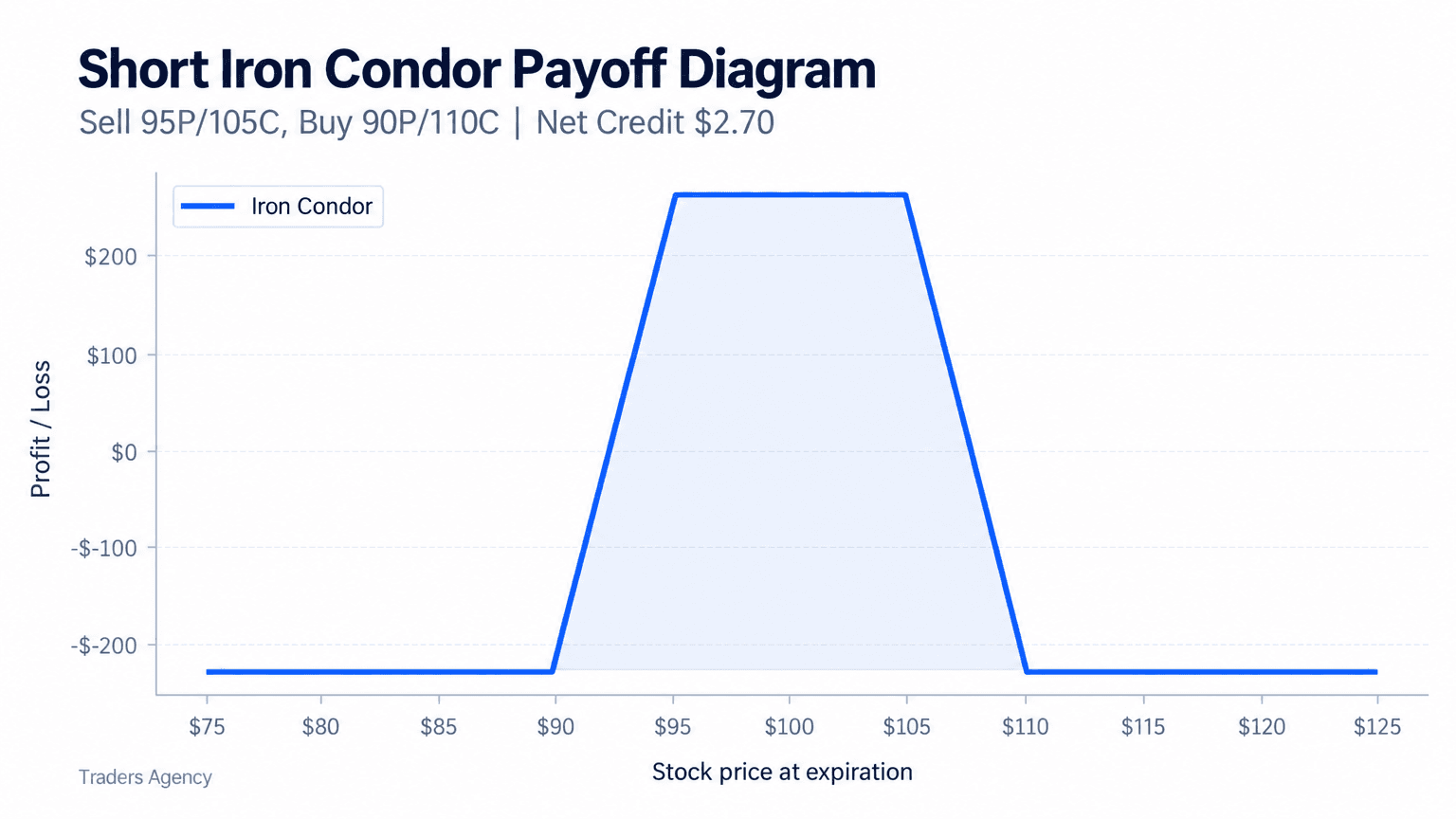
This structure is net theta positive because the two short strikes decay faster than the long wings that cap the risk, which is why iron condors are a favorite for range-bound markets.
How Do You Actually Make Money From Theta Decay?
You make money from theta by selling options or spreads and letting extrinsic value erode in your favor, provided the underlying stays inside your expected range. The seller's profit builds a little more each day the position is not challenged by price movement.
That is the mirror image of buying options outright, where every passing day costs you something.
When Should You Use Theta Decay Strategies, and When Should You Stay Out?
Theta-based strategies work best when you expect a stock to stay range-bound or move only modestly, and when implied volatility is elevated relative to its recent history. Selling premium into high volatility and then watching it contract gives you a second tailwind on top of theta.
They tend to underperform, or lose outright, around earnings announcements, major economic releases, and Federal Reserve policy decisions. Any event capable of producing a large directional move is a threat. One sharp gap can erase weeks of theta gains in a short spread.
Watch Out: Theta gains accumulate slowly and disappear quickly. A short premium position that has been working for three weeks can give back every dollar in a single session if the underlying gaps through your short strike.
Common Mistakes to Avoid
- Selling too close to expiration without a plan, then getting caught by a late move with no time left to adjust
- Ignoring vega, since a volatility spike can hurt a short premium position even while theta is technically working for you
- Oversizing because the premium looks small, when spreads and condors still carry very real max-loss numbers
- Holding through earnings without accounting for the volatility crush or expansion that can override theta's normal behavior
How Buyers Can Reduce Theta Drag
If you are buying options rather than selling them, you cannot eliminate theta, but you can blunt it. Three habits do most of the work:
- Buy longer-dated contracts so the daily decay bite is smaller relative to the premium paid
- Avoid holding through the final two weeks unless you have a strong, specific directional thesis
- Use debit spreads instead of naked long options so a short leg offsets part of the decay you are paying
Most broker platforms include a theta or time-decay projection tool. Use it before you enter so you know the daily cost of carrying the position instead of guessing at it.
Risk Management Basics
- Keep any single short premium position to a small share of total account size. Many traders cap capital at risk around 2% to 5% per trade.
- Favor defined-risk structures like spreads and condors over naked short options.
- Set an exit level based on a multiple of the credit received, such as closing when the loss reaches 2x the premium collected.
What Is the "Best" Theta for Options?
There is no single best theta number, because the right value depends on position size, account risk tolerance, and how the trade is structured. What we pay attention to instead is the relationship between theta and risk: theta relative to margin, or theta relative to max loss. Then we ask whether the decay rate actually matches how long we plan to hold the trade.
Remember This: A large theta number means nothing on its own. A position collecting $20 a day against $400 of max loss is a very different trade from one collecting $20 a day against $4,000 of max loss.
Want expert trading insights delivered daily?
Join thousands of traders who rely on Traders Agency for market analysis and trade ideas.
Join Traders AgencyDISCLAIMER: Traders Agency does not offer financial advice. The information provided is for educational purposes only and should not be considered financial advice. Traders Agency is not responsible for any financial losses or consequences resulting from the use of the information provided. Trading carries inherent risks and may not be suitable for all individuals. You are advised to conduct your own research and seek personalized advice before making any investment decisions, recognizing the potential risks and rewards involved.
See more from Traders Agency on Google
Make us a preferred source and our market analysis will appear more prominently in your Google Search, Top Stories, and AI results.
Add to Preferred Sources