
The U.S. Treasury is considering tapping its near-$950 billion General Account to fund an expanded bond buyback program. This potential shift sent yields lower on Monday. Our team is watching what could become a major change in government debt strategy, one that may alter the trajectory of long-term interest rates. The numbers tell a clear story about government liquidity, and here is what traders need to know right now about treasury general account bond buybacks.
What Caused Treasury Yields to Decline on Monday?
Treasury yields fell on Monday on news that the government might use its massive cash reserves to purchase off-the-run securities. The 10-year Treasury note yield dropped 4 basis points to 4.7%, while the 30-year yield lost 4 basis points to trade at 5.23%.
The Move: The 10-year yield dropped 4 bps to 4.7% and the 30-year fell 4 bps to 5.23% on news the Treasury could fund buybacks directly from its $950 billion General Account.
This price action directly reflects new expectations around government intervention. Treasury Secretary Scott Bessent recently unveiled an extended debt buyback program aimed at easing long-end yield curve pressure. Initially, the market expected these purchases to be funded through new short-term bill sales. Bessent labeled that approach a "Treasury Twist" last week.
Now, the potential use of the Treasury General Account provides an alternative funding source. The TGA currently holds roughly $950 billion, funded by existing tax collections. This massive balance completely dwarfs the $550 to $600 billion level the Biden administration originally aimed to maintain. Tapping this account could help counter analyst doubts about the program's scale.
How Could Treasury General Account Bond Buybacks Impact Markets?
The mechanics of these buybacks are expanding rapidly. Treasury officials recently announced they would at least double the per-operation buyback sizes for longer-dated securities. The ceiling is rising from $2 billion to at least $4 billion for 10-to-30-year securities.
These enlarged operations are scheduled to run from September 9 through November 4, 2026. Bessent stated that operations could even exceed the new $4 billion ceiling depending on market conditions. He framed the entire program as a liquidity measure for the 30-year sector.
Current projections place the next debt-ceiling bind between next winter and early spring. Officials indicated that a partial TGA drawdown does not create near-term cash management problems. This timeline could give the Treasury a reasonable window to restore the balance before any constraint bites.
What Happens When Treasury Yields Decline?
When Treasury yields decline, bond prices rise and borrowing costs typically fall across the broader economy. However, the current environment shows an unusual divergence where the U.S. dollar is dropping alongside falling yields. As Richard Reyle, chief investment officer at Questar Capital Partners, noted, the dollar dropping as yields rose "is abnormal."
Reyle connected this dynamic to artificial intelligence spending, which he said is increasingly dependent on debt. As yields fluctuate, the cost of funding that AI spend changes rapidly. "Interest rates may be the single most important thing in our economy right now," Reyle said.
Traders need to understand why treasury yields move up or down in this specific context. Yields and prices move inversely to one another. A basis point equals 0.01%. The 30-year yield last week hit levels not seen since 2007, showing how sensitive the market is to liquidity signals. We are closely monitoring how this intervention affects the broader equities market. Over the last 10 days, the SPY exchange-traded fund shows a price change of -1.37%.
Want expert trading insights delivered daily?
Join thousands of traders who rely on Traders Agency for market analysis and trade ideas.
Join Traders AgencyHow Could the Jackson Hole Fed Chair Speech Affect Trading?
Market attention now turns to the annual Jackson Hole Symposium this week. Traders are heavily focused on the upcoming speech from Federal Reserve Chair Kevin Warsh on Friday. The Treasury's intervention in the bond market significantly raises the stakes for Warsh's comments.
Sustained inflation pressures and the $40 trillion U.S. debt loom over the entire event. The market is looking for signals on how the central bank views the Treasury's liquidity measures. Warsh will speak following a raft of fresh economic data releases.
We are tracking two major data points hitting the wire this week. The July core PCE price index serves as the Fed's preferred inflation gauge. The second quarter GDP estimate will also provide a read on economic growth. These releases could strengthen the case for the Fed to continue holding rates steady or signal a shift in policy direction.
What Should Traders Watch Next in the Treasury Market?
The setup we see warrants careful monitoring of long-term bond ETFs and market sentiment indicators. The Fear & Greed index currently sits at 68, showing relatively positive sentiment despite the debt backdrop. WallStreetBets sentiment registers at 0.03 with 2,748 mentions.
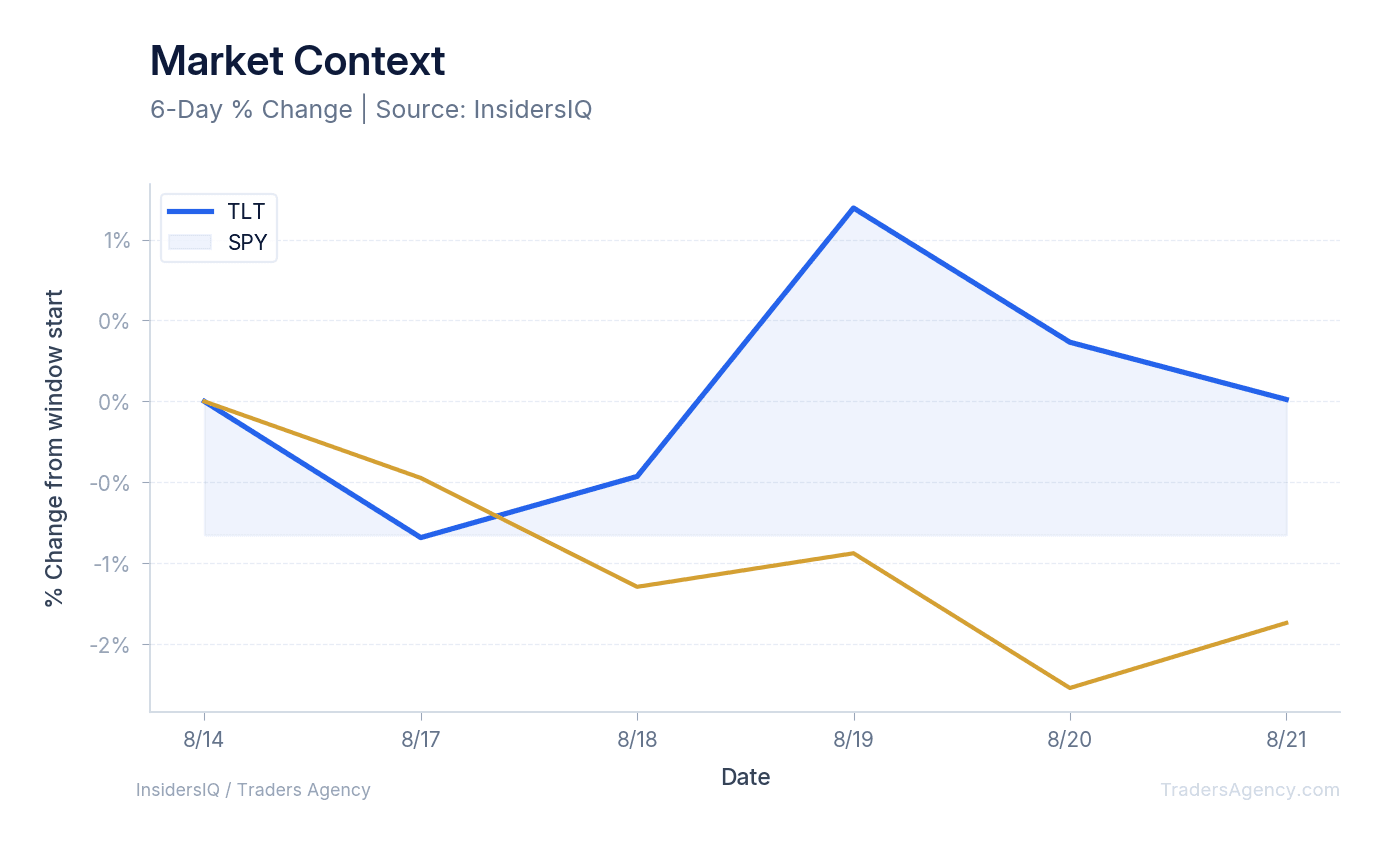
Our team is tracking the TLT ETF, which tracks long-term Treasury bonds. The TLT 10-day price change is currently +0.01%. This flat performance highlights the tension between the recent yield drop and the broader trend.
Key Tension: Despite yields falling 4 bps on Monday, TLT is essentially flat over 10 days (+0.01%), signaling the market has not yet fully priced in the buyback program's potential scale.
Here are the key factors we are monitoring:
- Buyback Execution: Watch the operations starting September 9, 2026. The scale of these purchases will test the Treasury's commitment to the $4 billion ceiling.
- TGA Balance: Track the $950 billion General Account. Any rapid depletion could signal aggressive intervention aimed at preventing a disorderly selloff in long-duration bonds.
- Foreign Holdings: Monitor international demand. While speculation persists about potential shifts in foreign Treasury holdings, the immediate focus remains on domestic Treasury actions.
- Yield Curve Action: Keep an eye on the 30-year yield at 5.23%. Further drops could confirm the effectiveness of the Treasury's liquidity measures.
The Bottom Line
The possibility of Treasury General Account-funded bond buybacks introduces a massive new variable for bond traders. The Treasury is actively deploying tools to manage the yield curve ahead of major economic data and Fed commentary. Our team is positioning for increased volatility in both bond yields and the U.S. dollar as these buyback operations potentially scale up this fall.
Want expert trading insights delivered daily?
Join thousands of traders who rely on Traders Agency for market analysis and trade ideas.
Join Traders AgencyKey Takeaways
- The 10-year Treasury yield dropped 4 basis points to 4.7% and the 30-year fell 4 basis points to 5.23% on Monday following reports the Treasury could fund bond buybacks directly from its General Account.
- The Treasury General Account currently holds roughly $950 billion, funded by existing tax collections, making it a potential alternative to issuing new short-term bills to finance buyback operations.
- Treasury Secretary Scott Bessent previously described a bill-funded buyback approach as a 'Treasury Twist,' but the possible shift to TGA funding changes the market's expected mechanics of the program.
- The buyback program is aimed at easing long-end yield curve pressure, with the 30-year yield at 5.23% flagged as a key level to watch for signs the liquidity measures are gaining traction.
- Bond traders should be prepared for the possibility of increased volatility in both yields and the U.S. dollar if TGA-funded buyback operations potentially scale up this fall, as the funding source introduces a significant new variable into debt market dynamics.
DISCLAIMER: Traders Agency does not offer financial advice. The information provided is for educational purposes only and should not be considered financial advice. Traders Agency is not responsible for any financial losses or consequences resulting from the use of the information provided. Trading carries inherent risks and may not be suitable for all individuals. You are advised to conduct your own research and seek personalized advice before making any investment decisions, recognizing the potential risks and rewards involved.
See more from Traders Agency on Google
Make us a preferred source and our market analysis will appear more prominently in your Google Search, Top Stories, and AI results.
Add to Preferred Sources