
Producer prices climbed 1.3% in September from August and 6.3% from a year earlier, the Bureau of Labor Statistics reported, marking the sharpest monthly increase since March 2022 and the highest annual rate since December 2022, according to CNBC and CNN. The data landed a day after a hotter-than-expected consumer price index reading, intensifying questions about whether the Federal Reserve can hold the line on interest rates.
Producer prices blow past forecasts
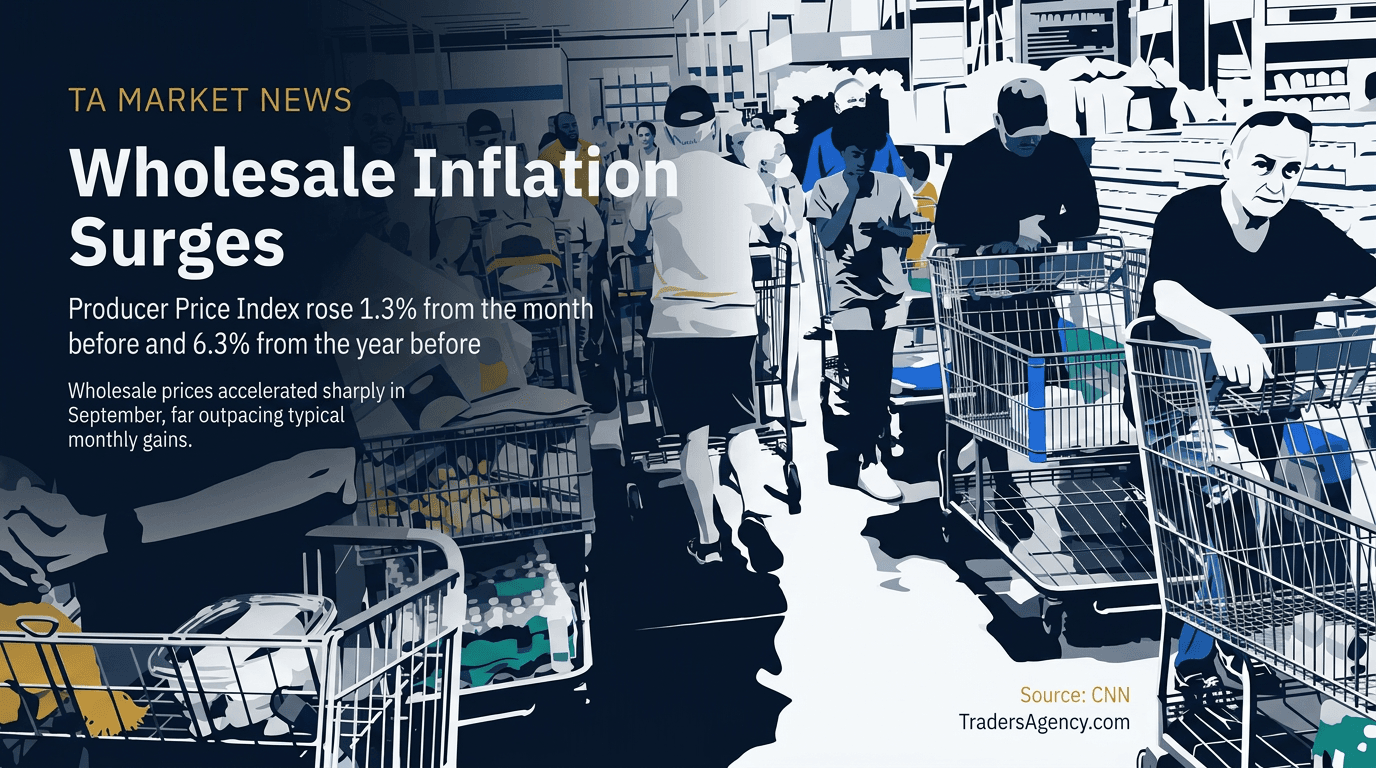
Both the monthly and annual PPI figures topped Wall Street's expectations by a wide margin. Economists polled by Dow Jones had forecast a 0.6% monthly gain and a 5.5% annual rate, according to CNBC, while FactSet-surveyed economists projected 0.5% and 5.3%, respectively, according to CNN. The actual 6.3% annual print came in 0.8 percentage point above the Dow Jones consensus and 1.0 percentage point above the FactSet figure (6.3 minus 5.5 and 6.3 minus 5.3, our calculation), underscoring how far inflation pressure outran forecasts.
September's reading was also a sharp acceleration from August, when wholesale prices rose a more modest 0.5% on the month and 5.6% annually, per CNN.
Core PPI hits highest level since early 2023
Core PPI, which strips out volatile food and energy prices, rose 0.7% on the month and 5% over the trailing 12 months, according to CNBC and CNN. CNN reported that the monthly gain was the fastest in five months and that the annual rate was the highest since January 2023. Because core PPI measures underlying price pressure further removed from swings in oil and food, its acceleration suggests — our interpretation of the reported figures — that the inflation pickup was not confined to a single volatile category.
Energy and the Iran war drove the headline move
Energy prices accounted for 80% of a 2.9% jump in goods prices during September, CNN reported, citing BLS data. That goods increase was described as the largest monthly rise in records dating back to 2009. CNN tied the energy surge to geopolitical conflicts including the war with Iran, while CNBC attributed it to a Middle East conflict that curtailed oil supply and sent prices surging. The BLS further said in its release that almost half of September's increase in processed goods for immediate demand was tied to higher diesel fuel prices, a sign that energy costs were working their way into other parts of the supply chain, per CNBC.
How this connects to the Fed's inflation gauge
Some components of the PPI feed directly into the Personal Consumption Expenditures price index, which is the inflation measure the Federal Reserve uses for its 2% target, CNN reported.
The wholesale inflation report followed Wednesday's consumer price index, which showed prices rising 0.6% on the month and 3.7% annually, against Dow Jones forecasts of 0.6% and 3.6%, according to CNBC. Core CPI, excluding food and energy, rose 0.3% monthly and 2.6% annually, versus expectations of 0.2% and 2.5%. CNN described the CPI report as evidence that inflationary pressures were broadening even before the PPI data arrived.
Rate-hike odds shift sharply
The back-to-back inflation surprises moved market pricing on the Fed's next move. Traders were pricing in a nearly 34% chance of a rate hike at the central bank's meeting later in October, up from under 18% a week earlier, according to CME's FedWatch tool as cited by CNBC. That implies an increase of at least 16 percentage points in a single week (34 minus 18, our calculation), since the earlier reading was below 18%.
Chris Zaccarelli, investing chief at Northlight Asset Management, said, "With a second day in a row of higher-than-expected inflation numbers, it seems the Fed will have no choice but to raise rates again this year," according to CNBC.
Separately, Wednesday's Federal Reserve Beige Book contained the highest number of inflation-related mentions on record, based on an analysis from Bespoke Investment Group cited by CNBC, adding another data point to the narrative that price pressures are broadening across the economy.
Retail sales and market reaction
The PPI report was released alongside September retail sales data, which rose 0.8%, above the 0.4% economists had expected, but a slowdown from August's 1.3% gain, according to CNBC and CNN. Excluding autos and gas stations, sales rose about 0.25%, down from roughly 1.1% the prior month, per CNBC. CNN noted that retail sales figures are adjusted for seasonality but not inflation, meaning the 0.6% monthly rise in consumer prices left real spending close to flat.
Stock futures were mixed after the releases. Dow futures held gains of 0.3%, while S&P 500 and Nasdaq 100 futures slipped 0.3% and 1.2%, respectively, CNN reported.
What analysts are watching
Seeking Alpha Market News reported that business input costs are rising across categories and that some of those increases are expected to be passed on to consumers, which it said would likely keep consumer inflation elevated. That is an attributed expectation rather than a confirmed outcome, and it echoes the diesel-driven pass-through the BLS flagged in its own release, per CNBC.
Both CNN and CNBC pointed out that the reports arrived just weeks before the U.S. midterm elections, where affordability is expected to weigh heavily on voters.
Bottom Line
September's producer price data confirmed that wholesale inflation accelerated well beyond what economists had forecast, with energy costs tied to the Iran war doing much of the work alongside a broader pickup in core prices. Combined with Wednesday's hotter CPI report, the numbers were enough to meaningfully shift fed funds futures pricing toward a possible October rate hike, though that remains a market-implied probability rather than a Fed decision. Whether the price pressure proves durable will likely hinge on how much of the diesel and energy-driven cost increases businesses continue to pass through to consumers in the months ahead.
DISCLAIMER: Traders Agency does not offer financial advice. The information provided is for educational purposes only and should not be considered financial advice. Traders Agency is not responsible for any financial losses or consequences resulting from the use of the information provided. Trading carries inherent risks and may not be suitable for all individuals. You are advised to conduct your own research and seek personalized advice before making any investment decisions, recognizing the potential risks and rewards involved.
- CNBC Top News: September producer price index, retail sales data · accessed Oct 15, 2026
- CNN: Wholesale inflation surged in September, keeping affordability in focus ahead of the midterms · accessed Oct 15, 2026
- Seeking Alpha Market News: PPI inflation sees biggest monthly advance since March 2022 in September · accessed Oct 15, 2026
See more from Traders Agency on Google
Make us a preferred source and our market analysis will appear more prominently in your Google Search, Top Stories, and AI results.
Add to Preferred Sources