A senior Federal Reserve official is increasingly framing inflation risk not as a story about wages and job openings, but as a story about oil markets and artificial intelligence investment. In remarks delivered this week, Fed Vice Chair for Supervision Michelle Bowman said she is watching both energy prices tied to the ongoing U.S.-Iran standoff and the economic effects of the AI investment boom as the two forces most likely to shape the path of interest rates from here.
A Federal Reserve Focused on Two Supply-Side Forces
Bowman's remarks, delivered at the Council on Foreign Relations, framed the Fed's inflation problem as largely a matter of factors sitting outside the usual tug-of-war between hiring and wages. She said she is "monitoring expectations about AI and energy prices" as the two issues most relevant to the central bank's dual mandate right now.
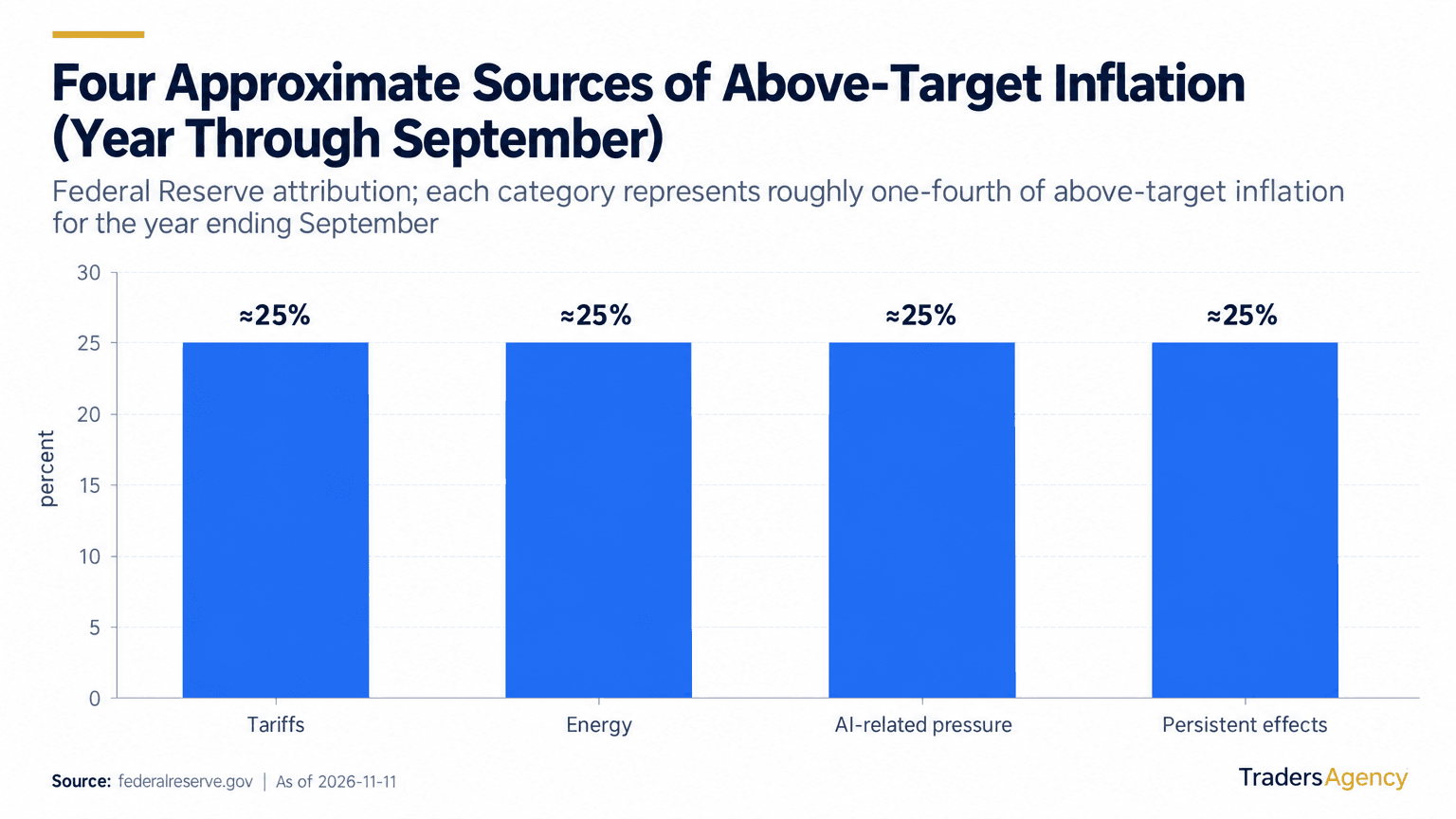
To make that concrete, Bowman offered an informal breakdown of the inflation that has run above the Fed's 2% target over the year through September. In her accounting, roughly a quarter of that excess came from tariffs, another quarter from energy prices tied largely to the Iran conflict, a further quarter from AI-related cost pressures, and the remainder from lingering effects of earlier shocks. She separately offered an estimate, built on recent CPI data rather than an official release, that core PCE inflation could come in near 3.3% once October figures are published.
That framing matters for investors because two of those four categories, tariffs and energy, are things Bowman explicitly said should "wane" or "unwind" if conditions change, namely if trade frictions ease and the Middle East conflict resolves. The other two, AI-related pressures and the residual effects of earlier shocks, are less tied to any single policy decision and could persist longer regardless of what happens with trade or geopolitics.
Why an Iran Deal Still Matters to the Path of Rates
Markets have been pricing in additional Fed rate increases in the months ahead, reflecting expectations that Bowman's conditional scenario for lower inflation, a resolved Iran conflict feeding through to softer energy prices, is not close to playing out. According to a report from Axios describing a closed-door G7 session, Secretary of State Marco Rubio told foreign ministers that the administration views continuing economic pressure on Iran as a distinct "third option," separate from either accepting what it considers an unfavorable deal or returning to open conflict, with no stated deadline attached.
Prediction-market pricing on platforms such as Kalshi has reflected that lack of urgency. Contracts tied to a U.S.-Iran nuclear agreement implied only a modest chance, in the mid-teens percentage range, of a deal being reached before March 2027, based on pricing cited around the time of this analysis. It is worth remembering that prediction-market odds reflect trader sentiment and positioning, not an official probability of what Washington or Tehran will actually do.
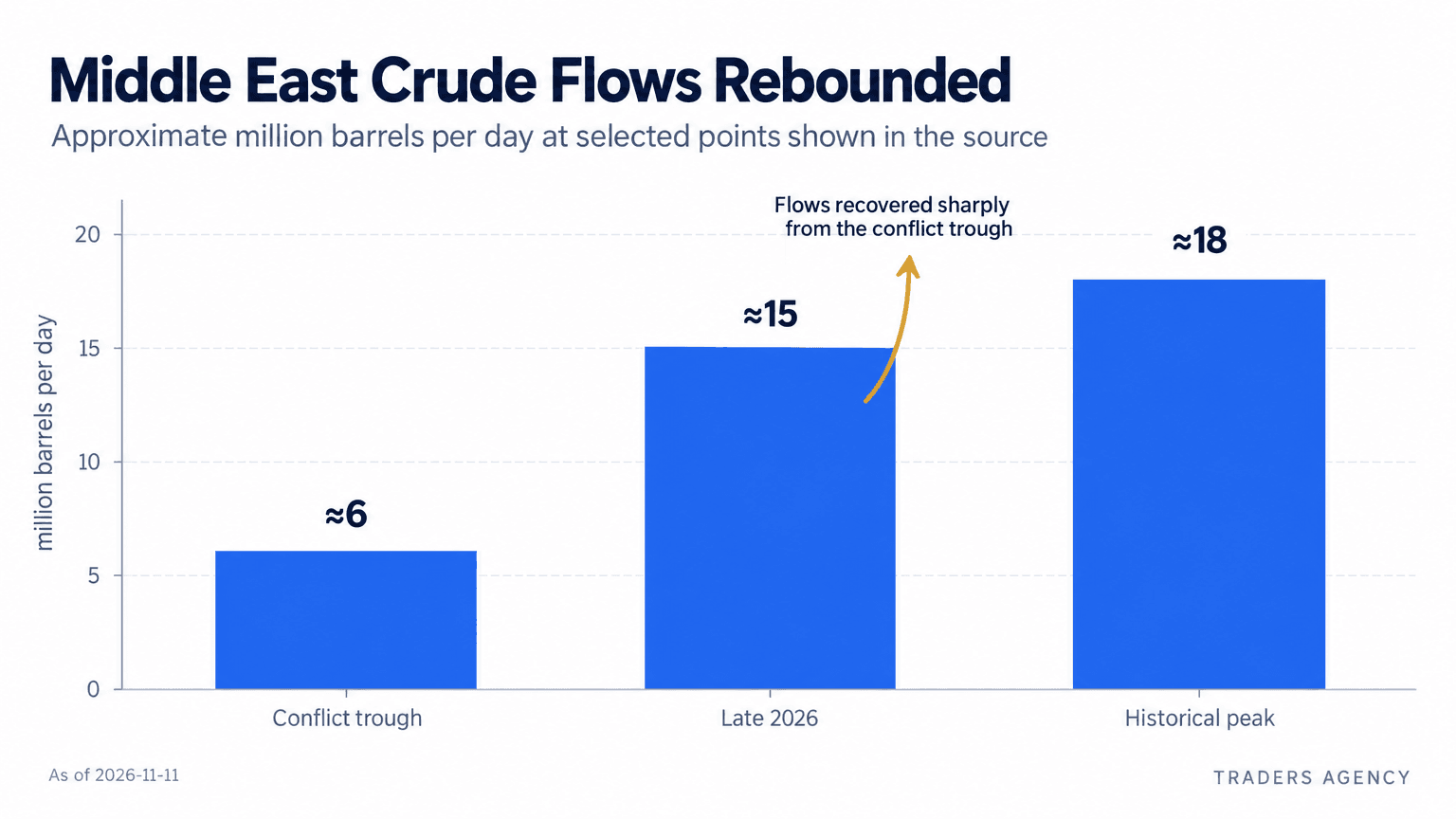
According to commentary cited in the source reporting, including an account attributed to a professor at the University of Tehran, Iran's economy has shown significant strain from sanctions and disrupted trade routes, and Iranian officials have reportedly sought an end to the conflict, sanctions relief and continued rights to its nuclear program, conditions the U.S. has shown little appetite to meet. Meanwhile, oil prices have pulled back meaningfully from highs reached earlier this year, a retreat some market commentary attributes to improving physical supply rather than diplomatic progress. Traders Agency analysts are watching whether that supply recovery continues even without a deal, since Bowman's own framework suggests the Fed would welcome either outcome, a diplomatic resolution or simply more oil reaching the market, as a disinflationary development.
Want expert trading insights delivered daily?
Join thousands of traders who rely on Traders Agency for market analysis and trade ideas.
Join Traders AgencyThe Labor Market Buys the Fed Some Room, For Now
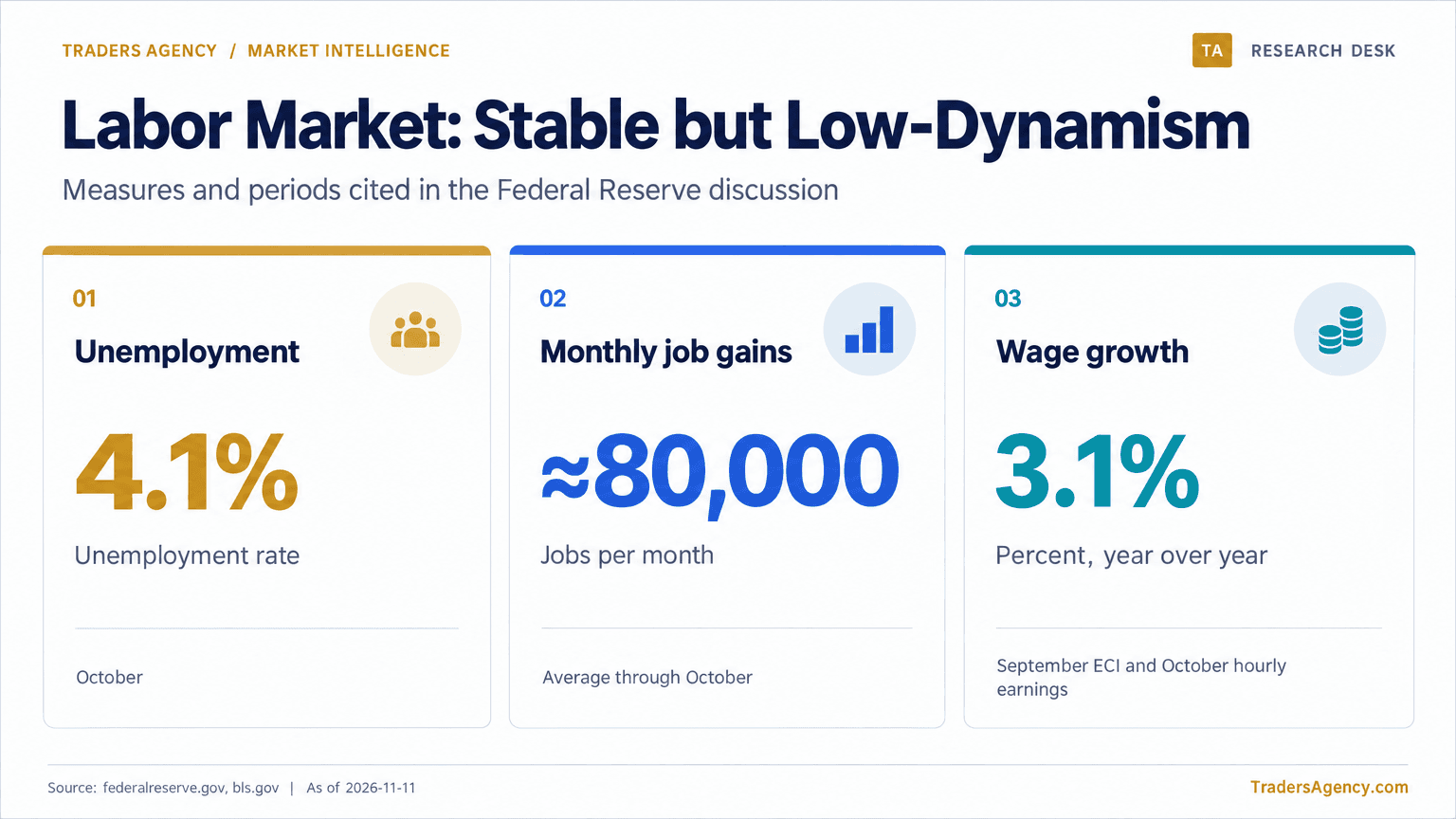
Bowman's remarks also touched on the labor side of the ledger, and the picture there is more reassuring, at least for the moment. She cited an unemployment rate of 4.1% in October, average monthly job gains of roughly 80,000 through the month, and wage growth near 3.1% on two separate measures. Layoffs have stayed low even as hiring has cooled, a combination that gives the Fed some latitude to keep its attention on inflation rather than employment.
That latitude comes with a caveat. Bowman described a downside scenario in which disappointing returns on AI investment trigger a sizable correction in equity valuations, weakening consumer spending through the so-called wealth effect and adding pressure to interest-rate-sensitive sectors such as housing and small-business investment. In other words, the labor market's current stability does not fully insulate the economy if the AI trade sours in financial markets, even without job losses showing up first.
The AI Wildcard: Productivity Boost or Financing Risk
The AI boom cuts both ways in the Fed's thinking. Bowman said that over time, broader AI adoption should raise productivity and put downward pressure on inflation by lowering production costs. But she also warned that sustained AI-related supply-chain pressure, strained data-center components, power constraints and specialized labor, could have the opposite effect in the near term.
Financial markets have already been recalibrating around AI-related risk. Some reports suggest hedge funds have meaningfully trimmed their AI exposure this year, though the precise scope of that shift is difficult to confirm from publicly available data. A sharp rebound in several AI-and-semiconductor-linked stocks following a recent selloff has been cited as evidence that investors remain willing to buy into the theme on dips, even as positioning data point to caution elsewhere.
Financing structures within the AI buildout have also drawn scrutiny. CoreWeave, a cloud-computing company closely tied to AI infrastructure demand, indicated it does not plan to issue additional unsecured debt at the parent level at current market yields through 2027. Instead, the company said it expects to lean on contract-backed delayed-draw term loan facilities, supported by its relationships with investment-grade and enterprise customers, to fund continued growth. That is a meaningfully different financing posture than borrowing fresh unsecured debt at today's elevated rates, and it suggests at least some AI infrastructure players are finding alternative routes to capital rather than relying on public credit markets.
Separately, reports of strong demand for recent private AI funding rounds, including interest in Anthropic's latest raise, have been cited as evidence that investor appetite for AI exposure remains intact at the private-company level even as public markets have grown more selective. Bowman herself framed the current tightening in financial conditions as a reasonably healthy development, a sign that markets are being more discerning about AI-related risk rather than reacting with broad panic.
What It Means for Investors
Put together, the Fed's own framing suggests its next moves hinge less on the traditional jobs report and more on two developments largely outside its control: whether energy prices ease, which depends on diplomatic progress with Iran that currently looks distant, and whether the AI investment cycle continues to deliver on its productivity promise rather than becoming a source of financial strain. Both scenarios point toward lower inflation if they resolve favorably, and both carry real downside if they do not. For now, a stable but low-dynamism labor market gives the Fed room to watch and wait, but investors should expect interest-rate expectations to keep moving with headlines about Iran negotiations and AI earnings just as much as with conventional labor-market data.
Want expert trading insights delivered daily?
Join thousands of traders who rely on Traders Agency for market analysis and trade ideas.
Join Traders AgencyDISCLAIMER: Traders Agency does not offer financial advice. The information provided is for educational purposes only and should not be considered financial advice. Traders Agency is not responsible for any financial losses or consequences resulting from the use of the information provided. Trading carries inherent risks and may not be suitable for all individuals. You are advised to conduct your own research and seek personalized advice before making any investment decisions, recognizing the potential risks and rewards involved.
- Global Markets Monitor — November 11, 2026
- The U.S. Economy and Considerations for Monetary Policy
- Trump swung between war and diplomacy — then chose a third way
- Before Mar 1, 2027: Will the US agree to a new Iranian nuclear deal this year?
- Iran's Ghalibaf links Hormuz reopening to seven conditions
- The Employment Situation — October 2026
- Lessons from a miserable month for hedge funds
- CoreWeave Third Quarter 2026 Earnings Call Transcript
- How major US stock indexes fared Wednesday 11/11/2026
- Anthropic IPO Prospectus
- Anthropic and OpenAI's revenue chasm, explained
See more from Traders Agency on Google
Make us a preferred source and our market analysis will appear more prominently in your Google Search, Top Stories, and AI results.
Add to Preferred Sources