A newly filed securities class action against Nvidia and CEO Jensen Huang has reignited questions about export-control compliance, corporate disclosures and executive accountability, even as the chipmaker's underlying financial performance continues to impress Wall Street. The case, tied to allegations involving a company called Megaspeed and a woman identified in reporting as Alice Huang, raises serious legal and reputational questions. But proving the kind of investor harm required under federal securities law is a different and much harder task than simply alleging wrongdoing.
A Securities Class Action Targets Nvidia and Jensen Huang
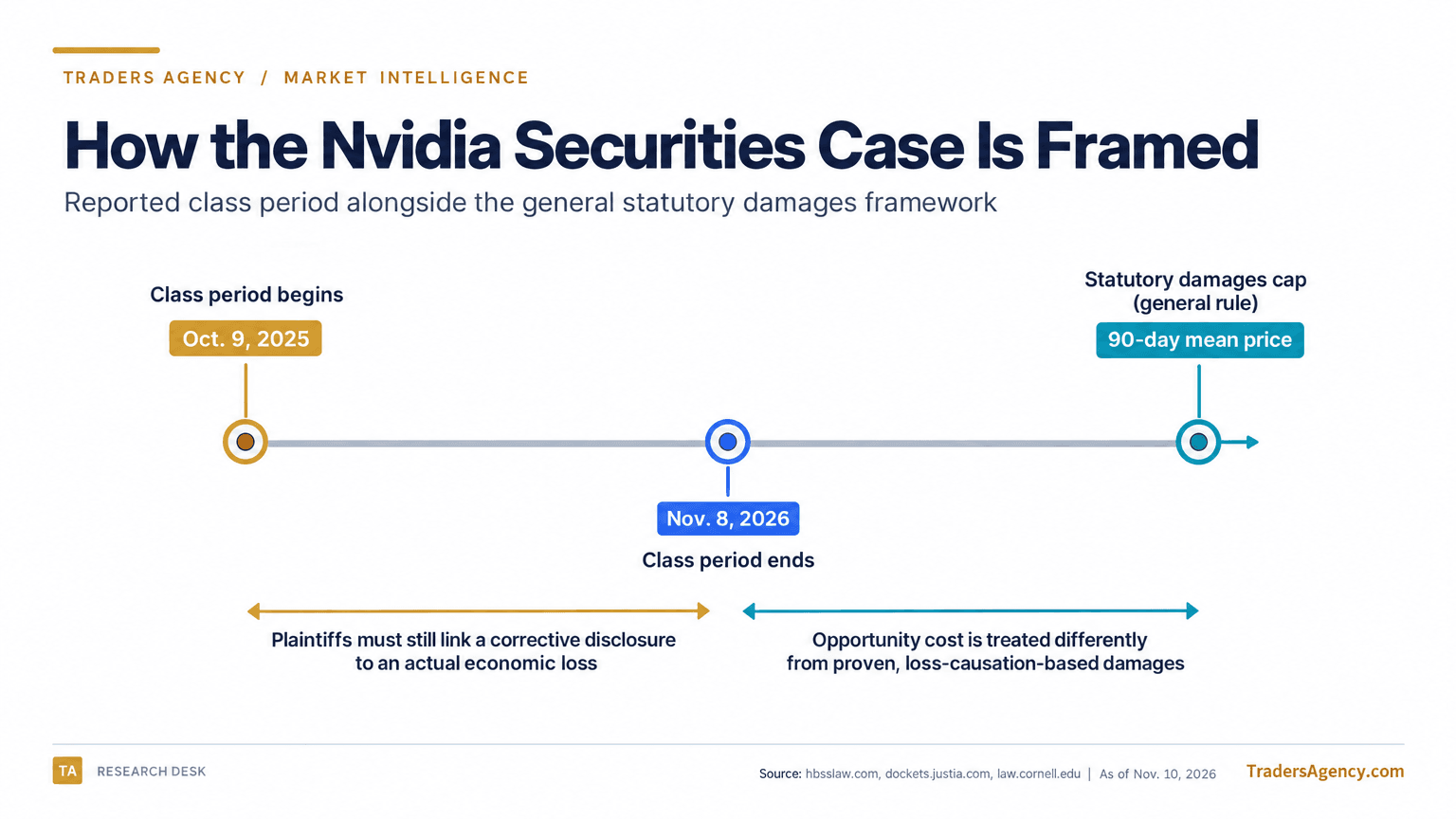
According to court filings, a federal securities class action was lodged against Nvidia and Jensen Huang asserting claims under Sections 10(b) and 20(a) of the Securities Exchange Act. The complaint proposes a class period running from October 9, 2025 through November 8, 2026, a window that spans roughly 395 to 396 days depending on how the endpoints are counted.
The core allegation is that Nvidia misled investors about its compliance with export controls meant to keep advanced chips out of China, and about relationships connected to Megaspeed, a cloud-services customer, and to Alice Huang. The complaint cites, among other things, a social anecdote in which Alice allegedly bet she could get Jensen Huang to appear at a gathering, after which he reportedly showed up at a bar with a group that included other Nvidia executives. Plaintiffs' lawyers argue that a routine company statement about executives occasionally greeting customers at events became materially misleading in light of this personal connection.
That is a significant legal reach. Turning a casual social appearance into an actionable false statement requires showing that the original statement was itself misleading and that investors relied on it to their detriment, not simply that an awkward personal relationship existed alongside ordinary corporate messaging.
Commerce Department Scrutiny Raises Unanswered Questions
Separately, reporting by The New York Times described a months-long Commerce Department investigation into Megaspeed that was reportedly halted and later transferred to the Justice Department in late 2025. The reported chronology involves Nvidia's general counsel, Tim Teter, who is said to have contacted Commerce officials and invoked permission from Jeffrey Kessler, the Commerce under secretary who oversaw the Bureau of Industry and Security, before the inquiry shifted away from Commerce.
It is important to be precise about what this sequence does and does not show. A government inquiry changing hands between agencies is not, by itself, evidence of favoritism or improper influence. There is no public evidence of insider trading or that any official intervened improperly on Nvidia's behalf. What the reporting does raise is a legitimate question about the circumstances surrounding the handoff, one that will likely draw continued scrutiny from journalists and possibly lawmakers as the Justice Department's review proceeds.
Megaspeed, Export Controls and Nvidia's Response
Nvidia has publicly addressed the underlying diversion concerns. In a December 2025 statement, the company said repeated facility visits found no evidence that chips were being redirected and confirmed the GPUs were located where expected. That is a company denial following an internal review, not a government enforcement finding, and the two should not be conflated.
On the regulatory question itself, U.S. export guidance emphasizes customer screening and attention to diversion red flags, but it does not impose a blanket requirement that chipmakers physically track every unit after sale. At the same time, that guidance does not automatically render a transaction lawful simply because a buyer operates an overseas cloud service; destination, ownership, end-user and licensing restrictions still matter. Megaspeed was reportedly designated a cloud service provider permitted under export rules, and if it leased capacity to Chinese customers rather than shipping hardware directly, that structure could fall within permitted channels. Whether it actually did so in every instance is precisely the kind of factual question regulators and, potentially, courts will need to sort out.
Want expert trading insights delivered daily?
Join thousands of traders who rely on Traders Agency for market analysis and trade ideas.
Join Traders AgencyWhat the Lawsuit Must Prove, and What Damages Could Look Like
Winning a Section 10(b) claim requires far more than showing a stock dropped after bad news. Plaintiffs must establish a material misstatement or omission, intent to deceive, a connection to an actual purchase or sale of securities, reliance, and crucially, that a specific corrective disclosure caused an economic loss. Courts have been clear that simply overpaying for a stock is not sufficient; there must be a demonstrable link between the alleged misrepresentation, a later disclosure, and a drop in price.
Federal securities law also caps market-price-based damages using a formula tied to the difference between the purchase price and the average trading price during a defined period after corrective information becomes public. That is a damages ceiling, not a formula guaranteeing a payout, and how it would apply here remains unresolved.
History offers useful context for sizing worst-case outcomes. Enron's settlement reached $7.2 billion, WorldCom's hit $6.1 billion, Tyco settled for $3.2 billion and Bank of America paid $2.4 billion, figures from some of the largest securities fraud cases on record. But those are outliers. Cornerstone Research found the median securities class-action settlement in 2025 was closer to $17.3 million, with plaintiffs' attorneys often taking roughly 30 percent of any recovery. Most cases of this type settle rather than go to trial, and the vast majority never approach Enron-scale numbers.
Leadership Uncertainty: What Prediction Markets Suggest
Beyond the courtroom, investors are also weighing whether the controversy threatens Jensen Huang's position at Nvidia. Prediction-market contracts on Kalshi have implied relatively low odds of Huang departing in the near term, with the implied probability rising meaningfully over longer multi-year horizons. These figures reflect market sentiment at a given moment rather than inside knowledge of Nvidia's board intentions, and such odds can shift quickly as new information emerges. Traders Agency analysts will be watching Nvidia's upcoming quarterly earnings call for any direct comment on leadership continuity, which could meaningfully move sentiment in either direction.
Nvidia's Fundamentals Tell a Different Story
Set against the legal uncertainty, Nvidia's reported operating performance remains extraordinary. The company's quarter ended July 26, 2026 showed $96.2 billion in revenue, $63.7 billion in operating income and $59.7 billion in net income, a net margin of roughly 62 percent. Six-month operating cash flow reached $74.4 billion, figures that leave little doubt about the company's current cash-generating capacity.
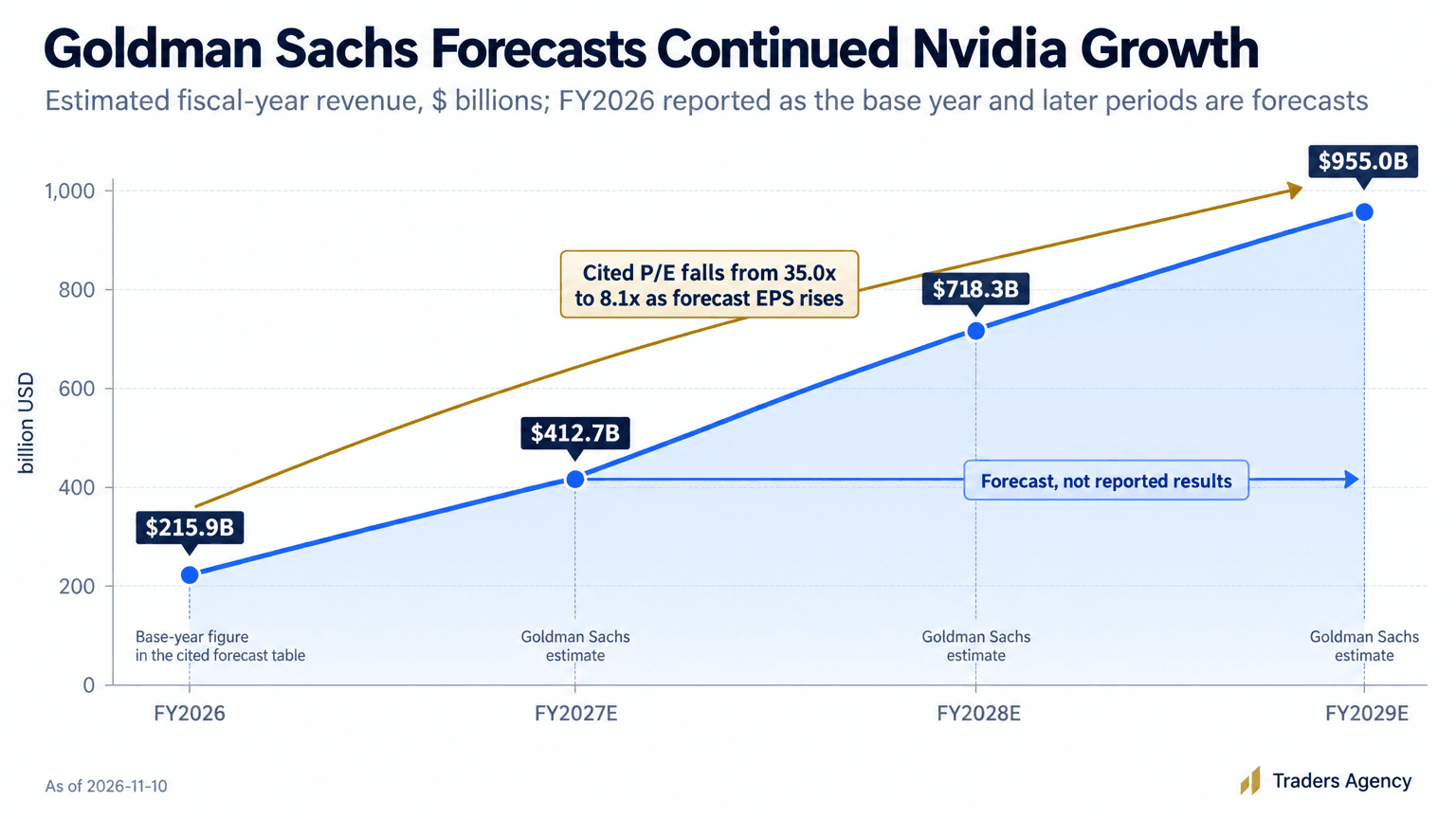
Goldman Sachs estimates project continued expansion, with forecast revenue climbing from about $215.9 billion in fiscal 2026 to roughly $955 billion by fiscal 2029, alongside a forward price-to-earnings multiple that compresses from 35 times down to around 8 times as projected earnings grow. These are forecasts built on assumptions about sustained data-center demand, not reported results, and they carry the usual risks of execution, competition and customer concentration. If even directionally accurate, though, they suggest the scale of Nvidia's core business could dwarf the direct financial exposure from a securities settlement, even a sizable one.
AMD as an Alternative Data-Center Bet
Some investors looking for data-center exposure without Nvidia-specific legal and leadership overhangs have turned attention toward AMD. The comparison remains largely qualitative since there is no consistent, period-matched operating data placing the two companies side by side in this context, but the logic is straightforward: as hyperscalers continue building AI infrastructure, a credible alternative supplier benefits from any hesitation around Nvidia, regardless of how the underlying legal questions ultimately resolve.
The Bottom Line
Nvidia enters this period facing a genuine convergence of legal, regulatory and reputational questions that deserve careful, ongoing scrutiny rather than dismissal. At the same time, the gap between headline-grabbing allegations and a provable securities claim is wide, and historical settlement patterns suggest even an adverse outcome would likely represent a small fraction of Nvidia's quarterly profit rather than an existential threat. For investors, the more consequential variables may ultimately be the Justice Department's ongoing review, any statements Huang makes about his own tenure, and whether Nvidia's next earnings report keeps pace with the growth assumptions baked into Wall Street's bullish forecasts.
Want expert trading insights delivered daily?
Join thousands of traders who rely on Traders Agency for market analysis and trade ideas.
Join Traders AgencyDISCLAIMER: Traders Agency does not offer financial advice. The information provided is for educational purposes only and should not be considered financial advice. Traders Agency is not responsible for any financial losses or consequences resulting from the use of the information provided. Trading carries inherent risks and may not be suitable for all individuals. You are advised to conduct your own research and seek personalized advice before making any investment decisions, recognizing the potential risks and rewards involved.
- Kistenmacher v. NVIDIA Corporation — Complaint
- Kistenmacher v. NVIDIA Corporation et al — Docket
- Dura Pharmaceuticals, Inc. v. Broudo
- 15 U.S.C. § 78u-4 — Private securities litigation
- CNA: Times reports Commerce Megaspeed inquiry transferred to Justice
- March 20, 2026 letter concerning advanced-chip export controls
- Culper Research — NVIDIA report, May 13, 2026
- PC Gamer — Jensen Huang affair and Megaspeed allegations
- Tom's Hardware — Megaspeed and U.S. AI export controls
- BIS — Industry Guidance to Prevent Diversion of Advanced Computing Integrated Circuits
- Stanford Securities Class Action Clearinghouse — Largest Settlements
- Securities Class Action Settlements — 2025 Review and Analysis
- Kalshi — Jensen Huang exit odds
- NVIDIA Form 10-Q — Quarter ended July 26, 2026
See more from Traders Agency on Google
Make us a preferred source and our market analysis will appear more prominently in your Google Search, Top Stories, and AI results.
Add to Preferred Sources