
A broad selloff in artificial-intelligence-linked stocks pulled the Nasdaq Composite into correction territory on Thursday, as investors reassessed the outlook for AI infrastructure spending following a decisive midterm win for Democrats. The retreat, which erased most of the prior session's postelection rally, was concentrated in chipmakers, hyperscalers and so-called neocloud providers tied to the data-center buildout, according to CNBC.
Thursday's Selloff by the Numbers
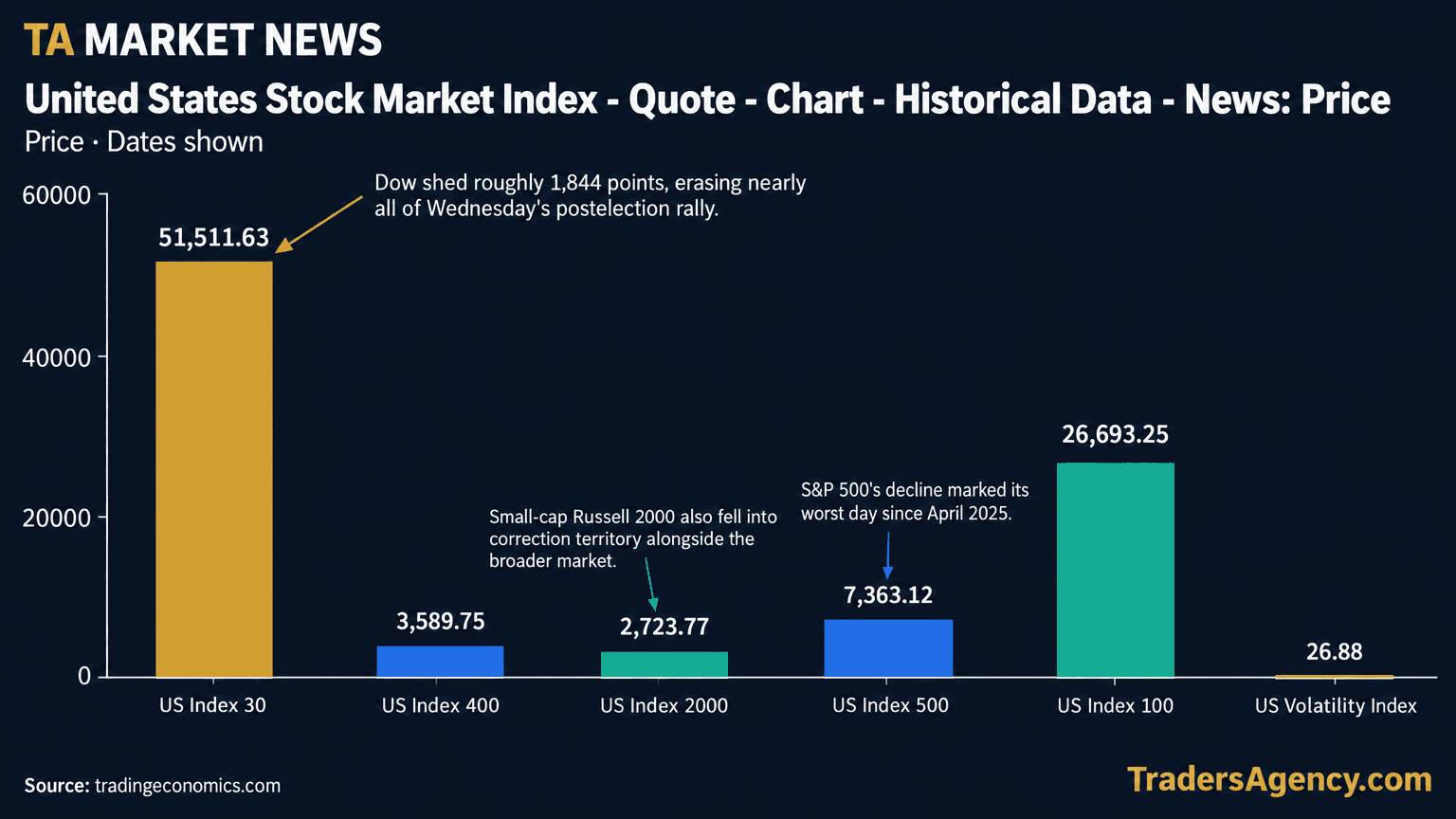
The Nasdaq Composite declined 5.4% on Thursday, putting it more than 10% below the record it set the previous month and formally into correction territory, CNBC reported. The S&P 500 fell 4.3%, on track for its worst day since April 2025, while the Dow Jones Industrial Average shed 1,844 points, or 3.7%, wiping out nearly all of the prior session's gains, per CNBC's live markets coverage. The small-cap Russell 2000 index fell 4.4% and also entered a correction, CNBC said.
Separately, data compiled by TradingEconomics showed the Nasdaq-100 down 6.13% on the day and 14.51% over the trailing month as of November 5. Morningstar reported that the index had already fallen into a correction on Tuesday — defined as a drop of at least 10% from a recent peak — and was down more than 5% again on Thursday, while Yahoo Finance said the tech-heavy index was 14% below its latest high.
The moves came a day after a sharp reversal: on Wednesday, the Dow had jumped more than 1,500 points, its best day since April 2025, while the S&P 500 and Nasdaq Composite each rose more than 1%, according to CNBC, following midterm election results that initially appeared to buoy markets.
Chipmakers and AI Infrastructure Names Lead the Decline
The sharpest losses were concentrated in semiconductor and AI-infrastructure stocks. CNBC reported that chipmakers Broadcom and Nvidia each fell 9% on Thursday, while software company Oracle dropped 7%. Qualcomm, which beat earnings estimates, saw its stock fall 10% on a weaker-than-expected outlook, per the same CNBC report. The iShares Semiconductor ETF (SOXX) fell more than 10%, which CNBC noted would be its worst day since the Covid-19 selloff of March 2020.
Data compiled by TradingEconomics showed slightly different but directionally consistent figures: Nvidia down about 8.5%, Broadcom down more than 9%, and Micron and AMD each plunging near 15%. The same data showed Tesla slumping near 11% and Applied Materials and Lam Research falling more than 11.5% and nearly 14%, respectively. Among hyperscalers, Microsoft and Meta each shed about 4%, according to the same dataset.
Neocloud providers were hit particularly hard. CNBC reported CoreWeave losing 11%, while Nebius and Iren each slid 16% amid what the outlet described as investor worry over a political backlash to the industry following the election results in various states.
Selling pressure was not confined to technology. CNBC reported industrial name Caterpillar declining 5%, financial stock JPMorgan falling 4%, and Boeing and Nike each pulling back 3%, suggesting the tech-driven selloff was beginning to weigh on the broader market by Thursday's close.
Data-Center Regulation Fears Behind the Reversal
The proximate catalyst, according to both CNBC and Business Insider, was the outcome of the midterm elections. Democrats won control of both the Senate and House of Representatives, and Business Insider reported that the party is expected to push for tighter regulation of the computing hubs that underpin AI development, which could slow infrastructure expansion and delay rollouts that major companies have been counting on.
CNBC reported that Vermont Senator Bernie Sanders, who caucuses with Democrats, called for a national data-center moratorium, writing on X Wednesday evening that "Americans don't want Big Tech oligarchs wrecking the environment, gutting jobs and threatening humanity's future."
Wall Street Reacts
Market strategists quoted by the outlets framed the move as investors stepping back from a trade that has driven much of the market's gains over the past several years. Tim Holland, chief investment officer at Orion, told CNBC that investors are "stepping away until they get a better sense of the implications of the midterms around the AI capex cycle in particular, which is the biggest economic tailwind we've had going for us for the last, call it, three years."
Keith Lerner, chief investment officer at Truist Wealth, told CNBC that the tech selloff's scale was now spreading into the broader market: "Unlike yesterday, you're just seeing that the sell-off in tech, the size of it, is now feeding itself into the broader market. The rubber band is becoming increasingly stretched."
Michael O'Rourke, chief market strategist at Jones Trading, offered a more cautious read in comments to Morningstar: "Nobody knows whether this selloff is going to get worse before it gets better."
Not Every Stock Fell
The damage was not uniform across the market in the days leading up to Thursday's drop. Business Insider reported that as the Nasdaq headed toward correction on Monday, nearly 70% of S&P 500 stocks were still positive for the day, and seven of 11 sectors were in the green, led by financials and consumer staples. That breadth data, reported ahead of Thursday's broader decline, underscores that the steepest losses have been concentrated in AI-linked technology and energy names rather than the market as a whole.
Bottom Line
Thursday's selloff marked a sharp reversal from Wednesday's postelection rally, driven by investor concern — as reported by CNBC and Business Insider — that a Democratic-controlled Congress could tighten regulation of AI data centers and slow the capital spending cycle that has powered much of the market's recent gains. The declines were heavily concentrated in chipmakers, hyperscalers and neocloud providers, and strategists quoted by CNBC and Morningstar said the near-term path remains unclear: Truist Wealth's Keith Lerner described the tech selling as increasingly spilling into the broader market, while Jones Trading's Michael O'Rourke said nobody knows whether the selloff gets worse before it gets better.
DISCLAIMER: Traders Agency does not offer financial advice. The information provided is for educational purposes only and should not be considered financial advice. Traders Agency is not responsible for any financial losses or consequences resulting from the use of the information provided. Trading carries inherent risks and may not be suitable for all individuals. You are advised to conduct your own research and seek personalized advice before making any investment decisions, recognizing the potential risks and rewards involved.
- CNBC Top News: Stock market today: Live updates · accessed Nov 5, 2026
- finance.yahoo.com: What investing pros are saying as the Nasdaq tumbles into correction territory · accessed Nov 5, 2026
- www.businessinsider.com: Big Tech's AI Sell-Off Is Hitting Indexes, but Other Stocks Are Rallying · accessed Nov 5, 2026
- www.facebook.com: 11K views · 82 reactions | A selloff in technology stocks is dragging global equities lower, led by a retreat in chipmakers that have been at the forefront of an unprecedented AI-driven rally, as Neil Campling reports. bloom.bg/4uPjf0s | Bloomberg · accessed Nov 5, 2026
- www.nbcnews.com: Nasdaq-100 slides into correction as global chip and memory stocks sell off · accessed Nov 5, 2026
- www.morningstar.com: Is this 'the big one' for the stock market? Wall Street sounds off as tech plunges. · accessed Nov 5, 2026
- www.youtube.com: - YouTube · accessed Nov 5, 2026
- tradingeconomics.com: United States Stock Market Index - Quote - Chart - Historical Data - News · accessed Nov 5, 2026
- www.nasdaq.com: Listings, Market Data & Financial Technology · accessed Nov 5, 2026
See more from Traders Agency on Google
Make us a preferred source and our market analysis will appear more prominently in your Google Search, Top Stories, and AI results.
Add to Preferred Sources