Stock market today: Dow Jones futures stalled as traders processed a last-minute tariff reprieve. President Donald Trump paused a planned 50% tariff on Canadian goods just hours before the midnight deadline, following 11th-hour talks between Trump officials and Canadian Prime Minister Mark Carney's team. The sudden postponement has left major index futures hovering near the flat line, and our Traders Agency research team is breaking down what this means for your positions right now.
What Is the US Stock Market Doing Today?
The major indexes are struggling to find direction this morning. Futures on the Dow Jones Industrial Average rose a modest 0.1%, while the S&P 500 hovered near flat. Contracts for the Nasdaq-100 declined by 0.2% as tech weakness continues to weigh on the broader market.
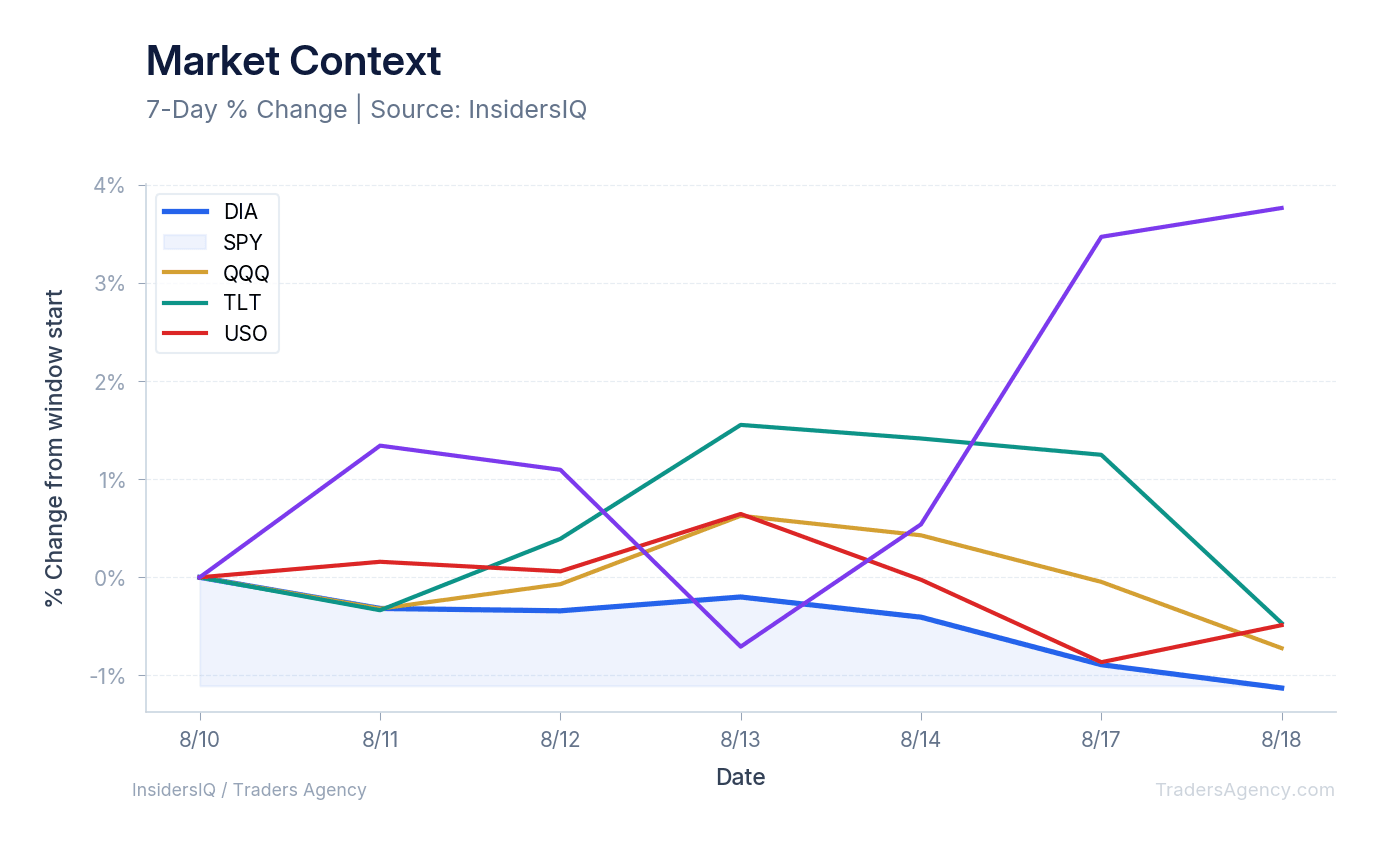
10-Day Performance Snapshot: DIA (Dow ETF) is down -1.13%, SPY (S&P 500 ETF) is down -0.72%, and QQQ (Nasdaq-100 ETF) has dropped -0.47%. This reflects a broader losing week on Wall Street.
The market is reacting to multiple overlapping events. We believe the combination of trade uncertainty and macroeconomic pressure requires careful attention from retail traders and institutions alike.
Why Did Trump Pause Canadian Tariffs?
President Trump announced on Truth Social that the 50% tariffs against Canada are paused for a three-day period. He cited a "DEAL!" subject to the finalization of documents. The tariffs were scheduled to take effect at 12:01 a.m. ET.
The proposed tariffs would have covered roughly $20 billion worth of imports, representing about 5% of the total value of US imports from Canada last year. The targeted goods included dairy, alcohol, and furniture, but the reach extended well beyond those categories to cover industrial equipment, plastics, clothing, and other manufactured goods.
Trump planned to rely on Section 338, a little-known trade law from the 1930s. This law has never been used to impose tariffs in this way. The administration's use of the law was expected to face legal challenges, but until a court weighs in, the president could apply it. This was the case with the sweeping duties the Supreme Court overturned earlier this year.
Unlike some of the other statutes Trump has turned to recently, this specific trade law does not appear to impose a time limit on the duties. Had the tariffs taken effect, they could have remained in place indefinitely unless Trump or a future president chose to remove them.
In his post, Trump also referred to the Keystone XL pipeline, stating it "may be awoken from the grave!" without providing further details.
Why Is the Market Falling This Week?
The market is under pressure from a combination of rising bond yields and climbing oil prices weighing heavily on the major indexes. This macroeconomic pressure is compounded by a sell-off in tech stocks on Tuesday. These factors are creating a difficult environment for equities across the board.
Over the last 10 days, TLT (the long-term Treasury bond ETF) has fallen -0.49%, reflecting the rise in bond yields. Meanwhile, the USO oil fund has surged +3.76% over the same timeframe. Rising bond yields and oil prices weigh directly on equity valuations, creating a drag on overall performance.
Global Sell-Off: Japan's Nikkei index fell 3% overnight, and South Korea's KOSPI index dropped over 5%. This international weakness sets a negative tone for US markets heading into today's session.
Want expert trading insights delivered daily?
Join thousands of traders who rely on Traders Agency for market analysis and trade ideas.
Join Traders AgencyWhat Does This Mean for Trade and Tariffs?
This three-day delay may signal upcoming negotiations for the US-Mexico-Canada Trade Agreement. While experts have said the tariffs would have had limited economic ramifications, the use of Section 338 introduces meaningful trade uncertainty. Traders should factor this uncertainty into their risk models.
Canadian Prime Minister Mark Carney and Trump spoke on Monday and Tuesday as negotiations continued. Carney described the talks with the Trump administration as "very delicate and intense." In a statement late Tuesday, Carney confirmed tariffs had been postponed until the end of the day on August 21. He noted that substantial progress has been made, although there is important work still to be done.
Trump specifically targeted Canada, alleging that it made it harder for the US to export dairy, cars, and alcohol. Canada was the only country besides China to retaliate against Trump's earlier tariffs. Carney later rolled back most of those measures. Our research team is watching closely to see if retaliatory measures return if the tariffs are ultimately implemented.
How Could This Affect the Market?
The market reaction will largely depend on whether a finalized deal materializes after the three-day pause. If the tariffs take effect, we could see increased volatility in trade-heavy sectors. Traders should also monitor the broader macroeconomic data, as rising yields and oil prices continue to pressure equities.
The threat of indefinite tariffs under Section 338 creates a complex risk profile for companies reliant on Canadian imports. The potential reach covering industrial equipment, plastics, clothing, and other manufactured goods means multiple sectors could face cost increases as the August 21 deadline approaches.
For those trading Dow Jones futures, the technical setup remains fragile. The major indexes are already weathering a losing week on Wall Street. The added layer of international trade disputes could strengthen the case for defensive positioning.
What Should Traders Watch After the Canadian Tariff Pause?
Our team is tracking several specific events and data points that could dictate the next market move. Here's what we recommend keeping a close eye on.
1. Trade Negotiations and the Deadline
The three-day pause expires at the end of the day on August 21. Traders need to watch for official confirmation of a finalized deal or the sudden implementation of the 50% tariffs. The status of the Keystone XL pipeline also remains a potential source of energy sector volatility based on Trump's recent comments.
2. FOMC July Meeting Minutes
Investors will get the Fed's meeting minutes from the FOMC's July meeting, which promise clues into policymakers' debates on inflation, policy, and other key economic data. This release could heavily influence bond yields, which are already weighing on the market.
3. Retail Earnings Reports
Earnings from Target (TGT), Lowe's (LOW), and TJX Companies (TJX) will provide a look at consumer trends over the spring and summer. We are specifically watching TGT, which is currently trading at $152.48. These reports will offer direct insight into consumer health during a period of rising oil prices and bond yields.
4. Index Futures and Market Hours
Regular trading hours apply today. Futures markets will provide the earliest signals of market sentiment as new trade details emerge from the ongoing negotiations between the US and Canada.
The Bottom Line
The stock market today remains in a holding pattern as traders digest the temporary pause on Canadian tariffs. Our research team believes the combination of unresolved trade negotiations, rising oil prices, and upcoming FOMC minutes creates a highly reactive trading environment. We are keeping a close eye on retail earnings and index futures to gauge the market's next directional move.
Want expert trading insights delivered daily?
Join thousands of traders who rely on Traders Agency for market analysis and trade ideas.
Join Traders AgencyKey Takeaways
- President Trump paused a planned 50% tariff on Canadian goods for three days, hours before the midnight deadline, following last-minute talks with Prime Minister Mark Carney's team.
- Dow Jones futures rose just 0.1%, S&P 500 hovered near flat, and Nasdaq-100 futures declined 0.2% in the immediate aftermath of the tariff pause announcement.
- Over the prior 10 days, DIA fell 1.13%, SPY dropped 0.72%, and QQQ declined 0.47%, reflecting a broader losing stretch on Wall Street heading into this event.
- The tariff pause is tied to a deal Trump described as subject to document finalization, meaning the situation remains unresolved and open to change.
- Traders are watching FOMC minutes, retail earnings, and oil prices alongside the Canada trade talks as overlapping catalysts in a reactive market environment.
DISCLAIMER: Traders Agency does not offer financial advice. The information provided is for educational purposes only and should not be considered financial advice. Traders Agency is not responsible for any financial losses or consequences resulting from the use of the information provided. Trading carries inherent risks and may not be suitable for all individuals. You are advised to conduct your own research and seek personalized advice before making any investment decisions, recognizing the potential risks and rewards involved.
See more from Traders Agency on Google
Make us a preferred source and our market analysis will appear more prominently in your Google Search, Top Stories, and AI results.
Add to Preferred Sources