
The S&P 500 index committee just made a decision that will affect millions of passive investors: SpaceX is locked out. Despite going public on the Nasdaq with a valuation that rose above $2 trillion, the biggest IPO in the history of the market will not appear in the most widely held index funds for at least a year. Our team has been tracking this story closely, and the implications for traders are immediate.
Why Did the S&P 500 Reject the SpaceX IPO?
Bottom Line: The S&P 500 inclusion rules are doing exactly what they were designed to do: slow down the index's exposure to unprofitable, newly public companies. For traders, the practical consequence is that nearly $2 trillion in passive capital cannot chase SpaceX until at least 2026, and possibly longer. The performance gap between index funds and vehicles that hold SpaceX directly is the trade to watch.
SpaceX went public on Friday with a valuation of $1.77 trillion in the IPO, with shares initially rising to a value above $2 trillion. But the index committee that oversees the rules for new stock inclusion in the S&P 500 decided to leave in place its standard 12-month waiting period for newly public companies. That single decision locks SpaceX out of funds like the Vanguard S&P 500 ETF (VOO), which recently passed the $1 trillion mark in assets under management.
The Key Number: The Vanguard and BlackRock S&P 500 ETFs manage nearly $2 trillion combined. All of that passive capital is now sidelined from the biggest IPO in market history.
The committee also maintained its profitability test for stocks. That creates a serious hurdle for SpaceX, which reported a net loss of $4.28 billion in its latest quarter. Even after the waiting period expires, there is no guarantee the company will qualify.
How Will S&P 500 Index Inclusion Rules Affect Traders?
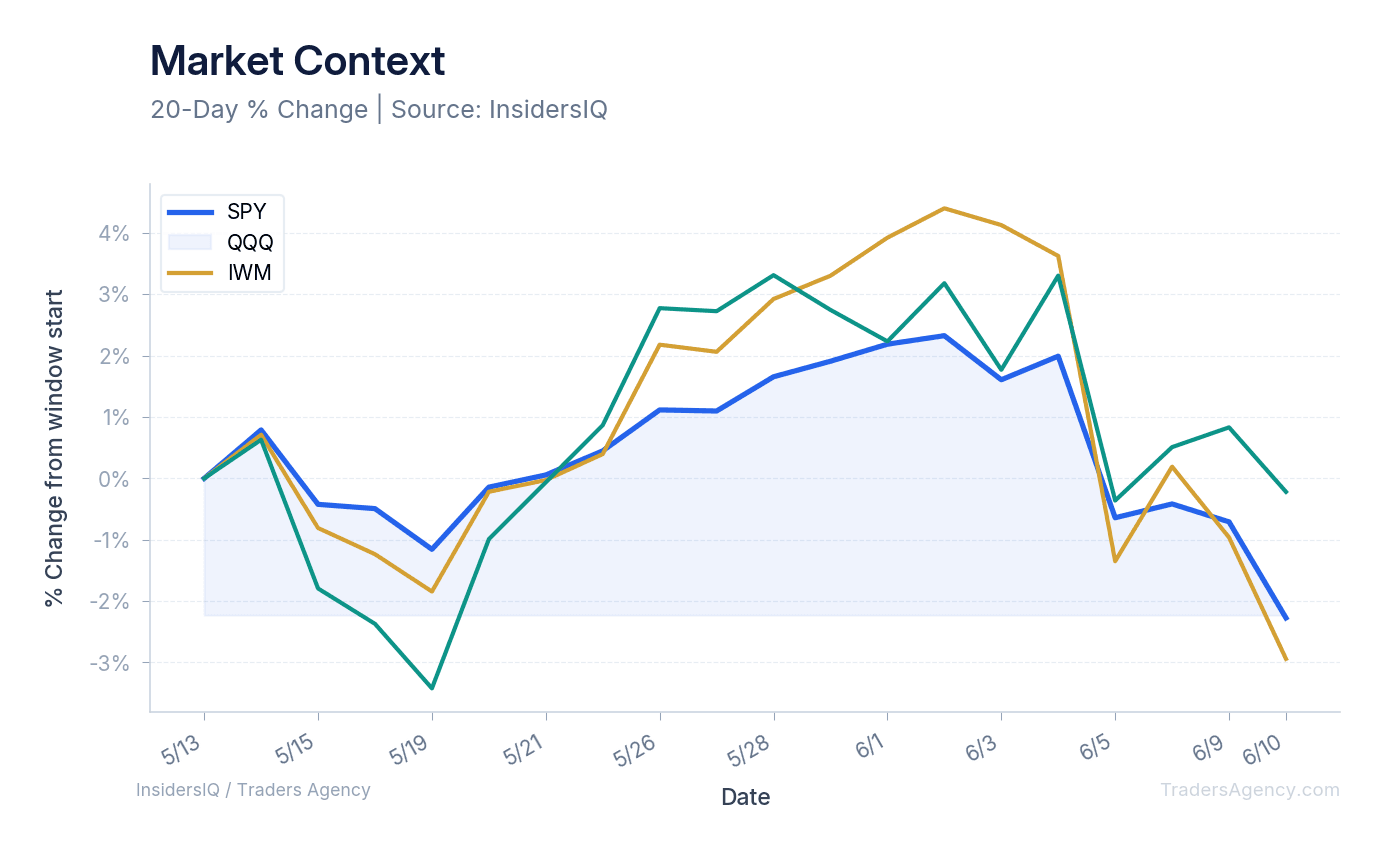
S&P 500 index inclusion rules are now creating a measurable performance gap between major market benchmarks. Because the S&P 500 demands a 12-month seasoning period and proven profitability, funds tracking this index will miss the early price action entirely.
The competing indexes are moving fast. The Nasdaq and Russell index committees said they would update their rules. This split could create what one strategist called an "index war," with performance dispersions between the S&P 500, Nasdaq, and other indexes. Traders holding the Invesco QQQ Trust (QQQ) or Russell 1000 products will gain exposure much faster than those in traditional S&P 500 vehicles.
What Does This Mean for VOO and SPY Holders?
If you hold core S&P 500 funds like VOO, IVV, or SPY, you will not receive any SpaceX exposure until at least mid-2027. These funds will not include SpaceX shares during this period, which means traders may need to look elsewhere for exposure.
Here is what our data shows across the major ETFs over the last 30 days:
- SPY (SPDR S&P 500 ETF Trust): -2.27%
- IVV (iShares Core S&P 500 ETF): -2.26%
- QQQ (Invesco QQQ Trust): -2.94%
- IWM (iShares Russell 2000 ETF): -0.22%
The relative outperformance of small caps is notable here, but the real story is the structural gap that could widen once Nasdaq and Russell products begin adding SpaceX to their holdings.
Want expert trading insights delivered daily?
Join thousands of traders who rely on Traders Agency for market analysis and trade ideas.
Join Traders AgencyNew ETFs and Leveraged Vehicles Are Filling the Void
With traditional index funds locked out, ETF issuers are racing to capture trader demand. We are closely monitoring several new products designed specifically for active positioning around SpaceX.
- Thematic Space Funds: The Tema ETFs Space Innovators ETF (NASA) launched on May 30 and has reached $2.6 billion in assets. This fund offered direct access to SpaceX before the IPO through pre-IPO direct stakes.
- Bullish Leveraged ETFs: ProShares will launch the Ultra SpaceX ETF (SPCF) next Monday, seeking to get two times the daily performance of the stock. GraniteShares will also launch the GraniteShares 2x Long SpaceX Daily ETF (SPAL).
- Bearish Leveraged ETFs: For traders looking to short the volatility, GraniteShares is launching the 2x Short SpaceX Daily ETF (SNK).
Risk Warning: These leveraged products come with relatively high expense ratios and are intended as trading vehicles rather than core holdings. They are not designed for long-term portfolio diversification. Losses compound rapidly in these investments, making them unsuitable for buy-and-hold strategies.
Will S&P 500 Index Inclusion Rules Block Future IPOs?
The strict application of S&P 500 index inclusion rules here sets a precedent that upcoming mega-cap listings will face identical roadblocks. OpenAI and Anthropic are both expected to follow the SpaceX IPO with huge offerings. These companies are burning through cash at a significant rate and racking up losses, and they can be expected to face the same scrutiny from the S&P 500 that SpaceX just did.
Our analysis points to a clear divide forming in the indexing world. The S&P 500 is prioritizing historical profitability over immediate market capitalization representation. We expect smaller independent ETF issuers to get creative, potentially building products that blend large-cap index exposure with direct allocation to these excluded tech giants. As one strategist put it, "There is nothing the ETF industry can't do in terms of creativity."
The Precedent: Every unprofitable mega-cap IPO going forward will face this same exclusion. If you rely solely on S&P 500 funds for equity exposure, you will systematically miss the first year (or more) of trading in the largest new public companies.
The real question for traders is whether this structural gap between indexes becomes a lasting performance differentiator, or whether the S&P 500 committee eventually adjusts its rules. TD Securities' head of index and market structure research, Peter Haynes, noted it could be "much longer" than a year before S&P 500 investors get exposure to SpaceX because of the profitability test. For now, the rules stand, and the money is moving accordingly.
Want expert trading insights delivered daily?
Join thousands of traders who rely on Traders Agency for market analysis and trade ideas.
Join Traders AgencyKey Takeaways
- The S&P 500 committee upheld its standard 12-month waiting period for newly public companies, blocking SpaceX from index inclusion despite its $2 trillion+ valuation at IPO.
- SpaceX reported a net loss of $4.28 billion in its latest quarter, meaning it also fails the S&P 500 profitability test and may remain locked out well beyond the one-year window.
- Vanguard and BlackRock S&P 500 ETFs manage nearly $2 trillion combined, meaning that passive capital is entirely sidelined from the largest IPO in market history.
- TD Securities' Peter Haynes warned exposure for S&P 500 investors could take 'much longer' than a year given the profitability hurdle, not just the waiting period.
- New ETFs and leveraged vehicles are already emerging to fill the gap, creating a measurable performance split between index-tracking funds and products with direct SpaceX exposure.
DISCLAIMER: Traders Agency does not offer financial advice. The information provided is for educational purposes only and should not be considered financial advice. Traders Agency is not responsible for any financial losses or consequences resulting from the use of the information provided. Trading carries inherent risks and may not be suitable for all individuals. You are advised to conduct your own research and seek personalized advice before making any investment decisions, recognizing the potential risks and rewards involved.
See more from Traders Agency on Google
Make us a preferred source and our market analysis will appear more prominently in your Google Search, Top Stories, and AI results.
Add to Preferred Sources