
Moderna shares fell as much as 25% on Thursday, October 22, 2026, after partial Phase 3 results for its personalized melanoma vaccine, developed with Merck, appeared online ahead of their scheduled unveiling at a major oncology conference, according to CNBC and Yahoo Finance. The underlying data, once confirmed, showed the combination therapy cut the risk of melanoma recurrence or death by 42% compared with Merck's Keytruda alone, a result analysts described as clinically meaningful even as the stock fell.
The episode illustrates how a premature data posting, rather than the substance of the results themselves, can drive an outsized market reaction when expectations are already stretched.
How the data leaked
According to Yahoo Finance, the results appeared on medical news website Oncology Central around 12:30 p.m. ET and were taken down shortly afterward. The data had been scheduled for formal presentation at the European Society for Medical Oncology (ESMO) Congress on October 24, two days later, per reporting from 247wallst.com. Moderna declined to comment on the briefly posted report, 247wallst.com said. It is not clear from available reporting whether ESMO or Oncology Central has issued a statement on how the material was posted or taken down.
What the full data actually showed
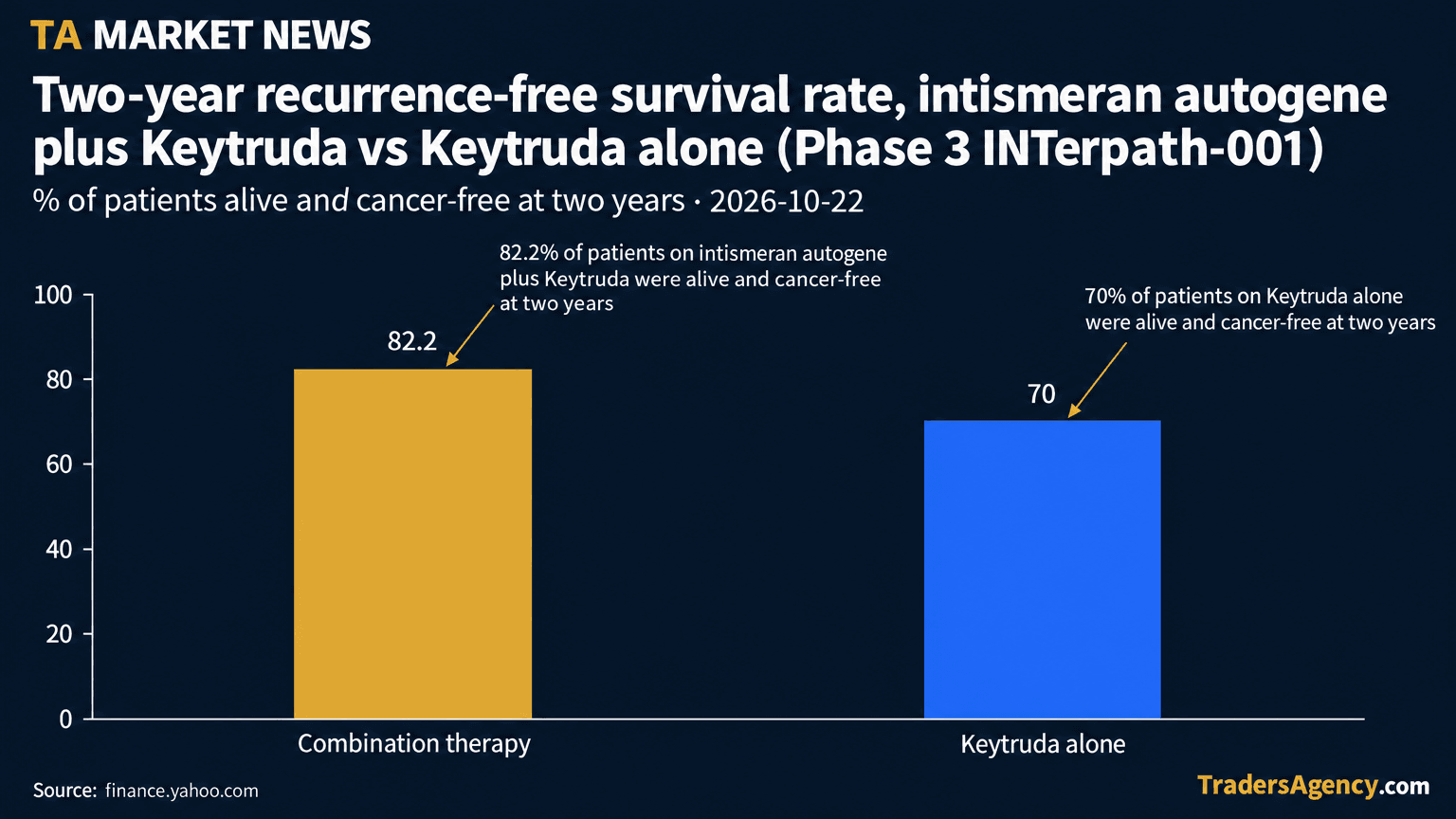
Once Merck confirmed the key figures, the picture matched what had leaked: intismeran autogene, Moderna's individualized neoantigen vaccine, paired with Keytruda reduced the risk of melanoma recurrence or death by 42% compared with Keytruda alone, and cut the risk of the cancer spreading to distant parts of the body or death by 38%, according to CNBC and Yahoo Finance. At two years, 82.2% of patients on the combination were alive and cancer-free, versus 70% of those on Keytruda alone, a 12.2 percentage-point gap, or roughly a 17.4% relative difference (82.2 minus 70, divided by 70, times 100) -- our calculation based on the reported two-year survival figures.
Merck said no new safety concerns were identified and that the safety profile was generally consistent with earlier studies, per Yahoo Finance and Moderna's own press release. Overall survival data remain immature, though Merck characterized the early trend as encouraging. The trial, known as INTerpath-001, enrolled patients with completely resected stage IIB, IIC, III or IV cutaneous melanoma who had not previously received systemic therapy, and the companies had already disclosed in August that the trial met its primary endpoint of recurrence-free survival and its key secondary endpoint of distant metastasis-free survival, without releasing detailed figures at the time.
For context, an earlier Phase 2b trial (KEYNOTE-942) had shown larger five-year risk reductions of 49% for recurrence or death and 59% for distant metastasis or death, according to Moderna's release. The Phase 3 reductions of 42% and 38% are smaller than those earlier Phase 2b figures -- gaps of 7 and 21 percentage points respectively (49 minus 42, and 59 minus 38), by our calculation -- though cross-trial comparisons of this kind are not a like-for-like measure of efficacy and should be read as context rather than as evidence of a declining treatment effect.
Market reaction and analyst commentary
CNBC reported Merck shares fell about 1% on Thursday, while Yahoo Finance reported Merck fell over 3%; the two outlets' accounts of Merck's move diverge. Selling pressure was concentrated in Moderna rather than the broader sector: the iShares Biotechnology ETF fell 2% and the SPDR S&P 500 ETF Trust was down 1.32%, while mRNA peer BioNTech slipped 2% and Pfizer rose 0.9%, according to 247wallst.com.
Sell-side analysts largely attributed the stock drop to inflated expectations rather than disappointing science. BMO Capital Markets analyst Evan Seigerman wrote in a research note that the 42% reduction in recurrence or death is "clinically meaningful" and that the reaction "likely reflects inflated expectations into the full data release, rather than a true indictment on the efficacy of the combo therapy," per CNBC. UBS analysts called it "overall a strong data set" that gives more confidence in upcoming studies of the vaccine in kidney and bladder cancers, CNBC reported.
The scale of Thursday's drop stands in contrast to the market's reaction when the companies first announced topline results in August. On that announcement, Merck shares climbed more than 12% and Moderna's stock soared about 177%, according to CNBC, with the size of those moves reflecting the companies' relative market capitalizations at the time -- roughly $333 billion for Merck versus about $25 billion for Moderna. Ahead of that August readout, Leerink Partners analyst Mani Foroohar had called the Phase 3 results a make-or-break event for Moderna's stock, per CNBC, and analysts said the company's valuation already priced in expectations that the vaccine could eventually work across multiple cancer types beyond melanoma.
Regulatory path and economics
In August, Moderna and Merck said they planned to engage with regulators on filing submissions for intismeran autogene in combination with Keytruda, according to Moderna's press release. Merck Research Laboratories president Dean Li told CNBC's "Squawk Box" that talks with regulatory agencies would likely begin "in the next few months," though a specific U.S. submission date has not been disclosed. The Phase 3 trial will continue to assess other secondary endpoints, including overall survival, per both Moderna's release and CNBC's reporting.
Keytruda is already approved as adjuvant treatment for patients with Stage IIB, IIC or III melanoma following complete resection, making it both the trial's comparator and the backbone of the new combination regimen -- a structure that gives Merck its own direct commercial stake in the outcome, as 247wallst.com noted. The broader INTerpath program spans nine Phase 2 and Phase 3 trials across melanoma, non-small cell lung cancer, bladder cancer and renal cell carcinoma, giving the melanoma result read-through for Moderna's wider oncology ambitions, according to Moderna and 247wallst.com. Because the vaccine is personalized to each patient's tumor, the manufacturing process can take six weeks, though Merck CEO Robert Davis told CNBC the company believes it can shorten that timeline to reach more patients more quickly.
Bottom Line
The substance of Thursday's data, a 42% reduction in melanoma recurrence or death with no new safety signals, was broadly in line with what the companies had already flagged in August, and analysts at BMO and UBS described it as clinically meaningful. The sharp share-price drop appears tied more to how the data emerged, an unscheduled early posting ahead of ESMO, and to expectations built up since the summer announcement, than to any new concern about the drug itself. Regulatory conversations are still described as months away, and overall survival data, the metric likely to matter most for eventual approval and uptake, remain immature.
DISCLAIMER: Traders Agency does not offer financial advice. The information provided is for educational purposes only and should not be considered financial advice. Traders Agency is not responsible for any financial losses or consequences resulting from the use of the information provided. Trading carries inherent risks and may not be suitable for all individuals. You are advised to conduct your own research and seek personalized advice before making any investment decisions, recognizing the potential risks and rewards involved.
- CNBC Top News: Moderna stock falls after cancer vaccine data leak · accessed Oct 22, 2026
- finance.yahoo.com: Moderna shares plunge on cancer vaccine data leak · accessed Oct 22, 2026
- 247wallst.com: Moderna Tumbles 25% After Apparent Early Leak of Melanoma Vaccine Data; BioNTech Dips, Pfizer Edges Higher · accessed Oct 22, 2026
- www.cnbc.com: Moderna, Merck cancer vaccine shows initial late-stage melanoma data · accessed Oct 22, 2026
- www.facebook.com: 15K views · 265 reactions | An experimental personalized cancer vaccine from Merck and Moderna showed positive initial results in its first-ever late-stage trial. The combination regimen met the main study goal of significantly extending the time patients lived without their melanoma returning, compared with Keytruda alone, and also reduced the risk of the cancer spreading to distant parts of the body. Read more here: cnb.cx/4ii7YmM | CNBC · accessed Oct 22, 2026
- news.modernatx.com: Merck and Moderna Announce Phase 3 INTerpath-001 Trial of Intismeran Autogene Plus KEYTRUDA® Met Endpoints of Recurrence-Free Survival (RFS) and Distant Metastasis-Free Survival (DMFS) in Patients With Completely Resected Stage IIB-IV Melanoma - Moderna · accessed Oct 22, 2026
- www.modernatx.com: Pioneering mRNA technology - Moderna · accessed Oct 22, 2026
See more from Traders Agency on Google
Make us a preferred source and our market analysis will appear more prominently in your Google Search, Top Stories, and AI results.
Add to Preferred Sources