
Last week, the FDA did something it almost never does. It didn't approve a product. It created an entirely new category of product, and one company stands to benefit in a big big way, which reframes the case for medical robotics investing.
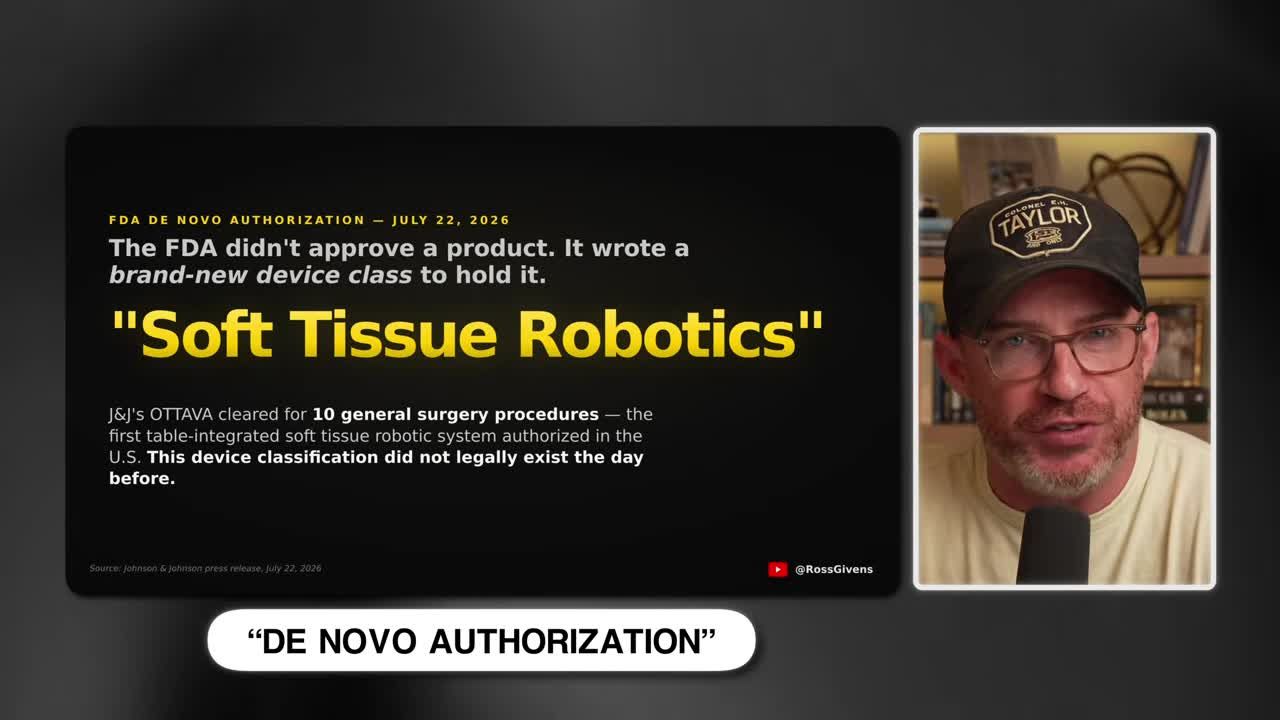
The agency handed Johnson & Johnson's Ottava surgical robot what's called a DeNovo authorization. That is not a normal clearance. The FDA looked at the machine, decided nothing on the books was close enough to compare it to, and wrote a brand new device classification to hold it. They called it soft tissue robotics.
That class could not legally exist the day before. Now it changes the entire sector.
What Does the FDA's DeNovo Ruling Mean for Surgical Robotics?
Bottom Line: The FDA's DeNovo ruling matters less for J&J than for what it signals about the entire medical robotics investing landscape: surgical robotics is now a multi-player regulated category, and that legitimacy redirects capital toward overlooked names. The core call is Stryker as a category leader trading at a discounted entry point, with a razor-and-blades revenue model and maintained guidance through adversity as the fundamental support for a long-term hold.
The monopoly just cracked open
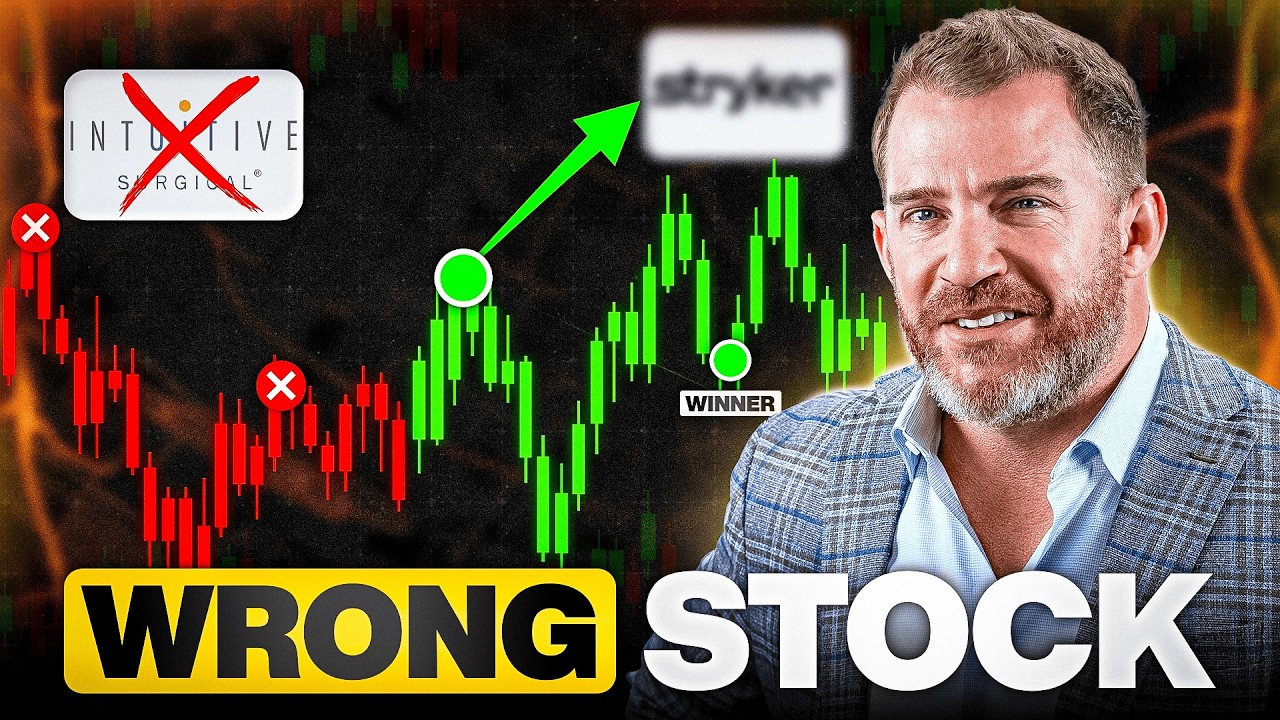
Every headline after the news said the same thing. Johnson & Johnson can finally compete with Intuitive Surgical, the dominant player in this space for years.
But what the FDA actually told us is that robotic surgery has stopped being one company's private monopoly. It has become a regulated category with room in it for other players. For anyone focused on medical robotics investing, that shift changes the entire opportunity set.
When a category cracks open like that, the last thing I want to own is the company whose monopoly just got broken. I want the one that already owns a completely different piece of this market. I want the competitor that happens to be on sale for a reason that has nothing to do with any of this FDA news.
Who Is the Overlooked Leader in Medical Robotics Investing?
Ask who leads medical robotics investing and most people immediately think of Intuitive. But there is another company roughly the same size, with more robots installed in its category than anybody on Earth.
The company is Stryker, ticker SYK.
Most people who have heard the name Stryker think about hospital beds and surgical tools. That is the old Stryker. The new Stryker owns a robot called Mako. Mako does orthopedic surgery. It handles knees, hips, and now shoulders.
Stryker is not in the soft tissue fight at all. You have Ottava, Da Vinci, and Medtronic's Hugo swinging at gallbladders and hernias. Stryker is in bone.
While three of the biggest companies on Earth fight over abdominal surgeries, Stryker sits in its own category with almost no competition.
The Razor Blade Model for Bone
The FDA just spent a Wednesday afternoon reminding every investor on the planet that surgical robots are a real, approvable, and enormous market. That news is bringing the crowd, but the crowd showed up looking at the wrong tickers.
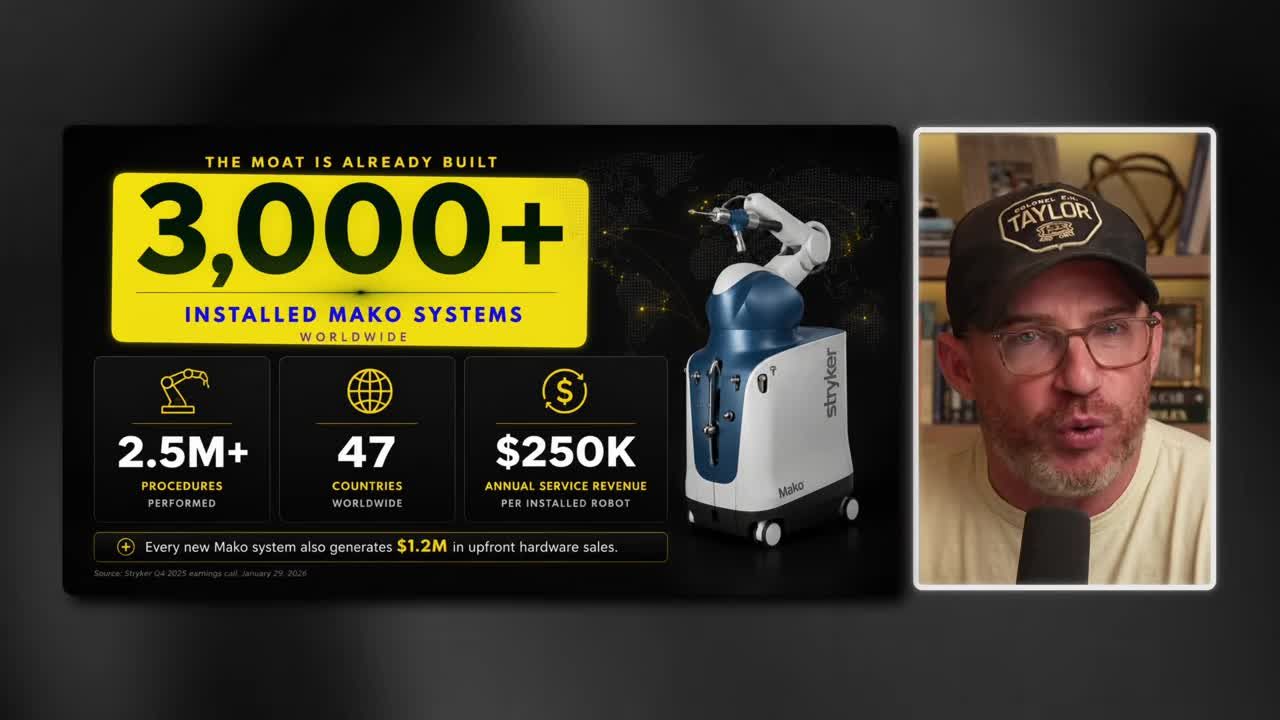
Here is the true scale of Stryker's operation:
- More than 3,000 Mako systems installed worldwide
- 2.5 million surgical procedures across 47 countries
- $1.2 million price tag per machine
- $250,000 a year in service contract revenue per machine
Two out of every three surgeries using this company's knee replacements in the US are done by its own robot. One out of every three hips uses the robot.
A lot of investors get this wrong. The robot is not the product. The robot is the thing that sells the product.
A hospital buys a Mako, and the surgeons train on it. Then every knee, hip, and shoulder replacement that hospital implants comes from Stryker, because the robot is built around Stryker's implants.
The machine locks in the implant revenue for the next decade. It is the razor blade model, but for orthopedics. The implants are the recurring blade. Globally, they are only at about 50% utilization on knees and just 20% on hips. There is a lot of market share still up for grabs. This is the kind of recurring economics that makes medical robotics investing so compelling.
Get an entire year of live weekly mentoring sessions, my newsletter, indicators, bonus reports, tons more. Click the link and I'll see you in the next live session.
Join my Black Ops Trading ClubDid a Cyberattack Create a Buying Opportunity in This Stock?
Stryker stock is currently 17% off its highs. This drop happened not because of competition or missed earnings, but because somebody hacked them.
In the first quarter of this year, a cyberattack breached their systems. Stryker had to halt global production for three weeks. That is three weeks of a $25 billion company not shipping product. The damage came out to roughly $375 million in lost and deferred revenue.
The stock fell from $380 in March to $280 in May.
But management did not touch guidance. They did not revise down what they expected their sales and profits to be. They kept the full year at 8 to 9.5% organic growth and roughly $15 in adjusted earnings, with the recovery mostly coming in the back half of the year.
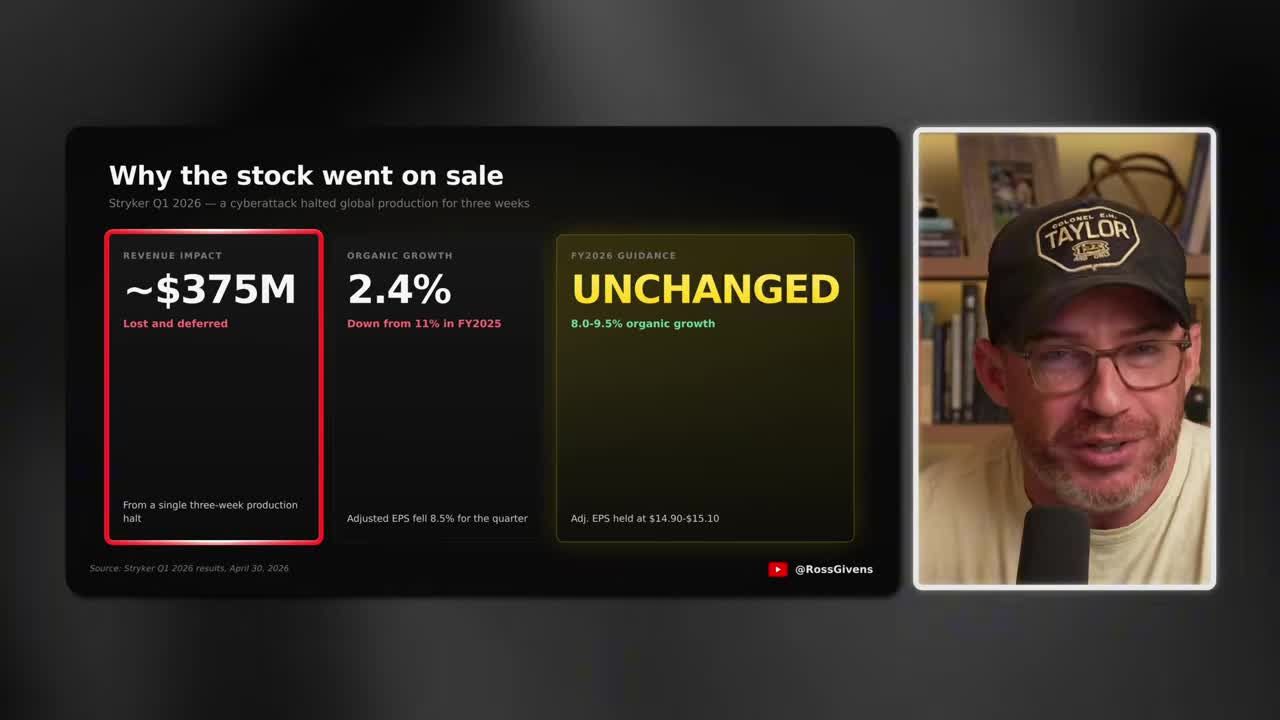
The company is saying they did not lose the business. They lost three weeks of shipping, and they are going to catch up. That dip in the stock price is a mispriced discount.
Even with this three-week production outage, their Mako installations were a first-quarter record in the US and internationally. Customers did not cancel their orders. They waited. That is a massive moat when you are talking about a million-dollar product.
The Product Cycle Nobody Is Watching
Stryker is in the middle of the biggest product cycle in Mako's history. It is happening right now while everybody stares at Johnson & Johnson, whose robotics represent a fraction of their business.
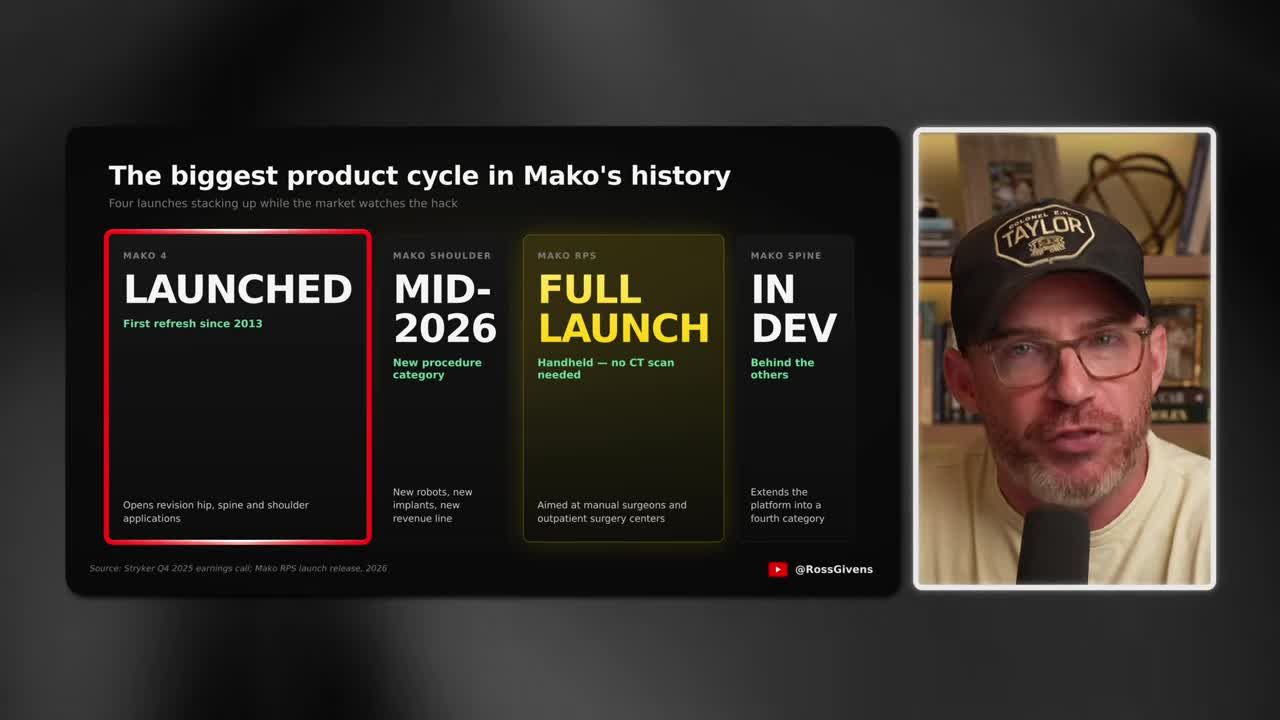
1. The Mako 4 Refresh
The new Mako 4 is the first major hardware refresh since Stryker bought the platform 13 years ago in 2013. The CEO described the customer uptake as incredible. It opens the door to applications the old system could not run.
2. Mako Shoulder
Mako shoulder launches on Mako 4 mid-year. That is an entirely new procedure category, with new robots, new implants, and new revenue.
3. Mako RPS Handheld Robot
Mako RPS is a handheld robot that just went to full US commercial launch. There is no big machine in the corner of the room, and no CT scan is required beforehand. Stryker's Mako general manager said they are specifically targeting surgeons who do manual procedures and do not use a robot at all today. They are seeing heavy interest from ambulatory surgery centers. A fixed robot costs a fortune and eats a whole operating room, but an outpatient center can afford a handheld unit.
4. Mako Spine
Mako spine is still in development, right behind these other launches. Four product launches are stacking up in a business that already dominates this category.
The Chart and the Track Record
The chart shows a textbook turnaround. The stock was trending beautifully through 2019, 2020, 2021, 2022, 2023, and 2024. It sat in a big holding pattern before the cyberattack decline. If that trend were still intact, this stock would be up in the high $400s, if not $500 a share.
Now we are seeing a structural recovery. The chart shows a rounded bottom. After a 30-plus percent decline, the pullbacks are getting shallower. Buyers are coming in, creating higher lows and higher highs against resistance in the $330 to $340 area. It is currently breaking through. If deferred revenue comes back, I would not be surprised to see this stock back above the $400 high by the end of the year.
Stryker also pays you to wait. The dividend yield is low, but the company has raised the dividend 16 years in a row. The payout ratio is only 40%, leaving plenty of room to keep raising it.
This is a company that keeps compounding quarter after quarter, and nobody talks about it because Intuitive Surgical steals the headlines. You can review Stryker's own filings through the SEC's EDGAR database.
Which Robotics Stock to Actually Own
With a market cap of $129 billion, Stryker is an institutional grade stock. It is perfectly positioned to ride the momentum as robotics takes center stage in the financial markets, which is why it deserves a hard look from anyone serious about medical robotics investing.
The FDA story is evidence that this category is approvable, killing the idea that one company owns surgical robots forever.
It puts a lot of new eyeballs on this sector. Stryker is what those eyeballs will eventually find. This is a category leader sitting mid-product cycle at a fair price. They maintained guidance through a crisis and have a long track record of success. For a long-term investment, that is about as close to a no-brainer as you are going to find. Right now, you can buy this asset at 2024 prices.
Get an entire year of live weekly mentoring sessions, my newsletter, indicators, bonus reports, tons more. Click the link and I'll see you in the next live session.
Key Takeaways
- The FDA's DeNovo authorization for J&J's Ottava system created a legally new device class called 'Soft Tissue Robotics' that did not exist before the ruling, signaling that robotic surgery is now a regulated open category rather than a single-company domain.
- The primary stock call is Stryker, not J&J or Intuitive Surgical, on the thesis that the FDA news drives new investor attention to the sector and Stryker is the name those investors will find.
- Stryker is described as sitting mid-product cycle at what the analysis calls '2024 prices,' making the current entry point the core valuation argument.
- A cyberattack on Stryker created a temporary price dislocation that the analysis treats as a buying opportunity rather than a fundamental impairment.
- The investment framework here is explicitly contrarian on Intuitive Surgical: when a monopoly cracks open, the thesis favors the competitor already owning a different piece of the market, not the company whose pricing power just got challenged.
DISCLAIMER: Traders Agency does not offer financial advice. The information provided is for educational purposes only and should not be considered financial advice. Traders Agency is not responsible for any financial losses or consequences resulting from the use of the information provided. Trading carries inherent risks and may not be suitable for all individuals. You are advised to conduct your own research and seek personalized advice before making any investment decisions, recognizing the potential risks and rewards involved.
See more from Traders Agency on Google
Make us a preferred source and our market analysis will appear more prominently in your Google Search, Top Stories, and AI results.
Add to Preferred Sources