
Wall Street is pulling in two directions at once. Falling oil prices are easing some inflation worries even as a nervous Federal Reserve and a cooling semiconductor trade weigh on technology stocks. The result is a market where Morgan Stanley is urging investors to stay with artificial-intelligence infrastructure while Goldman Sachs data points to hedge-fund buying shifting toward consumer discretionary stocks instead.
Oil Prices Ease, But the Iran Standoff Isn't Resolved
One of the more encouraging threads in the market right now involves energy. Diesel crack spreads, the pricing gap between crude oil and refined diesel that widens when supply worries intensify, have been narrowing in recent weeks even though they remain elevated by historical standards. Allianz Research's mid-November inflation outlook put current diesel pricing pressure at roughly $45 per barrel in the United States and about $75 in Europe, still tight but less acute than earlier in the year. That easing matters because diesel costs ripple through trucking, farming and shipping, feeding directly into consumer prices.
The backdrop remains tense. Tensions around Iran, including reported strikes, counterstrikes and restricted access for international nuclear inspectors, continue to simmer, and reported odds of a near-term negotiated resolution have diminished since the U.S. election. These are serious, unresolved geopolitical questions that deserve continued scrutiny rather than a declaration of victory. Still, falling energy costs combined with a Federal Reserve that has been signaling further tightening create an unusual pairing: oil-driven relief on one side, central-bank-driven caution on the other. Investors watching inflation expectations will want to see whether softer energy costs can offset the drag from tighter financial conditions.
Semiconductor Stocks Lose Their Crowd
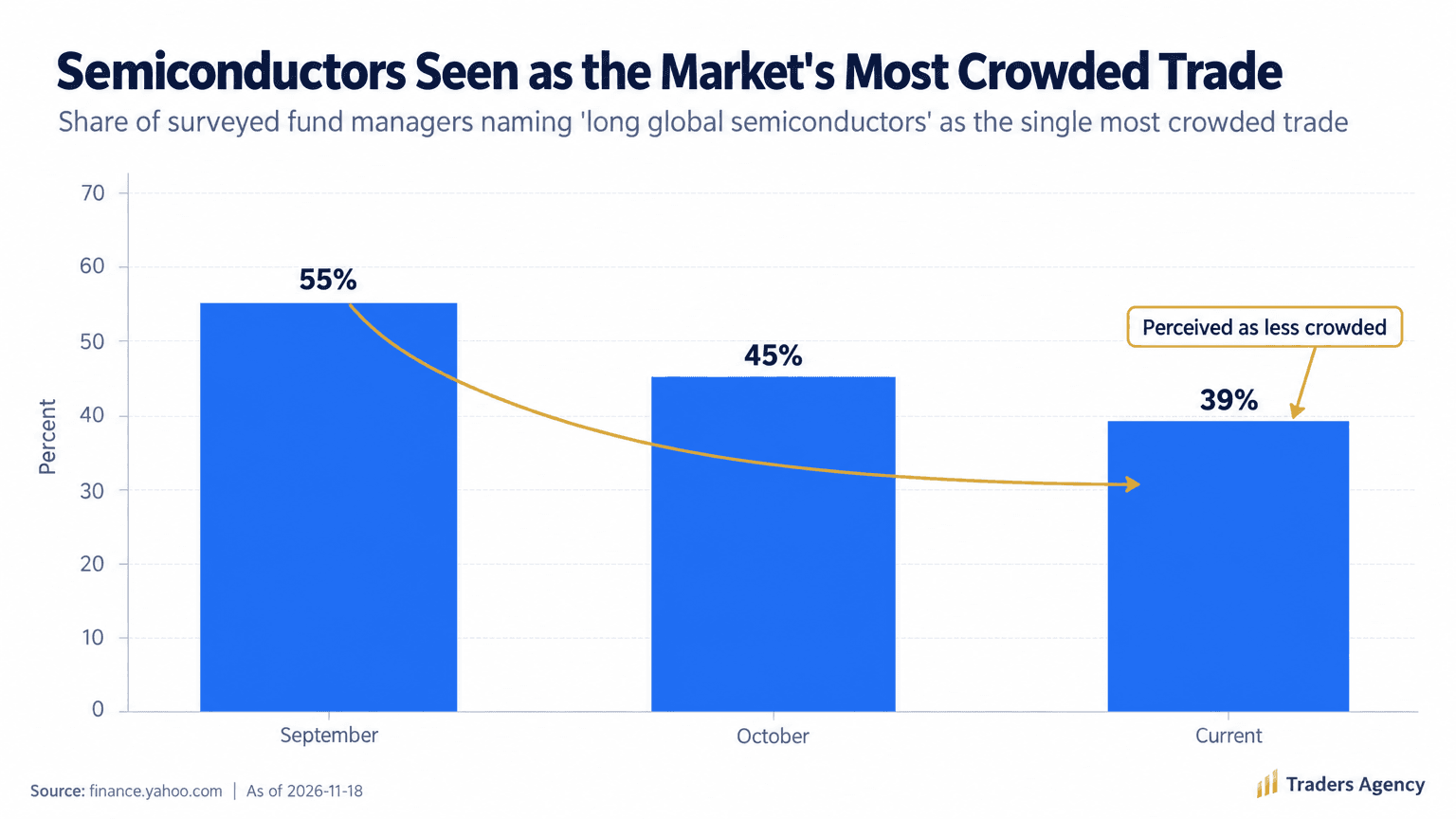
Technology, and semiconductors specifically, have become the epicenter of investor anxiety. A Bank of America fund-manager survey cited in the source found that 39% of respondents identified "long global semiconductors" as the market's most crowded trade, a notably lower reading than earlier in the fall. That is a measure of perceived crowding in the trade, not a literal tally of how many managers hold semiconductor positions, but the direction is clear: enthusiasm for the group has cooled.
The same survey found that 52% of respondents expect at least one AI hyperscaler to announce a capital-expenditure cut within six months, up sharply from 30% in October. That is meaningfully different from predicting an outright decline in industry-wide AI spending; it simply reflects rising odds that one major player trims guidance. Still, the shift in sentiment has been swift, and some investors point to credit-default-swap pricing on companies tied to AI infrastructure buildouts as staying elevated after an earlier spike, a sign that credit risk is being weighed alongside growth risk.
Adding to the uncertainty, NVIDIA's leadership is facing fresh scrutiny in Washington. House committee chairs announced on November 17 that Jensen Huang and NVIDIA general counsel Tim Teter had agreed to transcribed interviews scheduled for December 1 and December 2, respectively, concerning national-security and chip-access questions. That is a scheduled investigative step, not a finding of wrongdoing, but it adds another layer of headline risk for a sector already shedding positioning.
Morgan Stanley's Case for Staying in AI and Hyperscalers
Despite the selloff, Morgan Stanley has taken a notably constructive stance. The firm's strategists have described current positioning and sentiment indicators as approaching capitulation levels historically associated with market lows, while cautioning that a more hawkish Fed could stretch the bottoming process into December. Morgan Stanley's base-case 12-month S&P 500 target sits at 8,700, a view built on an outlook for continued, if slower, AI-driven earnings growth; the index itself was trading in the mid-7,000s in mid-November.
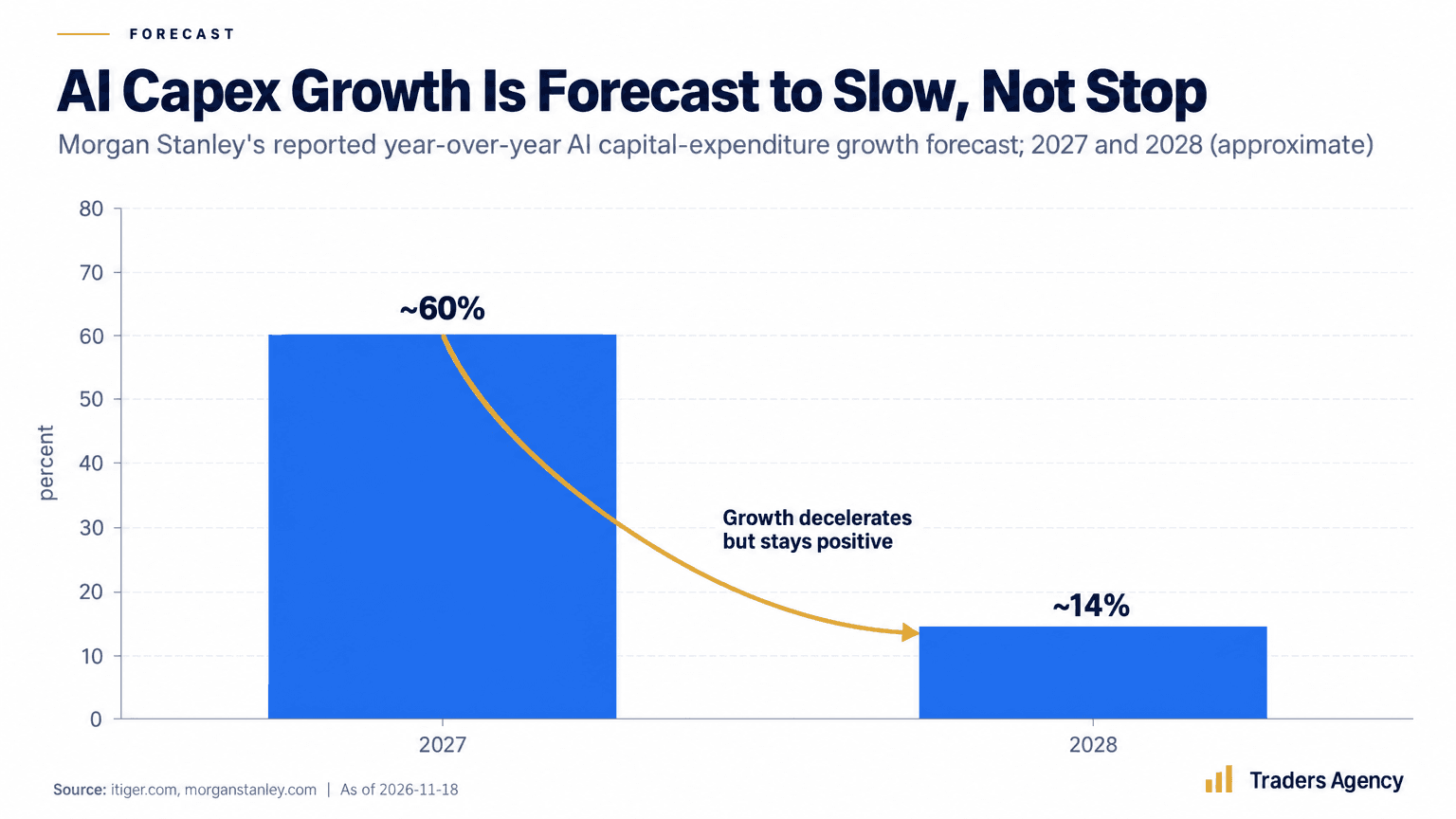
The firm's thesis hinges on a distinction that is easy to overlook: a slowdown in the growth rate of AI capital spending is not the same as a decline in absolute spending. Morgan Stanley's projections, as reported, point to AI-related capital expenditure growth of roughly 60% in 2027, decelerating to around 14% in 2028, translating into estimated hyperscaler spending near $1.6 trillion in 2027 and $1.8 trillion in 2028. Spending that continues to rise, even at a slower pace, still supports the companies selling the underlying infrastructure.
Policy developments add a layer of nuance. On November 16, the Bureau of Industry and Security issued an interim final rule addressing remote access to advanced computing by overseas customers, aimed at data centers abroad that supply significant compute capacity to restricted end users. The rule's actual licensing requirements depend on destination, customer and end-use conditions, not simply where a company is headquartered, a distinction that matters for how investors assess which AI infrastructure providers face export-control exposure. Morgan Stanley's broader preference leans toward hyperscalers and companies actively adopting AI tools, arguing that productivity gains may prove more durable than near-term spending growth rates suggest.
Want expert trading insights delivered daily?
Join thousands of traders who rely on Traders Agency for market analysis and trade ideas.
Join Traders AgencyGoldman Sachs Flags Hedge-Fund Buying in Consumer Discretionary
Goldman Sachs offers a contrasting near-term signal. Data from the firm's Prime Services desk, covering hedge-fund client activity for the week ending November 12, identified consumer discretionary as the most actively purchased sector among its tracked clients, while consumer staples was actually among the sectors seeing the largest outflows that same week, a meaningful distinction from any suggestion that both groups were attracting inflows simultaneously. This is a snapshot of one client base's recent trading, not a market-wide verdict, and sector rotations of this kind can reverse quickly. Even so, it illustrates a genuine divergence from Morgan Stanley's longer-horizon AI thesis: some investors appear to be seeking shelter in consumer names while the AI trade works through its current turbulence.
What the Numbers Say About Disney, Cheesecake Factory and Broadcom
To illustrate how valuation reasoning might apply across sectors, the walkthrough below uses hypothetical price-to-earnings-growth, or PEG, comparisons for three companies. These figures reflect the speaker's own illustrative assumptions about growth rates and fair-value multiples, not company guidance or confirmed analyst targets, and should be read as a scenario exercise rather than a forecast.
Under those assumptions, Disney was modeled trading near a 1.45 PEG against an assumed fair value of 2.0, implying theoretical upside if the market reassessed its growth prospects. Cheesecake Factory, by contrast, was modeled near a 2.0 PEG against an assumed fair value closer to 1.3, suggesting it may have benefited from a flight toward consumer-facing stocks rather than from a re-rating of its underlying growth. Broadcom was framed as potentially attractive under more conservative growth assumptions given its reported net margins, though the outcome depends heavily on which terminal growth rate an investor chooses to apply. None of these figures should be treated as price targets; they are sensitivity exercises meant to show how assumptions, not just headlines, drive valuation conclusions.
A Market Still Finding Its Footing
Taken together, the picture is one of a market negotiating two competing stories at once. Easing oil prices offer modest relief on inflation even as the Iran situation remains unresolved and the Fed stays cautious. Semiconductor positioning has thinned out sharply, reflecting real concerns about AI capex timing, export policy and credit risk, while Morgan Stanley argues the long-term productivity case for hyperscalers remains intact. Goldman's data, meanwhile, shows near-term money gravitating toward consumer names. Traders Agency analysts will be watching whether the AI capex deceleration proves temporary or whether consumer-sector momentum extends further, since the answer will likely determine which of these two institutional views holds up first.
Want expert trading insights delivered daily?
Join thousands of traders who rely on Traders Agency for market analysis and trade ideas.
Join Traders AgencyDISCLAIMER: Traders Agency does not offer financial advice. The information provided is for educational purposes only and should not be considered financial advice. Traders Agency is not responsible for any financial losses or consequences resulting from the use of the information provided. Trading carries inherent risks and may not be suitable for all individuals. You are advised to conduct your own research and seek personalized advice before making any investment decisions, recognizing the potential risks and rewards involved.
- Allianz Research: Inflation Outlook, November 13, 2026
- The Oil Market Is Brimming With Crude Despite Tanker Attacks
- ING: The Commodities Feed, November 10, 2026
- EU Statement: NPT Safeguards Agreement with Iran, November 2026
- Betting on chip stocks remains the most crowded trade by far, BofA’s survey finds
- Guinness Global Equity Income: November 2026 Commentary
- Guardian Capital: Macro Musings, November 2026
- Morgan Stanley: Thoughts on the Market
- Reuters: Morgan Stanley raises global equities to maximum overweight
- Morgan Stanley Rethinks AI Trade After Capitulation Selling
- BIS Issues Rule Addressing Remote Access to American Super Intelligence Technology
- Federal Register: Advanced Computing Remote-Access Interim Final Rule
- Hedge funds sell U.S. stocks for second week, Goldman says
- Jensen Huang and Nvidia Agree to Appear Before Congress
See more from Traders Agency on Google
Make us a preferred source and our market analysis will appear more prominently in your Google Search, Top Stories, and AI results.
Add to Preferred Sources