The latest round of 13F filings paints a mixed picture of how prominent money managers are positioning for the months ahead. One fund made a dramatic pivot away from payment networks and credit-ratings companies toward semiconductors and cloud giants, while several others barely touched their portfolios at all. Layered on top of that filing data are fresh questions about Nvidia's leadership, a notable Amazon entertainment bet, and a public moment that highlighted the gap between what some AI commentators say and how they invest their own money.
Valley Forge Capital Rotates From Ratings Agencies Into Chips
Valley Forge Capital Management, run by Dev Kantasaria, has reportedly been going through a difficult stretch, with commentary describing it as the fund's longest period of underperformance since its founding, though the exact measurement window wasn't specified. Much of that pressure has reportedly centered on Fair Isaac, the company behind the FICO credit score. Fair Isaac reportedly once represented roughly 30% of the portfolio, and its shares are said to have fallen from around $2,400 to about $700 — a decline that alone would sharply shrink the position's weight even without major selling. Notably, the fund's own trimming of that stake has reportedly been modest.
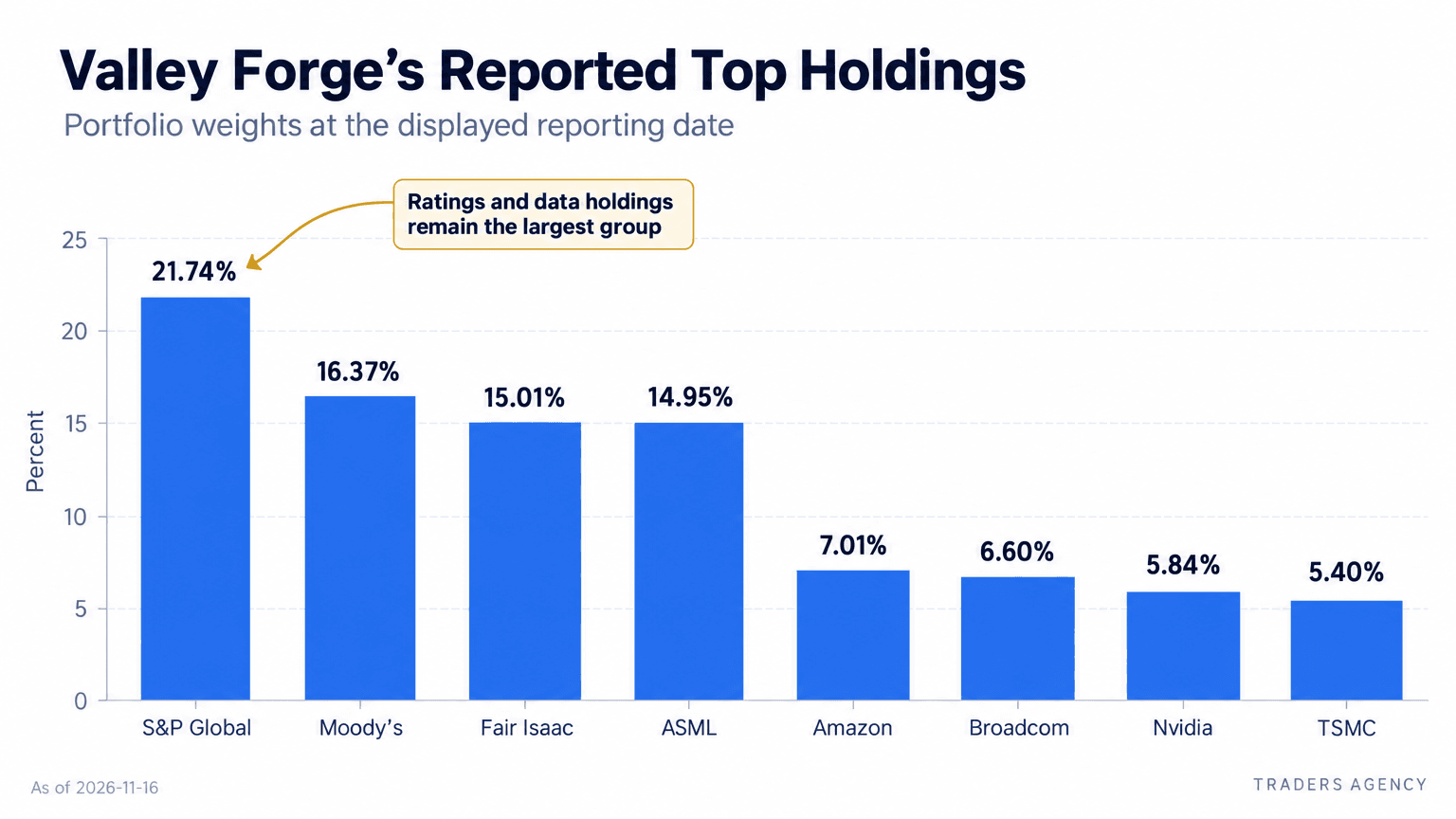
The quarter's activity table tells a clearer story. Valley Forge reportedly cut Mastercard by 84.10%, Moody's by 30.82% and Visa by 48.55%, while exiting Intuit entirely. At the same time, it added new or expanded positions in Amazon, Broadcom, Nvidia, Taiwan Semiconductor Manufacturing Company (TSMC) and ASML. Even after that shift, the portfolio's largest weights were still S&P Global at 21.74%, Moody's at 16.37%, Fair Isaac at 15.01% and ASML at 14.95%, with Amazon, Broadcom, Nvidia and TSMC trailing at 7.01%, 6.60%, 5.84% and 5.40%, respectively. In other words, the fund remains anchored in ratings and financial-data businesses even as its technology exposure has grown meaningfully.
The investment reasoning behind these moves centers on long-term structural advantages. Amazon was framed as a business with retail, advertising, cloud computing and streaming exposure, with automation eventually offering a path to higher retail margins, though that remains a forward-looking possibility rather than a current result. TSMC and ASML were characterized as companies with unusually durable competitive positions, with Taiwan-related geopolitical risk flagged as the main offsetting concern for TSMC. One timing wrinkle worth noting: because the filing reflects activity before the September 30 reporting date, the Broadcom and Nvidia purchases may have been made before a subsequent pullback in chip stocks, a reminder that 13F snapshots show positions at a point in time rather than the price an investor ultimately paid or the position held today.
Other Prominent Investors Stay the Course
Not every manager made sweeping changes this quarter. Chris Hohn's TCI Fund Management portfolio looked largely similar to prior periods, with GE Aerospace, Visa, Moody's and S&P Global making up the bulk of the fund at reported weights of 29.83%, 22.02%, 13.08% and 11.20%. Berkshire Hathaway's public equity book likewise stayed concentrated in familiar names such as Apple, American Express and Coca-Cola, with the filing showing only a small reduction in Bank of America.
Smaller managers showed a bit more movement. Josh Tarasoff reportedly raised his allocation to short-term Treasuries to roughly 9% of the portfolio and exited his Netflix position entirely, a shift that reads as a modestly more defensive posture. Pat Dorsey's fund, meanwhile, reportedly added two new software and cloud positions identified as Veeva Systems and Tyler Technologies, alongside additions to AppLovin, Meta, S&P Global, Booking Holdings and Uber. Dorsey also reduced his ASML stake, echoing the gains-taking seen elsewhere this quarter.
Want expert trading insights delivered daily?
Join thousands of traders who rely on Traders Agency for market analysis and trade ideas.
Join Traders AgencyNvidia's Leadership Shake-Up and China Revenue Questions
Nvidia has remained a focal point well beyond its stock price. Jensen Huang, the company's longtime chief executive, stepped down effective November 11, 2026. In the days that followed, a public campaign emerged pushing for his reinstatement, but reporting that cited a person familiar with the matter said Nvidia's board was not considering bringing him back as of November 16.
The backdrop to the departure involves more than a simple leadership transition. On November 8, Nvidia's board said it had opened an independent investigation into reports that Huang had been targeted by a foreign intelligence effort, while adding that it had no reason at that time to believe national security or company secrets had been compromised. Separately, lawmakers have sought information about Huang's relationship with a former executive at Megaspeed and about Nvidia's security protocols. None of this has established that Nvidia made unauthorized chip sales or that confidential information was actually compromised, and the matter should be understood as an ongoing inquiry rather than a settled conclusion.
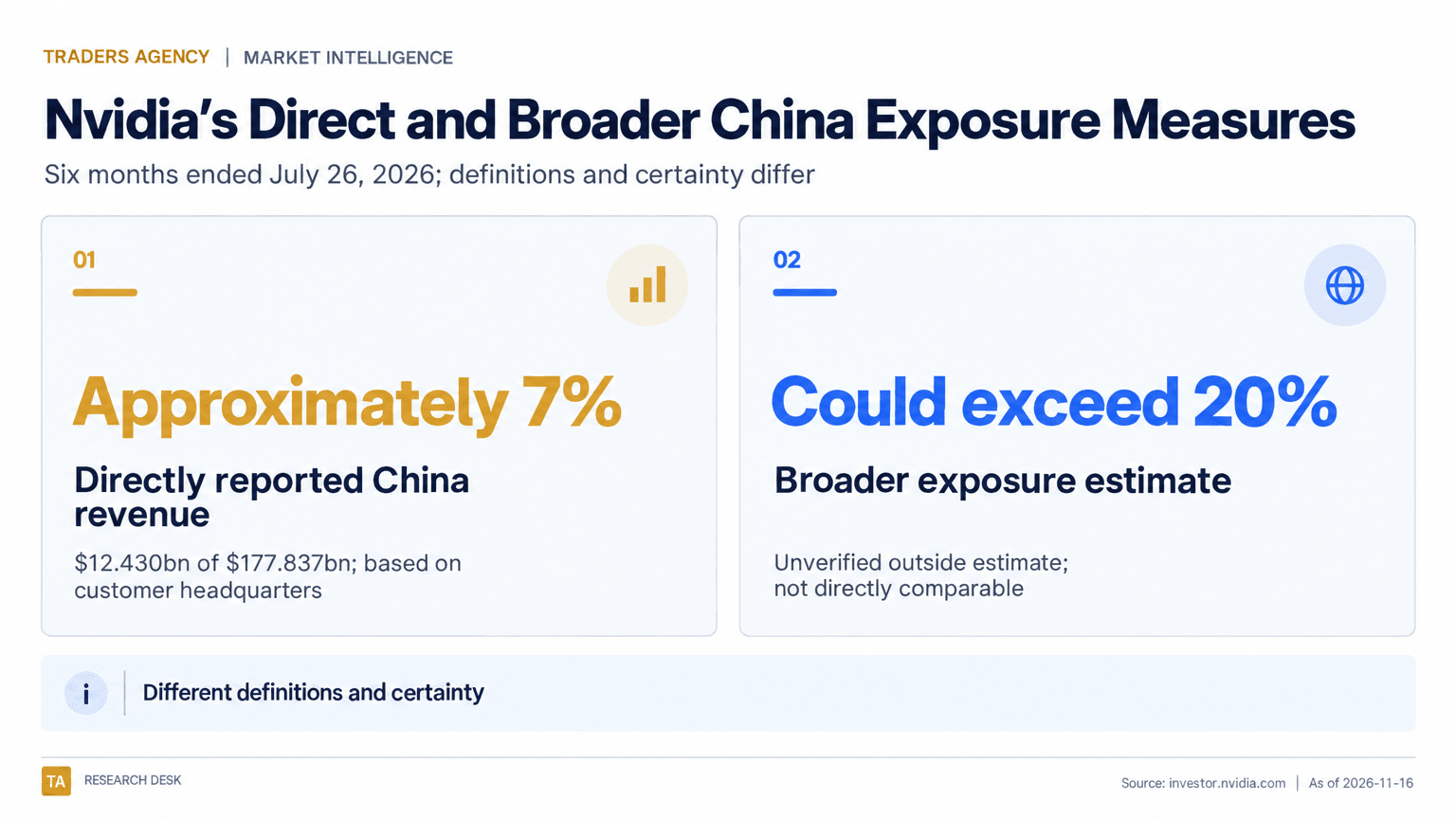
China exposure adds another layer to the story. Nvidia's own disclosures show $12.43 billion in revenue attributed to customers headquartered in China, including Hong Kong, for the six months ended July 26, 2026, which works out to roughly 7% of its $177.84 billion in global revenue over that period. That figure reflects where customers are headquartered, not necessarily where chips ultimately end up. A broader, less precisely sourced estimate points to indirect exposure — including demand tied to data centers across Southeast Asia — that could exceed 20% of revenue, though the methodology behind that figure isn't fully specified and it should not be treated as directly comparable to the company's reported figure. Traders Agency analysts will be watching whether Nvidia provides further detail on this distinction in upcoming disclosures.
Amazon's Next Big Swing: A New James Bond
Away from the filings, Amazon made entertainment news by casting Robert Pattinson as James Bond, with Denis Villeneuve set to direct. For a company that owns the franchise outright, the project carries real stakes. A successful run could strengthen Amazon's streaming and studio ambitions, following a mixed reception for its earlier Lord of the Rings series. As with any major film production, creative and commercial outcomes remain uncertain, and the eventual box office or streaming performance won't be known for some time.
A Reminder on Conflicts of Interest in AI Commentary
A recent public interview, reported to feature AI researcher and commentator Jacob Coxon, drew attention for a different reason. After warning publicly about severe risks from artificial intelligence, Coxon reportedly acknowledged in the exchange that he still held OpenAI equity from his time working there and explained that he valued the financial benefit of keeping it. The moment raises a fair question for investors and the public alike: how should outside observers weigh warnings from industry voices who retain a direct financial stake in the companies they're commenting on. It's a useful reminder to separate the substance of a risk argument from the incentives of the person making it.
The Bottom Line
This quarter's 13F filings show that big shifts and quiet continuity can coexist across the investing landscape. Valley Forge's move into semiconductors and cloud exposure signals a manager willing to rotate meaningfully even during a rough stretch, while Berkshire Hathaway and Chris Hohn's fund illustrate that conviction can also mean doing very little. Meanwhile, Nvidia's leadership transition and China revenue questions remain unresolved stories worth following closely, as does Amazon's bet that a new Bond can deliver the kind of franchise win the company is looking for.
Want expert trading insights delivered daily?
Join thousands of traders who rely on Traders Agency for market analysis and trade ideas.
Join Traders AgencyDISCLAIMER: Traders Agency does not offer financial advice. The information provided is for educational purposes only and should not be considered financial advice. Traders Agency is not responsible for any financial losses or consequences resulting from the use of the information provided. Trading carries inherent risks and may not be suitable for all individuals. You are advised to conduct your own research and seek personalized advice before making any investment decisions, recognizing the potential risks and rewards involved.
- Valley Forge Capital Management Q3 2026 EDGAR filing
- Valley Forge Capital — Q3 2026 13F — Berry Trail
- DATAROMA — Valley Forge Capital Management holdings
- Valley Forge Capital Management Q3 2026 portfolio changes
- Dorsey Asset Management Q3 2026 EDGAR filing
- Dorsey Asset Management Q3 2026 portfolio changes
- Pat Dorsey portfolio: Dorsey Asset Management Q3 2026 13F
- NVIDIA Form 8-K — November 2026 leadership changes
- Campaign to bring back Jensen Huang as Nvidia CEO gains steam with Trump support
- Nvidia board not weighing Huang’s return as CEO
- Statement from NVIDIA Board of Directors — November 8, 2026
- Congressional request for a briefing on NVIDIA security protocols and Jensen Huang
- NVIDIA fiscal 2027 second-quarter Form 10-Q
- Robert Pattinson cast as James Bond for the next 007 film
- Stanford HAI — A Conversation with Jacob Coxon & Rob Reich
- A Conversation with Jacob Coxon & Rob Reich — interview transcript
See more from Traders Agency on Google
Make us a preferred source and our market analysis will appear more prominently in your Google Search, Top Stories, and AI results.
Add to Preferred Sources