

Hey, Ross here:
Welcome back to a new week.
With softer inflation data… new highs… lower volatility… and broad participation…
Many are asking the question – is the market getting complacent?
Let’s take a look.
Chart of the Day
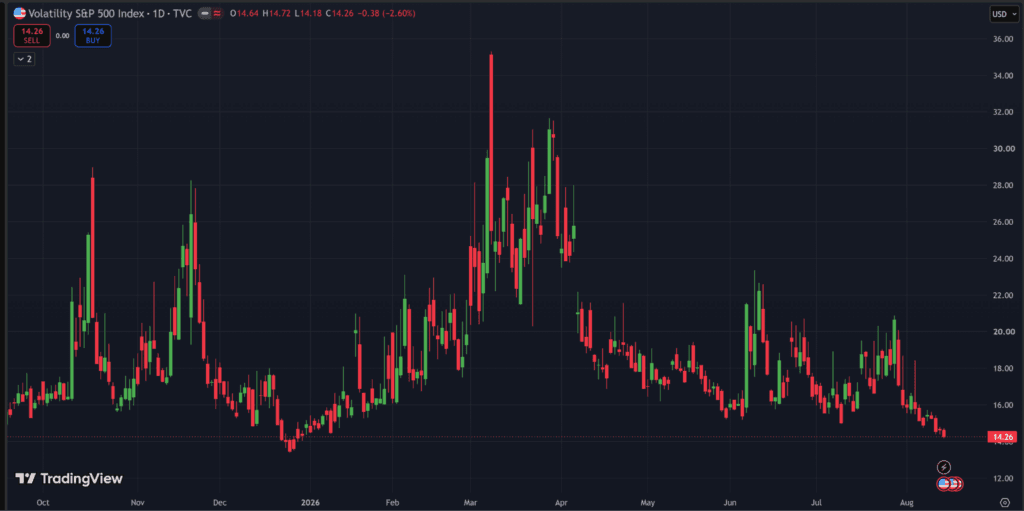
This is the Volatility Index (VIX).
And as you can see, in recent days, it has collapsed to below 15 – its second-lowest reading in a year.
At the same time, the S&P 500 is less than 0.1% off a new high, which it hit last Thursday.
This low volatility + new high combination can naturally seem like a recipe for complacency.
And while I’m not dismissing the need to be vigilant…
Historical data shows that this is generally speaking a good thing.
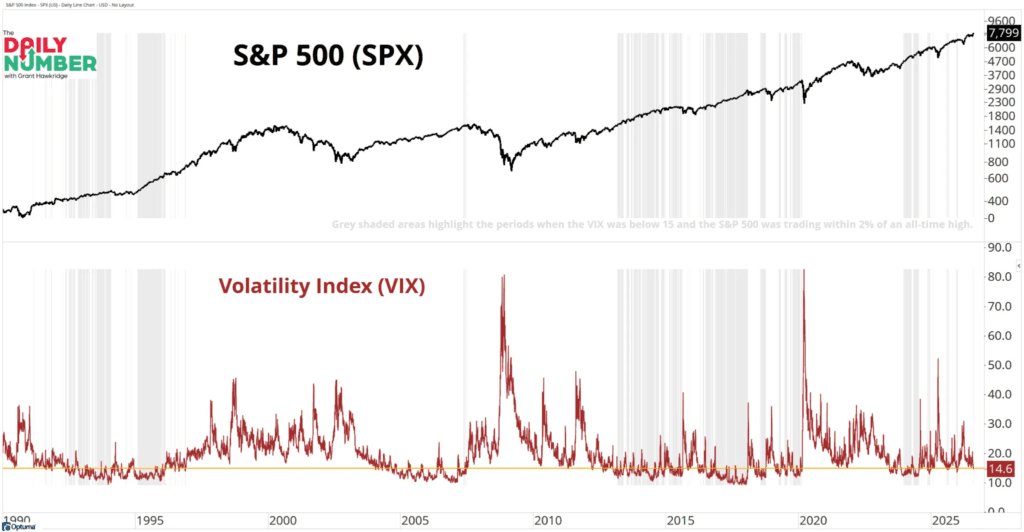
The gray areas mark every period when two things happened at the same time:
The VIX was below 15…
And the S&P 500 was within 2% of an all-time high.
You might expect that kind of calm to come right before trouble.
Historically, it usually didn’t.
Twelve months later, the S&P 500 was higher 84.4% of the time.
The average gain was 10.8%.
And the median gain was even better at 12.1%.
So low volatility near the highs hasn’t generally been a reason to run for cover.
Quite the opposite.
It has usually shown up during healthy bull markets that had more room to run.
But if this bull market does keep going…
There’s another shift underway that could tell us where some of the better opportunities show up next.
Take a look:
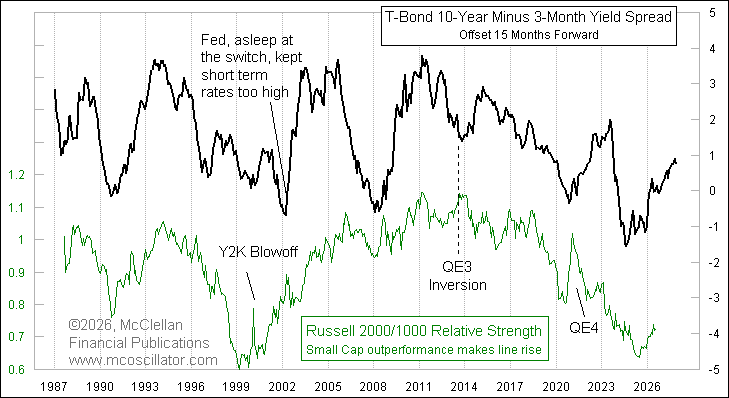
The green line tracks the relative performance of the Russell 2000 versus the Russell 1000.
When it rises, small caps are beating large caps.
And after years of getting crushed…
Small caps have finally started turning higher.
The black line gives us another reason to watch this closely.
It shows the spread between the 10-year Treasury yield and the 3-month yield, shifted 15 months forward.
Historically, that relationship has done a surprisingly good job of leading the relative performance of small caps.
And right now, it points higher.
If that relationship holds, the small-cap comeback may have a lot further to run.
Which is exactly why I wouldn’t be so quick to fade this market.
There’s a trap in trying to be too clever here.
I explain below.
Insight of the Day
Stop trying to be contrarian all the time
Being contrarian can feel sophisticated.
You’re not chasing the crowd. You’re thinking independently. And every so often, you’ll catch a turn before everyone else.
But none of that makes contrarianism a trading strategy.
Most of the time, markets trend.
And when a trend is healthy, constantly looking for reasons to bet against it can keep you on the sidelines for a long time.
That’s especially true in a bull market.
Low volatility doesn’t automatically mean complacency.
New highs don’t automatically mean stocks are overextended.
And a trade becoming popular doesn’t mean it’s about to reverse.
You still need evidence that the move is actually weakening.
Right now, I’m seeing the opposite.
The market remains near its highs, volatility is low, and small caps are finally starting to participate after years of lagging.
So instead of trying to call the top, I want to see whether the biggest players in the market are still adding fuel.
I’ll reveal exactly how I do that tomorrow morning – so keep an eye out for that.
In the meantime, here is the one market warning sign you actually want to be paying attention to.
Customer Story of the Day
“I started a few months ago and started implementing the simple strategy with $1000 and have seen a return of over $300.
Ross makes trading very understandable and if you follow along you will make money even with the losers.
Probably the best thing you learn is risk management!”

Ross Givens
Editor, Stock Surge Daily
See more from Traders Agency on Google
Make us a preferred source and our market analysis will appear more prominently in your Google Search, Top Stories, and AI results.
Add to Preferred Sources