Fresh inflation data and an unresolved standoff with Iran are reshaping how traders think about the Federal Reserve's next moves. Producer and consumer prices both ran hotter than expected this week, energy costs are climbing again, and officials at the Fed are openly questioning whether inflation is still headed toward its 2% target. Taken together, the backdrop looks less like a Fed preparing to ease and more like one bracing for additional tightening.
Producer and Consumer Prices Run Hotter Than Expected
October's Producer Price Index told a mixed but ultimately concerning story. Headline PPI rose 6.5% year over year, just under the 6.6% consensus, with the monthly figure at 0.3% versus an expected 0.4%. On the surface, that looks like a modest cooling. But strip out food, energy and trade services, and the picture flips: core producer prices rose 0.5% for the month and 4.9% over the past year, both signaling that underlying price pressure has not eased.
Consumer prices followed a similar pattern. Headline CPI rose 0.4% month over month, with core CPI up 0.3%, each a tenth of a percentage point above consensus estimates of 0.3% and 0.2%. September's PPI readings were also revised higher, with the headline figure now shown at 1.4% and the core measure at 0.8%, both a tenth above initial estimates. None of these are dramatic misses on their own, but the consistent direction, upward, is what has caught the Fed's attention.
How Energy and Freight Costs Could Shape Fed Policy
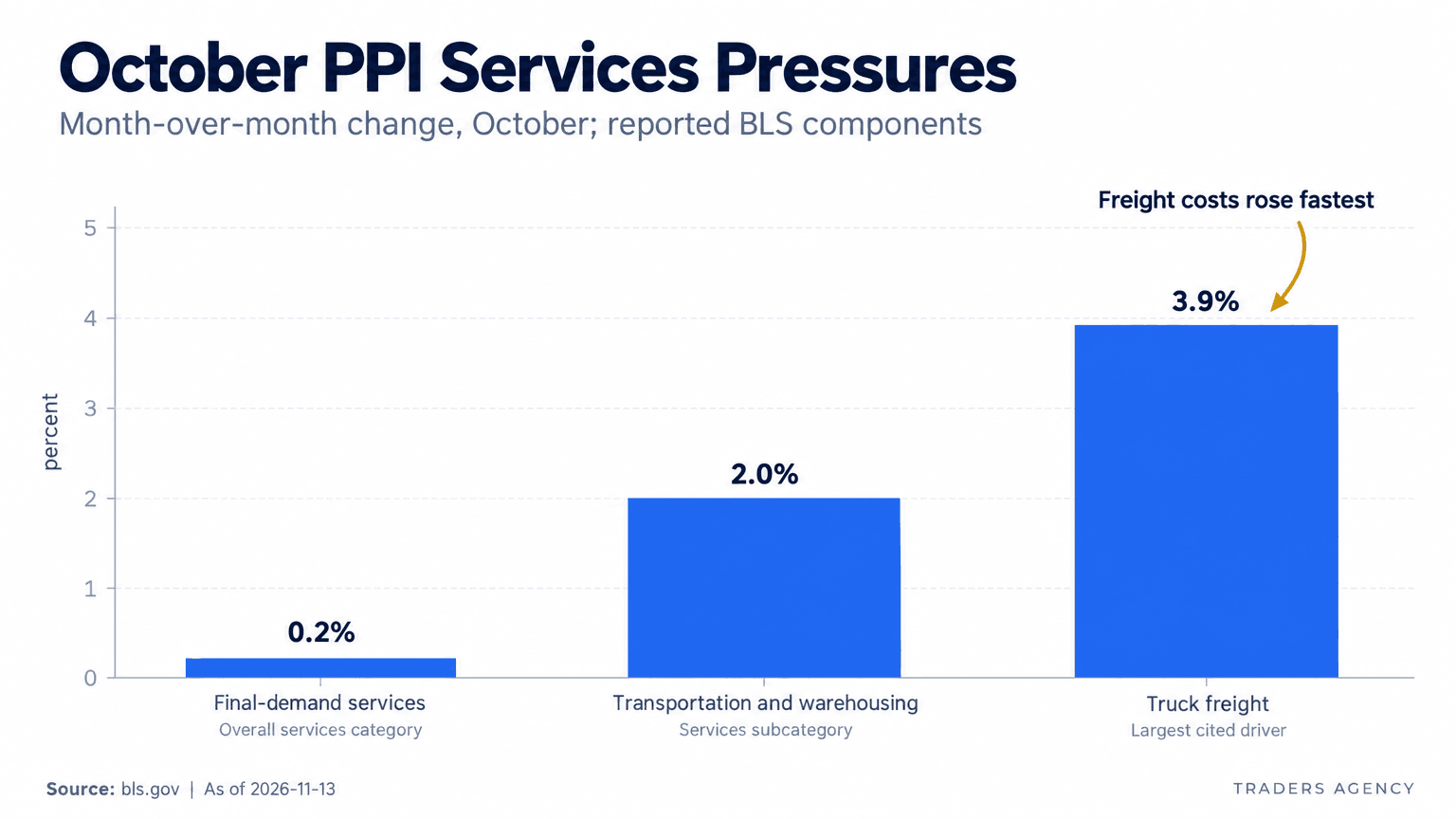
A closer look at October's PPI data points to transportation as a key driver. Final-demand services rose 0.2% for the month, but transportation and warehousing costs jumped 2.0%, and truck transportation of freight alone rose 3.9%. According to the Bureau of Labor Statistics, truck freight accounted for the large majority of October's increase in final-demand services. That matters because freight costs are closely tied to oil prices, which have climbed back toward $96 a barrel after dipping below $90 at the end of October.
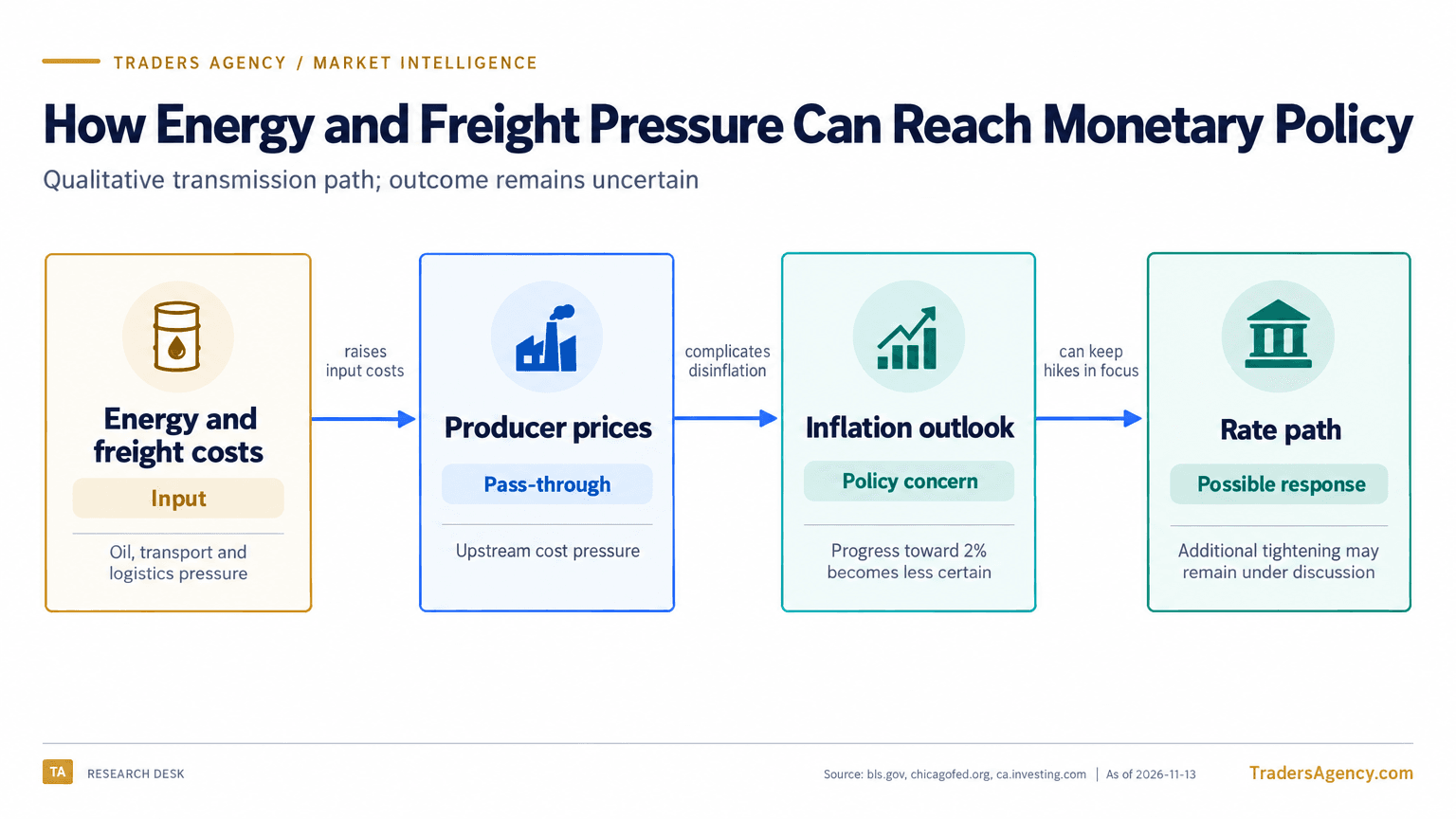
The mechanism is straightforward: higher oil prices raise shipping and logistics costs, those costs feed into producer prices, and persistent producer-price pressure makes it harder for the Fed to argue that inflation is reliably moving toward 2%. If energy prices continue climbing, that chain could keep additional rate hikes on the table longer than markets had been pricing just a few weeks ago.
Fed Officials Point to More Tightening Ahead
Chicago Fed President Austan Goolsbee did not mince words this week. Asked directly whether inflation is on a path back to 2%, he said, "My feeling is we are not on track." He also noted that the labor market remains stable and may even be tightening, and he pointed to AI-related demand and lingering effects from earlier tariffs as possible contributors to current price pressures. Those specific causal links are his interpretation rather than settled data, but his conclusion was unambiguous: if inflation trends keep deteriorating, the Fed may need to act, and act firmly.
Fed Governor Michelle Bowman echoed a related concern in remarks on November 10. She said that even a relatively quick resolution to the Middle East conflict might not bring energy prices down quickly, since projected demand could continue to outpace supply while inventories remain depleted. In other words, ending the conflict and cooling energy prices are not necessarily the same thing on the same timeline.
Want expert trading insights delivered daily?
Join thousands of traders who rely on Traders Agency for market analysis and trade ideas.
Join Traders AgencyIran, Oil Supply and the Case for Lower Prices
The geopolitical backdrop remains genuinely unsettled. On November 13, Iran's Revolutionary Guard said it had struck a U.S. early-warning radar installation in Bahrain. U.S. Central Command disputed that account, saying no strike succeeded and that American forces intercepted two Iranian attack drones, with no reported injuries or damage. Disputes like this underscore how quickly the region's risk calculus can shift, and traders are watching closely for signs of further escalation that could ripple through energy markets.
Not everyone agrees oil prices are destined to stay elevated, however. Some observers argue that Gulf oil exports have already climbed above prewar levels, which would suggest supply has adjusted and that a genuine diplomatic breakthrough with Iran could still send crude prices sharply lower rather than keep them stuck near current levels. That counterargument matters for the inflation outlook: if energy costs fall meaningfully, much of the freight-driven pressure in producer prices could unwind just as quickly as it appeared.
Markets Adjust to a More Hawkish Outlook
Financial markets have responded to this mix of hot data and geopolitical uncertainty by pricing in a more aggressive Fed. Traders in interest-rate futures were described as shifting toward pricing in continued tightening at upcoming meetings, a shift framed as a notable change from the more dovish pricing seen roughly a week and a half earlier. As of November 13, bitcoin had fallen under $70,000, and the 10-year Treasury yield climbed to roughly 5.14%, both consistent with markets bracing for tighter financial conditions. The 10-year/2-year Treasury spread, meanwhile, held near 0.28 percentage points, which suggests the yield curve has not tipped into the kind of inversion that often signals acute recession fears. Traders Agency analysts are watching whether upcoming CPI and PPI prints, along with any shift in the Iran standoff, confirm or reverse this hawkish repricing.
Trade Policy Frictions Add to the Noise
Beyond inflation and oil, trade policy remains a source of friction. Treasury Secretary Scott Bessent said this week he remains hopeful that a trade agreement with Mexico and Canada can be reached soon, though the timeline has already slipped well past earlier expectations. Bessent was also reported as suggesting a disagreement between agencies over semiconductor export controls, with the Treasury Department described as having favored tighter restrictions that the Commerce Department did not pursue as aggressively. That characterization of interagency conduct has not been independently confirmed and should be treated as an allegation rather than an established account of government policy.
What It Means for Investors
The overall picture is one of genuine uncertainty rather than a settled forecast. Hot inflation readings, rising energy costs and an unresolved conflict with Iran are pushing markets to price in more Fed tightening, and officials like Goolsbee and Bowman have reinforced that message in public remarks. At the same time, the counterargument that oil supply has already normalized, paired with the possibility of a diplomatic resolution, means this narrative could shift quickly if energy prices roll over. For now, investors should treat the current hawkish repricing as a reasonable response to the available data, not as a locked-in outcome.
Want expert trading insights delivered daily?
Join thousands of traders who rely on Traders Agency for market analysis and trade ideas.
Join Traders AgencyDISCLAIMER: Traders Agency does not offer financial advice. The information provided is for educational purposes only and should not be considered financial advice. Traders Agency is not responsible for any financial losses or consequences resulting from the use of the information provided. Trading carries inherent risks and may not be suitable for all individuals. You are advised to conduct your own research and seek personalized advice before making any investment decisions, recognizing the potential risks and rewards involved.
- Producer Price Indexes — October 2026
- U.S. Political, Economic Calendar — Week Ahead
- Consumer Price Index — October 2026
- Weekly market note: the S&P 500, sectors, breadth and the economy
- Office of the President: Media Appearances
- Goolsbee says Fed not on track to hit 2% inflation target
- The U.S. Economy and Considerations for Monetary Policy
- Houthi control of Bab al-Mandab Strait poses new threat to global economy
- RFE/RL report reproducing CENTCOM's November 13 statement
- Federal Reserve Board — Calendar: December 2026
- Bitcoin on November 13, 2026: pre-market brief and outlook
- US Treasury's Bessent says he is optimistic on trade deals with Canada, Mexico
See more from Traders Agency on Google
Make us a preferred source and our market analysis will appear more prominently in your Google Search, Top Stories, and AI results.
Add to Preferred Sources