
An FDA advisory panel voted 7-2, with one abstention, on Sept. 23, 2026, that the benefits of GRAIL's Galleri multi-cancer early detection blood test outweigh its risks for adults 50 and older, according to a GRAIL statement. The Molecular and Clinical Genetics Devices Panel also voted unanimously that Galleri is safe, but split 6-4 on whether the test has demonstrated effectiveness, the closest and most contested of the three questions put to committee members.
The vote marks the first time a federal advisory group has endorsed a multi-cancer screening blood test, according to Houston Public Media. The FDA is not bound by the panel's recommendation, though the agency takes it into account when reaching a final decision, which GRAIL said is expected in the coming months. No specific decision date was indicated at the meeting, per Houston Public Media's reporting. Ahead of the panel, GRAIL CEO Josh Ofman told analysts the company continues to expect FDA approval in the first part of 2027, according to MedTech Dive.
What Split the Committee on Effectiveness
The narrower 6-4 vote reflected disagreement over how to interpret the same underlying data. GRAIL's primary study, the 140,000-person NHS-Galleri trial in the U.K., found the test detected about 30% of cancers diagnosed over a one-year period, and roughly two-thirds of patients who received a "cancer signal detected" result were later confirmed to have cancer, according to WBTV and the Chicago Tribune.
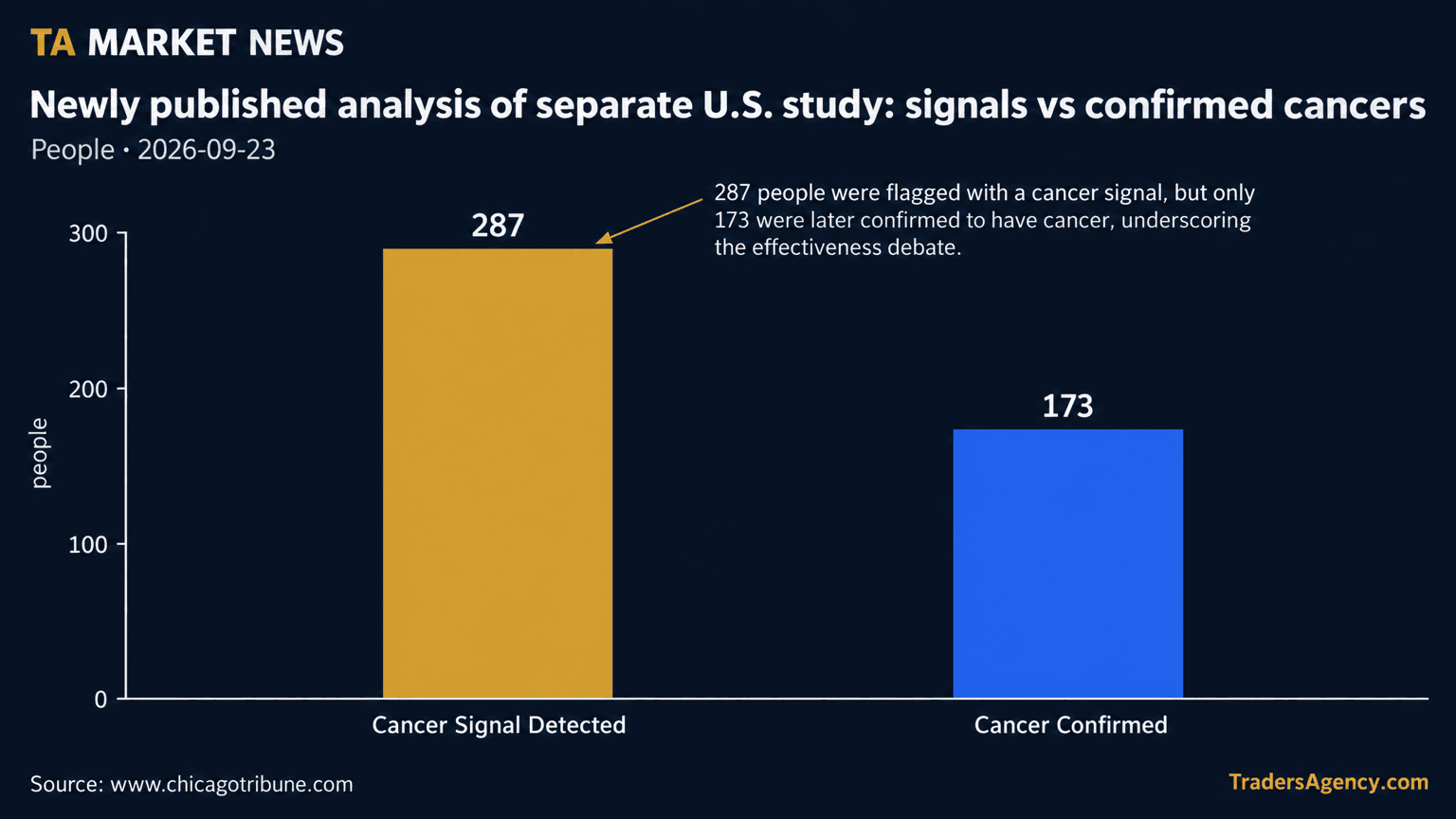
FDA's own chief reviewer framed the same data differently, pointing out the test missed two of three cancers diagnosed in the following year and was less accurate at detecting early-stage disease, when treatment is easier and more likely to benefit patients, WBTV reported. A newly published analysis of a separate U.S. study, cited by the Chicago Tribune, found the test flagged a cancer signal in 287 people, of whom 173 were eventually diagnosed with cancer. By our calculation, that leaves a gap of 114 people between signals flagged and cancers confirmed (287 − 173 = 114), a group equal to roughly 66% of the 173 confirmed cases (114 ÷ 173 = 65.9%). The test performed better on less common cancers such as liver and ovarian than on common cancers like prostate, per the Tribune.
GRAIL did not present data showing that screening with Galleri reduces cancer deaths, a metric that would have required years of additional follow-up beyond what its studies were designed to capture, WBTV and the Tribune both reported. The panel also declined to endorse marketing the test as an "early detection" tool, concluding it had not demonstrated effectiveness for that specific claim, and recommended labeling stating the test should supplement, not replace, routine cancer screenings and that a negative result does not rule out cancer, according to Houston Public Media and WBTV.
Dissenting voices at the meeting included Castle, chief of the National Cancer Institute's cancer prevention division, who told the panel the performance data were too premature to prove clinical benefit and warned that "routine approval and broad population rollout would risk harm and waste resources," per Houston Public Media. Diana Zuckerman of the National Center for Health Research raised a related concern in public comment, warning that patients who receive an all-clear result may delay seeking care if symptoms later emerge, WBTV reported. Even one panelist who voted yes, Dr. Victor van Berkel of UofL Physicians in Louisville, Kentucky, characterized his vote as provisional, saying, "Perhaps my yes is a hopeful rather than an accurate one," per WBTV and KIRO7.
Regulatory Path and Commercial Stakes
GRAIL submitted its premarket approval application, the first ever for a multi-cancer early detection test, on Jan. 29, 2026; the FDA had designated Galleri a Breakthrough Device back in 2018, according to GRAIL and CLP Magazine. The submission rests on performance and safety data from 25,490 participants with one year of follow-up in the U.S.-based PATHFINDER 2 study, plus more than 70,000 participants from the NHS-Galleri intervention arm, bridged by an analysis comparing the trial-era test version with the updated version now under review, per CLP Magazine and the Chicago Tribune.
CDRH director Michelle Tarver called multi-cancer blood testing "a genuinely promising opportunity" while cautioning that "technologies with this kind of reach and novelty demand careful, rigorous evaluation," according to Houston Public Media. GRAIL CEO Ofman said the vote "reinforces the strength of Galleri's clinical evidence" and that the panel's recommendations "reaffirm a high evidence bar that GRAIL has set for a multi-cancer early detection test," per the company's statement, adding that more than 200 physicians, nurses, professional societies and patient advocates submitted supportive comments through the public docket.
Galleri has been sold in the U.S. since 2021 as a laboratory-developed test by prescription, with most patients paying out of pocket at a $949 list price, according to KIRO7 and Houston Public Media. GRAIL sold more than 61,000 Galleri tests in the second quarter of 2026, a 35% increase in volume year over year, and reported 117,000 tests taken in the first half of the year, per MedTech Dive and KIRO7.
FDA approval would open the door to Medicare and private insurance coverage. Congress has already authorized Medicare to cover FDA-approved multi-cancer detection tests, with legislation backed by GRAIL permitting Medicare coverage of Galleri beginning in 2028 if the agency approves it, according to KIRO7 and Houston Public Media. Ahead of the panel meeting, TD Cowen analyst Dan Brennan wrote that the FDA sides with its advisory committees roughly 80% of the time and put the odds of eventual approval at 75%, according to MedTech Dive. By our calculation, that is a five-percentage-point gap between the historical concurrence rate and Brennan's approval estimate (80 − 75 = 5); because the note was written before the committee met, it does not reflect the outcome of the effectiveness vote.
Galleri would be the first FDA-approved multi-cancer early detection test on the market and is widely viewed as a bellwether for competitors, including Abbott's CancerGuard, which is also pursuing approval, per MedTech Dive and Houston Public Media.
Bottom Line
The panel's split verdict, a strong benefit-risk endorsement alongside a much narrower effectiveness vote, signals that regulators and outside experts see real promise in blood-based multi-cancer screening but remain unsettled on how well Galleri actually performs, particularly on early-stage and common cancers, and on whether it changes survival outcomes. The FDA's final decision, expected within months and by GRAIL's own timeline potentially in early 2027, will determine whether the test moves from a self-pay laboratory offering toward broader, insurance-backed use starting with Medicare's 2028 coverage window.
DISCLAIMER: Traders Agency does not offer financial advice. The information provided is for educational purposes only and should not be considered financial advice. Traders Agency is not responsible for any financial losses or consequences resulting from the use of the information provided. Trading carries inherent risks and may not be suitable for all individuals. You are advised to conduct your own research and seek personalized advice before making any investment decisions, recognizing the potential risks and rewards involved.
- GRAIL: FDA Advisory Committee Votes In Favor of Approval of GRAIL's Galleri® Multi-Cancer Early Detection Test · accessed Sep 24, 2026
- clpmag.com: FDA Panel to Review GRAIL Galleri Multi-Cancer Blood Test in Sept 2026 · accessed Sep 24, 2026
- www.houstonpublicmedia.org: FDA advisory panel recommends a first: multi-cancer blood test · accessed Sep 24, 2026
- cancerletter.com: FDA advisory committee to vote on GRAIL’s multi-cancer detection test, Galleri · accessed Sep 24, 2026
- www.wbtv.com: FDA panel endorses blood test that can detect more than 50 cancers · accessed Sep 24, 2026
- www.medtechdive.com: FDA sets advisory panel for Galleri multicancer screening test · accessed Sep 24, 2026
- www.kiro7.com: FDA panel endorses blood cancer test from Grail · accessed Sep 24, 2026
- www.chicagotribune.com: Grail’s cancer blood test faces high-stakes FDA review · accessed Sep 24, 2026
- grail.com: GRAIL to Announce Second Quarter 2026 Financial Results · accessed Sep 24, 2026
- www.federalregister.gov: Federal Register :: Molecular and Clinical Genetics Panel of the Medical Devices Advisory Committee; Notice of Meeting; Establishment of a Public Docket; Request for Comments-GRAIL, Inc. Galleri · accessed Sep 24, 2026
See more from Traders Agency on Google
Make us a preferred source and our market analysis will appear more prominently in your Google Search, Top Stories, and AI results.
Add to Preferred Sources