
Bloom Energy reported record third-quarter 2026 revenue of $1.24 billion and raised its full-year 2026 guidance for the third time this year, according to the company's October 22 earnings release. The results beat Wall Street estimates, but shares still fell 5% in after-hours trading, CNBC reported.
A Beat on Both Revenue and Earnings
Bloom Energy's third-quarter revenue of $1,235.8 million and non-GAAP diluted earnings per share of $0.94 topped the LSEG consensus estimates of $1.06 billion and $0.68 per share, CNBC reported. GAAP diluted EPS came in at $0.78, versus a loss of $0.10 per share in the year-earlier quarter, as the company swung to net profit of $250.3 million from a net loss of $23.1 million in the third quarter of 2025, according to figures in the earnings release.
Margins and Operating Income Expand Sharply
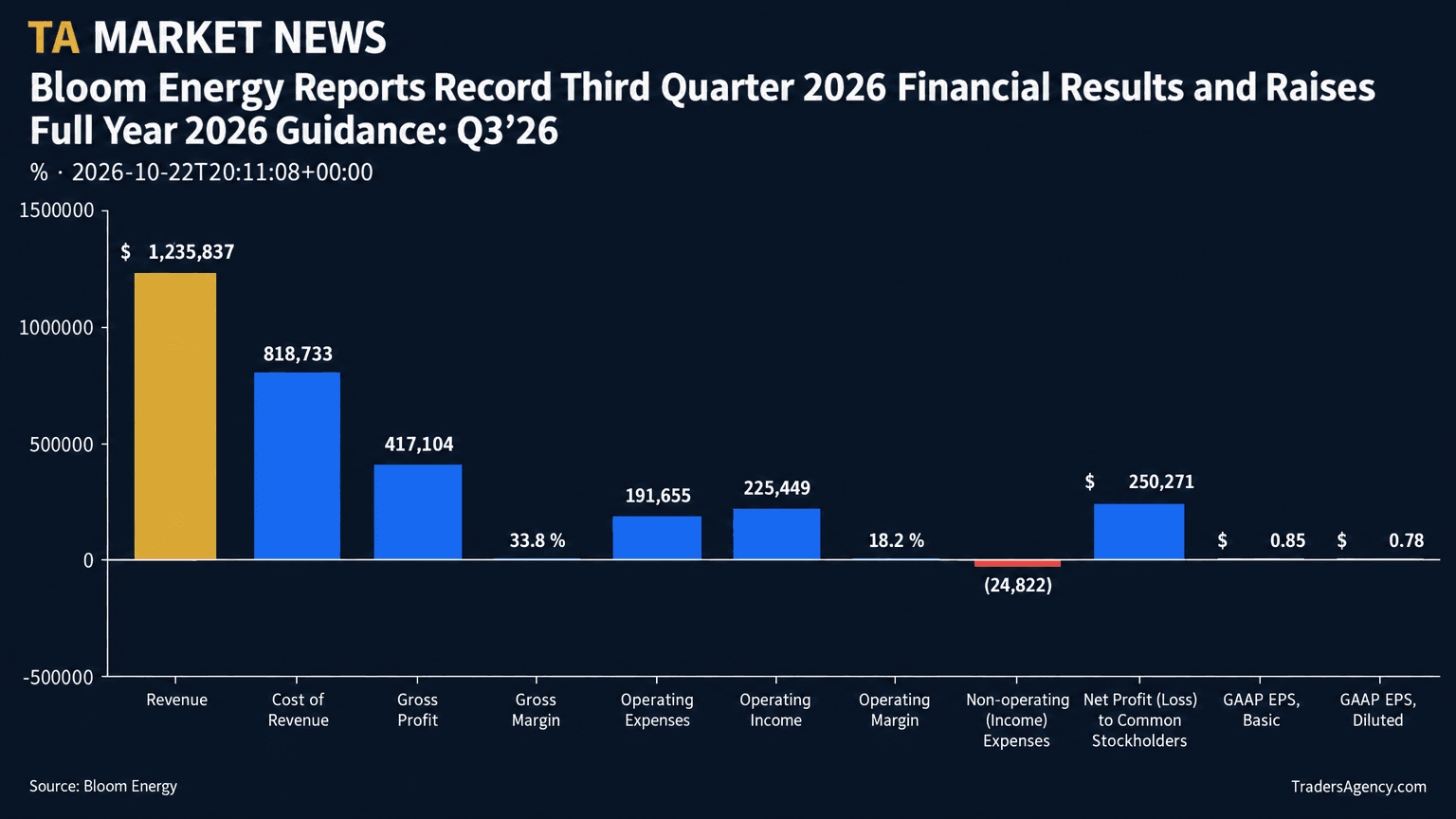
GAAP gross margin rose 453 basis points year over year to 33.8%, while non-GAAP gross margin rose 412 basis points to 34.5%, the company said. GAAP operating income reached $225.4 million, up $217.6 million from $7.8 million a year earlier, lifting operating margin to 18.2% from 1.5%. On a non-GAAP basis, operating income was $285.7 million, against $46.2 million in the third quarter of 2025, and adjusted EBITDA was $299.5 million, against $59.0 million a year earlier, according to the release's financial tables.
CEO KR Sridhar tied the growth to a widening customer base beyond the company's original hyperscaler clients: "What began with hyperscalers is rapidly moving across market segments because every business needs reliable power to grow. We are building the electricity platform for the digital era: power where it is needed, when it is needed, clean and always on." CFO Simon Edwards said the quarter "reflect[ed] strong execution across the business, with significant revenue growth and expanded operating margins," adding that the company "continue[s] to invest with discipline to build the capabilities and capacity needed to scale the business."
Cash Flow Tells a More Mixed Story
Despite the profit growth, Bloom Energy's operating activities used $27.1 million in cash during the quarter, and the company spent $153.5 million on property, plant and equipment, according to the cash-flow figures disclosed in the release. Based on those two reported figures, the company's cash outflow after capital spending totaled roughly $180.6 million for the quarter ($27.1 million used in operations plus $153.5 million in capex), a calculation drawn directly from Bloom Energy's reported line items rather than a figure the company stated outright.
The operating cash drain was driven largely by asset build-up tied to growth: contract assets increased by $430.3 million, inventories rose $170.4 million, accounts receivable grew $175.2 million and other long-term assets increased $178.0 million, all cash uses as the company scales production and deliveries. These were partly offset by a $309.3 million increase in deferred revenue and customer deposits and a $184.7 million increase in accounts payable, both sources of cash in the period, per the release's reported figures.
Third Guidance Raise of the Year
Bloom Energy raised its full-year 2026 revenue guidance to a range of $4.4 billion to $4.6 billion, which it said represents 122% year-over-year growth at the midpoint. The company said its "year-to-date performance and customer demand give us confidence to raise our 2026 outlook for the third time this year." CNBC reported that the updated revenue and adjusted-earnings guidance also came in ahead of analyst estimates.
The company also disclosed it was added to the S&P 500 during the period, calling it "an important milestone for Bloom Energy as a public company."
Why Shares Fell Despite the Beat
The 5% after-hours decline that CNBC reported came even though both revenue and earnings cleared consensus and guidance was raised again. The earnings release does not explain the share reaction, and Bloom Energy's own filing language offers a possible lens on investor caution rather than a direct explanation: the company's risk disclosures flag dependence on continued AI data-center build-out, noting risk from "any actual or perceived slowdown in the adoption of AI resulting in a slower expansion of AI data centers," the availability of financing for data-center developments, air permitting delays, and "the ability of current product and service backlog to ultimately be recognizable as revenue."
Taken together with the quarter's negative operating cash flow and heavy investment in inventories, contract assets and receivables, it is a reasonable interpretation, though not one stated by the company or CNBC, that investors may be weighing the pace of cash consumption and backlog-to-revenue conversion risk against the headline beat. The company's release does not break out what portion of the raised guidance depends on data-center and AI-related orders versus utility and international business, nor does it disclose a current backlog figure or name specific new data-center agreements.
Bottom Line
Bloom Energy delivered a record quarter by its own reported standards, with revenue up sharply, margins expanding by hundreds of basis points, and guidance raised for the third time in 2026. At the same time, the quarter consumed cash in operations and capital spending even as profitability improved, and the company's own risk disclosures point to AI-demand dependence and backlog-conversion uncertainty as ongoing variables. The after-hours stock drop that CNBC reported suggests the market is weighing those variables alongside the headline beat, though neither Bloom Energy nor CNBC's reporting specified the exact cause of the decline.
DISCLAIMER: Traders Agency does not offer financial advice. The information provided is for educational purposes only and should not be considered financial advice. Traders Agency is not responsible for any financial losses or consequences resulting from the use of the information provided. Trading carries inherent risks and may not be suitable for all individuals. You are advised to conduct your own research and seek personalized advice before making any investment decisions, recognizing the potential risks and rewards involved.
- CNBC Top News: Stocks making the biggest moves in after hours: WDC, BE, DECK · accessed Oct 23, 2026
- Bloom Energy: Bloom Energy Reports Record Third Quarter 2026 Financial Results and Raises Full Year 2026 Guidance · accessed Oct 23, 2026
See more from Traders Agency on Google
Make us a preferred source and our market analysis will appear more prominently in your Google Search, Top Stories, and AI results.
Add to Preferred Sources