


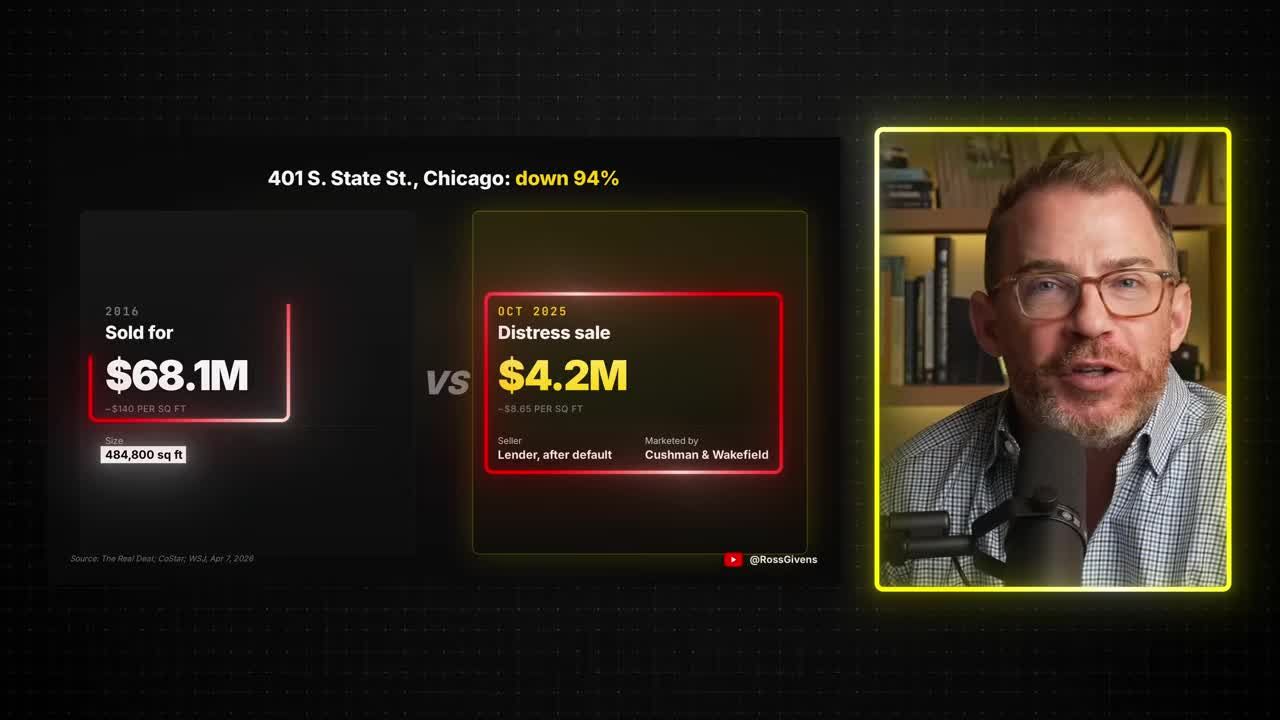
A 484,000 square foot office building in downtown Chicago sold for $4.2 million in October of last year. That same building sold for $68.1 million back in 2016. That's a 94% haircut on a landmark building in the middle of the Loop, and it's not a one-off. It's a snapshot of the commercial real estate crash now working its way through the office market.
The commercial real estate crash is hitting office towers across the country. Office landlords like Vornado, Boston Properties, and SL Green all dropped 20% or more from their summer highs to mid-October, and that part of the story is getting plenty of attention.
What nobody seems to be talking about is the middleman behind every single one of those fire sales, and why Wall Street just threw that middleman out with the office towers.
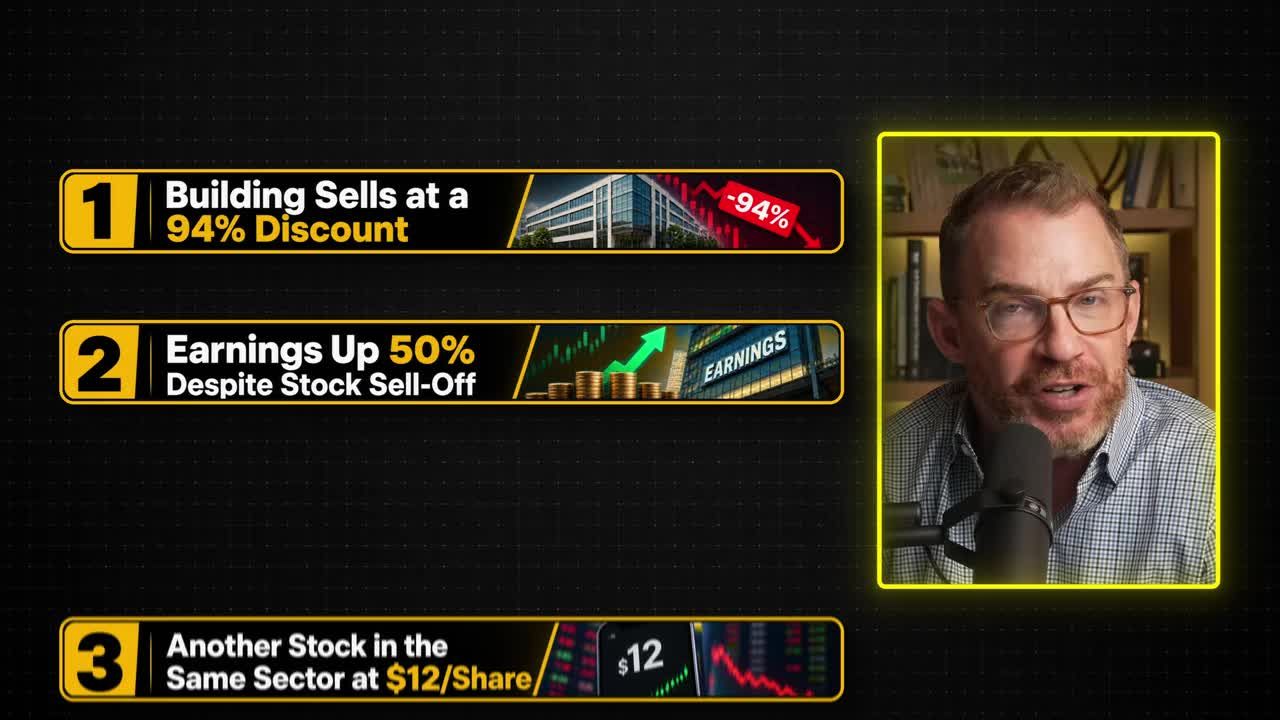
What Is Driving the Commercial Real Estate Crash?
Bottom Line: The commercial real estate crash is wiping out office building values by as much as 90%, but the brokers who handle these distressed sales still collect fees either way. That split explains why broker stocks like JLL and Cushman & Wakefield may be worth watching even as landlord stocks keep falling.
$875 billion in loans, and a math problem nobody can refinance their way out of
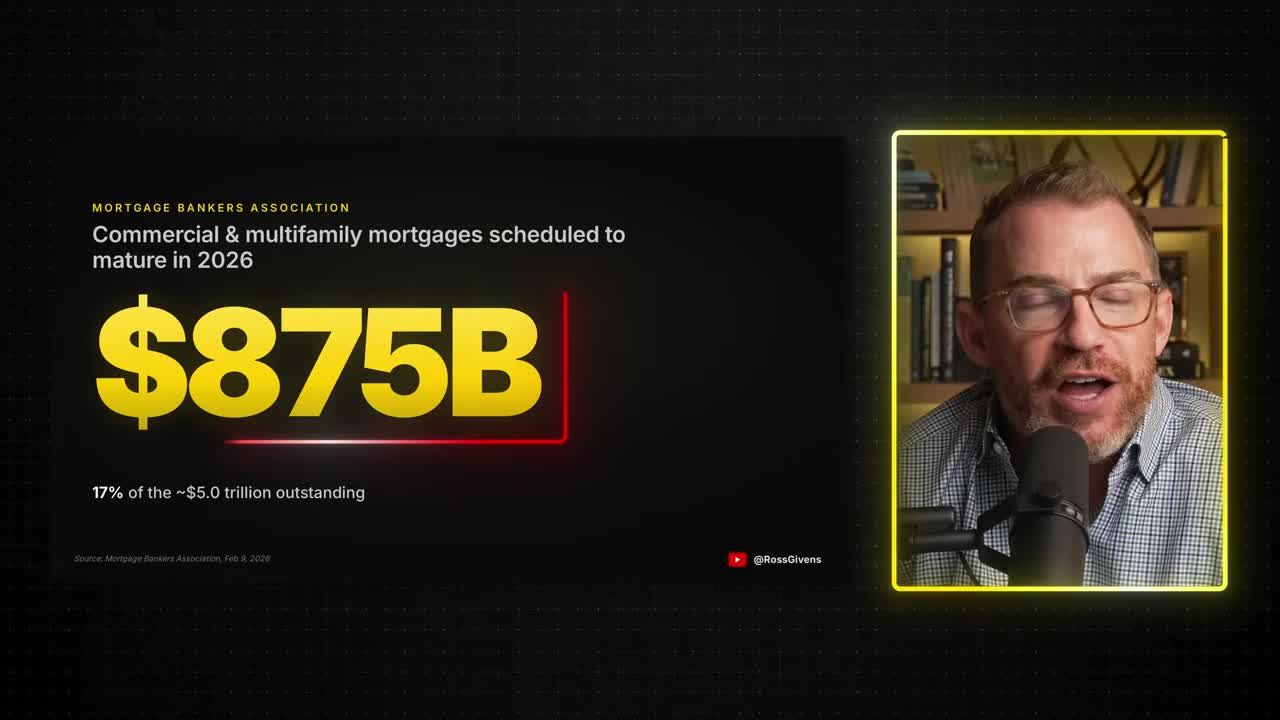
The commercial real estate crash is being driven by $875 billion in commercial mortgages coming due in 2026, roughly 17% of all commercial mortgages in America, according to the Mortgage Brokers Association. Many of those loans were written when rates sat near zero, and owners now have to refinance at far higher rates on buildings worth less with fewer paying tenants.
For some owners, the math simply doesn't work anymore. They hand the keys back to the bank.
That's exactly what happened at 401 South State Street in Chicago. The owner defaulted on the debt, the lender took the building, and the lender's only goal became getting rid of it as fast as possible.
Which raises a simple question: who do you call when you need to sell a massive downtown building that nobody wants?
Why Do Office Buildings Lose 90% of Their Value?
Office buildings are losing up to 90% of their value because loans written at near-zero interest rates now have to be refinanced at much higher rates, on buildings that have lost tenants and lost income at the same time. When the debt resets and the rent doesn't cover it, owners default rather than keep paying.
A building isn't just losing value because fewer people want to rent office space. It's losing value because the debt attached to it no longer makes sense at current rates, and the lender ends up stuck holding an asset nobody wants to buy at the old price.
How Do Brokers Get Paid During a Commercial Real Estate Crash?
The business that collects fees no matter which way prices move
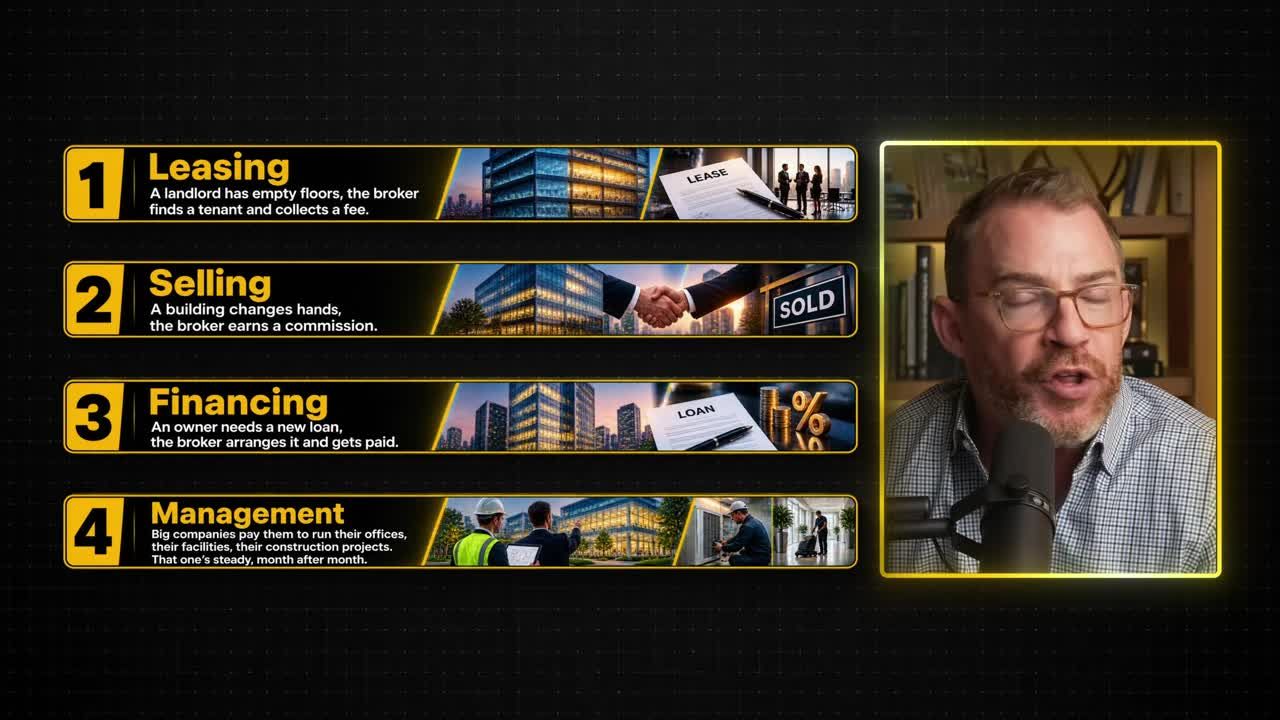
Every distressed sale needs someone to run the process. You call a commercial real estate services firm, a broker, and brokers get paid in four basic ways.
- Leasing, when a building has empty floors, the broker finds a tenant and collects a fee.
- Selling, every time a building changes hands, the broker earns a commission.
- Financing, when an owner needs a new loan, the broker often arranges it and connects them with the bank for a finder's fee.
- Management, companies pay brokers a steady fee to run the offices, the facilities, and the construction projects, and to collect the rent.
Now think about what a wave of distress does to a business built on those four fees. Every maturing loan needs to be refinanced or extended. Every foreclosure needs someone to market the property. Every half-empty tower needs someone to fill it.
The pain for the landlord is the work. The payday for the broker.
That broker doesn't own the building. He doesn't make the loan payments. He's not eating any of that 94% loss. He just shows up and collects money at every single transaction point, whether the building sells for $68 million or $4.2 million.
The Market Got This Backwards
Commercial real estate stocks split into two very different categories right now, and the market isn't pricing them that way. Landlords own the buildings and eat the losses. Brokers and service firms collect fees regardless of which direction the price moves, yet both groups have been sold off together.
The biggest name in the broker group actually fell harder than the landlords it serves. From its high on August 25th to its low in mid-October, that stock dropped about 25%. Over the same stretch, Vornado fell 21% and Boston Properties fell 20%.
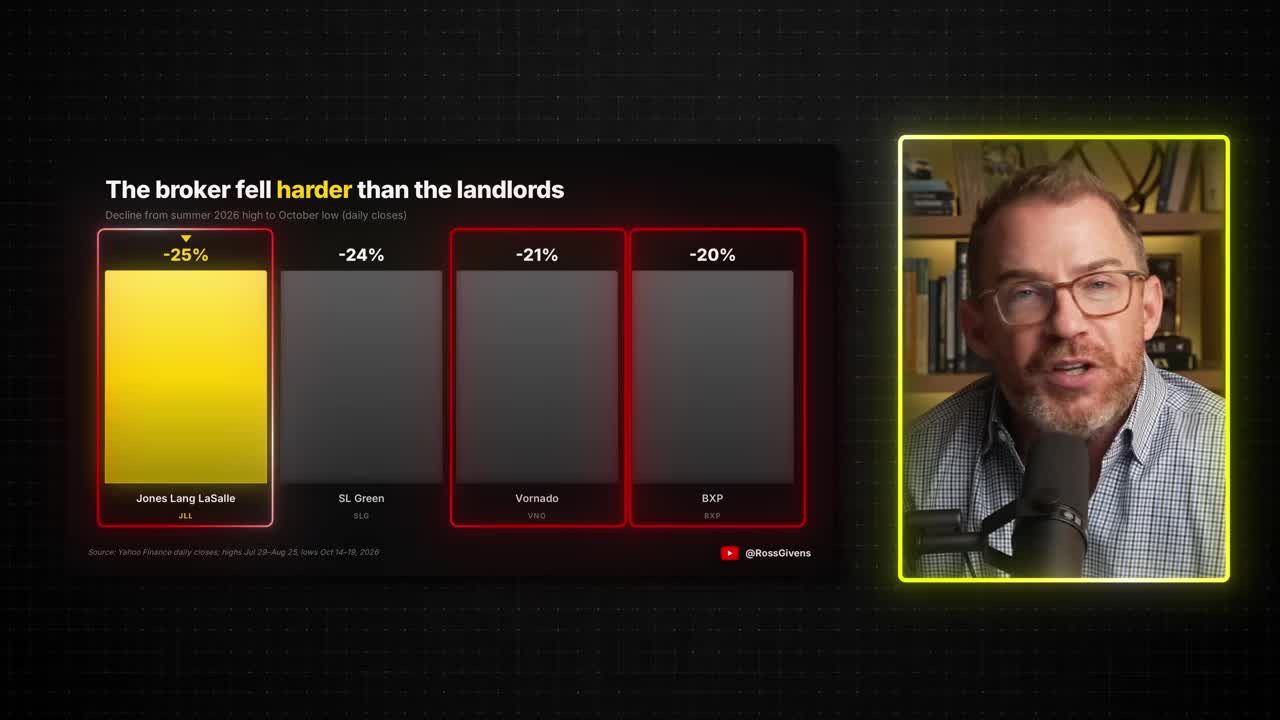
The company that doesn't own any buildings got hit harder than the companies that do.
This wasn't even the first time this year it happened. Back in February, a wave of panic hit anything that looked replaceable by AI. Brokers got lumped into that fear. CBRE, the biggest name in the space, fell 13% in a single day. The broker covered below, despite having zero exposure to foreclosures or vacancy rates, got dragged down right alongside it.
That company is Jones Lang LaSalle, ticker JLL.
Get an entire year of live weekly mentoring sessions, my newsletter, indicators, bonus reports, tons more. Click the link and I'll see you in the next live session.
Join my Black Ops Trading ClubJLL's Earnings Tell a Different Story
JLL is a Fortune 500 company with $26 billion in annual revenue and offices in more than 80 countries. If you've ever walked into a big corporate office building, there's a good chance JLL leased it, sold it, or manages it.
On October 28th, the company reported earnings that flatly contradict the narrative Wall Street has been pricing in.
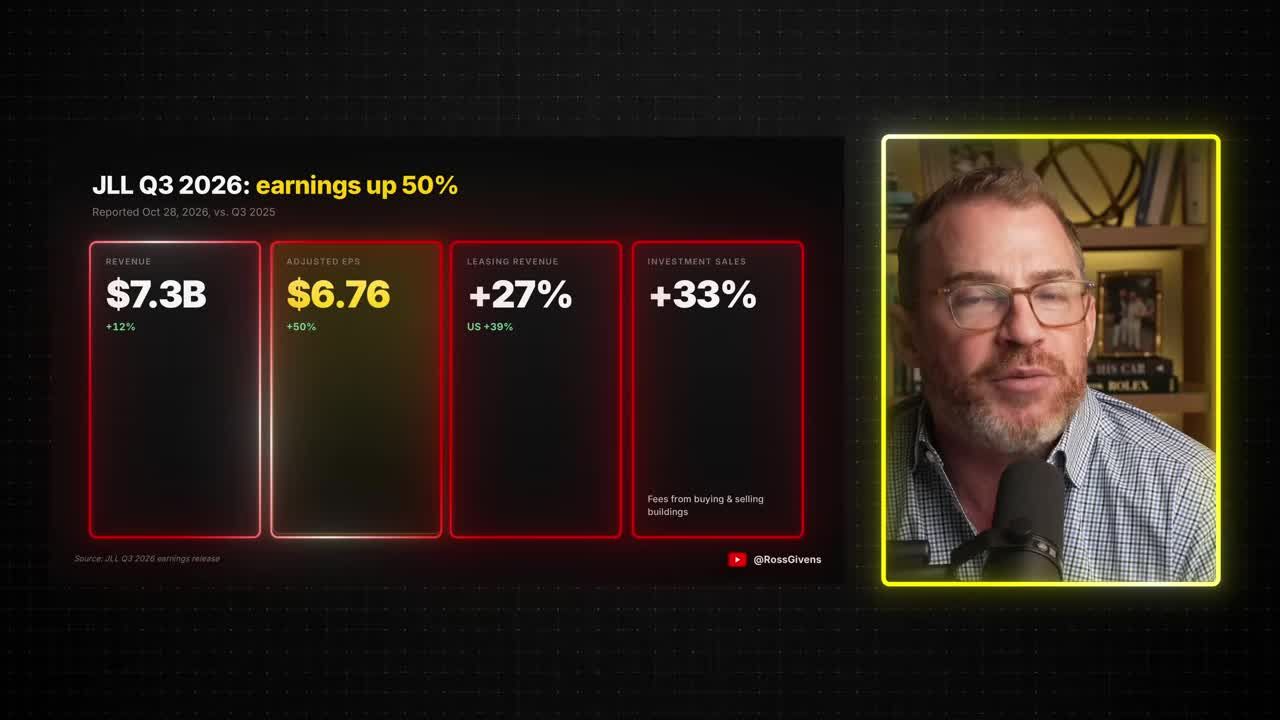
- Revenue came in at $7.3 billion, up 12%
- Adjusted earnings per share hit $6.76, up 50% from a year ago, a record for the third quarter
- Leasing revenue jumped 27%, with U.S. leasing revenue up 39%
- Investment sales, the fees from buying and selling buildings, rose 33%
That is not a company going down with the office market. JLL also tracks the overall market and compares its own growth against it. U.S. office leasing volume across the entire market rose just 2%. JLL's U.S. office leasing revenue rose 18%. Global investment sales across the whole market were up 9%. JLL's were up 33%.
JLL isn't riding the market. It's taking a bigger piece of it every quarter. When times get tough, landlords and lenders go to the biggest firm with the most buyers on speed dial, and that's JLL.
Office is only one piece of this story too. JLL's U.S. industrial leasing revenue, covering warehouses, factories, and logistics, jumped 56%. The business doesn't care what kind of building is changing hands.
Is a Landlord Crash Already Here?
A market crash for office landlords isn't speculation. It's already happening in slow motion through defaults, foreclosures, and distressed sales tied to $875 billion in maturing loans. But that doesn't mean every stock connected to commercial real estate deserves to fall with it.
The only real explanation for JLL's stock getting crushed is interest rates. Since July, the 10-year Treasury yield has climbed meaningfully higher. Higher rates make deals harder to finance, and the market is simply fearing that deal flow dries up. If you can borrow at 2%, you can make almost any building cash flow. If you have to borrow at 8% or 9%, the numbers stop working for a lot of buyers.
That fear is legitimate for some names. One analyst at Piper Sandler downgraded Newmark, a smaller broker, on exactly this concern back in October.
But JLL's own earnings report said the opposite. Its pipeline is strong enough that management raised its full-year earnings target, with the midpoint now calling for 37% growth in earnings per share for 2026. Then management backed that up with action: a new $500 million share buyback, executed immediately, bringing total 2026 buybacks to more than $1 billion.
There is one real risk worth flagging. JLL participates in a loan program with Fannie Mae where it agrees to share in losses if a loan goes bad, generally about a third of the loss, capped at 20% of the original loan amount. As of June 30th, there were about $26.8 billion of those loans outstanding.
But these are apartment loans, not office loans, and apartments are the part of commercial real estate people always need. You can work from home, but you can't live in your office. Rent is the last bill most people stop paying. JLL also has around $29.7 million set aside against this risk, and part of its third quarter earnings jump came from not booking a loan loss charge like it did in the same quarter last year.
It's not zero risk. But it's a small slice of a business that is mostly just fees, nothing like a bank or lender sitting on billions in office debt.
What JLL Is Actually Worth
After the earnings report, JLL stock surged about 12% and was trading in the mid-$330s. Even after that jump, JLL trades at just 12 times expected earnings over the next year, compared to roughly 19 times for the average S&P 500 company.
A company targeting 37% earnings growth trading at a 30% discount to the broader market is not how you'd expect a strong grower to be priced. Before this latest report, the 10 analysts covering JLL had an average price target near $407, about 20% above where the stock closed heading into earnings. Those targets are likely getting revised upward now.
The stock's recent price action backs this up technically. JLL gapped from $299 to $315 and ran all the way to $337 the same day, then held those gains into the close. Historically, a gap like that followed by continued strength during the day, rather than a fade back down, tends to mark the start of a new trend rather than a dead cat bounce. It's not a guarantee, but it's a pattern worth respecting.
A Cheaper Way to Play This
Cushman & Wakefield, ticker CWK
JLL isn't a cheap stock in dollar terms, trading in the $330 to $340 range. If you want exposure to the same trade at a lower share price, there's a second name worth knowing: Cushman & Wakefield, ticker CWK.
Cushman is the company that actually marketed the Chicago building that sold for $4.2 million, running the auction on behalf of the lender. It's one of the three biggest firms in this space, doing the same core business as JLL: leasing, selling, financing, and managing.
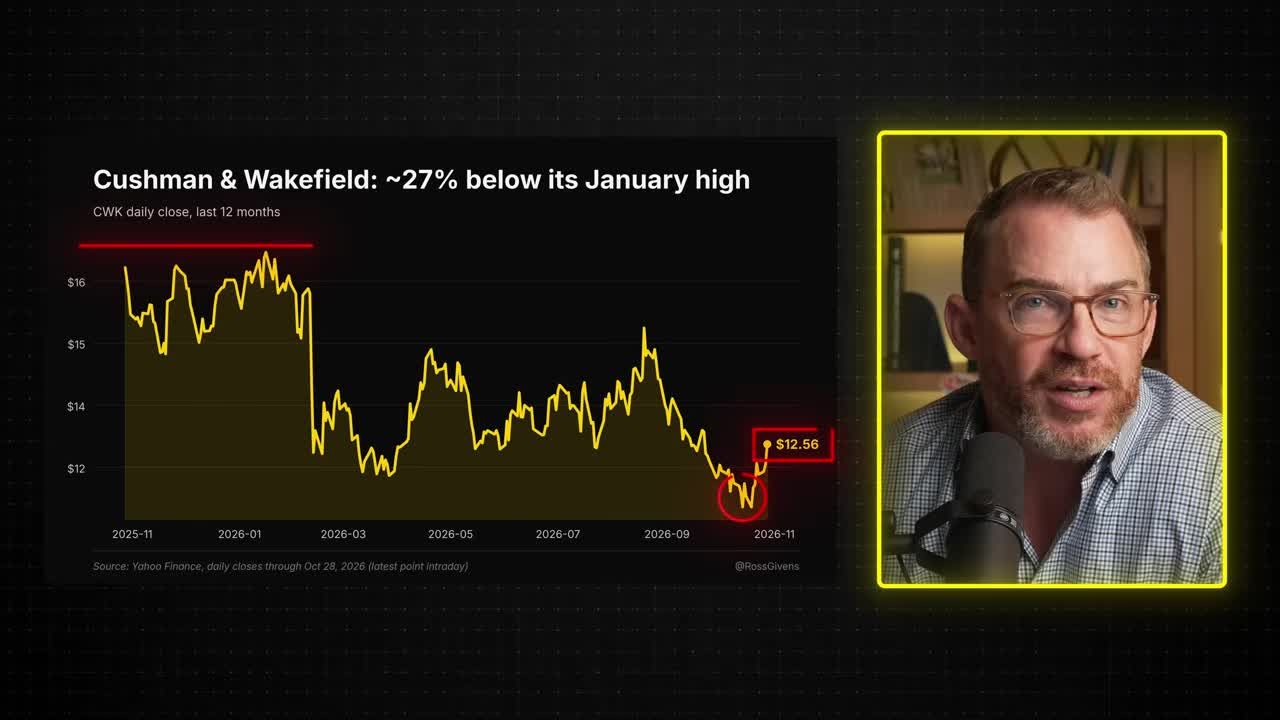
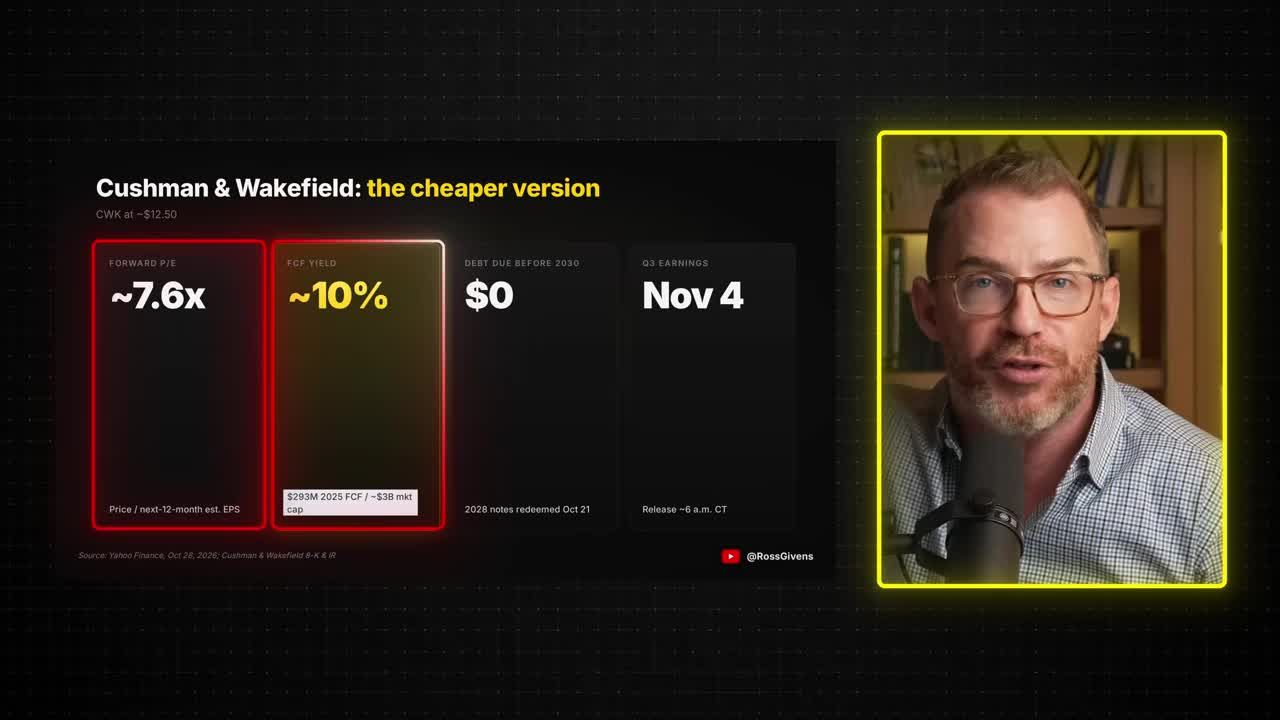
CWK has been treated even worse than JLL. It peaked around $17 in January and is now trading in the mid-$12s, roughly 27% below that high. At that price, Cushman trades at about seven and a half times expected earnings over the next year. In 2025, it generated $293 million of free cash flow against a total company valuation of only about $3 billion, putting the free cash flow yield near 10%.
The tradeoff is debt. Cushman carries around $2.4 billion in long-term debt as of the end of June, a much heavier load relative to earnings than JLL carries. No company in the history of the stock market has gone bankrupt without debt, which is exactly why debt load matters as a safety check before you buy anything.
To Cushman's credit, it paid off the last of its bonds due before 2028 last week, meaning it now has no long-term debt coming due before 2030.
Cushman reports earnings on November 4th. If those numbers look anything like JLL's, the stock has real room to run from current levels. If they don't, you'll know quickly.
Playing the Broker, Not the Landlord
The commercial real estate crash is a genuine problem for landlords holding office towers with maturing debt and shrinking rent rolls. But the stock market has been sloppy about separating the companies eating that pain from the companies collecting fees regardless of which way prices move.
JLL just posted the best quarter in its history: record third-quarter earnings per share up 50%, a raised full-year outlook calling for 37% EPS growth in 2026, and a balance sheet clean enough to pay off its debt with six months of profit. Cushman & Wakefield runs the same business at a steeper discount and a higher debt load, with its own earnings report due November 4th to confirm or deny the thesis.
The pain for the landlord has become the payday for the broker, and right now the market is pricing both the same way. That mismatch is the opportunity. JLL around $330 to $340 and Cushman & Wakefield around $12 are the two names worth watching as this plays out, one safer, one riskier, both benefiting from a crisis they don't actually own a piece of.
Get an entire year of live weekly mentoring sessions, my newsletter, indicators, bonus reports, tons more. Click the link and I'll see you in the next live session.
DISCLAIMER: Traders Agency does not offer financial advice. The information provided is for educational purposes only and should not be considered financial advice. Traders Agency is not responsible for any financial losses or consequences resulting from the use of the information provided. Trading carries inherent risks and may not be suitable for all individuals. You are advised to conduct your own research and seek personalized advice before making any investment decisions, recognizing the potential risks and rewards involved.
See more from Traders Agency on Google
Make us a preferred source and our market analysis will appear more prominently in your Google Search, Top Stories, and AI results.
Add to Preferred Sources