
China's economy sent mixed signals in August, according to data released by the National Bureau of Statistics (NBS). Retail sales growth slowed to 0.4% year-on-year, missing economists' expectations, while fixed-asset investment for the January-August period fell 7.2%, deepening a slump led by the property sector. Industrial output, by contrast, beat forecasts, expanding 5.2% year-on-year and accelerating from July.
Retail Sales Miss Deepens Consumption Concerns
Retail sales rose 0.4% in August from a year earlier, slowing from 0.6% growth in July and falling short of the 0.8% increase expected in a Reuters poll of economists, according to CNBC. That represents a 0.4 percentage point miss against the poll's consensus (0.8% forecast minus 0.4% actual, our calculation).
Industrial Output Surprises to the Upside
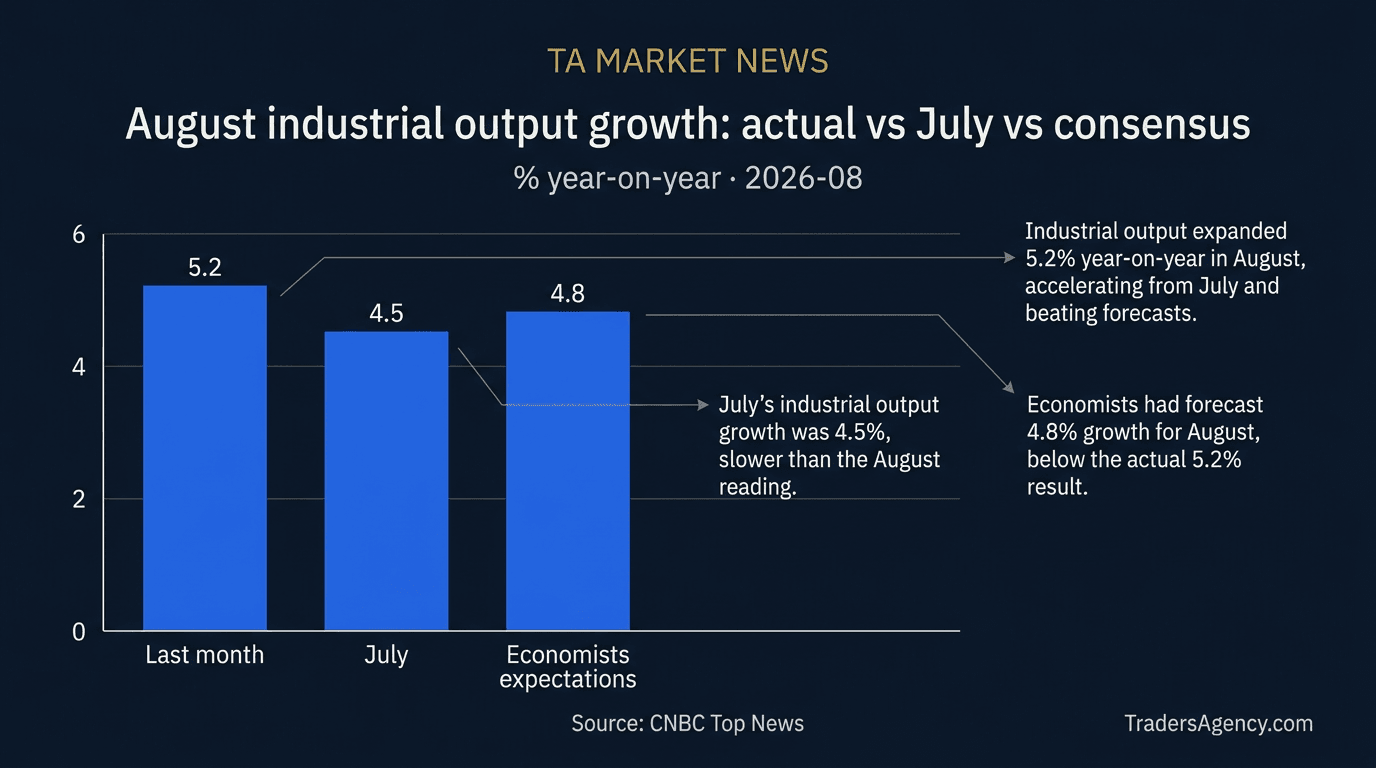
Industrial output told a different story. Value-added industrial production rose 5.2% year-on-year in August, up from 4.5% in July and above the 4.8% consensus forecast cited by CNBC, a beat of 0.4 percentage point (our calculation: 5.2% minus 4.8%). The NBS said the pace quickened by 0.7 percentage point from the previous month, with output up 0.54% on a month-on-month basis, according to National Business Daily's report on the release.
The strength was concentrated in high-value manufacturing. Equipment manufacturing value-added grew 12.1% and high-tech manufacturing 16.7% in August, respectively 6.9 and 11.5 percentage points faster than overall industrial output, National Business Daily reported. Mining output fell 1.4%, according to the NBS's own industrial data release.
Fixed-Asset Investment Slide Widens
Fixed-asset investment for the first eight months of the year fell 7.2% from a year earlier, according to NBS data, with declines recorded in every region of the country. The northeast posted the steepest regional contraction, down 25.5%, followed by the east (down 9.4%), the west (down 8.8%) and central China (down 8.7%), per the same NBS release.
Within the national investment total, property development investment fell 19.9% year-on-year, infrastructure investment declined 4.0% and manufacturing investment dropped 2.3%, according to the same National Business Daily report of the NBS release. Of those three components, property recorded by far the steepest decline, while infrastructure and manufacturing spending also contracted — a comparison based on the reported percentage changes rather than on component weightings.
NBS Acknowledges Supply-Demand Imbalance, Calls for More Support
In its statement accompanying the data, the NBS said the adverse impact of the external environment has deepened and that the domestic contradiction between "strong supply and weak demand" is acute, adding that some businesses continue to face operating difficulties and that the foundation for steady improvement needs consolidating. CNBC reported the bureau describing the imbalance between supply and demand as "acute."
The bureau called for stronger macro-policy adjustment, efforts to expand domestic demand, and industrial upgrading to strengthen growth momentum, according to both National Business Daily and CNBC's coverage of the statement. Beyond that language, the NBS did not detail specific new stimulus measures in the reported statement.
Credit, Trade and the Growth Outlook
Weakness was also evident in credit data released ahead of the activity figures. New bank loans expanded by just 60 billion yuan ($8.95 billion) in August, versus a roughly 400 billion yuan forecast and down from 590 billion yuan a year earlier, CNBC reported, a shortfall of roughly 340 billion yuan against the forecast (our calculation: 400bn minus 60bn). Outstanding loan growth slowed to a record-low 4.9%.
Trade was the clearer bright spot. Goods exports rose 18.6% and imports 21.7% in yuan terms in August, lifting total trade growth to 19.8%, 0.6 percentage point faster than July, National Business Daily reported. China's official manufacturing PMI also showed new orders and output returning to expansion in August after contracting in July, per CNBC.
The broader growth backdrop remains soft. Second-quarter GDP growth slowed to 4.3%, the weakest pace in more than three years, and policymakers have so far relied on incremental measures such as increased government bond issuance and expanded loan-interest subsidies rather than aggressive stimulus, CNBC reported. Oxford Economics estimates third-quarter growth at 4.3%, with weak consumption and the property slump cited as the biggest drags even as exports and high-tech manufacturing add momentum, against Beijing's annual target range of 4.5% to 5%, according to CNBC's reporting of the firm's estimate.
Analysts quoted by CNBC pointed to fiscal policy as the key swing factor. Zhiwei Zhang, president at Pinpoint Asset Management, said "the market is waiting for the fiscal policy to become more supportive in Q3." Separately, ANZ Research economists led by Raymond Yeung wrote that "September could represent an important policy window to revive business confidence ahead of October's Golden Week holidays," while suggesting more fiscal support is needed even as a policy rate cut remains unlikely, per CNBC.
Bottom Line
August's data present a split picture: an industrial sector outperforming expectations on the back of high-tech manufacturing and trade, against a consumer and investment backdrop that continues to soften, with property investment down almost a fifth year-to-date. On our reading of the NBS's own language — acknowledging an "acute" supply-demand imbalance and calling for stronger macro-policy adjustment — officials appear to view current settings as needing reinforcement, though the reported statement stopped short of announcing new measures. Whether additional fiscal support materializes in the coming weeks, as some economists quoted by CNBC anticipate, will shape whether the divergence between industrial strength and consumer weakness narrows or widens.
DISCLAIMER: Traders Agency does not offer financial advice. The information provided is for educational purposes only and should not be considered financial advice. Traders Agency is not responsible for any financial losses or consequences resulting from the use of the information provided. Trading carries inherent risks and may not be suitable for all individuals. You are advised to conduct your own research and seek personalized advice before making any investment decisions, recognizing the potential risks and rewards involved.
- CNBC Top News: China's August retail sales miss forecast as investment slump deepens · accessed Sep 15, 2026
- National Business Daily: 国家统计局:8月份国民经济运行平稳、发展向新向优 · accessed Sep 15, 2026
- National Bureau of Statistics of China: 2026年8月份规模以上工业增加值增长5.2% · accessed Sep 15, 2026
- National Bureau of Statistics of China: 2026年1-8月份全国固定资产投资基本情况 · accessed Sep 15, 2026
See more from Traders Agency on Google
Make us a preferred source and our market analysis will appear more prominently in your Google Search, Top Stories, and AI results.
Add to Preferred Sources