
The Federal Reserve's latest Beige Book does not describe an economy sliding into recession. Most of the central bank's twelve districts still reported growth, layoffs stayed limited in many regions, and some employers kept adding workers. But a closer read of the report, which compiles anecdotal business conditions from contacts across the country, shows a labor market that is quietly cooling beneath a headline that still looks stable. Firms increasingly described replacing departing workers rather than expanding payrolls, growing pickier about who they hire, and in a number of districts, leaning on artificial intelligence tools to get more output from the staff they already have.
Growth Continues, But With Less Comfort
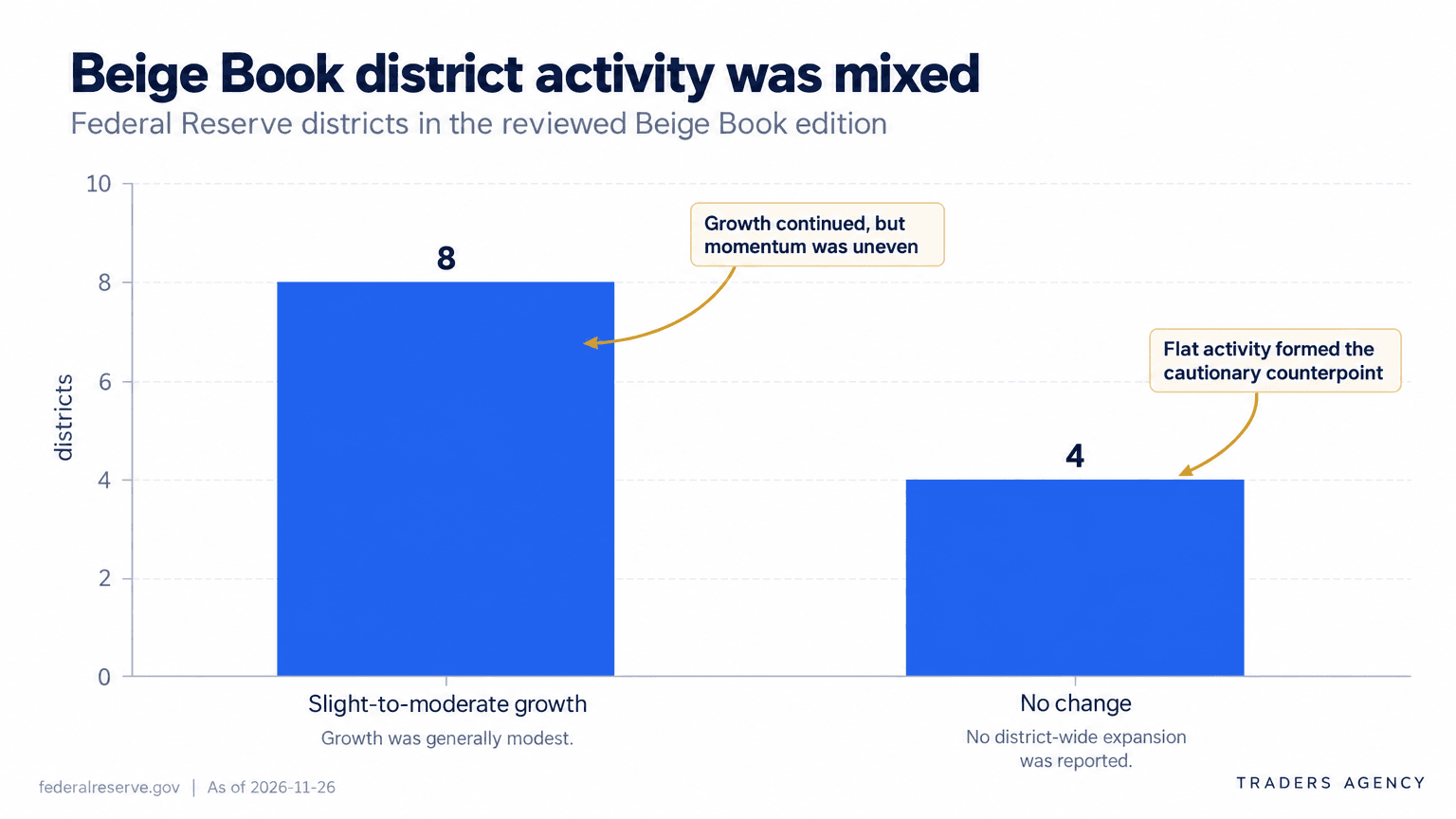
The national summary reviewed in the report found eight of the twelve Federal Reserve districts reporting slight-to-moderate growth, while the remaining four reported no change. That is not a contraction signal. Still, the texture underneath the growth figure was less reassuring. Consumers were described as becoming more selective with their spending, a notable shift given how resilient retail activity has looked in other recent data. Auto sales softened as fuel prices and borrowing costs weighed on buyers, residential real estate activity cooled as affordability constraints bit harder, and construction activity declined amid elevated interest rates. Manufacturing was a relative bright spot, growing modestly as strength in some industrial segments offset softness elsewhere. Commercial activity, meanwhile, was mixed.
Stable Headcounts Hide a Weaker Hiring Pulse
The report's national labor-market language is where the caution really starts. Many firms described stable headcounts, with hiring largely limited to replacing workers who left rather than adding net new positions. Only a minority of firms reported meaningful increases in hiring. That distinction matters because an economy that is genuinely strengthening typically shows broader hiring momentum, not just enough turnover to keep headcount flat. When businesses did raise pay, the report characterized those increases as largely a response to workers' cost-of-living pressures rather than competition for scarce talent, meaning employers have limited pricing power to pass costs through to customers and are compensating by keeping hiring cautious.
A District-by-District Scorecard
Regional conditions in the Beige Book were far from uniform, and that unevenness is itself part of the story.
Where Hiring Held Up
New York stood out as the clearest positive example. Employment rose modestly after holding steady, with a noticeable pickup in labor demand concentrated in manufacturing, alongside rising hours worked and labor supply and demand that remained roughly balanced. Minneapolis offered the other bright spot: hiring was described as modestly positive, construction firms reported hiring at slightly higher rates than a year earlier, layoffs stayed low, and initial unemployment claims in the district came in lower than the prior year.
Where Warning Signs Multiplied
Elsewhere, the picture turned more cautious. Boston contacts described a mix of effects from artificial intelligence on employment, including retraining existing staff to work alongside AI tools and, in some cases, hiring less because of it. Philadelphia employment rose modestly, though two-thirds of surveyed firms reported no change at all, and firms that did adjust staffing tended to hire rather than cut. Still, the district's housing sector showed clear strain: homebuilders reported a modest sales decline and expected to build fewer homes in 2027, anticipating likely layoffs, an architect said weak demand could force layoffs at their firm, and a commercial contractor focused on apartment construction had announced it would finish current projects and then cease future operations.
Cleveland saw modest net employment gains overall, but some firms across sectors said they were using AI specifically to limit hiring amid soft demand or to offset rising costs, while high interest rates were described as weighing on both new and existing home activity. Richmond reported unchanged employment on balance, with contacts citing hesitancy to hire amid uncertainty and firms in trucking and poultry processing pausing hiring because of tighter margins. Atlanta held employment stable with minimal layoffs, though only a minority of firms reported increased hiring, and contacts there said AI would make employees more efficient rather than replace them, at least in the near term. Chicago still showed slight employment growth, but businesses reported receiving more applications per opening and some had paused hiring or reported layoffs amid uncertainty about the outlook.
St. Louis held employment roughly unchanged, with job openings concentrated in professional and IT services and firms changing skill requirements as AI capabilities advanced, even as manufacturers looking to expand struggled to find qualified applicants. Kansas City reported little change in employment, with recruiting firms seeing higher applicant volumes alongside a mismatch between available skills and the AI-related requirements of new roles. Most firms there said they were training existing employees to work alongside AI tools, that the technology had so far had little measurable effect on employment, and that they expected headcount to stay roughly unchanged over the coming year. Dallas posted modest employment growth, but staffing firms said employers were taking longer to decide on hires and emphasizing better use of their existing workforce over expansion. San Francisco held employment flat overall, and several contacts there said they were using AI and automation to meet demand without changing staffing levels, even as skilled construction and manufacturing trades, along with experienced or technical finance roles, remained difficult to fill.
Tallying the district commentary loosely, only New York and Minneapolis read as cleanly positive, while Philadelphia landed somewhere in between given its mix of modest job growth and visible housing-sector strain. The rest leaned toward caution. That rough split reflects where leading risks appear concentrated rather than an official Federal Reserve classification or a count of districts in outright contraction, since the report's own national summary recorded growth in eight districts and no change in four.
Want expert trading insights delivered daily?
Join thousands of traders who rely on Traders Agency for market analysis and trade ideas.
Join Traders AgencyIs AI Quietly Capping Hiring?
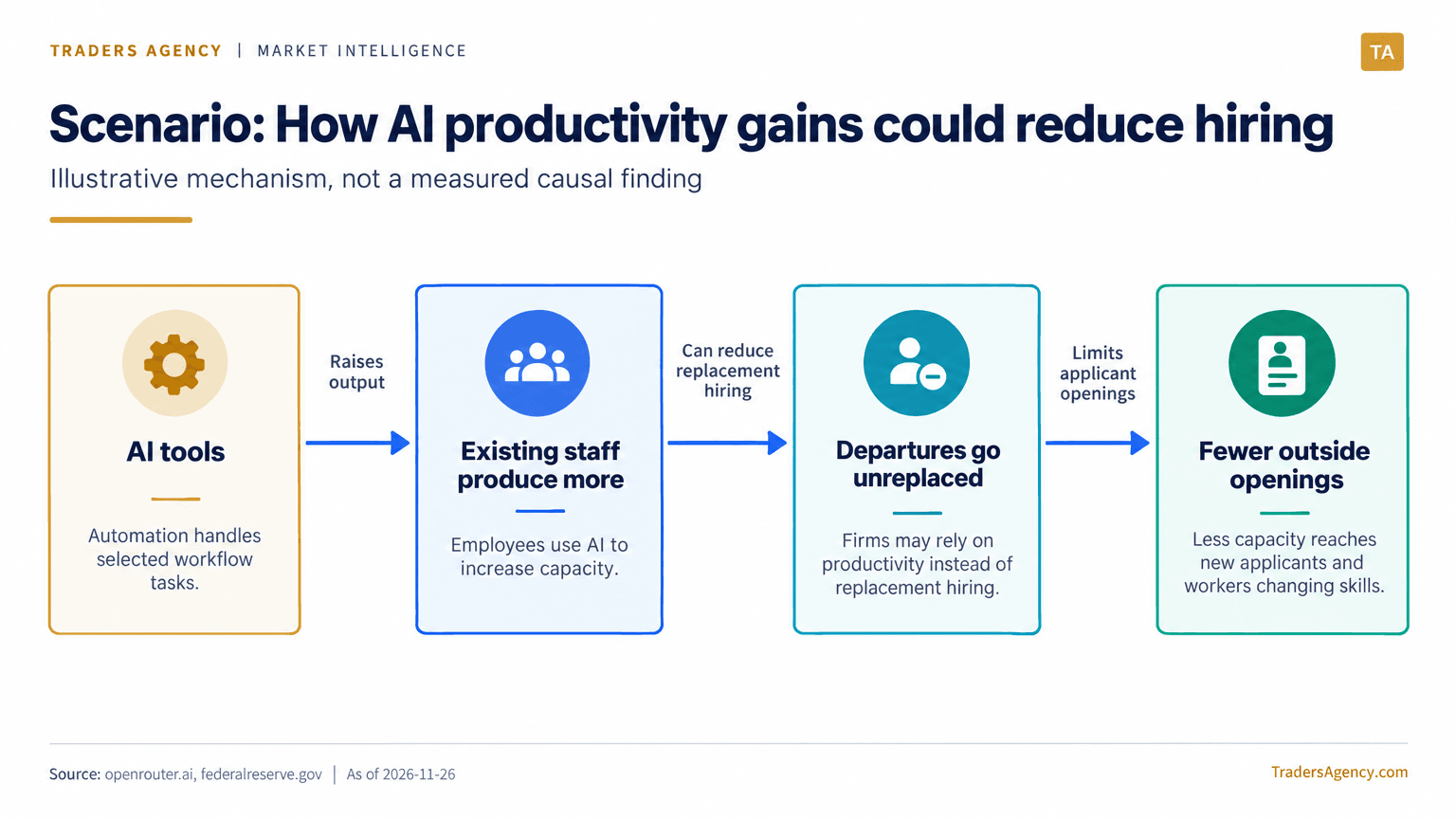
A recurring theme across several districts was employers turning to artificial intelligence to handle workloads that might otherwise require new hires. One way to think about this is as a capacity question: in a healthy labor market, workers who retire or leave create openings that new graduates and newly skilled workers can fill, keeping total employment roughly steady even as individuals cycle through. If AI tools increasingly absorb that same capacity, whether by helping existing staff produce more output or by letting departures go unreplaced, fewer of those openings reach the outside labor pool. Workers who lack the specific AI-related skills employers now expect may find themselves locked out of the hiring pipeline altogether. This is best understood as an interpretation of the pattern described across districts like Boston, Cleveland, St. Louis, Kansas City, Dallas, and San Francisco, not a measured causal finding. General AI-usage figures from platforms that track token activity describe overall usage trends, not hiring outcomes, so they cannot by themselves confirm that automation is substituting for workers; the Beige Book anecdotes are the more direct evidence here, and even those describe limited near-term effects in some regions, such as Atlanta, where contacts expected AI to boost efficiency without displacing staff in the near term.
Separately, two recent government data points add context worth noting, though they come from different surveys and time periods and should not be read as proof of an AI-driven effect. Preliminary September JOLTS data showed 5.402 million hires against 5.319 million separations, a gap of roughly 83,000, which reflects labor-market turnover rather than the official monthly payroll employment change. October's household survey separately showed a seasonally adjusted increase of 356,000 people working part time due to slack work or weak business conditions, while total involuntary part-time employment rose by 339,000. Taken together, these figures point to some hidden softness beneath the surface of recent hiring reports, though they measure different things and neither establishes an AI-specific cause.
Affordability, Housing, and Margin Pressure
Running beneath the labor-market commentary is a persistent affordability squeeze. Higher living costs have pushed workers to ask for pay increases, but businesses described limited ability to pass those higher costs on to customers, compressing margins. That combination discourages net new hiring even when demand holds up reasonably well. Housing and construction bore much of the visible strain, with elevated borrowing costs described in multiple districts as weighing on both new and existing home activity. At the same time, some specialized segments, including data-center development, certain manufacturing niches, and skilled trades, continued to face labor shortages, a reminder that the slowdown is uneven rather than universal across the economy.
A Leading Warning, Not a Sell Signal
It is worth being precise about what this report does and does not suggest. The Beige Book is not evidence that a recession has already begun; rather, it functions as a leading indicator rather than an immediate reason for markets to sell off. Instead, the combination of softer net hiring, growing employer selectivity, housing and construction pressure, and AI-driven changes to hiring practices is best viewed as an early warning sign for labor conditions over roughly the next two years. Traders Agency analysts will be watching whether districts like Minneapolis and New York can keep their relative strength, whether AI-related hiring caution spreads further, and whether upcoming JOLTS and payroll reports confirm or ease the softening described here. For now, the takeaway for everyday investors is conditional caution rather than alarm: the labor market has not rolled over, but the report gives good reason to watch its trajectory closely in the quarters ahead.
Want expert trading insights delivered daily?
Join thousands of traders who rely on Traders Agency for market analysis and trade ideas.
Join Traders AgencyDISCLAIMER: Traders Agency does not offer financial advice. The information provided is for educational purposes only and should not be considered financial advice. Traders Agency is not responsible for any financial losses or consequences resulting from the use of the information provided. Trading carries inherent risks and may not be suitable for all individuals. You are advised to conduct your own research and seek personalized advice before making any investment decisions, recognizing the potential risks and rewards involved.
- November 2026 Beige Book: National Summary
- OpenRouter: State of AI — An Empirical 100 Trillion Token Study
- November 25, 2026 Beige Book: Boston District
- November 2026 Beige Book: Philadelphia District
- November 2026 Beige Book: Cleveland District
- November 2026 Beige Book: Atlanta District
- November 2026 Beige Book: Minneapolis District
- November 2026 Beige Book: Kansas City District
- November 2026 Beige Book: San Francisco District
- BLS: September 2026 Job Openings and Labor Turnover, released November 3, 2026
- BLS: Involuntary part-time employment rose by 339,000 to 4.8 million in October 2026
See more from Traders Agency on Google
Make us a preferred source and our market analysis will appear more prominently in your Google Search, Top Stories, and AI results.
Add to Preferred Sources