
The Conference Board's Consumer Confidence Index jumped to 103.3 in November, up from 91.9 in October, a rise of 11.4 points, according to The Conference Board. The reading easily topped the Dow Jones consensus forecast of 92.2, as reported by CNBC, and marked the second straight monthly increase following a September reading that had fallen to its lowest level since April 2014, per WKMG.
By our calculation, based on the Conference Board's own figures, the 11.4-point move from 91.9 to 103.3 represents a 12.4% increase month over month (103.3 minus 91.9, divided by 91.9).
What Drove the Improvement
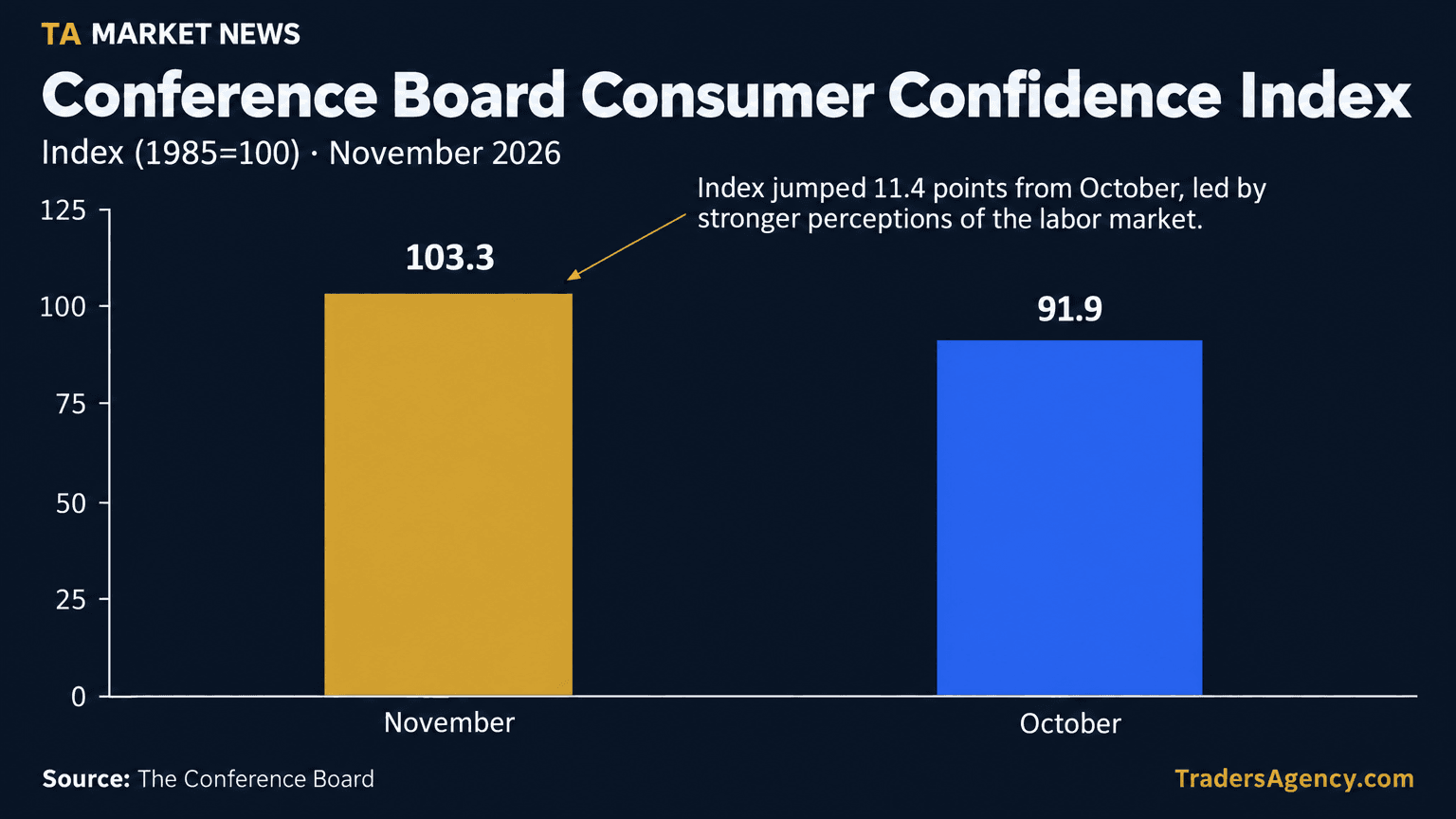
The Conference Board said the gain in confidence was led by stronger perceptions of present and future labor market conditions. Within the survey, the share of consumers calling jobs "plentiful" rose to 30.8% from 26.2% in October, while those saying jobs are "hard to get" fell to 18.4% from 21.4%, the organization reported.
The index's two main components both moved higher. The Present Situation Index, which reflects consumers' assessment of current business and labor market conditions, increased 13.7 points to 132.8. The Expectations Index, based on consumers' short-term outlook for income, business and labor conditions, climbed 9.9 points to 83.6, according to the Conference Board.
Consumers also reported plans for slightly higher spending on goods and vacations. Vacation plans over the next six months rose to 44.9% of consumers from 42.7% in October, a gain of 2.2 percentage points, the Conference Board said.
The improvement was not uniform across the political spectrum. Confidence rose sharply among Democrats and independents but declined modestly among Republicans, who nonetheless remained the most confident group overall, per the Conference Board and corroborated by WKMG and CNBC.
Conference Board senior economist Fergus McCormick noted that write-in responses in November were "slightly less negative than previous months," adding that while consumers continued to express frustration with high prices and rising costs, "some comments cited hope for the general economy," according to WKMG's reporting of his comments.
Inflation Expectations Ease, but Remain Elevated
Consumers' average 12-month inflation expectations fell for a second consecutive month but remained elevated at 5.7%, the Conference Board reported. That decline comes even as actual inflation moved in the other direction: the government reported that inflation rose to 4% in October from 3.7% in September, per WKMG, a 0.3 percentage point increase by our calculation (4% minus 3.7%).
CNBC framed the gap this way: a growing number of Americans are now seeing improvement in the labor market and expecting inflation to cool, even though the headline inflation rate itself ticked up in the most recent government data. The Federal Reserve has been trying to bring inflation down from levels that have run above its 2% target for roughly five and a half years, CNBC reported, and the Commerce Department's Fed-watched inflation gauge, due out the following day, was also expected to show inflation remaining noticeably above that target, according to WKMG.
What It Could Mean for the Fed
CNBC reported that the Federal Reserve is expected to raise its benchmark interest rate by a quarter percentage point when it meets again in two weeks. The confidence data arrives as policymakers weigh improving labor-market sentiment against inflation readings that, while easing in consumers' own expectations, remain above the Fed's stated target in the official data. This juxtaposition, a stronger confidence reading paired with inflation expectations still at 5.7% and headline inflation at 4%, illustrates the balancing act facing the central bank as it approaches its next decision.
How It Lines Up With Other Signals
The Conference Board's findings echo a separate survey released the prior Friday. The University of Michigan's November consumer sentiment survey showed a 7.3% increase since October, with a similar partisan split in the results, according to CNBC.
On the spending side, WKMG reported that the National Retail Federation has forecast holiday sales will rise at a healthy clip despite stubbornly high inflation, even as prices rise faster than average weekly paychecks. Read alongside the confidence data, that is an interpretation rather than a confirmation: sentiment improved in November, per the Conference Board, while WKMG's account notes prices continuing to outpace weekly paychecks heading into the holiday shopping season.
At the same time, WKMG noted that economists caution these sentiment surveys have become less reliable indicators of actual consumer behavior since the pandemic, when measures of Americans' economic outlook were unusually gloomy relative to how consumers ultimately spent. That caveat is worth keeping in mind when reading November's jump as a signal of what shoppers will actually do over Black Friday and beyond.
Falling gasoline prices also featured in the backdrop. WKMG reported that prices at the pump fell to $3.61 a gallon on average nationwide on Tuesday, down 17 cents from a week earlier and sharply below the $4.30 average of a month earlier, according to AAA. Prices remain well above the $3.07 that motorists were paying a year earlier, per the same report. The improvement in confidence also follows an unexpectedly positive October jobs report, in which the unemployment rate ticked down to 4.1% from 4.2% as hiring accelerated, WKMG reported.
Bottom Line
November's Consumer Confidence Index reading of 103.3 represents a clear and well-documented improvement from October's 91.9, driven by stronger labor-market perceptions and easing, though still elevated, inflation expectations. The data beat Wall Street's forecast and echoed a similar gain in the University of Michigan's survey. Whether this translates into stronger actual holiday spending remains an open question, one that economists say sentiment surveys alone cannot reliably answer, particularly with headline inflation still running at 4% and the Fed weighing its next policy move in the weeks ahead.
DISCLAIMER: Traders Agency does not offer financial advice. The information provided is for educational purposes only and should not be considered financial advice. Traders Agency is not responsible for any financial losses or consequences resulting from the use of the information provided. Trading carries inherent risks and may not be suitable for all individuals. You are advised to conduct your own research and seek personalized advice before making any investment decisions, recognizing the potential risks and rewards involved.
- WKMG: US consumer confidence soars with elections in the rearview mirror and gas prices in retreat · accessed Nov 24, 2026
- CNBC Top News: Consumer confidence shoots up after Democrats' midterm victories - though inflation worries persist · accessed Nov 24, 2026
- The Conference Board: US Consumer Confidence · accessed Nov 24, 2026
See more from Traders Agency on Google
Make us a preferred source and our market analysis will appear more prominently in your Google Search, Top Stories, and AI results.
Add to Preferred Sources