Mortgage rates have climbed sharply over the past year, yet national home prices have mostly held their ground. That disconnect is the starting point for a broader argument: higher borrowing costs are suppressing sales, not values, while a parallel slowdown in home construction could set up a tighter supply picture just as rates eventually ease. The result, according to this view, is a housing market where today's pain for builders could become tomorrow's pain for buyers.
Rates Climb, Transactions Freeze, Prices Hold
The 30-year fixed mortgage rate rose from roughly 6.23% a year ago to about 7.21% most recently, an increase of close to a full percentage point. That kind of move typically reshapes a housing market, and it has, but mainly on the transaction side. Pending home sales, tracked on an index that began in 2001, recently fell to a reading near 63, among the weakest levels in the series' history. Fewer people are listing homes, fewer are buying them, and closings have slowed to a crawl.
What hasn't happened, at least nationally, is a price collapse. Redfin data puts the national median home sale price at $388,634 in October 2026, down about 0.35% from a year earlier. That is a mild decline, not the dramatic drop some market commentary implies, and it reinforces a simple distinction: higher rates have been far more effective at killing transactions than at killing prices. Existing homeowners, many of whom locked in much lower rates years ago, have little incentive to sell and trade up into a 7% mortgage, which keeps inventory thin and props up pricing even as sales volume shrinks.
Why Builders Are Pulling Back
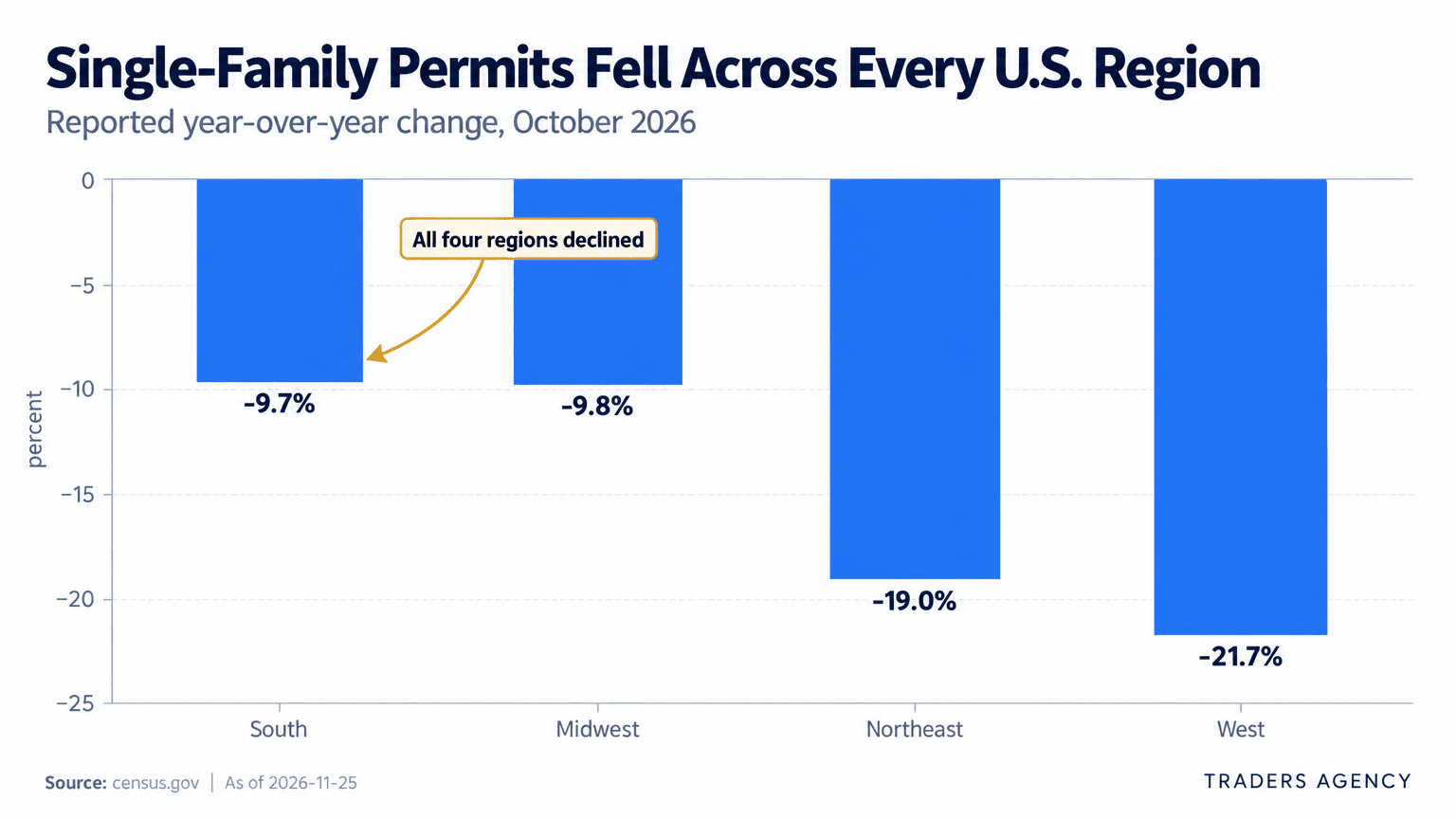
If reluctant sellers explain why existing homes aren't flooding the market, weak permitting explains why new ones aren't filling the gap. Census Bureau and HUD data for October 2026 show single-family permits falling year over year in every region of the country: down 9.7% in the South, 9.8% in the Midwest, 19% in the Northeast and 21.7% in the West. That is a broad-based pullback, not a regional anomaly, and January permitting data reportedly showed a similar pattern.
Part of the explanation is simple caution. Builders facing economic uncertainty, volatile tariffs and a cautious Federal Reserve have little appetite to start new projects. But construction activity hasn't disappeared, it has shifted. Associated General Contractors of America data on September 2026 Census construction-spending figures shows data-center construction spending up roughly 90% year over year, even as total private residential construction spending fell about 8.9%, with single-family construction spending down roughly 2.4%. It's worth noting that the broader residential decline includes multifamily building and home improvements, not just new single-family homes, so the comparison overstates how much single-family construction specifically has slowed. Even so, the direction is consistent: capital and labor are migrating toward data centers.
Oxford Economics research, as described in trade reporting, estimates that the ten states with the heaviest data-center spending could see a shortfall of up to 45,000 construction workers relative to employment growth elsewhere, a comparison against the other 40 states rather than a confirmed count of builders walking off residential jobs. The same research also flags soft housing demand as a separate factor. Separately, trade groups have reported that data-center developers in Northern Virginia have outbid homebuilders for land, a dynamic that, if it spreads, could squeeze residential supply in high-demand corridors even further.
Want expert trading insights delivered daily?
Join thousands of traders who rely on Traders Agency for market analysis and trade ideas.
Join Traders AgencyCould Falling Rates Make Affordability Worse?
Here is where the argument gets more speculative, and more interesting. Several forces, including a possible oil-supply increase, cooling inflation and productivity gains tied to artificial intelligence, could push interest rates lower over a multi-year horizon. A Federal Reserve FEDS Note published November 20, 2026 by researchers Antoine Lepetit and David Miller found that anticipated productivity shocks can lower the modeled 10-year Treasury yield and the expected real short-term rate five to ten years out, even though near-term short rates may rise temporarily as the economy strengthens. This is an empirical research finding about how productivity shocks move theoretical rate models, not an official Fed forecast or a prediction about mortgage rates specifically.
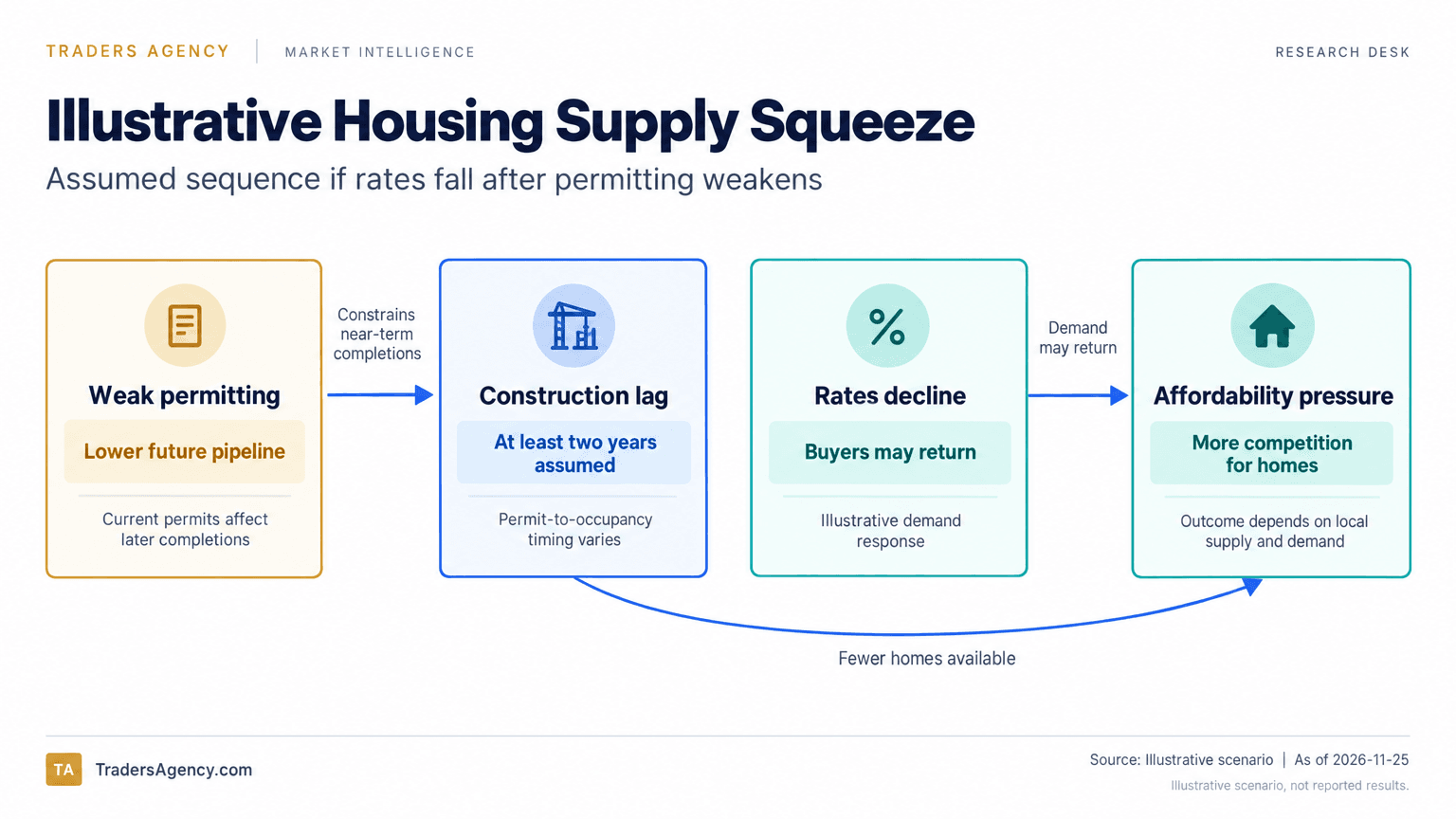
Still, it illustrates a plausible scenario worth watching: if borrowing costs do eventually decline, currently sidelined buyers could return to the market. Because there is typically a construction lag of two years or more between a building permit and a completed, move-in ready home, a wave of demand returning in 2027 or 2028 could meet a thinner pipeline shaped by today's weak permitting. If that sequence plays out, competition for a smaller stock of homes could push affordability further out of reach for buyers, even as it benefits existing owners whose properties become scarcer and, potentially, more valuable. That asymmetry, a warning sign for prospective buyers and a tailwind for current owners, is the crux of the broader argument, though it remains a scenario contingent on rates, demand and supply all moving in a particular direction rather than a locked-in outcome.
Local Rules, Geography and Uneven Outcomes
Housing supply doesn't move uniformly across the country. The argument points to Census-based comparisons showing permitting activity varies by state and by which party controls state government, including contrasts between markets like Hartford and Austin, but these specific comparisons reflect the source's own classification and calculations rather than independently confirmed statistics. What is clearer is the broader point: party label alone doesn't determine permitting outcomes. Local zoning rules, litigation risk, and physical geography, such as coastal and mountain boundaries or agricultural land-preservation rules in parts of California, all shape how much a given market can actually build, regardless of which party controls the statehouse.
How Investors Might Think About Exposure
For those considering real-estate exposure amid this uncertainty, the source outlines several broad categories rather than specific recommendations: value-add or fixer-upper properties, accessory dwelling units in supply-constrained areas, scarce or exclusive land, publicly traded homebuilders such as Lennar and Taylor Morrison, mortgage originators such as Rocket Mortgage, and pooled vehicles like REITs. Each carries different risk. Mortgage-related companies are especially sensitive to rate swings, benefiting when rates fall and struggling when they rise again. Pooled real-estate vehicles can carry layered fees, including management and asset-management charges stacked on top of fund-level costs, which investors should scrutinize carefully before committing capital.
The Bottom Line
Higher mortgage rates have clearly throttled housing transactions without producing a national price crash, largely because existing owners aren't selling. Meanwhile, weak permitting and construction resources flowing toward data centers raise a real question about future supply. Whether that translates into a meaningfully tighter affordability squeeze by 2027 or 2028 depends on several moving pieces, including the pace of any rate decline, how quickly builders respond, and how local rules and geography shape supply market by market. Traders Agency analysts will be watching permit data, construction-spending trends and mortgage-rate movements closely, since the interplay between these forces, not any single data point, will determine whether the next phase of this cycle favors buyers or owners.
Want expert trading insights delivered daily?
Join thousands of traders who rely on Traders Agency for market analysis and trade ideas.
Join Traders AgencyDISCLAIMER: Traders Agency does not offer financial advice. The information provided is for educational purposes only and should not be considered financial advice. Traders Agency is not responsible for any financial losses or consequences resulting from the use of the information provided. Trading carries inherent risks and may not be suitable for all individuals. You are advised to conduct your own research and seek personalized advice before making any investment decisions, recognizing the potential risks and rewards involved.
- Mortgage Rates — Freddie Mac
- Homes Are Selling for Near-Record Highs as Supply Hits New Low
- United States Housing Market & Prices
- Pending Home Sales Decreased 4.7% in October, According to NAR Report
- Pending Home Sales — Charts and Data
- Monthly New Residential Construction, October 2026
- Data Centers, Power Projects Buoy Construction Spending in September as Other Sectors Stall or Slide in Face of Rising Costs, Uncertain Funding
- Data center growth is pulling workers away from homebuilding, report finds
- Data Centre Boom Exacerbates Construction Labor Shortages in US
- Homebuilders Accuse Data Centers of Snapping Up Land at ‘Impossible Prices’
- When productivity booms, do interest rates rise?
- Building Permits Survey
- Building Permits Survey — How the Data are Collected
- Home Prices Fall in 76 of 300 Largest U.S. Markets
See more from Traders Agency on Google
Make us a preferred source and our market analysis will appear more prominently in your Google Search, Top Stories, and AI results.
Add to Preferred Sources