
The Commerce Department's August Personal Consumption Expenditures (PCE) report, released Wednesday, Sept. 30, showed annual inflation running cooler than economists had anticipated even as consumer spending accelerated sharply. The headline PCE price index rose 3.4% from a year earlier, below the 3.7% increase economists surveyed by Dow Jones had expected, according to CNBC. Data compiled by Trading Economics show that 3.4% annual pace was unchanged from a downwardly revised July reading, and that the core PCE price index, which excludes food and energy, also held at 3.0% year-over-year in August, unchanged from July.
Which Month Does the Data Cover?
The report released Sept. 30 covers August 2026 activity. CNBC's write-up of the release frames the data as consumer prices for August, and Trading Economics' underlying dataset lists August 2026 as the reference period for both the headline and core figures. September's PCE figures are scheduled for release Oct. 29, according to Trading Economics' release calendar.
Headline Undershoots Forecasts, Core Holds Steady
On a monthly basis, the headline PCE price index rose a seasonally adjusted 0.3% in August, matching Trading Economics' own forecast but coming in slightly below the 0.4% consensus estimate cited by that outlet. That followed a July reading that was revised down to a 0.1% monthly gain from an initially reported 0.2%, a downward revision of 0.1 percentage point (0.2% minus 0.1%, based on Trading Economics data). Core PCE rose 0.2% on the month, up from 0.1% in July, while its year-over-year rate remained at 3.0%.
CNBC reported that the softer annual readings came as the Bureau of Economic Analysis adjusted the way it computes several components of the index, and that it was "not immediately clear what impact the revisions had on the final numbers." CNBC did not detail the size or scope of those methodological changes.
Consumer Spending and Income
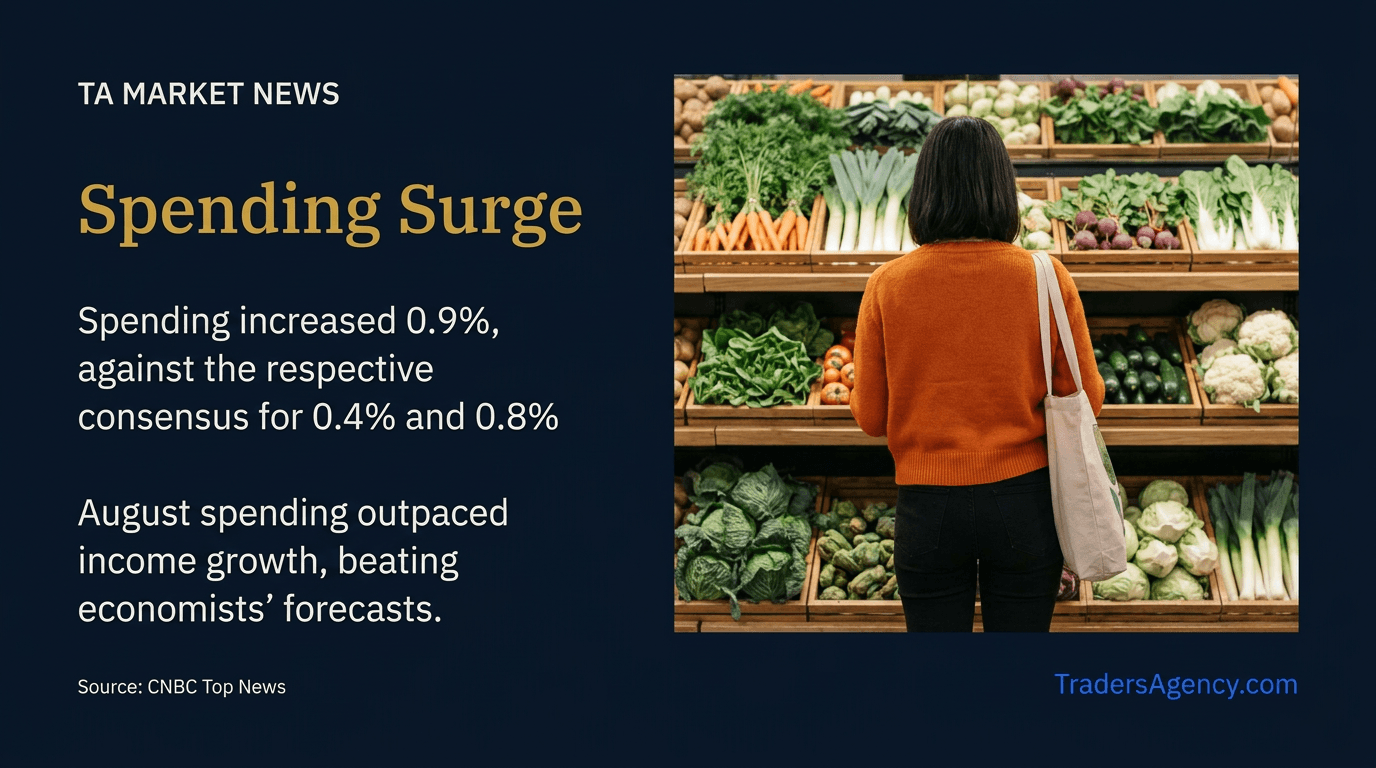
Spending outpaced income growth by a wide margin in August. Personal income rose just 0.2%, missing the 0.4% consensus estimate cited by CNBC, while personal spending jumped 0.9%, ahead of the 0.8% consensus. In inflation-adjusted terms, Trading Economics data show real personal spending rose 0.6% in August, up from a revised 0.1% gain in July. Read alongside the 0.9% nominal gain, that suggests — our interpretation of the two reported figures, not a conclusion stated in the release — that much of the spending increase reflected higher real consumption rather than price effects alone.
Energy Led the Price Increase
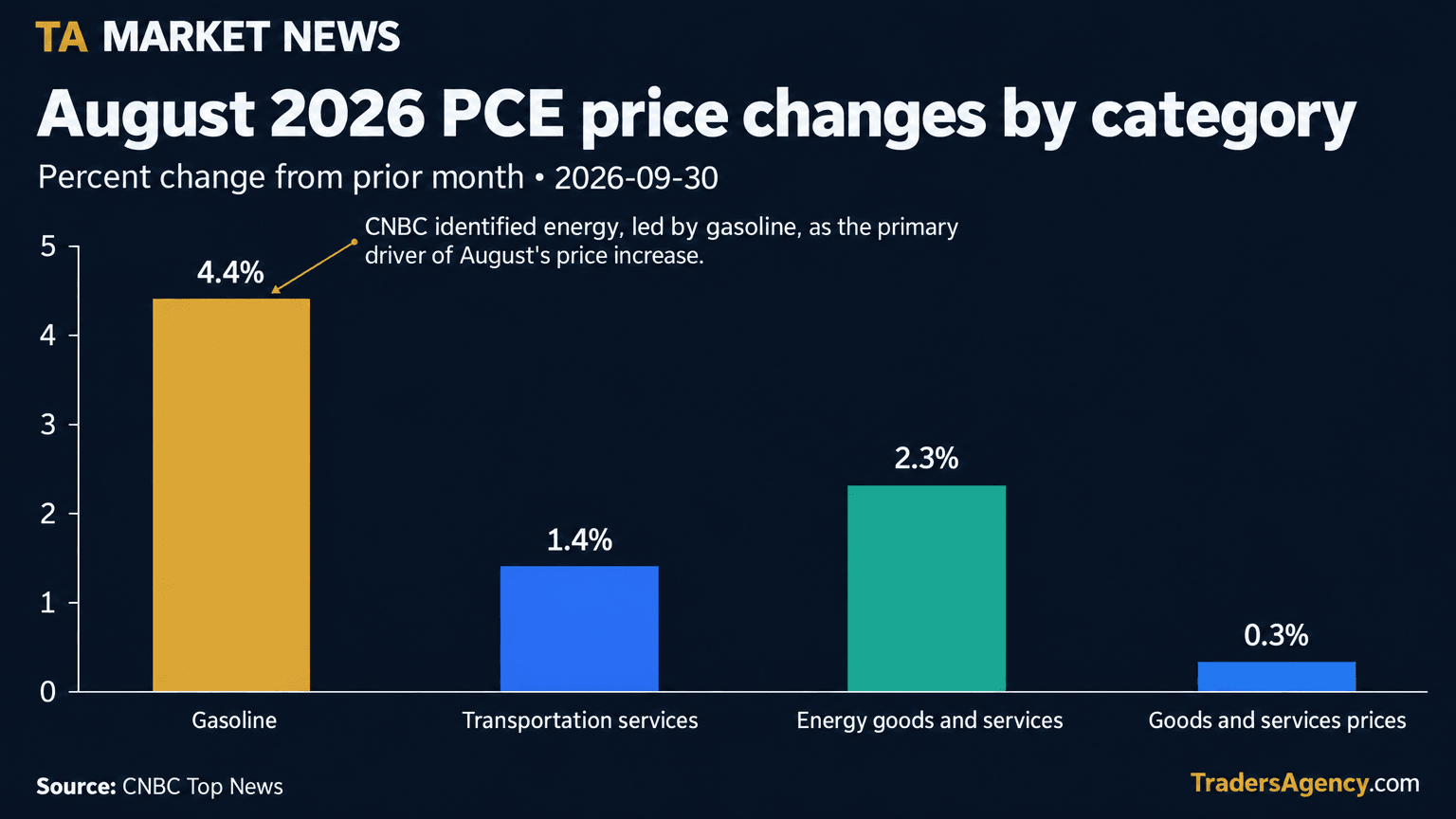
CNBC identified energy as "the primary culprit for the price rise in August, though multiple other sectors also showed gains." Gasoline prices jumped 4.4% and transportation services rose 1.4%, while broader energy goods and services climbed 2.3%. Goods and services prices each rose 0.3% for the month. Trading Economics' category breakdown adds further texture: goods prices rose 0.3%, rebounding from a 0.1% decline in July, led by a 0.5% increase in nondurable goods tied largely to the gasoline jump. Durable goods inflation eased to 0.1% from 0.4%, while services prices accelerated to 0.3% from 0.1%, driven mainly by transportation services and a 0.5% rise in food services and accommodations.
Market and Fed Reaction
Stock market futures gained ground following the report while Treasury yields moved lower, according to CNBC. Traders priced in a reduced probability of an October Federal Reserve rate increase, pushing the next expected hike out to December.
David Russell, global head of market strategy at TradeStation, told CNBC the reading was "good news for investors worried about the recent surge in bond yields," and that "it bolsters the case for not hiking in October." He cautioned, however, that the data is "relatively old" and "doesn't reflect this month's surge in diesel prices," a qualified reminder that the report is a rearview look at August conditions rather than a real-time signal.
Expectations for an October move had already softened a day earlier after New York Fed President John Williams said, "With the policy action we took at our September meeting, there is no need for urgency, and we have time to gather more information." Williams added he still believes another hike "may be appropriate late this year," a comment CNBC said led markets to shift the next expected increase to December.
Still Above Target
Both the headline and core PCE readings remain well above the Fed's 2% inflation target following the central bank's quarter-point rate increase in September, according to CNBC, leaving October and December as the two remaining 2026 meetings where policymakers could act again. Trading Economics separately notes the PCE price index has stayed above the 2% goal continuously since 2021, underscoring that this cooler-than-forecast reading, welcome as it may be to markets, still leaves the Fed's work unfinished.
Bottom Line
August's PCE report delivered a softer-than-expected headline inflation number alongside a core rate that simply held its ground at 3.0%, even as consumers opened their wallets more than economists anticipated. The combination gave bond and equity markets an initial reason to price out an October rate hike, but the update covers a month-old snapshot of the economy, and both officials and strategists cited in the coverage were careful to note that more recent price pressures, particularly in energy, are not yet reflected in the data.
DISCLAIMER: Traders Agency does not offer financial advice. The information provided is for educational purposes only and should not be considered financial advice. Traders Agency is not responsible for any financial losses or consequences resulting from the use of the information provided. Trading carries inherent risks and may not be suitable for all individuals. You are advised to conduct your own research and seek personalized advice before making any investment decisions, recognizing the potential risks and rewards involved.
- CNBC Top News: Fed’s preferred gauge showed core inflation at 3.0% in August, much lighter than expected · accessed Sep 30, 2026
- www.bea.gov: Personal Consumption Expenditures Price Index · accessed Sep 30, 2026
- www.cnbc.com: PCE inflation report May 2026: · accessed Sep 30, 2026
- tradingeconomics.com: United States PCE Price Index Monthly Change · accessed Sep 30, 2026
- www.jec.senate.gov: Expenditures Update - U.S. Congress Joint Economic Committee · accessed Sep 30, 2026
- finance.yahoo.com: June 2026 PCE inflation falls 0.1%, consumer spending up 0.3% · accessed Sep 30, 2026
- www.youtube.com: - YouTube · accessed Sep 30, 2026
- www.oxfordeconomics.com: US PCE Nowcast - Rise in core inflation isn't a signal for 2026 · accessed Sep 30, 2026
- tradingeconomics.com: United States PCE Price Index Annual Change · accessed Sep 30, 2026
See more from Traders Agency on Google
Make us a preferred source and our market analysis will appear more prominently in your Google Search, Top Stories, and AI results.
Add to Preferred Sources