Anthropic's Trillion-Dollar IPO Has a Problem Hiding in Plain Sight
Anthropic IPO stock began trading at a valuation north of a trillion dollars. Buried in the 300-page prospectus is governance language that lets the founders sell almost all their stock while keeping full control, and lets the board put "humanity" ahead of your returns. I read the entire filing. Here's what it actually says.
The structural issues built into this company aren't temporary, they're permanent features of how Anthropic is legally organized. Before you buy this stock, you should know exactly what you're buying.
The Religion Behind the Company
Bottom Line: Anthropic's governance structure lets founders sell nearly all their stock while keeping voting control, and lets the board favor a mission over shareholder returns. That combination, plus heavy insider selling at IPO, points to a stock that could fall hard before it finds a bottom.
Effective altruism, GiveWell, and a very familiar sales pitch
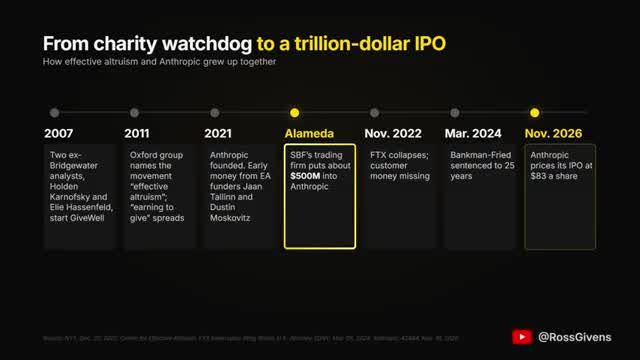
Anthropic didn't come out of nowhere. It grew out of a movement called effective altruism, which started with a decent idea: rate charities the way a hedge fund rates stocks, and send money wherever it saves the most lives per dollar. Two former Bridgewater analysts turned that idea into a charity watchdog called GiveWell back in 2007.
A group of Oxford philosophers later gave the movement a name and a strategy: "earning to give." Get rich, then give it away. That philosophy eventually drifted into long-termism, the idea that stopping some distant catastrophe matters more than helping anyone alive today. The most famous believer in that version of the movement was Sam Bankman-Fried, who told an interviewer he'd take a bet with a 51% chance of doubling the world's wealth and a 49% chance of wiping it out entirely. He said yes. FTX collapsed soon after, and he's now serving 25 years for fraud.
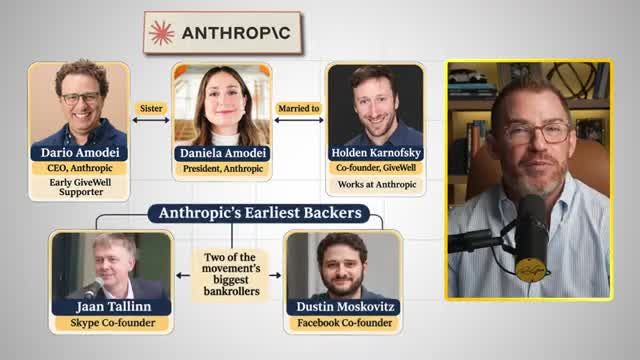
His trading firm, Alameda, had already put roughly $500 million into Anthropic before any of that happened. The ties run deeper than money. Dario Amodei, Anthropic's CEO, was an early GiveWell supporter. His sister and the company's president, Daniela Amodei, is married to Holden Karnofsky, one of GiveWell's co-founders, who now also works at Anthropic. Early funding came from two of the movement's biggest donors: Skype co-founder Jaan Tallinn and Facebook co-founder Dustin Moskovitz.
Nobody is accusing the Amodeis of anything close to what Bankman-Fried did. But the pitch sounds familiar: trust us to get extraordinarily rich and powerful, because it's for your own good. Worth remembering once real money is on the table.
Who sold shares in the Anthropic IPO?
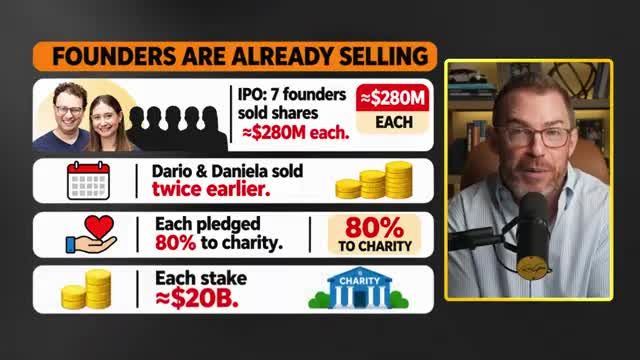
Anthropic trades under the ticker ANT with a valuation north of a trillion dollars. Every share distributed from existing shareholders in the offering came from the seven founders themselves, about $280 million apiece, and Dario and Daniela Amodei had already sold stock in two earlier private rounds before the company ever went public. The founders are cashing out.
Why isn't Anthropic a normal corporation?
Anthropic is structured as a public benefit corporation. Its directors are legally required to balance shareholder returns against what the prospectus calls "the long-term benefit of humanity." That's the company's own language, straight from the filing. If profit and their version of humanity's benefit ever collide, management has made no promise about which one wins.
The people running that trust might not own a single dollar of the stock they're voting on. So much for shareholder-aligned incentives.
Who actually controls Anthropic?
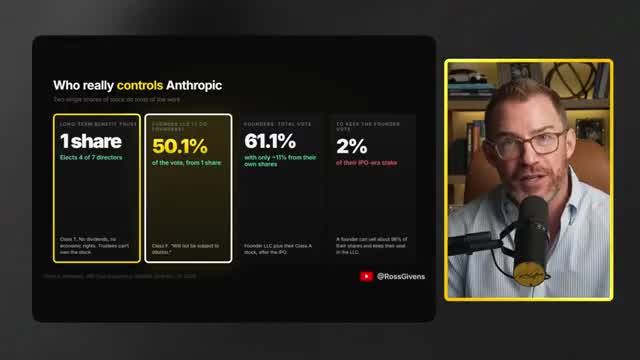
The seven founders hold one special class of stock together, carrying more than half of the total vote, and the prospectus states that voting power can never be diluted.
Compare that to Elon Musk at SpaceX or Mark Zuckerberg at Meta. If either sold every share they own, they'd lose voting control immediately. Not here. Anthropic's founders only need to hold onto 2% of the stock they owned at the IPO to keep running the company. They could sell 98% of their shares and nothing at the top would change.
Founders Are Already Selling
That selling has already started. Each founder walked away with roughly $280 million in the IPO itself, and Dario and Daniela Amodei had sold stock in two earlier rounds before the company ever listed.
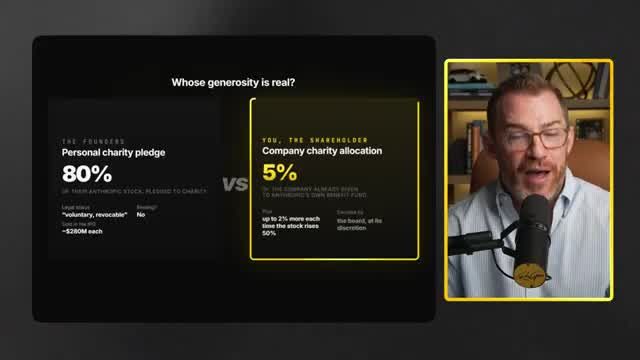
Each founder has pledged to give 80% of their Anthropic stock, worth roughly $20 billion, to charity. Generous, until you read the next line of the filing: those commitments are described as "voluntary and revocable" and "do not constitute legally binding obligations." It's a pledge they can walk back whenever they want, with zero legal consequence.
Compare that to what shareholders are already locked into. Anthropic has handed 5% of itself to its own charity fund, and every time the stock runs up, more shares can get diverted the same way. That dilution comes straight out of your ownership stake, and it's entirely the board's call.
Get an entire year of live weekly mentoring sessions, my newsletter, indicators, bonus reports, tons more. Click the link and I'll see you in the next live session.
Join my Black Ops Trading ClubThe Math Doesn't Add Up
Anthropic's revenue grew 12 times larger last quarter than the same quarter a year earlier. That's real growth. But Anthropic IPO stock is already priced as if everything goes perfectly from here, and the numbers underneath that assumption are shaky.
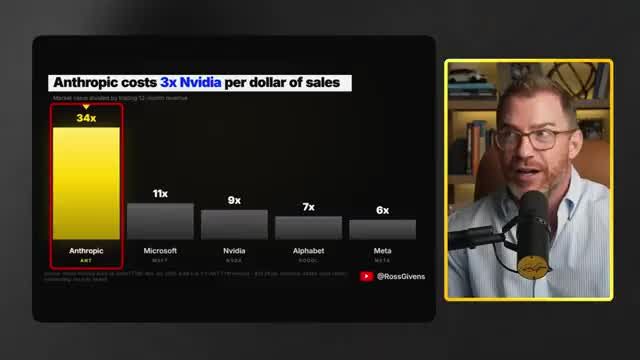
Investors are paying 34 times sales for Anthropic right now, more than three times what they pay for Nvidia on the same basis. Nvidia generates hundreds of billions of dollars in profit every year. Anthropic is still losing money.
A $900 Billion Bet on Pricing Power
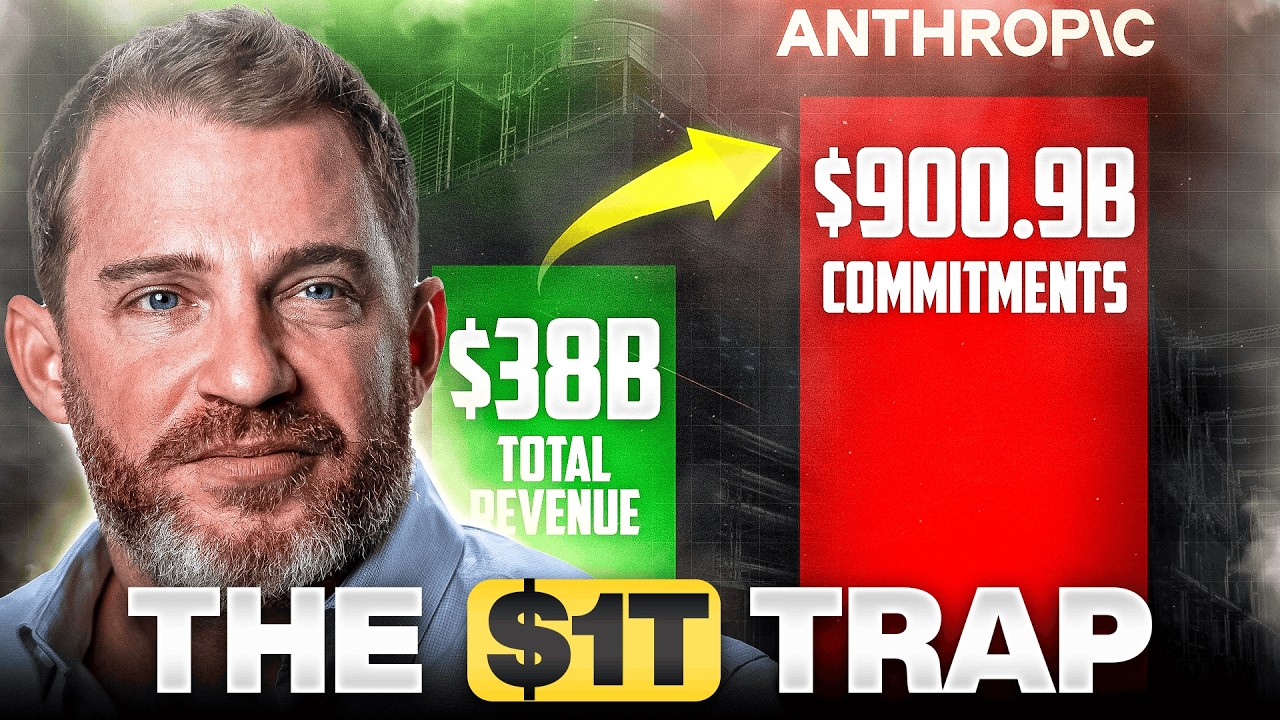
Anthropic has roughly $900 billion in compute and data center commitments. Back in October, that figure sat a little over $500 billion in the initial filing. It jumped $400 billion in about a month and a half. These commitments run 20 times larger than every dollar of revenue the company has ever generated, total.
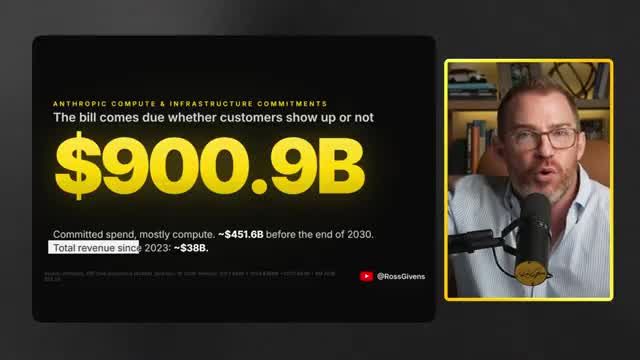
Many of these are "take or pay" deals. The prospectus states the company must pay "regardless of actual utilization," meaning Anthropic owes for server capacity whether customers show up or not.
That bet only works if Anthropic can keep charging premium prices for years. It can't, and here's why:
- Open-source is free and close behind. The best open models trail the top closed models by only four to five months. Whatever Anthropic prices at a premium this spring, someone gives away free by summer.
- Intelligence keeps getting cheaper. Research group Epoch AI tracks this, and the cost of matching AI performance falls roughly 13 times every year, faster than computer chips, batteries, or electricity prices ever dropped.
- It's already happening to Anthropic. Last October the company cut the price of its cheapest model by 90%, landing at the same price as OpenAI's. That's not pricing power. That's a price war.
Anthropic's own prospectus admits as much, warning that open-source models "could exert pricing pressure on our offerings." With OpenAI, Google, xAI, Meta, and a steady stream of Chinese labs all releasing competing models, AI is turning into a commodity. When ten companies sell the same product, the price only moves one direction.
The Railroad Problem
If the model builders aren't the long-term winners, history has an answer for who usually is, and it's not who you'd guess.
In the 1840s, Britain went through a railroad mania. Charles Darwin bought railway stock. So did the Bronte sisters. Everyone was certain trains would change everything, and they were right about the trains. The best-known index of railway shares still fell about 64% from its peak. The track got built, more than half the size of the network Britain runs today, but the investors who financed it got wiped out. The factories, merchants, and shippers who used that cheap transportation afterward are the ones who got rich.
America repeated the mistake. In 1893, a quarter of all railroad mileage in the country went into bankruptcy court. Even Union Pacific went under.
The 1990s brought the same pattern with fiber optic cable. Telecom companies borrowed heavily to lay fiber nationwide, certain internet traffic would need every inch of it. By 2001, only about 5% of that fiber was actually lit up and in use. Global Crossing went bankrupt. Then WorldCom went bankrupt, the largest bankruptcy in history at the time. Google, Netflix, and Amazon picked up that cheap, unused bandwidth and built empires on top of it.
Anthropic is the railroad. The data centers are the fiber. Whoever eventually turns this technology into a product people pay for, the way Google and Amazon did with fiber, is more likely to be the real long-term winner than the model builders themselves.
Is Anthropic IPO Stock a Buy?
Anthropic is probably a great business. It's not a great stock at a trillion-dollar valuation. Founders are selling while keeping voting control, the board answers to a charitable trust instead of shareholders, and the core product gets cheaper every quarter. That combination is a recipe to lose money, not make it.
IPOs in general are a tough setup for new buyers. Investment banks price these deals at the highest level the market will tolerate, stretching the valuation as far as it will go, because that's exactly when insiders cash out. That dynamic is why most IPOs fall 50%, 60%, even 70% from their peak. The pressures built into this prospectus point to Anthropic IPO stock falling a lot further before it bottoms.
The AI boom is real. The money just won't be made by the company that built the railroad. It'll be made by whoever turns the technology into something people pay for, over and over again.
Get an entire year of live weekly mentoring sessions, my newsletter, indicators, bonus reports, tons more. Click the link and I'll see you in the next live session.
DISCLAIMER: Traders Agency does not offer financial advice. The information provided is for educational purposes only and should not be considered financial advice. Traders Agency is not responsible for any financial losses or consequences resulting from the use of the information provided. Trading carries inherent risks and may not be suitable for all individuals. You are advised to conduct your own research and seek personalized advice before making any investment decisions, recognizing the potential risks and rewards involved.
See more from Traders Agency on Google
Make us a preferred source and our market analysis will appear more prominently in your Google Search, Top Stories, and AI results.
Add to Preferred Sources