Nvidia's extraordinary leadership reversal has rippled across the chip sector this month, reviving investor appetite for semiconductor stocks just as many of them traded well below their recent highs. Amid that renewed enthusiasm, one name has drawn particular attention from investors scanning for value: Taiwan Semiconductor Manufacturing Company, the foundry giant whose shares fell sharply before staging a partial recovery.
A Leadership Reversal That Shook the Chip Sector
Nvidia's chief executive, Jensen Huang, resigned amid reporting that examined his personal conduct, including coverage describing an affair involving an executive at Megaspeed whom reporting said was suspected of ties to Chinese intelligence, as well as a separate relationship with an Nvidia subordinate. Nvidia's regulatory filing records the board's acceptance of his resignation on November 11, with the announcement following on November 12. Nvidia reinstated Huang as president, chief executive and board director on November 23, while noting that its independent investigation would continue.
Huang reportedly posted publicly after stepping down, apologizing and arguing that Nvidia's technological complexity, customer relationships and geopolitical exposure required his continued leadership; the exact wording of that post has not been independently verified for this article. President Trump has since said publicly that he personally intervened to help bring Huang back, telling an interviewer he convinced Nvidia's board directly and calling Huang essential to the company's future.
Investors appear split on how to read the episode. Supporters of Huang's return argue that his leadership built Nvidia into what it is today, and that simply removing uncertainty over who runs the company justified much of the rebound in the stock. Critics counter that the underlying conduct represented a serious breach of trust, and that a sitting president intervening directly in a public company's boardroom decision sets an uncomfortable precedent regardless of the business outcome. Both concerns carry some weight: Huang's reinstatement erased a meaningful unknown for shareholders, yet the manner in which it happened raises governance questions that could keep drawing political and regulatory scrutiny in the years ahead. According to the investor's account examined for this piece, the news triggered a rally across AI-linked shares that day, including Nvidia, ASML and Google, as some of the uncertainty weighing on the sector eased.
Why TSMC Stands Out After the Sell-Off
Within that broader rebound, TSMC has become a focal point for investors looking past the headlines toward fundamentals. The company's customer base includes Nvidia, AMD, Apple and Broadcom, among the industry's most significant designers of advanced chips, giving it exposure to nearly every major player racing to build AI and high-performance computing hardware. Because TSMC sits near the top of that supply chain, with far smaller rivals such as Samsung and Intel, it has historically shown less cyclicality and competitive risk than many of the chip designers and component makers beneath it in the ecosystem.
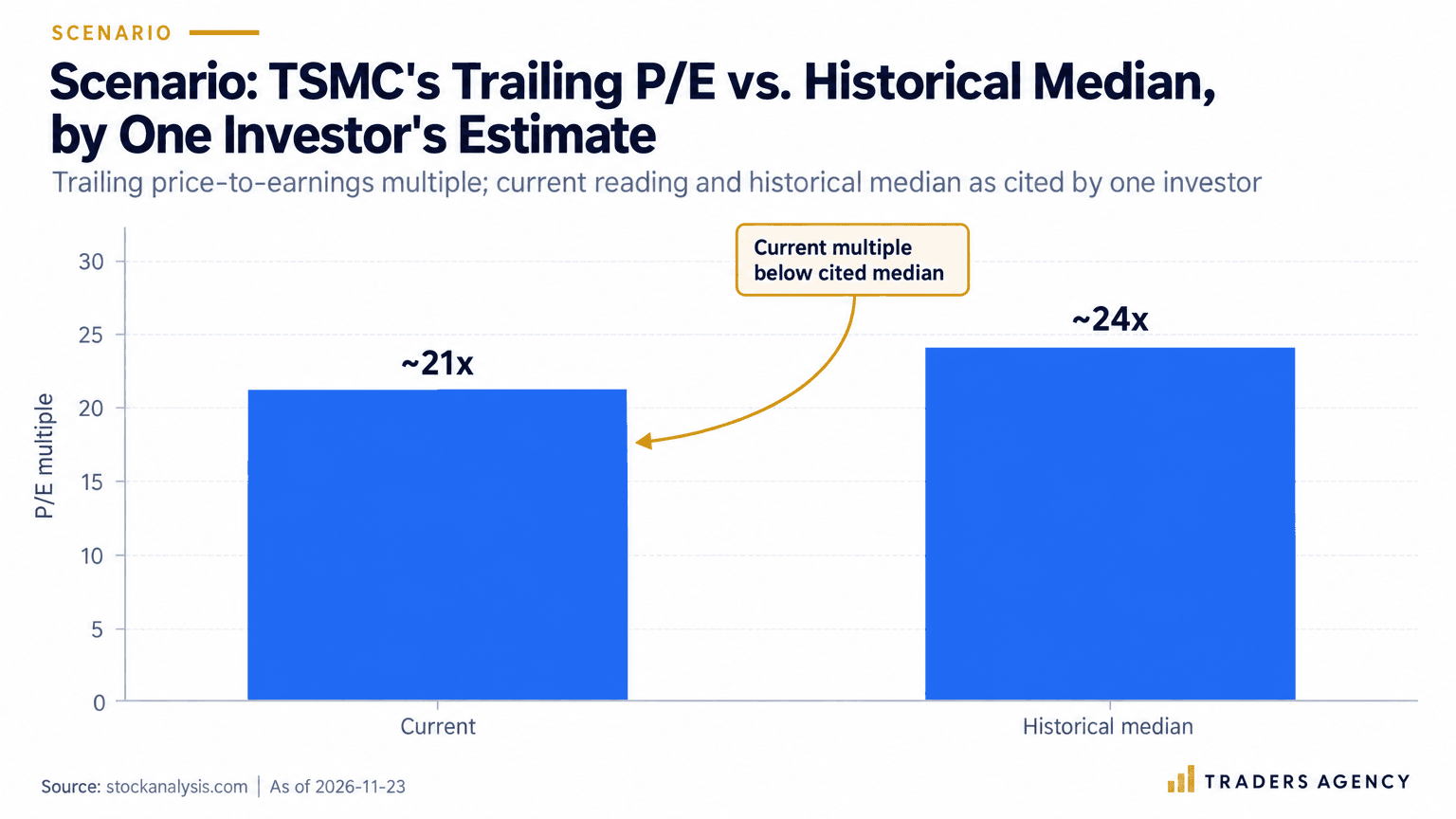
By one investor's assessment, TSMC shares had fallen roughly 35% from their highs during the recent sell-off before recovering somewhat, leaving the stock still around a quarter below its peak. That same investor placed TSMC's trailing price-to-earnings ratio at roughly 21 times, below a historical median the investor cited near 24 times, suggesting the stock traded toward the cheaper end of its own range even as the underlying business kept growing. TSMC's most recent quarterly results showed continued strength and sustained demand for its leading-edge manufacturing process, which supports the argument that the decline reflected shifting sentiment, including anxiety tied to the Nvidia leadership saga and broader political developments, more than any deterioration in TSMC's own business. Stock declines can also reflect legitimate reassessments of valuation or risk, so sentiment alone is unlikely to be the entire explanation.
Building on that reasoning, one investor's illustrative scenario places TSMC's estimated fair value near $450, premised on the company simply meeting its current analyst guidance rather than requiring any upward revision. That figure is best read as a valuation scenario tied to specific growth assumptions, not a price target or a guarantee of future performance.
Want expert trading insights delivered daily?
Join thousands of traders who rely on Traders Agency for market analysis and trade ideas.
Join Traders AgencyThe Semiconductor Moat Hierarchy
The thesis ranks companies across the chip supply chain by how defensible their position is. ASML, the sole maker of the extreme ultraviolet lithography machines TSMC depends on, is treated as closest to a true monopoly. TSMC ranks just below it, with a manufacturing moat described as wider than that of chip designers such as Nvidia and AMD, which rely on TSMC to physically produce the chips they design. Further down that scale sit more commoditized businesses, including memory makers, energy companies and so-called neocloud providers, whose products and services are generally easier for competitors to replicate.
Industry data from TrendForce put TSMC's share of global foundry revenue at 72.5% in the second quarter of 2026, far ahead of Samsung's 5.9%, though that figure covers foundry revenue broadly rather than a narrowly defined category of only the most advanced chips. Replicating TSMC's position requires more than capital. It demands massive fabrication facilities, deep manufacturing know-how, high production yields and long-standing partnerships with customers who need volumes in the billions of units, a combination few competitors can assemble at comparable scale.
Capacity Expansion and the Growth Case
TSMC's own disclosures from its October 2026 earnings call describe nearly 20 fabrication and advanced-packaging facilities in progress worldwide, with 13 leading-edge and advanced-packaging fabs in Taiwan and another five to six planned overseas over the following several years. That points to a higher concentration of new capacity remaining on the island than looser summaries of the plan sometimes suggest.
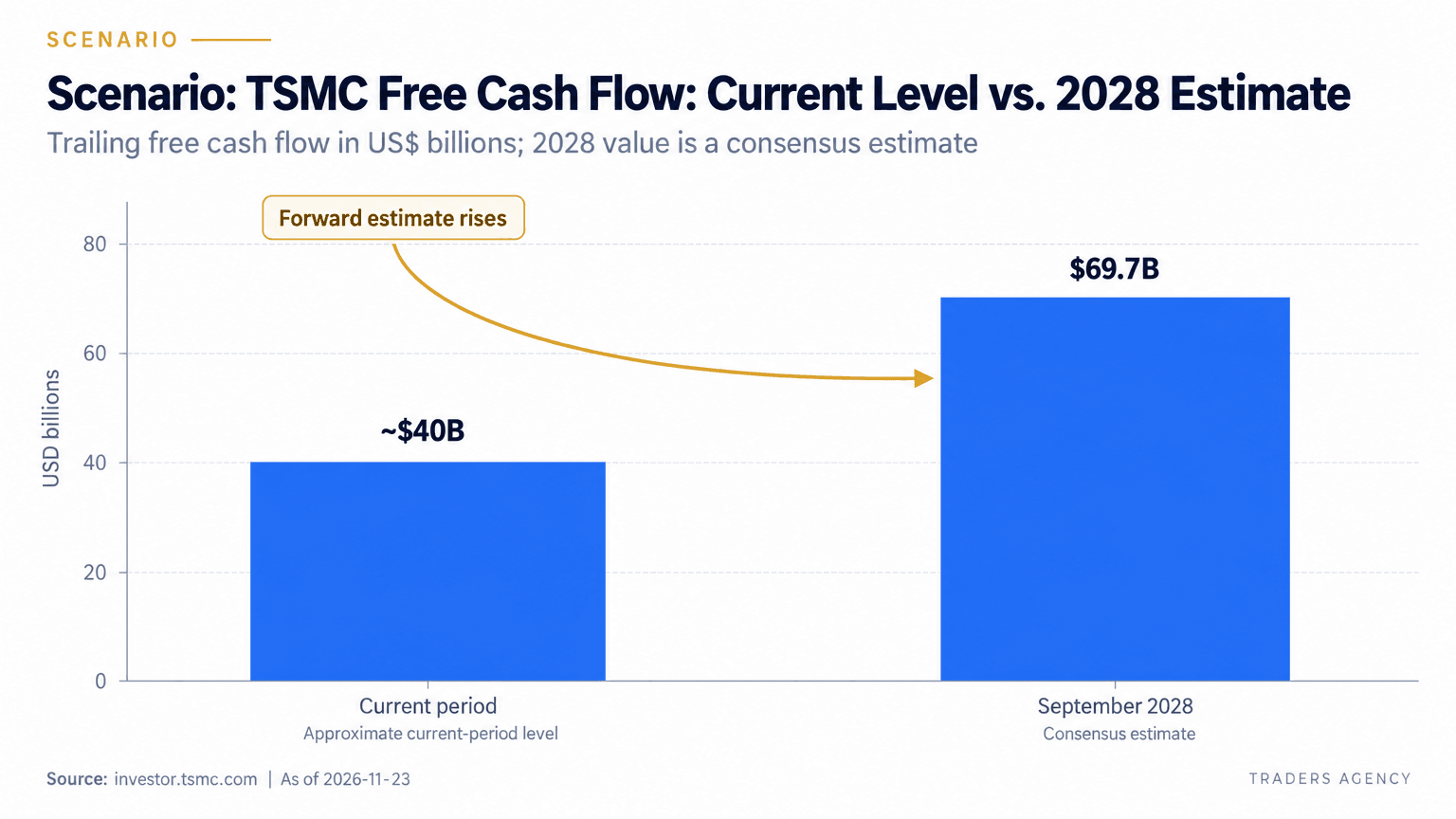
The growth case also leans on forward estimates rather than reported results. One cited consensus estimate puts TSMC's trailing free cash flow near $69.7 billion by September 2028, compared with roughly $40 billion currently. As with any multi-year forecast, that outcome depends on sustained AI infrastructure spending and successful execution of an expensive, multi-year capacity build. Similarly, consensus estimates place TSMC's earnings per share near $26 by 2028, with one investor's illustrative scenario suggesting it could reach roughly $40 by 2030 if annual earnings growth continues near the mid-30% range. Those later-year figures are not company guidance and should be treated as a forward scenario rather than a forecast.
Taiwan and the China Question
A central risk to any TSMC thesis remains geopolitical. A full-scale move by China against Taiwan would disrupt TSMC's operations, the broader AI trade and global markets well beyond the semiconductor sector. One investor's view treats that scenario as unlikely, reasoning that the economic and strategic costs to Beijing of destabilizing Taiwan would be severe. That remains a probability judgment rather than a certainty, and geopolitical risk assessments can shift quickly with little warning.
The same investor suggested that TSMC's strategic importance effectively makes Taiwan comparable to a NATO member in terms of the protection it might receive from allies. Taiwan is not a NATO member and holds no Article 5 treaty guarantee, so that comparison reflects an opinion about strategic importance rather than any established legal or alliance status.
The Bottom Line
Nvidia's leadership saga and the broader semiconductor sell-off have reset expectations across the chip sector, and TSMC's combination of manufacturing dominance, customer dependence and a valuation sitting below its own historical median help explain why investors are taking a fresh look at the stock. The company's near-monopoly position in advanced manufacturing, its ongoing capacity expansion and the broader AI buildout underpin the bull case, but that case still depends on continued execution, sustained AI spending and a geopolitical status quo across the Taiwan Strait that, while currently favored to hold, is not guaranteed. Traders Agency analysts will be watching whether TSMC's coming quarterly results and capital spending updates validate the growth assumptions built into its current valuation, and whether the AI trade's recent rebound proves durable once governance questions around Nvidia's leadership move further into the background.
Want expert trading insights delivered daily?
Join thousands of traders who rely on Traders Agency for market analysis and trade ideas.
Join Traders AgencyDISCLAIMER: Traders Agency does not offer financial advice. The information provided is for educational purposes only and should not be considered financial advice. Traders Agency is not responsible for any financial losses or consequences resulting from the use of the information provided. Trading carries inherent risks and may not be suitable for all individuals. You are advised to conduct your own research and seek personalized advice before making any investment decisions, recognizing the potential risks and rewards involved.
- NVIDIA Form 8-K recording Huang's resignation
- Reuters: How Nvidia CEO Jensen Huang got entangled in a China chip and spy scandal
- NVIDIA Board Reinstates Jensen Huang as President, CEO and Board Director
- 'I made the deal': Trump says he 'convinced' Nvidia board to reinstate Jensen Huang
- TSMC Third Quarter 2026 Earnings Release
- JPMorgan Eye on the Market: AI tracker
- TSMC Statistics and Valuation
- TSMC Financial Ratios
- TSMC ADR Stock Price History
- Global Foundry Revenue Approaches US$53.49 Billion in 2Q26 as SMIC Narrows Market Share Gap with Samsung
- TSMC Third Quarter 2026 Earnings Call Transcript
- TSMC Third Quarter 2026 Management Report
- What Is NATO?
- Collective defence and Article 5
See more from Traders Agency on Google
Make us a preferred source and our market analysis will appear more prominently in your Google Search, Top Stories, and AI results.
Add to Preferred Sources