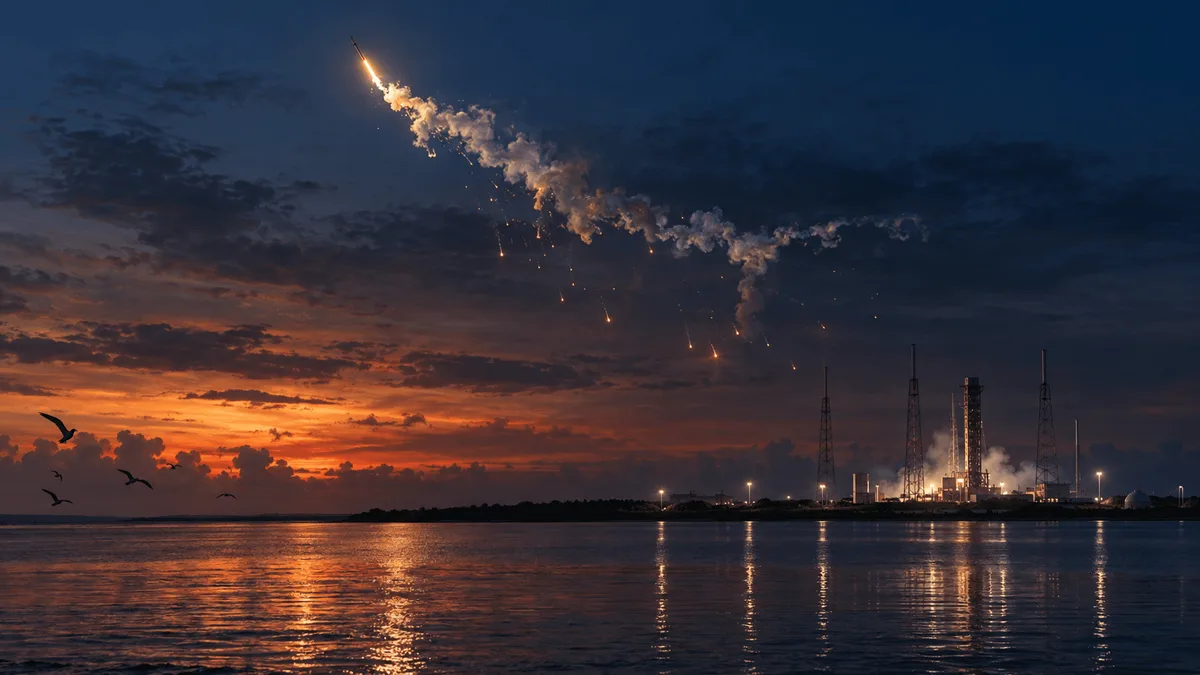
A United Launch Alliance Vulcan rocket failed roughly ten minutes after lifting off from Cape Canaveral on Sunday, destroying a payload of 40 satellites bound for Amazon's Leo broadband constellation and ending the company's previously unblemished launch record, according to Reuters and DW.
The mission, designated LV-01, was the first of 38 Vulcan launches ULA has contracted to deploy Amazon's Leo network, formerly known as Project Kuiper, using a VC6L configuration with six solid rocket boosters and an extended payload fairing, according to a Space.com video description of the launch.
What ULA Has Confirmed So Far
ULA said in a statement cited by DW that, based on data from its Launch Director, the Vulcan vehicle "suffered an anomaly 10 minutes into the flight and failed to deliver the Amazon mission to orbit." The company added that it did not yet have specific data to explain what occurred, noting only that "every flight generates data, and every flight teaches us something."
According to CNBC, the exact cause remained unclear as of the reporting, though the anomaly appeared to occur after Vulcan's second stage, which carried the Amazon satellites, separated from the first-stage booster powered by Blue Origin-supplied BE-4 engines. CNBC reported it was unclear whether the BE-4 engines played any role in the failure. Both CNBC and Reuters reported that Blue Origin is working with ULA on the investigation, citing a person familiar with the matter.
CNBC and DW both reported that the failure is expected to trigger a lengthy technical investigation that could keep Vulcan off the market for months. No specific return-to-flight date has been disclosed in the reporting reviewed.
A Troubled Return to Flight
Sunday's launch was Vulcan's fifth since its 2024 debut and its first in nine months, DW reported. That gap followed separate investigations into the rocket's solid rocket boosters and its core BE-4 engines. The solid rocket boosters had already come under scrutiny after anomalies on Vulcan's previous two flights, including one during a February 2026 mission for the U.S. Space Force, according to DW's reporting.
Those earlier missions ultimately delivered their payloads successfully, but CNBC reported that the Pentagon had not yet cleared Vulcan to resume carrying national security payloads, pending its performance on Sunday's Amazon flight. DW reported that the Space Force had paused Vulcan's national security launches pending the outcome of an investigation and the implementation of corrective measures. Sunday's mission was intended, in part, to help inform that decision; instead, it adds a fresh anomaly — and, unlike the earlier incidents, a total loss of payload — to the list ULA's investigators must resolve.
ULA was formed in 2006 from the merger of Boeing's Delta rocket program and Lockheed Martin's Atlas rocket program, and CNBC reported it had maintained a 100% mission success record ever since. DW described Sunday's failure as the company's first total mission failure, ending that streak.
Amazon's Leo Build-Out Loses Ground
Amazon acknowledged the risk inherent in a debut mission. "There is risk with any launch, and that's especially true for inaugural missions like LV-01," the company said in a statement reported by DW, adding that "ULA has been a trusted partner for Amazon" and that it expects the launch provider to "learn from this mission and deliver on their long-term plans for Vulcan."
Before Sunday's failed flight, Amazon had launched 398 Leo satellites across 14 missions since 2025 — roughly 12% of the 3,236 satellites the company needs for global coverage — according to DW, citing Reuters figures. Amazon had hoped to begin initial internet service this year, DW reported. CNBC and DW both reported that repeated rocket failures, including the Vulcan loss, have now delayed Amazon's effort to compete with SpaceX's Starlink network, which both outlets said has more than 11,000 satellites and millions of customers worldwide.
Both CNBC and DW framed SpaceX's lead as stemming partly from owning its own launch vehicle, while rivals like Amazon must pay external providers billions of dollars to loft their satellites, adding cost and schedule risk that Sunday's failure illustrates directly.
A Tightening Launch Market
DW reported that the Vulcan failure compounds a broader U.S. launch bottleneck, noting that SpaceX is no longer accepting new bookings for its Falcon 9, the world's most active rocket, as the company moves toward retiring it. CNBC similarly described the setback as deepening a bottleneck caused by mishaps and challenges across the launch industry combined with Falcon 9's looming retirement.
Neither Amazon nor ULA disclosed insurance coverage or a financial loss estimate tied to the lost satellites in the statements cited by the outlets reviewed here, and no cost figures for the failure have been reported. The available reporting likewise does not detail any financial or outlook commentary from Boeing or Lockheed Martin regarding their stakes in ULA; in the reporting reviewed, the two companies' involvement is described only through ULA's joint-venture ownership structure and the pending question of whether the Pentagon will clear Vulcan for national security missions once the investigation concludes.
Bottom Line
ULA has confirmed only that Vulcan failed ten minutes into flight and that the cause is still under investigation, with Blue Origin assisting. The loss ends ULA's perfect launch record, adds to a run of Vulcan technical issues that had already delayed national security certification, and sets back Amazon's effort to close the gap with Starlink at a moment when the broader U.S. launch market is already tightening. How quickly ULA can identify the cause, satisfy the Space Force, and resume Amazon's 38-mission Leo manifest will determine how lasting this setback proves to be.
DISCLAIMER: Traders Agency does not offer financial advice. The information provided is for educational purposes only and should not be considered financial advice. Traders Agency is not responsible for any financial losses or consequences resulting from the use of the information provided. Trading carries inherent risks and may not be suitable for all individuals. You are advised to conduct your own research and seek personalized advice before making any investment decisions, recognizing the potential risks and rewards involved.
- CNBC Top News: Boeing-Lockheed rocket fails mid-flight, destroying Amazon satellites · accessed Nov 16, 2026
- Reuters: Rocket from Boeing-Lockheed firm fails mid-flight, destroys payload of Amazon satellites · accessed Nov 16, 2026
- www.dw.com: Boeing-Lockheed rocket fails, 40 Amazon satellites lost · accessed Nov 16, 2026
- www.facebook.com: 287K views · 1K reactions | A Vulcan rocket owned by United Launch Alliance, the joint venture between Boeing and Lockheed Martin, failed shortly after lift-off from Florida, destroying its payload of 40 satellites meant for Amazon's Leo internet network and marking the launch company's first mission failure. https://www.reuters.com/business/aerospace-defense/us-rocket-fails-after-launch-payload-amazon-internet-satellites-destroyed-2026-11-15/?utm_campaign=trueAnthem+Manual&utm_medium=trueAnthem&utm_source=facebook | Reuters · accessed Nov 16, 2026
- www.youtube.com: - YouTube · accessed Nov 16, 2026
- www.ulalaunch.com: ULA | United Launch Alliance · accessed Nov 16, 2026
- www.facebook.com: 59K views · 934 reactions | Watch live as United Launch Alliance (ULA) launches its powerful Vulcan rocket from Cape Canaveral Space Force Station in Florida on Sun. Nov. 15, 2026! The Vulcan Leo 1 mission will launch 40 Amazon Leo broadband internet satellites into low Earth orbit, marking the first Vulcan flight for Amazon's growing satellite constellation and the rocket's return to flight after a nine-month hiatus. This powerful Vulcan VC6L configuration features six solid rocket boosters, an extended payload fairing and an optimized Centaur V upper stage designed to deliver satellites into low Earth orbit. Liftoff is targeted for 12:11 p.m. EST (1711 GMT) from Space Launch Complex 41 at Cape Canaveral. The launch marks the fifth flight of ULA's next-generation Vulcan rocket and the first of 38 planned Vulcan missions supporting Amazon Leo, formerly known as Project Kuiper. Launch times are subject to change. Credit: United Launch Alliance (ULA) #ULA #Vulcan #VulcanRocket #RocketLaunch #AmazonLeo #ProjectKuiper #CapeCanaveral #Spaceflight #LiveLaunch | Space.com · accessed Nov 16, 2026
See more from Traders Agency on Google
Make us a preferred source and our market analysis will appear more prominently in your Google Search, Top Stories, and AI results.
Add to Preferred Sources