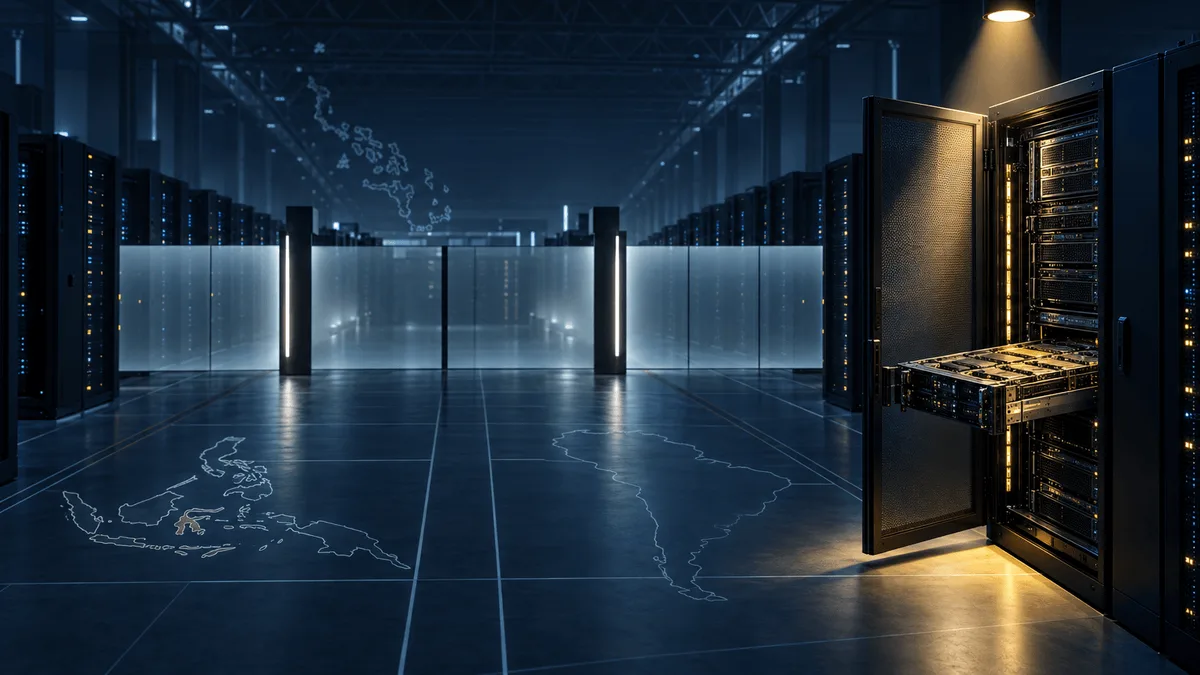
The U.S. Commerce Department has issued a new rule requiring licenses to export, reexport or transfer advanced semiconductors to Indonesia, Malaysia, Singapore, Thailand and Brazil, in what CNBC reported is an effort to close a loophole that allowed Chinese companies to lease Nvidia's advanced computing power from data centers in third countries.
New Licensing Requirement Targets Third-Country Data Centers
According to CNBC, the Commerce Department moved on Monday to close a loophole that has let Chinese companies lease Nvidia's advanced computing power from data centers in third countries, effectively circumventing controls on sensitive technology being exported to China.
Under the rule, companies will be required to obtain a license to export, reexport, or transfer in-country advanced semiconductors to Indonesia, Malaysia, Singapore, Thailand, or Brazil, CNBC reported, along with any additional country the Secretary of Commerce designates in consultation with the Secretary of State or the Assistant to the President for National Security Affairs. The outlet reported that Commerce characterized these jurisdictions as presenting a higher-than-normal risk of diversion.
Separately, Seeking Alpha reported that data centers, foreign foundries, and chip exporters must now conduct robust customer due diligence, including checks for direct or indirect ownership or control by persons in Country Group D:5 or Macau, before transacting with covered facilities.
Rule Emerges From Nvidia Scandal and Political Pressure
CNBC reported that the measure, an interim final rule issued by Commerce's Bureau of Industry and Security, is the first U.S. policy response to the scandal at Nvidia that led CEO Jensen Huang to resign last week. According to CNBC, the Commerce Department said the rule was "written by and at the direction of the Department of Treasury and the National Security Council."
As described by CNBC, the interim final rule states that the Department of Commerce "is establishing new rules to prevent certain foreign actors from leveraging advanced computing power based on U.S. technology to threaten U.S. national security and foreign policy interests," adding that the restrictions "will undermine the ability of companies headquartered in countries of concern from using U.S. advanced Super Intelligence (SI) semiconductors to train advanced SI models."
CNBC also reported that the rule came after rising criticism of Commerce Secretary Howard Lutnick, who has been accused of not doing enough to prevent possible diversion of Nvidia's most advanced chips to China in violation of American export controls. In an interview with CNBC's "Squawk Box," Treasury Secretary Scott Bessent blamed the Commerce Department for not placing Megaspeed, the Singapore-based company at the center of the Nvidia scandal, on the so-called entity list, which would restrict certain exports to it, according to CNBC.
Megaspeed's role at the center of the scandal has been reported by both CNBC and, via Reuters, The Guardian. The Guardian reported that Singapore's Minister for Digital Development and Information Josephine Teo discussed Megaspeed with U.S. Deputy Secretary of State Christopher Landau during a visit to Washington last week, and that the two sides "reaffirmed the commitment by both countries to continuing communications on issues of mutual interest, including on matters relating to Megaspeed."
The Guardian reported that Nvidia's shares were down almost 2% in premarket trading on Monday at $159.67, about 14% below their level just over a week earlier, before news broke that Huang had conducted an affair with a suspected Chinese spy.
Bottom line: Based on the reporting cited above, the interim final rule extends export-license requirements to five named countries and adds customer due-diligence obligations for data centers, foreign foundries and chip exporters. Interpretation: the measure targets remote access to U.S. advanced computing power rather than only physical chip shipments, though the reported details do not specify how licenses will be adjudicated or when additional countries might be designated.
DISCLAIMER: Traders Agency does not offer financial advice. The information provided is for educational purposes only and should not be considered financial advice. Traders Agency is not responsible for any financial losses or consequences resulting from the use of the information provided. Trading carries inherent risks and may not be suitable for all individuals. You are advised to conduct your own research and seek personalized advice before making any investment decisions, recognizing the potential risks and rewards involved.
- The Guardian: Trump says he wouldn’t mind Jensen Huang being reinstated as Nvidia CEO, as its shares fall again - as it happened · accessed Nov 16, 2026
- CNBC Top News: Commerce cracks down on China workaround of restrictions · accessed Nov 16, 2026
- Seeking Alpha Market News: No chips for you: US issues rule to stymie China's access to AI GPUs via data centers · accessed Nov 16, 2026
See more from Traders Agency on Google
Make us a preferred source and our market analysis will appear more prominently in your Google Search, Top Stories, and AI results.
Add to Preferred Sources