The U.S. House of Representatives passed the Lindsey O. Graham Sanctioning Russia and Iran Act of 2026 by a vote of 262-159 on Wednesday, September 16, sending the bill to President Donald Trump's desk, according to CNBC and NBC News. The legislation gives the president discretionary authority to impose tariffs of up to 100% on the top five purchasers of Russian oil or natural gas, a group that includes China and India, while also expanding sanctions on Russian officials, oligarchs, banks and the country's tanker "shadow fleet."
A capped, discretionary tool, not a mandate
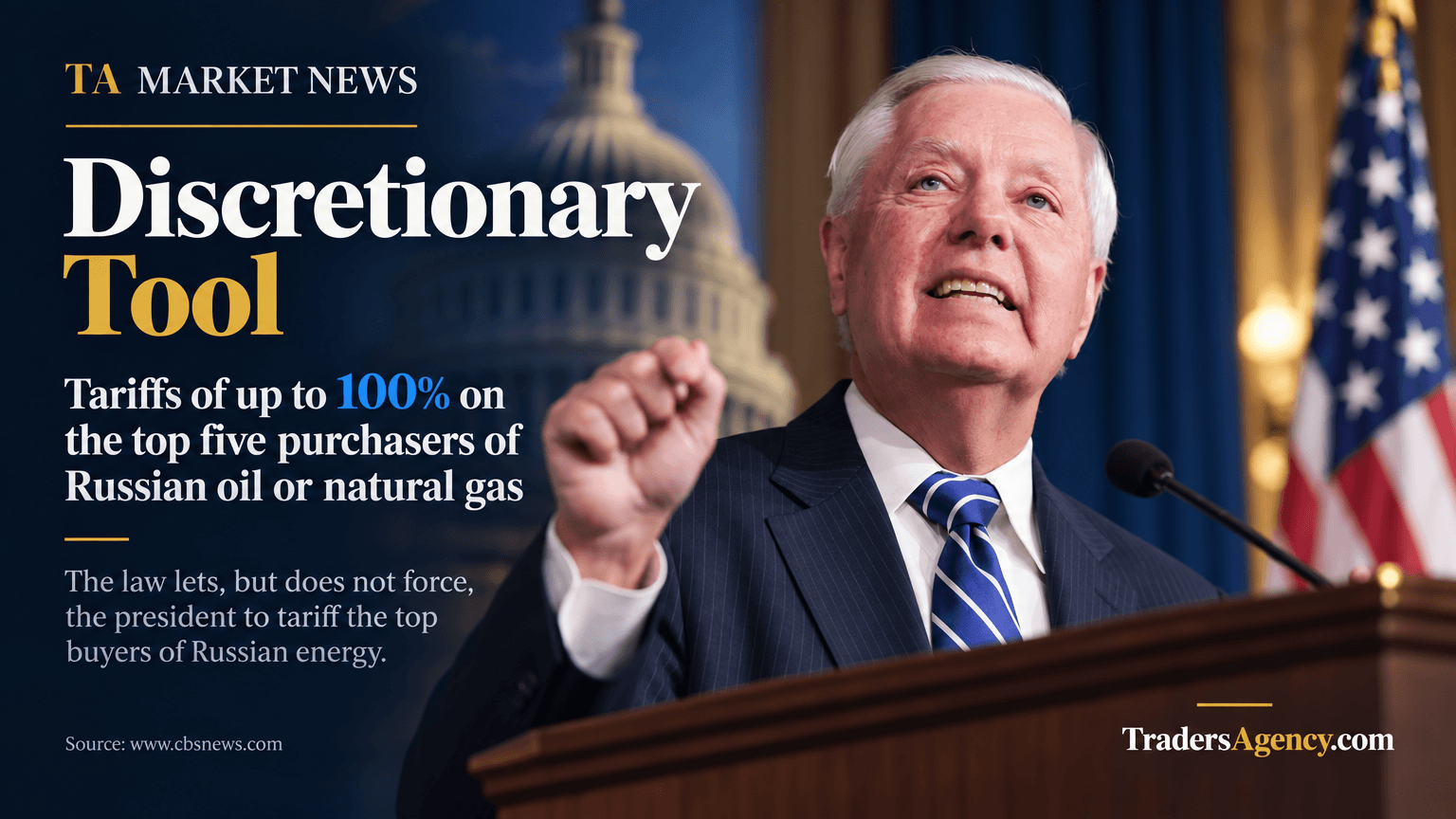
The bill allows, but does not require, the president to impose the tariffs, according to CBS News. It includes an exception for countries that import less than 15% of their natural gas from Russia and are taking "significant" steps to reduce those imports, and it lets the president waive the sanctions altogether if he certifies to Congress that doing so serves U.S. national interests, per CBS News reporting on the bill text.
The nonpartisan Center for Strategic and International Studies described the tariff provision as the act's "most consequential new authority," noting it replaces the blanket 500% tariff contained in the 2025 version of the bill with what it called "a more measured instrument," alongside a carve-out for countries taking significant steps to reduce dependence on Russian energy and whose imports amount to less than 15% of Russia's annual natural gas exports, as cited by NBC News.
That discretionary framing drew sharp criticism from House Democratic leadership. House Democratic Leader Hakeem Jeffries said on the floor that "the manner in which this bill has been written doesn't require the president of the United States to impose sanctions on Russia," adding that there are "so many loopholes written into the bill" that he believes it is "very unlikely" the measures contemplated in the legislation "will ever see the light of day," according to Al Jazeera. Rep. Gregory Meeks, the top Democrat on House Foreign Affairs, called the bill "deeply flawed," saying White House lawyers drafted it "to maximize President Trump's authority to impose new import taxes on the American people, and to minimize any obligation to actually impose new sanctions on Russia or its enablers," per Agence France-Presse. Republicans rejected amendments aimed at narrowing the tariff provisions, AFP reported.
Republican backers framed the tariff mechanism as the bill's enforcement teeth. Rep. Michael McCaul, who worked on the legislation with Graham, argued on the floor that "you can evade sanctions, which the Russians have done for years, but you cannot evade tariffs," calling tariffs "a powerful way to amplify the impact of sanctions" and "the teeth of this bill," per CBS News. House Speaker Mike Johnson said in a statement after passage that the bill "sends a powerful message of American unity and gives the Administration every tool in the toolbox to help bring this war to a just end," according to CBS News and his office.
Bipartisan path, midterm-eve timing
The House vote split both parties: 58 Democrats broke with leadership to support the bill, while seven Republicans voted against it, according to CBS News and Al Jazeera. The Senate had already passed the same text 86-11 in August, with 37 Senate Democrats in support, following more than a year of negotiations led by the late Sen. Lindsey Graham of South Carolina, who died unexpectedly in July. CBS News reported the House vote fell on the final day of the chamber's session before lawmakers left Washington until after Election Day, and Al Jazeera noted the bill marks the first legislation supporting Ukraine that Congress has passed in more than two years.
Trump is expected to sign the measure. AFP reported he has said he will sign it, and a White House official confirmed to CNBC that he intends to sign it into law. No signing date had been announced in the available reporting as of publication.
India and China's exposure
China and India are the largest buyers of Russian crude. As of end-August, China took half of Russia's crude exports and India purchased 37%, with Turkey and the European Union each at 5%, according to the Centre for Research on Energy and Clean Air, cited by CNBC. Kpler data show Russian oil made up more than 50% of India's crude purchases in June and July and over 40% in August, and the combined India-China share of Russian oil imports rose to one-third from one-fifth following the Hormuz crisis, per CNBC's report.
Russia has for years been China's largest supplier of oil and natural gas, accounting for about a fifth of China's crude imports and 10% of its natural gas consumption, CNBC reported. Kpler's head of oil trading analysis, Ivan Ryabov, told CNBC it would be "extremely challenging" for China and India to replace the roughly 3.5 million barrels per day of Russian seaborne supply they receive, plus the roughly 600,000 bpd China imports via pipeline.
New Delhi's response
India's External Affairs Ministry said the country is "determined to take all necessary measures to protect its trade and economic interests" and will continue buying oil through "diversified sourcing and on the basis of evolving market dynamics," citing energy security for its 1.4 billion people, according to India Today and CNBC. The ministry said it would work closely with Indian trade and industry bodies on the implications of the U.S. move.
India Today noted that the country's inclusion in the legislation does not itself impose a 100% tariff on Indian goods; the authority would still need to be triggered by the White House. Atman Trivedi of DGA Albright Stonebridge Group told CNBC that because the bill leaves use of the tool to the president's discretion and contains exceptions, the Indian government is likely to "quietly seek confirmation" from the White House on whether it could be eligible for an exemption. This follows a prior punitive episode: the U.S. imposed a 25% tariff on India last August over Russian oil purchases, lifting total duties to 50%, before cutting them to 18% in February, when Trump said India had "agreed to stop buying Russian Oil, and to buy much more from the United States and, potentially, Venezuela," per CNBC.
Whether Beijing bends
Analysts expect resistance from China if the tariff authority is used. Eurasia Group China director Dan Wang told CNBC that a meaningful pullback in Russian energy imports would hurt China's energy security and is "politically unacceptable," while Peterson Institute senior fellow Martin Chorzempa said "China would certainly retaliate" should the tariffs materialize.
Several analysts framed the tariff power as leverage rather than an imminent action. Hoover Institution visiting fellow Ronak D Desai told CNBC that "President Trump will sign this law and hold its tariff authority in reserve as an instrument of leverage," adding that nearly a dozen House Republicans had privately urged leadership to strip the tariff provisions for fear of rising prices on the eve of the midterms. Those are analyst assessments reported by CNBC, not announced administration policy, and the legislation leaves use of the authority optional rather than mandatory.
Bottom Line
Congress has cleared what AFP called the most substantial U.S. legislative effort against Moscow since Trump returned to office, but the House vote created a tool, not a trigger. The tariff ceiling of up to 100% on top buyers of Russian energy is capped, waivable, and carved out for countries taking significant steps to reduce their dependence on Russian energy, so its impact depends on whether and how Trump chooses to use it against two of the world's largest economies. India's External Affairs Ministry has said it will keep buying oil through diversified sourcing, while analysts told CNBC they expect Beijing to defy any restriction on its Russian energy imports.
DISCLAIMER: Traders Agency does not offer financial advice. The information provided is for educational purposes only and should not be considered financial advice. Traders Agency is not responsible for any financial losses or consequences resulting from the use of the information provided. Trading carries inherent risks and may not be suitable for all individuals. You are advised to conduct your own research and seek personalized advice before making any investment decisions, recognizing the potential risks and rewards involved.
- www.cnbc.com: Russia sanctions bill honoring Lindsey Graham passes House · accessed Sep 17, 2026
- www.aljazeera.com: Congress passes sweeping US sanctions bill targeting Russia · accessed Sep 17, 2026
- www.cbsnews.com: House passes Russia sanctions bill, overcoming opposition from Democratic leaders · accessed Sep 17, 2026
- www.house.gov: Homepage | house.gov · accessed Sep 17, 2026
- ballotpedia.org: United States House of Representatives elections, 2026 · accessed Sep 17, 2026
- www.youtube.com: - YouTube · accessed Sep 17, 2026
- en.wikipedia.org: 2026 United States House of Representatives elections · accessed Sep 17, 2026
- U.S. House of Representatives: Lindsey O. Graham Sanctioning Russia and Iran Act of 2026 — Final Legislative Text · accessed Sep 17, 2026
- Office of House Speaker Mike Johnson: House Republicans Put Maximum Pressure on Putin’s War Machine · accessed Sep 17, 2026
- Agence France-Presse: US Congress passes sweeping Russia sanctions bill · accessed Sep 17, 2026
- NBC News: House passes Russia sanctions bill named for Lindsey Graham, sending it to Trump · accessed Sep 17, 2026
- CNBC: Trump gains a tariff weapon against China and India. Will he use it? · accessed Sep 17, 2026
- BBC News: India faces 100% tariff threat over Russian oil after US House vote · accessed Sep 17, 2026
- India Today: Determined to protect trade, economic interests: India on US Russia sanctions bill · accessed Sep 17, 2026
See more from Traders Agency on Google
Make us a preferred source and our market analysis will appear more prominently in your Google Search, Top Stories, and AI results.
Add to Preferred Sources