
Uber Technologies topped Wall Street's revenue expectations for the third quarter of 2026 but fell well short on earnings per share, as its core ride-hailing business ran into fuel-price and driver-supply headwinds overseas even as freight and delivery growth carried the top line. The company also detailed an accelerating, multibillion-dollar push into driverless vehicles alongside new delivery partnerships.
Revenue Beat, EPS Miss
Uber reported revenue of $14.77 billion for the quarter, ahead of the $14.69 billion analysts had expected and up 10% from $13.47 billion a year earlier, according to CNBC. Earnings per share came in at 25 cents, far below the 96 cents analysts polled by LSEG had projected, CNBC reported.
Net income was $512 million, down 92% from the year-earlier quarter, when Uber's results had been boosted by a $4.9 billion benefit from a tax valuation release, according to both CNBC and Uber's SEC filing. Interpretation: that one-time prior-year benefit mechanically steepens the year-over-year net income decline, since the $6.63 billion GAAP net income reported in the comparable 2025 quarter included it.
Total gross bookings of $59.82 billion were essentially in line with the $59.83 billion analysts had expected, CNBC reported, while Uber's own filing put gross bookings growth at 20% year-over-year on both a reported and constant-currency basis.
Mobility Lags on Fuel Costs and Driver Supply
Uber's mobility segment, its ride-hailing business, posted revenue of $7.52 billion, down 2% from $7.68 billion a year earlier and below the $7.71 billion analysts had expected, according to CNBC and the company's SEC filing.
CEO Dara Khosrowshahi said in prepared remarks that the company's core mobility segment performed slightly below expectations overseas. "Elevated fuel prices and tighter driver availability weighed on supply growth in several international markets," he said, adding that Uber is making "targeted investments to strengthen driver supply," according to CNBC.
In a CNBC interview, Khosrowshahi said Uber has "more demand" than supply, especially for its mobility services. "We don't want to raise prices on our customers," he said, adding that the company is doing what it can to avoid longer wait times. He said Uber is "investing significantly" in bringing more drivers on board in India, Brazil and the U.S. to meet demand.
Freight Drives the Beat; Delivery and Segment Profits Grow
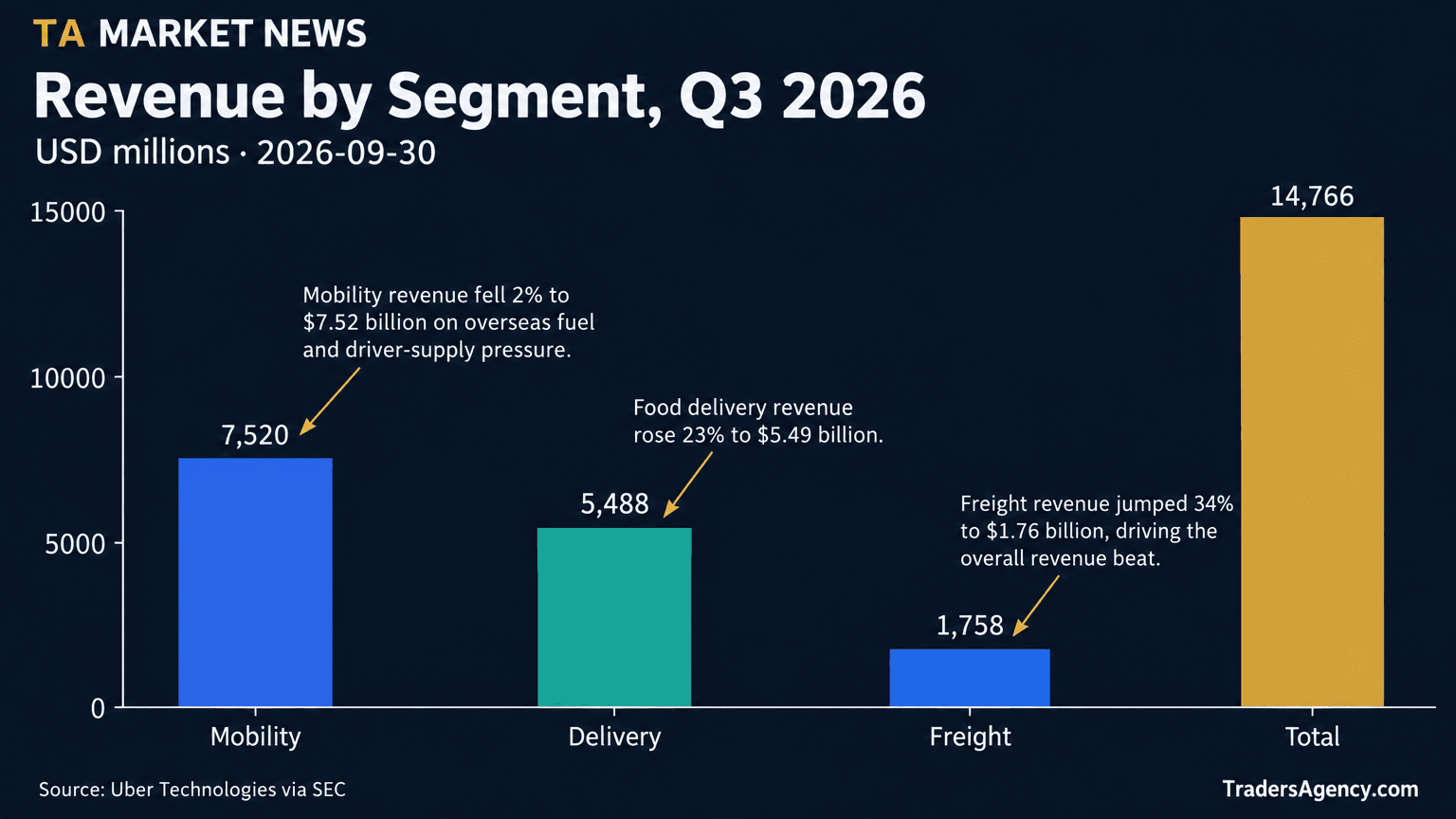
CNBC reported that the revenue beat came from Uber's freight division, where sales jumped 34% to $1.76 billion, topping the StreetAccount consensus of $1.49 billion. Food delivery revenue rose 23% to $5.49 billion, just below the $5.51 billion average estimate.
Profitability improved across the segments, according to Uber's filing. Mobility segment operating income rose 27% to $2.36 billion from $1.86 billion, delivery segment operating income rose 30% to $1.06 billion from $811 million, and the freight segment's operating loss narrowed 18% to $33 million from $40 million. Non-GAAP operating income grew 38% year over year to $2.3 billion, or 3.9% of gross bookings, up from 3.4% in the third quarter of 2025, while adjusted EBITDA grew 31% to $3.0 billion, a margin of 5.0% of gross bookings versus 4.5% a year earlier.
"Uber continues to translate strong growth into expanding profitability, with Non-GAAP Operating Income margins reaching a record 3.9% of Gross Bookings and Non-GAAP EPS growing 35%," CFO Balaji Krishnamurthy said in the release, adding that the fourth-quarter outlook "reinforces our confidence in the durability of our financial model as we enter 2027."
Driverless Push and Delivery Deals
Khosrowshahi said Uber has committed about $10 billion in capital to bring more driverless vehicles to its platform through an array of partnerships and investments in companies including Rivian, Nuro and AVRide, among others developing robotaxis and driverless trucks, CNBC reported. He also said Uber is growing its delivery business through acquisitions of Delivery Hero in Germany and ezCater in the U.S., and that a recently expanded Costco partnership in the U.S. is "tracking ahead of expectations." The company said Costco is now one of its top merchants by gross bookings.
Fourth-Quarter Outlook
For the fourth quarter of 2026, Uber said in its filing that it anticipates gross bookings of $63.25 billion to $65.25 billion, representing 18% to 22% year-over-year growth on a constant-currency basis, with the outlook assuming a roughly 1 percentage-point currency headwind to total reported growth. The company guided to non-GAAP EPS of $0.95 to $0.99, or 34% to 39% growth, which it said translates to adjusted EBITDA of $3.13 billion to $3.23 billion.
Bottom Line
Uber's quarter split along familiar lines: freight and delivery growth pushed revenue past consensus and segment profitability expanded, while the core ride-hailing business slipped 2% on what management described as fuel-price and driver-supply pressure abroad. The 92% drop in net income reflects a large prior-year tax benefit rather than current-quarter operations, and the company's fourth-quarter guidance points to continued bookings and non-GAAP earnings growth. None of the above is investment advice.
DISCLAIMER: Traders Agency does not offer financial advice. The information provided is for educational purposes only and should not be considered financial advice. Traders Agency is not responsible for any financial losses or consequences resulting from the use of the information provided. Trading carries inherent risks and may not be suitable for all individuals. You are advised to conduct your own research and seek personalized advice before making any investment decisions, recognizing the potential risks and rewards involved.
- CNBC Top News: Uber (UBER) Q3 2026 earnings · accessed Nov 4, 2026
- Uber Technologies via SEC: Document · accessed Nov 4, 2026
See more from Traders Agency on Google
Make us a preferred source and our market analysis will appear more prominently in your Google Search, Top Stories, and AI results.
Add to Preferred Sources