
Elon Musk just spent 55 minutes laying out exactly what SpaceX turns into over the next 18 months, and it changed how I look at SpaceX stock. Everyone is fixated on rockets right now. I think that's the wrong thing to watch.
Two weeks ago, on November 14th, SpaceX caught a Starship out of the sky with a pair of giant metal arms. That's the headline everyone's chasing. But the rocket is just the delivery truck. What it's delivering is the real story, and it's buried in the quarterly earnings report most people are glossing over completely.
Why Did the Starship Catch Change Everything?
Bottom Line: The Starship catch matters less for the rocket itself than for what it enables: cheap, reusable launch that can scale Starlink revenue and support StarMind, a satellite data-center network built to get around Earth's limits on power and land. The real thesis for SpaceX stock rests on that roadmap playing out over years, not on any single launch milestone.
Why the top half of the rocket was the real milestone
SpaceX has been catching the booster, the bottom half of the rocket, for a while now. That part wasn't new. The top half has always been the hard part, and nobody, not NASA, not anybody, had ever caught one before.
The space shuttle was supposed to be reusable too, but its big orange fuel tank got thrown away on every single flight. Musk has said the shuttle itself took something like nine months to rebuild between trips. Starship is built to land, refuel, and go back up just like a jet.
Here's what Musk said about the catch a few days after it happened:
He called it "the final major piece." Every part of the system has now flown to space and come back in good enough shape to fly again. Musk says full reuse can cut the cost of getting to orbit dramatically. That's not a minor efficiency gain. That's the entire economics of the company changing.
So what is SpaceX actually going to ship up there with all that newfound capacity? Starlink satellites, obviously. Maybe people to Mars eventually. But there's a third answer stated plainly in the earnings report, and it's bigger than either of those.
The Long-Term Bet
Why I'd rather own this for a decade than trade it for a week
SpaceX could be a strong long-term hold because its AI computing business is already outselling Starlink, its reusable rocket system gives it a transportation advantage nobody else has, and Wall Street's average price target sits north of $250 a share.
I think that price target is a bit ambitious in the near term. But over a ten-year window, I believe SpaceX could be the most important company on the planet. Musk isn't just building infrastructure. He's building products on top of it with Grok and Cursor, and he owns the only cheap ride to orbit in existence. That combination is rare, and it's why I'm not treating this as a short-term trade.
My plan is simple: buy it as cheaply as possible and let Elon do what he does.
The Hidden Business Inside SpaceX
It's not rockets anymore
SpaceX reports three business lines: rockets, Starlink, and AI. Rockets, the thing the company is famous for, brought in about 12 cents of every dollar of sales last quarter. The AI unit brought in more than half.
Let that sink in. The biggest business inside the most famous rocket company in the world isn't rockets. It's AI, and it's growing at a pace that should make every investor pay attention.
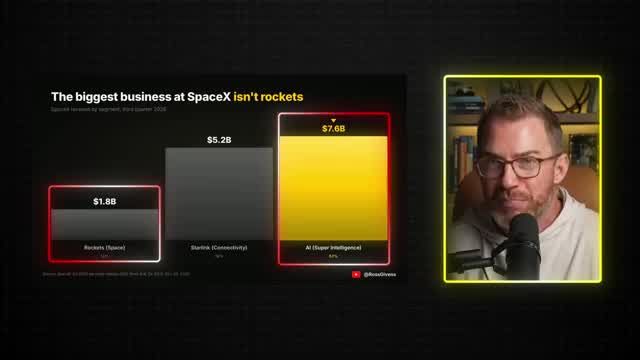
A year earlier, that AI unit was doing less than a billion dollars a quarter. Now it's the single largest thing SpaceX sells. So who's paying for all of it?
Some of it comes from Grok subscribers. On last month's earnings call, Musk said:
The rest is coming from Musk's own competitors. Anthropic, the same company racing to beat Grok, is renting computing power from SpaceX in a deal worth about $3 billion a month.
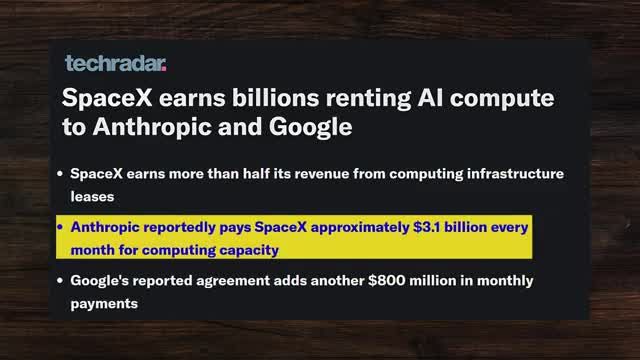
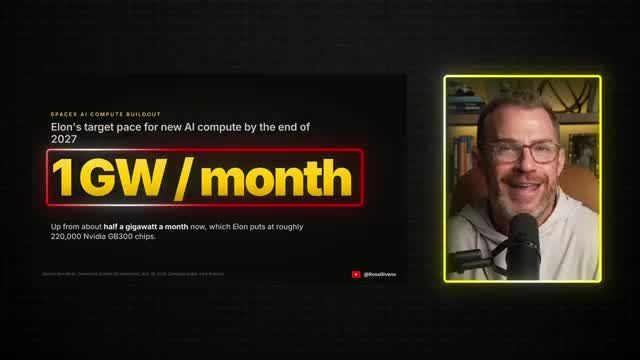
I don't think selling compute is a great long-term business by itself. But Musk is using that cash to build out infrastructure faster than anyone alive, adding half a gigawatt of new AI computing every single month. That's the equivalent of bolting on an entire power plant's worth of chips, every month, without pause.
Gavin Baker, a friend of Musk's who covers the compute sector professionally, was asked on stage at the Austin Investors Conference whether anyone else is building at that pace. His answer was no. Musk says that pace will double to more than a gigawatt a month by 2027.
Wall Street has been nervous about how SpaceX pays for all this. Musk's response was blunt: most outside estimates for data center build costs are off by at least a factor of two. His explanation was almost comedic. Most data centers get built like that meme with one guy digging a hole and eight guys standing around watching him. SpaceX trains its own crews instead. Musk even said some of his best data center workers came from In-N-Out Burger, because a guy who can flip burgers perfectly all day can plug in fiber optic cable just as well.
Then there's the Tesla connection. Chips pull power in huge spiky surges, and if you don't smooth that out, you can break the shaft of a turbine. So SpaceX parks Tesla megapacks right next to the data centers to absorb those spikes.
Where Does SpaceX Stock Sit Today?
The market hasn't caught up to the AI story yet
SpaceX stock peaked at $225 a share in June and is now trading below its IPO price. The market cap sits at $1.6 trillion as of Wednesday's close.
That's a staggering number, and it's worth sitting with. But think about what you're actually valuing at that price. The AI unit alone is already outselling Starlink, one of the most recognizable satellite networks on Earth. The stock is trading below its IPO price after that June peak, even while the AI unit keeps growing.
Get an entire year of live weekly mentoring sessions, my newsletter, indicators, bonus reports, tons more. Click the link and I'll see you in the next live session.
Join my Black Ops Trading ClubWhy Is SpaceX Stock Near Its Lows?
It's not the business. It's the credit market and your neighbors.
SpaceX stock is sitting near its all-time lows for the same reason Nvidia and CoreWeave are down: the credit market. SpaceX sold a large batch of bonds to pay for more Nvidia chips, and had to pay north of 8% to borrow the money.
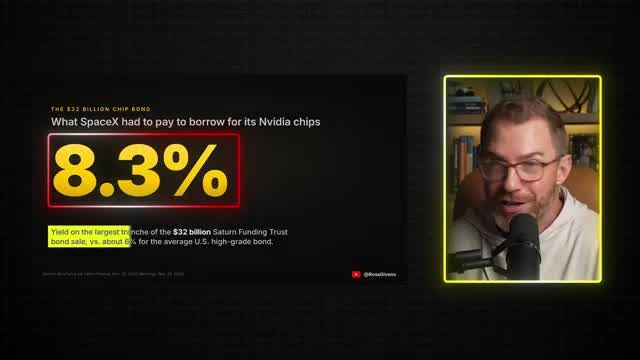
That debt isn't going to sink the company. It's $32 billion against a $1.5 trillion business, which is manageable. But there's a bigger problem than financing, and it has nothing to do with money. It's neighbors.
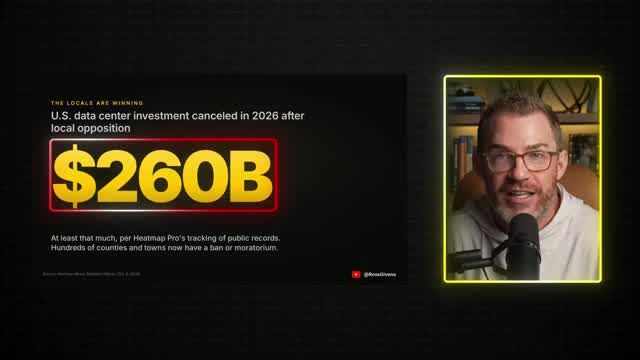
At least $260 billion worth of data center projects have already been canceled in 2026 after local communities fought back. Nobody wants a humming warehouse next to their kid's school, pulling power off the grid and running the AC nonstop. Town after town is passing bans. Permits are getting stuck for years. Texas just elected a governor who ran on a promise to put a moratorium on data center construction.
So you've got the hottest industry on Earth with nearly unlimited demand, and it's running out of places to physically plug in.
StarMind: Data Centers In Orbit
No neighbors, no permits, and free solar power around the clock
Now picture a location with no neighbors, no zoning board, no town hall meetings, and free solar power around the clock. That place is space, and SpaceX calls the project StarMind.
Musk says SpaceX is building its own solar power factories for orbit, aiming for 200 gigawatts a year, roughly 40% of what the entire United States uses on an average day. There's no way to get a permit for that kind of buildout on the ground. Musk said so himself: it's impossible down here. In orbit, no town hall is required, and the sun almost never sets.
So what does one of these satellites actually look like? Based on Musk's own breakdown, it comes down to four parts:
- A large array of solar panels generating power
- A double-sided radiator that dumps heat into the dark of space instead of toward the sun
- A StarMind computer, about a quarter the physical size of Nvidia's top-tier rack while matching its capability
- Lasers that beam the processed data back into Starlink, which sends it down to the ground
Musk says this design is actually simpler than the Starlink satellites SpaceX is already flying, and the company already has more than 11,000 Starlink satellites in orbit. He also casually mentioned SpaceX has about 30,000 lasers already operating in space.
Here's the part that tells you how seriously the financial world is taking this. According to the Financial Times, lenders on SpaceX's chip financing deal asked for a clause specifically to keep the chips on Earth. Why? Because if SpaceX ever stops paying, lenders want to be able to repossess the chips and sell them, something that's a lot harder to do if the collateral is orbiting the planet.
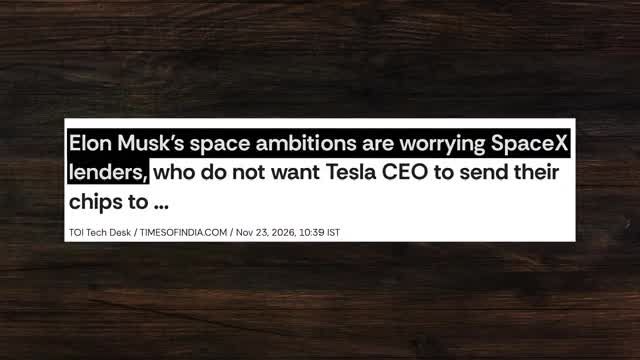

I don't think there's ever been a corporate bond clause in the history of capitalism that essentially says "you can't take the equipment off the planet."
What Analysts Think
The stock is priced for rockets. The business is becoming something else.
Wall Street's average price target on SpaceX sits north of $250 a share, a level the stock already touched once in June before falling back below its IPO price. I think that target is a bit ambitious in the short run, but the ten-year story is what I care about more.
The AI segment already generates more revenue than Starlink, and Gavin Baker said nobody else is building compute at the pace SpaceX is. Nobody, including Musk, knows exactly where the stock lands. What we do know is the roadmap he's laid out.
The Next 18 Months
Musk's own timeline, which he admitted was a guess
- Mid-2027: First test chip out of Terafab, SpaceX's chip factory project
- Q3 2027: First StarMind satellite launches, roughly nine months from now
- End of 2027: Compute pace expected to double to more than a gigawatt a month
- 2028: StarMind begins ramping production in earnest
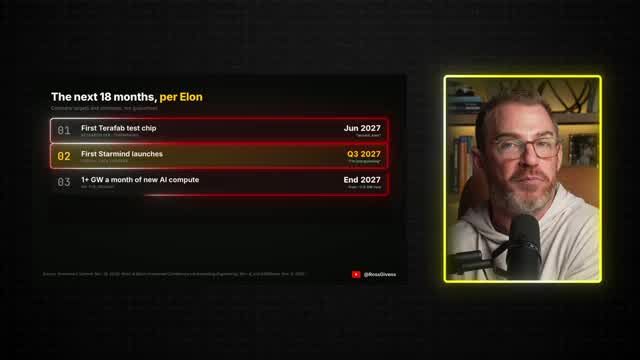
Musk's timelines typically run late. I'll say that plainly. But even late, he usually gets there eventually. People laughed at the idea of catching a booster too, and that turned out to be a huge milestone.
Getting thousands of heavy satellites into orbit requires serious tonnage, and Musk has said directly that Starship provides that. Amazon, Google, and Microsoft can buy all the chips they want. They can't buy a Starship. Jeff Bezos has been trying for years and hasn't come close.
The Moat Nobody Else Has
Nobody on Earth has a rocket that comes all the way back and flies again. That is SpaceX's moat, full stop. On November 14th, the last piece of that moat clicked into place with the ship catch.
SpaceX is turning into more of an AI company than a space company, and that shift should be driving any conversation about where SpaceX stock goes over the next five years. The rockets give SpaceX cheap, repeated access to orbit. The AI business gives it a reason to use that access at scale that nobody else can match. Put those two together and you have a company building its own transportation network and its own computing network at the same time, under one roof.
Will the stock double from here? I think so. I don't know when. But especially after it merges with Tesla, this is the kind of name I want to treat as a core long-term hold rather than a trade.
Final Thoughts: A Different Company
SpaceX is no longer just a rocket company. It's an AI infrastructure company that happens to own the only reusable rocket on the planet. That distinction matters more than anything happening with the share price today.
The rockets solve the transportation problem. The AI business, now bigger than Starlink, solves the revenue problem. StarMind, if Musk's timeline holds even loosely, solves the biggest bottleneck facing the entire AI industry: running out of room on Earth to build. None of that shows up if you're only watching the catch footage.
My approach here isn't complicated. I want to own this at the best price I can get, and then let the roadmap play out over years, not weeks.
Get an entire year of live weekly mentoring sessions, my newsletter, indicators, bonus reports, tons more. Click the link and I'll see you in the next live session.
DISCLAIMER: Traders Agency does not offer financial advice. The information provided is for educational purposes only and should not be considered financial advice. Traders Agency is not responsible for any financial losses or consequences resulting from the use of the information provided. Trading carries inherent risks and may not be suitable for all individuals. You are advised to conduct your own research and seek personalized advice before making any investment decisions, recognizing the potential risks and rewards involved.
See more from Traders Agency on Google
Make us a preferred source and our market analysis will appear more prominently in your Google Search, Top Stories, and AI results.
Add to Preferred Sources