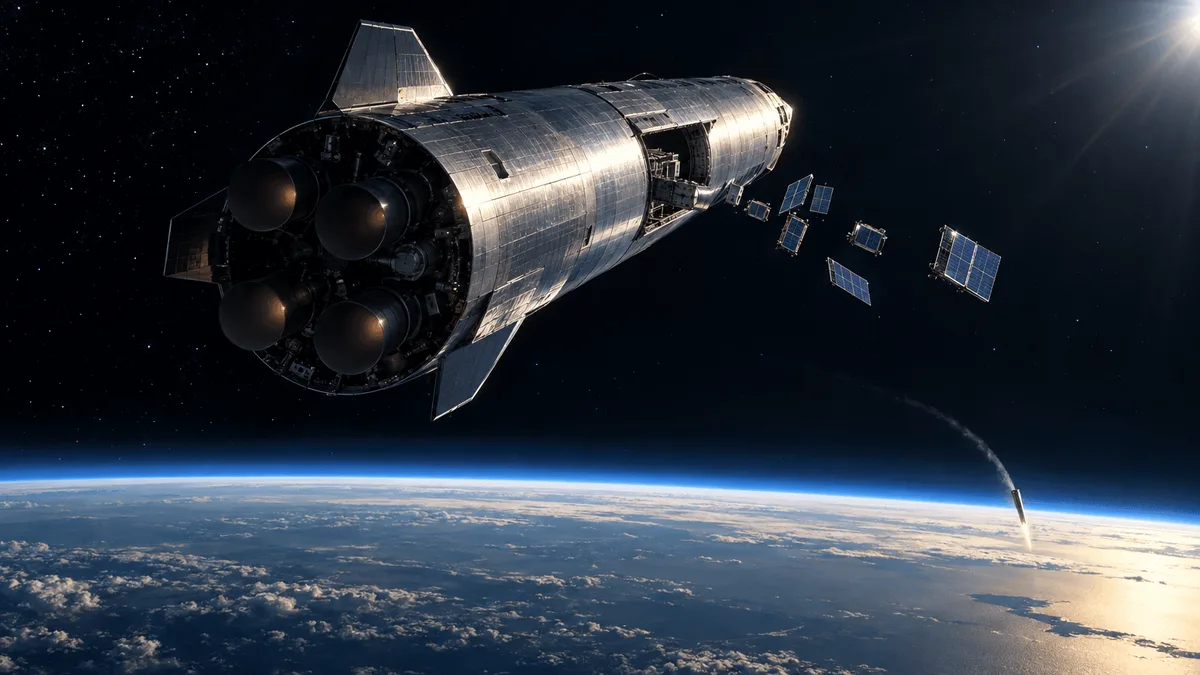
SpaceX's Starship reached Earth orbit for the first time early Monday, September 28, 2026, on the vehicle's 14th test flight, and the company reported it successfully deployed 26 of its new Starlink V3 satellites during the mission, according to CNBC. The flight lifted off from Starbase, Texas, and SpaceX said Starship reached orbit around 8:15 a.m. local time, with employees at the site cheering the milestone.
Liftoff and the Orbital Milestone
A livestream on the social platform X, which SpaceX owns, showed the rocket lifting off at 8:48 a.m. ET, or 7:48 a.m. local time, from Starbase, per CNBC. None of the 13 previous Starship test flights had been intended to reach orbit; SpaceX said those flights deliberately followed passively safe suborbital trajectories toward the Indian Ocean to maximize public safety while the company gathered data.
According to SpaceX's own mission profile, cited by Aviation Week, Starship was designed to fly that same passively safe suborbital arc after its initial ascent burn, giving flight controllers a coast phase in which to assess the vehicle's health before deciding whether to proceed to orbit or let the ship reenter and splash down in the Indian Ocean. Assuming the vehicle checked out, Starship was set to execute a circularization burn using a single sea-level Raptor engine to place itself in orbit. SpaceX also said it would only commit to the orbital insertion burn after confirming sufficient redundancy on hardware critical to the end-of-mission deorbit burn, according to SpaceX's Flight 14 mission page.
An Engine Dropout, but the Climb Continued
CNBC reported that the Starship spacecraft continued to climb into orbit even as one of its vacuum engines went out during the sub-orbital trajectory phase. Separately, the Super Heavy booster made what CNBC described as a "soft splashdown" off the coast of Starbase a few moments after launch. The available reporting does not detail how, or whether, the engine dropout altered the mission's subsequent sequence beyond the vehicle continuing on to orbit.
26 Starlink V3 Satellites Deployed
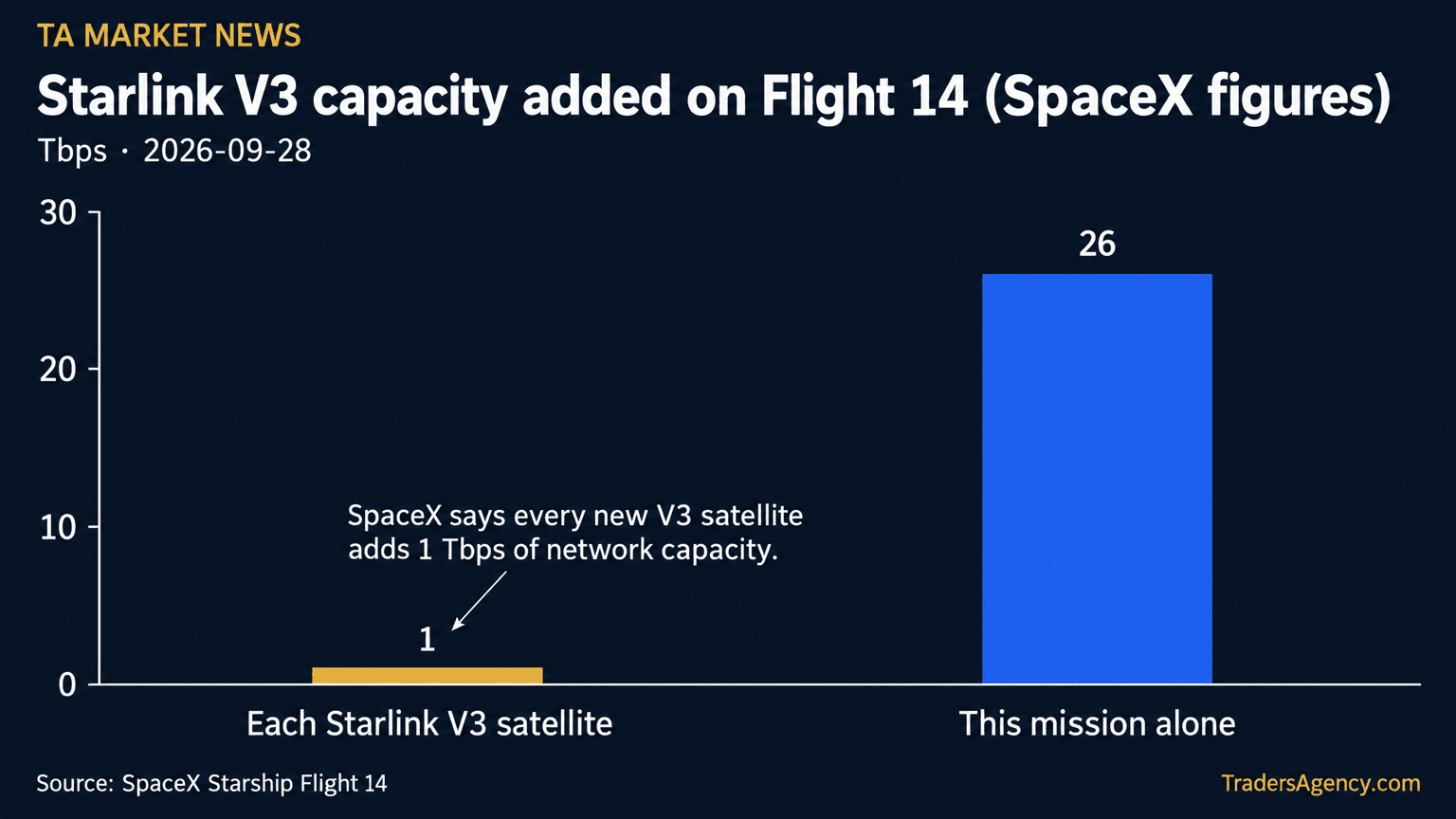
About 10 minutes after reaching orbit, Starship began deploying the 26 Starlink V3 satellites, according to SpaceX's mission profile as reported by Aviation Week. CNBC reported the deployment was completed, marking the first operational release of the V3 generation. SpaceX said each Starlink V3 satellite adds 1 Tbps of capacity to the constellation, for a total of 26 Tbps added on this mission alone (26 satellites x 1 Tbps = 26 Tbps, using SpaceX's own figures). The company also said that is roughly ten times the capacity of a single Falcon 9 launch carrying V2 mini satellites. CNBC additionally reported that one Starship can carry 60 V3 satellites, which the company said is about 20 times the capacity of a Falcon 9 launch.
SpaceX said the newly deployed satellites should begin serving customers as soon as a few weeks after launch, following on-orbit checkouts. Per CNBC's reporting, the V3 satellites are built at a SpaceX facility in Redmond, Washington, and carry solar arrays generating twice the power of prior generations; they are also larger and designed to transmit data more rapidly than earlier Starlink versions. CNBC noted that SpaceX currently operates around 11,000 active satellites in orbit, compared with roughly 650 for competitor Eutelsat OneWeb — a difference of 10,350 satellites, or about 1,592% more for SpaceX, based on those reported figures ((11,000 - 650) / 650 x 100). That is an arithmetic comparison of the two reported counts, not a forecast or a statement of competitive cause and effect.
No Booster Catch Attempted
Flight 14 was not designed to end with a tower catch. SpaceX's mission page stated the booster's primary test objective was executing a successful launch, ascent, stage separation, boostback burn, and landing burn at an offshore point in the Gulf of America, with both the Super Heavy booster and the Starship upper stage planned to splash down in the ocean rather than attempt a catch. Aviation Week reported that Elon Musk had considered attempting a Starship landing in the launch gantry on this flight, following the July 24 Flight 13 test that ended with an unexpectedly soft impact in the Indian Ocean, but that goal proved too ambitious for Flight 14 and was retargeted for Flight 15, contingent on how this mission performed.
What Comes Next
SpaceX framed the successful orbital flight as opening the door to the next phase of developing Starship into a fully and rapidly reusable vehicle. Aviation Week reported that NASA, which hired SpaceX in 2021 to fly astronauts to and from the lunar surface, is closely watching Starship's progress; the first crewed Artemis landing mission is slated for early 2028, and both SpaceX and Blue Origin plan lunar lander demonstration and checkout missions next year. CNBC reported separately that SpaceX is preparing Starship for a major NASA test flight next year and intends to use the rocket to return U.S. astronauts to the Moon's surface.
CNBC also noted that Musk had previously said Starship would reach orbit in 2022 and begin deploying satellites in 2023, underscoring how far the program's timeline slipped before Monday's milestone. On SpaceX's August earnings call, Musk said, according to CNBC, "It's not out of the question that at some point, Starlink will deliver a majority of the world's internet, at least in countries where we're allowed to operate, which is the vast majority of countries." CNBC further reported that SpaceX COO Gwynne Shotwell said at the All-In Summit earlier this month that the company also plans to use Starship to put "supercompute in space," launching "AI compute satellites" into orbit in 2027.
CNBC reported that Starlink, SpaceX's Connectivity segment, was the company's largest and only profitable segment as of the second quarter, and that SpaceX went public in June in what CNBC called the largest IPO on record, with the company now valued at about $2 trillion, according to that reporting.
Bottom Line
Flight 14 delivered SpaceX's first orbital Starship flight and its first operational Starlink V3 deployment, with 26 satellites released roughly ten minutes after orbital insertion despite one vacuum engine dropping out along the way. Neither the booster nor the ship attempted a catch this time; both were planned to splash down in the ocean, with a return-to-pad attempt now aimed at Flight 15. The mission's significance, according to the companies and outlets cited above, rests less in this single flight and more in what it is meant to unlock: higher-cadence Starlink capacity additions and a path toward the reusable Starship architecture NASA is counting on for Artemis lunar landings later this decade.
DISCLAIMER: Traders Agency does not offer financial advice. The information provided is for educational purposes only and should not be considered financial advice. Traders Agency is not responsible for any financial losses or consequences resulting from the use of the information provided. Trading carries inherent risks and may not be suitable for all individuals. You are advised to conduct your own research and seek personalized advice before making any investment decisions, recognizing the potential risks and rewards involved.
- SpaceX Starship Flight 14: Starship Flight 14 · accessed Sep 28, 2026
- SpaceX Starship Flight 14: SpaceX - Launches · accessed Sep 28, 2026
- SpaceX USSF-385 mission: SpaceX - Launches · accessed Sep 28, 2026
- CNBC Top News: SpaceX launches its massive Starship rocket into orbit for first time · accessed Sep 28, 2026
- Aviation Week: FAA Clears SpaceX For Starship 14 Flight · accessed Sep 28, 2026
See more from Traders Agency on Google
Make us a preferred source and our market analysis will appear more prominently in your Google Search, Top Stories, and AI results.
Add to Preferred Sources