
Hey, Ross here:
Welcome back to a new week.
The market has been under pressure lately…
And investors are starting to pay up for protection.
Chart of the Day
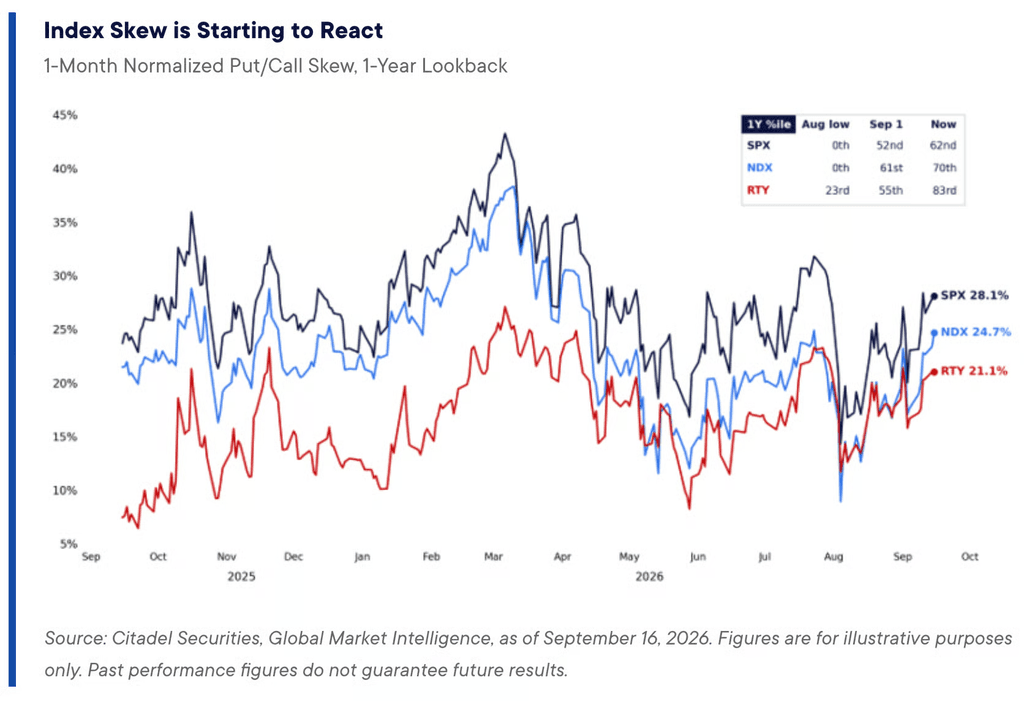
This chart tracks put/call skew across the major indexes.
You don’t need to know all the options jargon here.
Basically, the higher the reading, the more investors are paying for downside protection relative to upside exposure.
And those readings have climbed sharply.
The S&P 500 is now around the 62nd percentile of its one-year range.
The Nasdaq is around the 70th percentile.
And the Russell 2000 is all the way up around the 83rd percentile.
Back in August, some of those readings were sitting near the floor.
So investors have clearly become much more willing to spend money protecting themselves from a broad market drop.
But now look underneath the indexes:
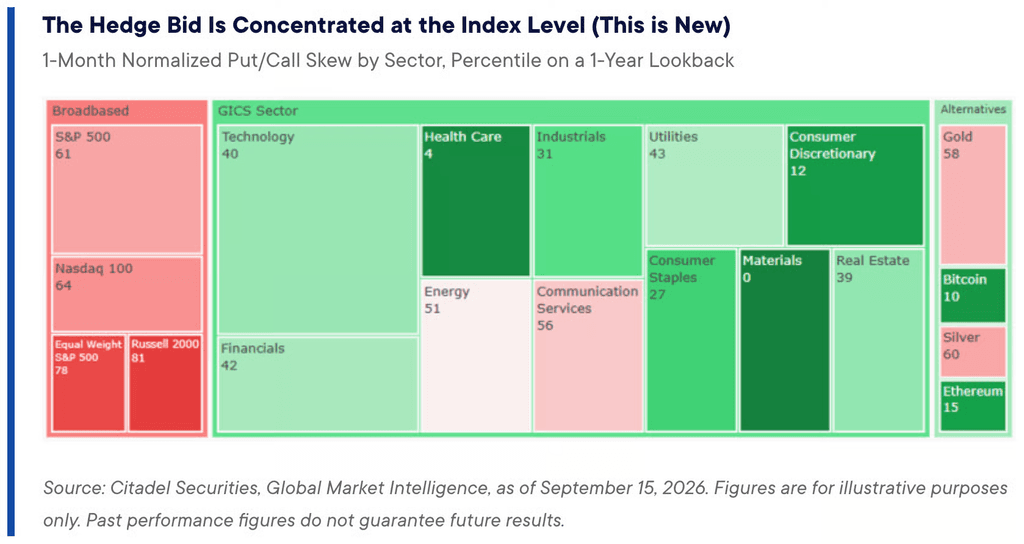
The same scramble for protection really isn’t showing up across individual sectors.
Technology is around the 40th percentile.
Financials at 42nd. Industrials at 31st.
Consumer Discretionary? Just 12th.
Healthcare is all the way down at 4.
And Materials is essentially at the bottom of its one-year range.
So investors are suddenly much more nervous about the market as a whole…
But they’re not showing the same fear about everything sitting underneath it.
That tells me a lot of the anxiety right now is probably tied to the big macro questions – like rates, geopolitics, and the broader economy…
The kind of risks that can hit an entire index in one shot.
But those risks don’t affect every business the same way.
And that creates a critical distinction we must understand.
I explain below.
Insight of the Day
A market hedge tells you almost nothing about one company
If a fund manager is worried about the Fed, they don’t need to go through 500 stocks one by one.
They can hedge the S&P and be done with it.
That trade can push pressure across the market…
Without saying anything about whether an individual business is actually getting better or worse.
And that can create some pretty big disconnects.
A perfectly healthy company can get sold because investors are nervous about the index.
Meanwhile, another stock can be falling for a very good reason.
From the outside, both charts may look equally ugly.
This is why I’m careful about reading too much into broad fear.
So once I’m considering trading an individual company, I want information that actually belongs to that company.
And one of the best ways I know to obtain such information…
Is by looking at insider buying.
Because if a CEO or CFO is buying a meaningful amount of stock with personal money while the market is dumping everything around them…
That can tell me something a broad-market hedge never will.
I’ve learned that someone with a front-row seat to the business thinks the market may be getting the price wrong.
Because executives don’t have to guess whether demand is improving.
They don’t have to wait for the next analyst report to find out how margins are doing.
They’re sitting inside the business watching it happen.
Tomorrow, I’ll be showing you exactly how I track those legal insider purchases…
The insider “warning signs” you must know about…
And my three most powerful – yet counterintuitive – insider buying signals I use.
But for today – this is one of the strongest buying opportunities right now.
Customer Story of the Day
“Best service available, and I have tried them all.
Ross is the only one who spends his time trying to TEACH you how to do it rather than telling you buy this sell that.
It’s like the old saying, “Give a man a fish you feed him for a day, Teach a man to fish, you feed him for life.”
As a lifetime private trading club member I would Highly, Highly recommend TA to anybody, and I have recommended it to several of my friends and family.”
Ross Givens
Editor, Stock Surge Daily
See more from Traders Agency on Google
Make us a preferred source and our market analysis will appear more prominently in your Google Search, Top Stories, and AI results.
Add to Preferred Sources