
OPEC+ closed its November 29, 2026 ministerial meeting without setting new production quotas for 2027, pushing the formal decision to its June 2027 ministerial meeting, or earlier if market conditions permit, according to the alliance's own communique. The deferral came after people familiar with the talks had told Reuters, in a report carried by CNBC, that the group had reached an 'agreement in principle' to leave output targets unchanged for the first quarter of 2027.
Official Outcome: Decision Deferred to June
According to the official OPEC statement, participating countries 'agreed to continue consultations and assess market developments, through existing mechanisms, with a decision on the required production levels for the subsequent period to be taken using the MSC assessment results at the 43rd OPEC and non-OPEC Ministerial Meeting on 6 June 2027, or earlier, if market conditions may permit.' The alliance has scheduled that 43rd Ministerial Meeting for June 6, 2027, per the same statement, with the deferred decision expected to be addressed there. Seeking Alpha similarly reported that OPEC+ 'ended its year-end ministerial meeting without announcing new production targets, saying consultations would continue ahead of a decision at its June meeting or sooner.'
Capacity Review Dispute Extends Into 2027
Part of the delay traces to an unresolved dispute over how much spare capacity individual members actually hold. OPEC's statement notes that the group endorsed the outcome of its Maximum Sustainable Production Capacity (MSC) assessment as the reference point for setting 2027 production baselines, but added that 'some Participating Countries requested further deliberations with the independent consultants to be concluded by the end of March 2027.' Seeking Alpha framed this as the alliance having 'extended its review of members' production capacity through March,' underscoring that the baseline dispute, not just market conditions, is a factor behind the deferred quota decision.
Reports Signaled Unchanged Output Ahead of the Meeting
Before the meeting convened, CNBC reported that OPEC+ had been leaning toward holding output targets steady for the first three months of 2027 'as the war in Iran disrupts Gulf exports and members argue over how much they can produce,' citing people familiar with the discussions who said on Friday that the group had reached an agreement in principle. Rapidan Energy Group, an oil analyst firm cited in the same CNBC report, said it also expected no changes to production targets, pointing to uncertainty over how long the U.S.-Iran war would last and how it would affect crude output and exports. The official communique's emphasis on continued consultations rather than a locked-in quota schedule is consistent with these pre-meeting signals, even though OPEC's own language frames the outcome as a deferred decision rather than an explicit confirmation of unchanged Q1 2027 targets.
Oil Price Reaction
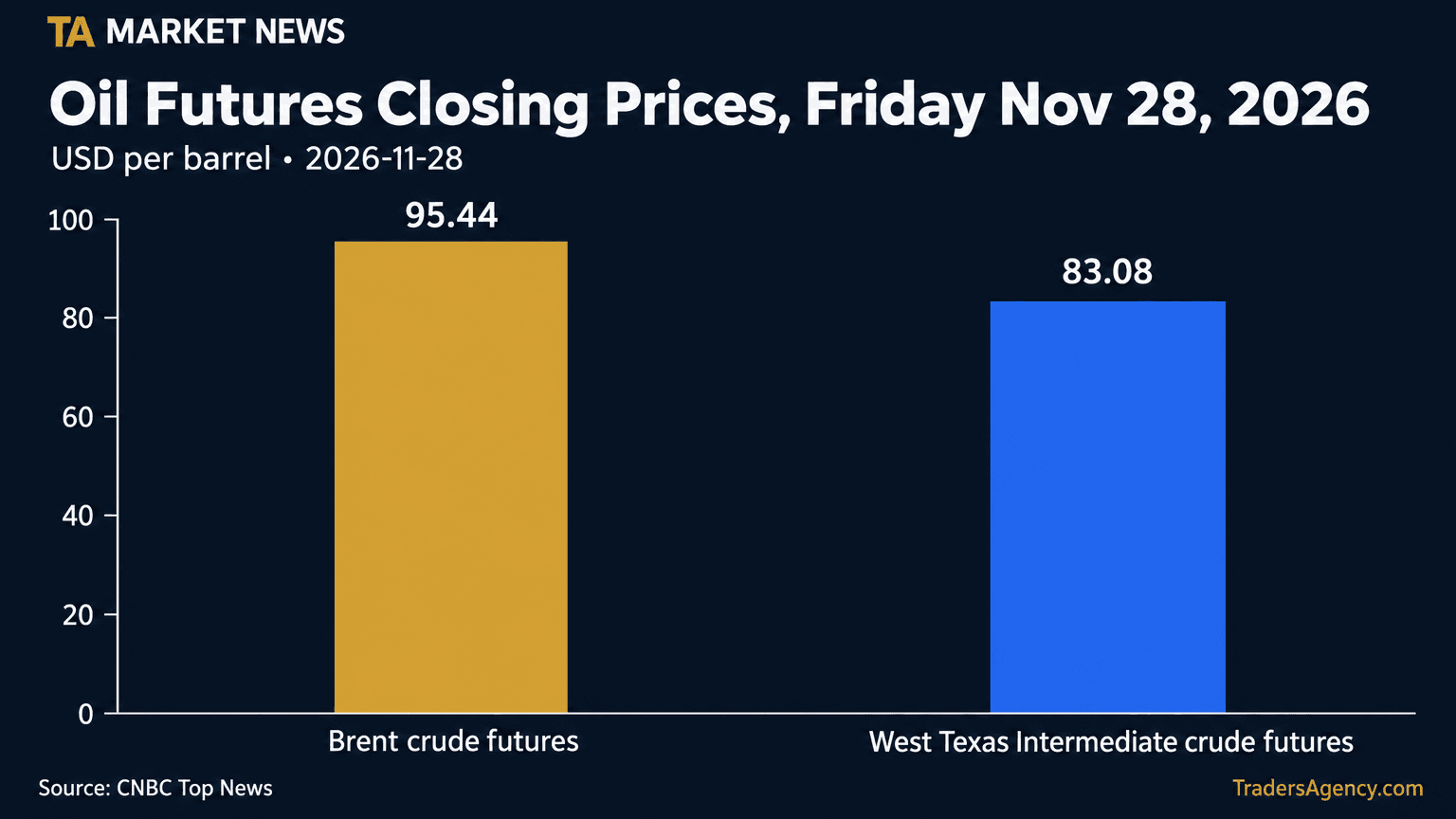
Futures markets moved ahead of and into the meeting window. CNBC reported that Brent crude futures fell $1.13, or 1.2%, to close at $95.44 a barrel on Friday, November 28, while West Texas Intermediate traded at $83.08 a barrel, down 60 cents, or 0.7%, from the prior Wednesday's close. On a weekly basis, CNBC reported Brent gained about 3% while WTI lost 0.9% over the same week.
Based on those two CNBC-reported closing levels, the spread between Brent and WTI on November 28 was $12.36 a barrel ($95.44 minus $83.08), or roughly 14.9% in relative terms (12.36 divided by 83.08, multiplied by 100). This is our calculation from the reported figures, not a forecast, and it reflects a snapshot pricing gap between the two benchmarks rather than any causal read on OPEC+ policy. The diverging weekly moves, Brent higher, WTI lower, suggest the two benchmarks were responding to somewhat different pressures during the week the quota decision was deferred, though the available reporting does not attribute a specific cause to either move.
Alliance Cohesion Under Strain
The deferred decision also lands against a backdrop of friction within the group. CNBC reported that the meeting came months after the United Arab Emirates left both OPEC and OPEC+ to pump more oil, following years of arguing its quota was set too low. The same report noted that Angola quit OPEC at the start of 2024, and that Iraq has warned it may leave if its own quota is not raised. These departures and threats form part of the context in which members requested additional capacity deliberations before committing to 2027 baselines.
Bottom Line
OPEC+ did not lock in new 2027 quotas at its late-November meeting, instead extending its capacity review into March 2027 and pushing the formal production-level decision to the June 6, 2027 ministerial meeting, per the group's own statement. Reports ahead of the meeting had pointed to an informal agreement to keep output steady through the first quarter, a signal broadly consistent with the deferral but not an explicit substitute for it. Oil benchmarks showed mixed weekly moves as the meeting approached, with Brent firmer and WTI softer, leaving the practical shape of 2027 supply policy to be determined at, or potentially before, the June session.
DISCLAIMER: Traders Agency does not offer financial advice. The information provided is for educational purposes only and should not be considered financial advice. Traders Agency is not responsible for any financial losses or consequences resulting from the use of the information provided. Trading carries inherent risks and may not be suitable for all individuals. You are advised to conduct your own research and seek personalized advice before making any investment decisions, recognizing the potential risks and rewards involved.
- CNBC Top News: OPEC+ set to keep oil output unchanged as Iran war persists · accessed Nov 29, 2026
- Seeking Alpha Market News: OPEC+ delays capacity review as oil quota dispute clouds 2027 outlook · accessed Nov 29, 2026
- OPEC: Organization of the Petroleum Exporting Countries · accessed Nov 29, 2026
See more from Traders Agency on Google
Make us a preferred source and our market analysis will appear more prominently in your Google Search, Top Stories, and AI results.
Add to Preferred Sources