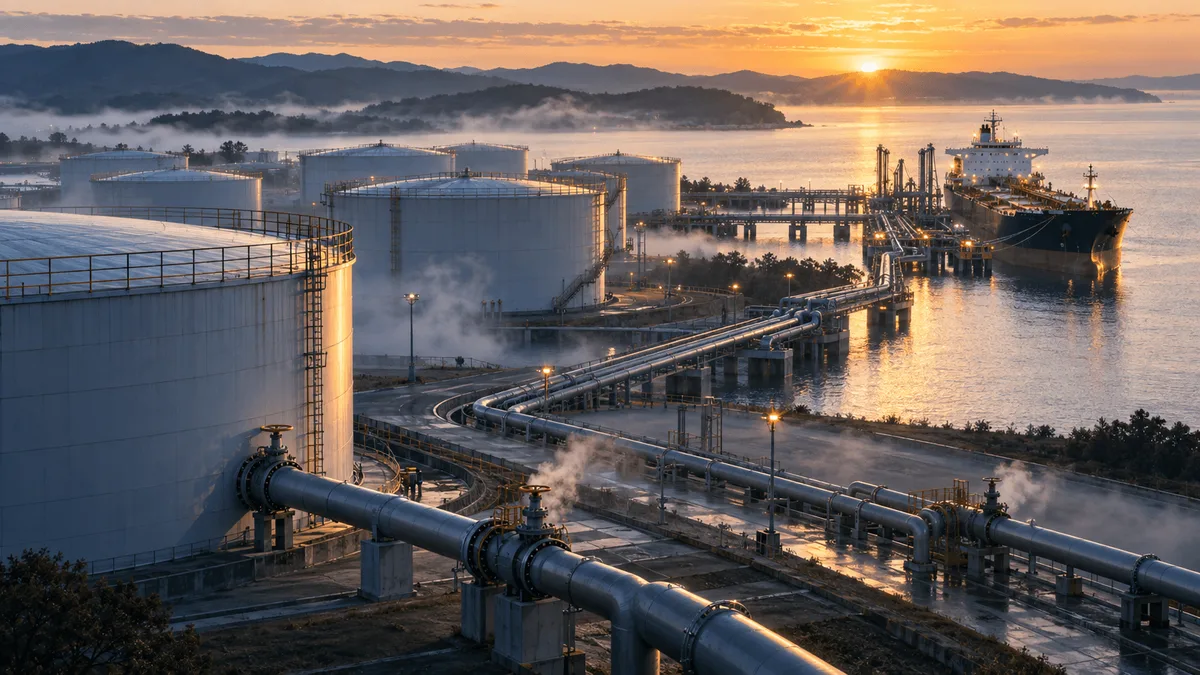
The Group of Seven said Friday it will coordinate the release of up to 100 million barrels of emergency crude and diesel stocks over the next four months, with a substantial diesel tranche frontloaded into the first 20 days, as fuel prices sit near record highs amid the U.S.-Israeli war with Iran and widening refinery disruptions. The move, set out in a joint G7 statement quoted by Al Jazeera and CNBC, followed an overnight conversation between President Trump and French President Emmanuel Macron, the chair of the G7, according to the French Embassy in the U.S. as reported by The Hindu.
What the G7 agreed
The G7's joint statement, quoted by The Hindu and WWMT, says the group will implement its commitments "with a coordinated release through the IEA of 100 million barrels (MB) to begin immediately over 4 months, including a frontloaded substantial diesel release within the first 20 days by G7 members and partners." Leaders also said they would convene again at the IEA "in the coming days to discuss the possibility of additional diesel releases as necessary," according to the statement cited by CNBC.
Oilprice.com reported that European countries had discussed releasing 50 million barrels of diesel while IEA members would supply another 50 million barrels of crude. Macron said the coordinated action should ease prices. "This common decision and this unity should bring down prices," he said, as quoted by KSAT, adding that "the volumes we're releasing should also add liquidity to the market and bring down prices."
Market reaction was mixed depending on the measure
CNBC reported that Brent crude settled at $102.25 a barrel, down 6 cents, while West Texas Intermediate shed $1.76 to close at $91.11. That is an $11.14 gap between the two benchmarks by our calculation (102.25 minus 91.11), a roughly 12.2% relative spread. The Associated Press, via KSAT, separately said the G7 statement pushed U.S. oil prices down 2% on the day.
Oilprice.com described a sharper intraday move: European gasoil futures fell more than 4%, Brent dropped about $3 to below $100 a barrel at one point, and diesel's premium over crude narrowed to roughly $69 a barrel from $76.77 on Thursday, a decline of about $7.77 in the crack by that outlet's figures (76.77 minus 69). Interpretation: the distance between oilprice.com's intraday description and the settlement prices reported by CNBC is consistent with a volatile session rather than a single directional move.
Raymond James investment strategy analyst Pavel Molchanov told the AP that the market reaction was tempered by ambiguity over whether the new 100 million barrels is additive to commitments made in March or simply "the final portion of the existing pledge." Oilprice.com's own assessment leaned toward the latter, concluding that "the G7 statement indicates that the 100 million barrels will help complete the emergency-release commitments made in March, rather than a clearly additional 100-million-barrel tranche."
How this stacks up against the March release
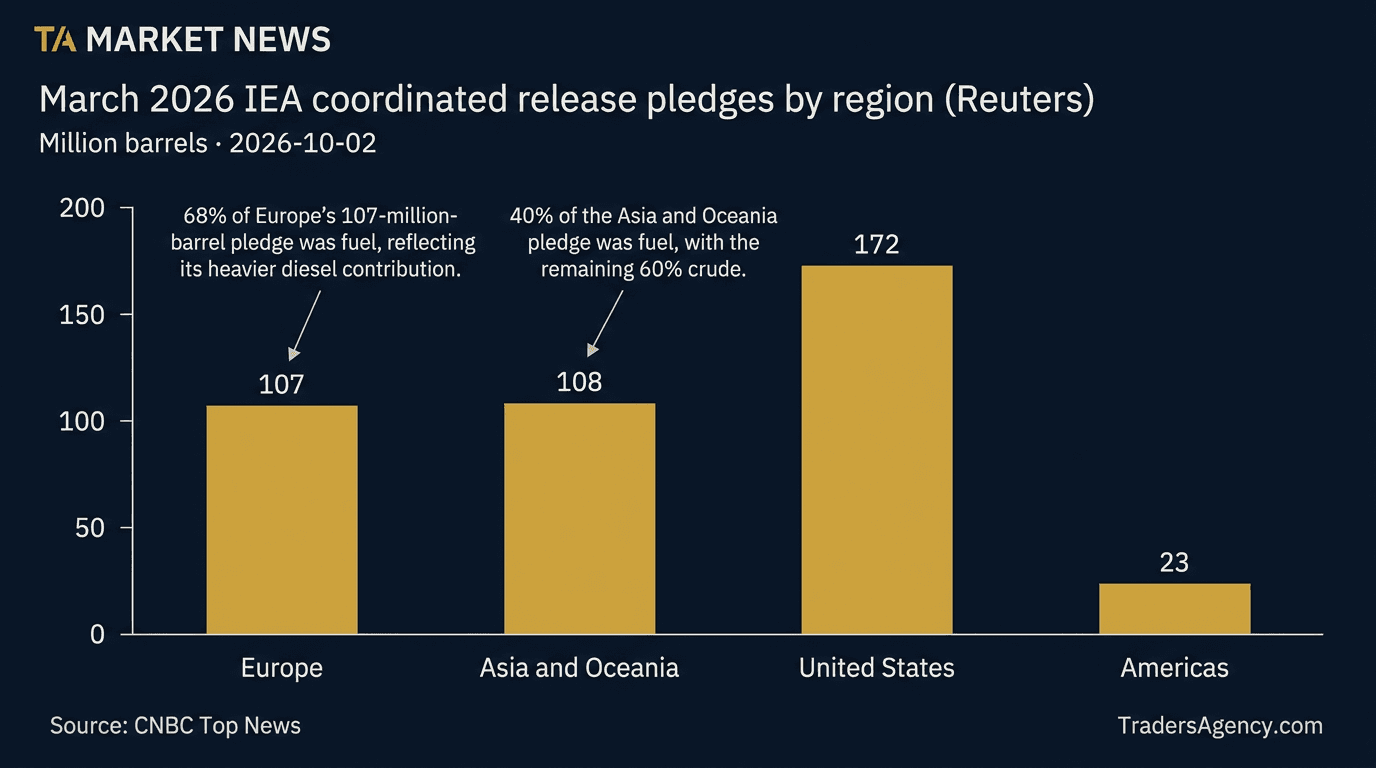
In March, IEA members agreed to make 400 million barrels of crude and refined products available after the Iran war began. Per Reuters figures cited by CNBC, the U.S. pledged 172 million barrels, all crude; Europe pledged about 107 million barrels, 68% of which was fuel; Asia and Oceania contributed 108 million barrels, 40% fuel; and the Americas added 23 million barrels. Oilprice.com said roughly two-thirds of that March tranche has been released so far, while Al Jazeera reported officials have said the release is not yet fully completed.
U.S. Energy Secretary Chris Wright said Tuesday that "the United States and Japan are delivering on their commitments," but "several European member countries have released only a fraction of the crude oil and petroleum products they pledged," according to CNBC. His comment followed the Department of Energy's announcement of a release of up to 40 million barrels of crude under the existing March commitments. Treasury Secretary Scott Bessent said Thursday that European partners "should accelerate delivery on their existing commitments and make additional supplies immediately available to address ongoing disruptions," adding that "American farmers, truckers, and businesses should not be left carrying the burden of a global diesel shortage."
Export ban threat rebuffed, for now
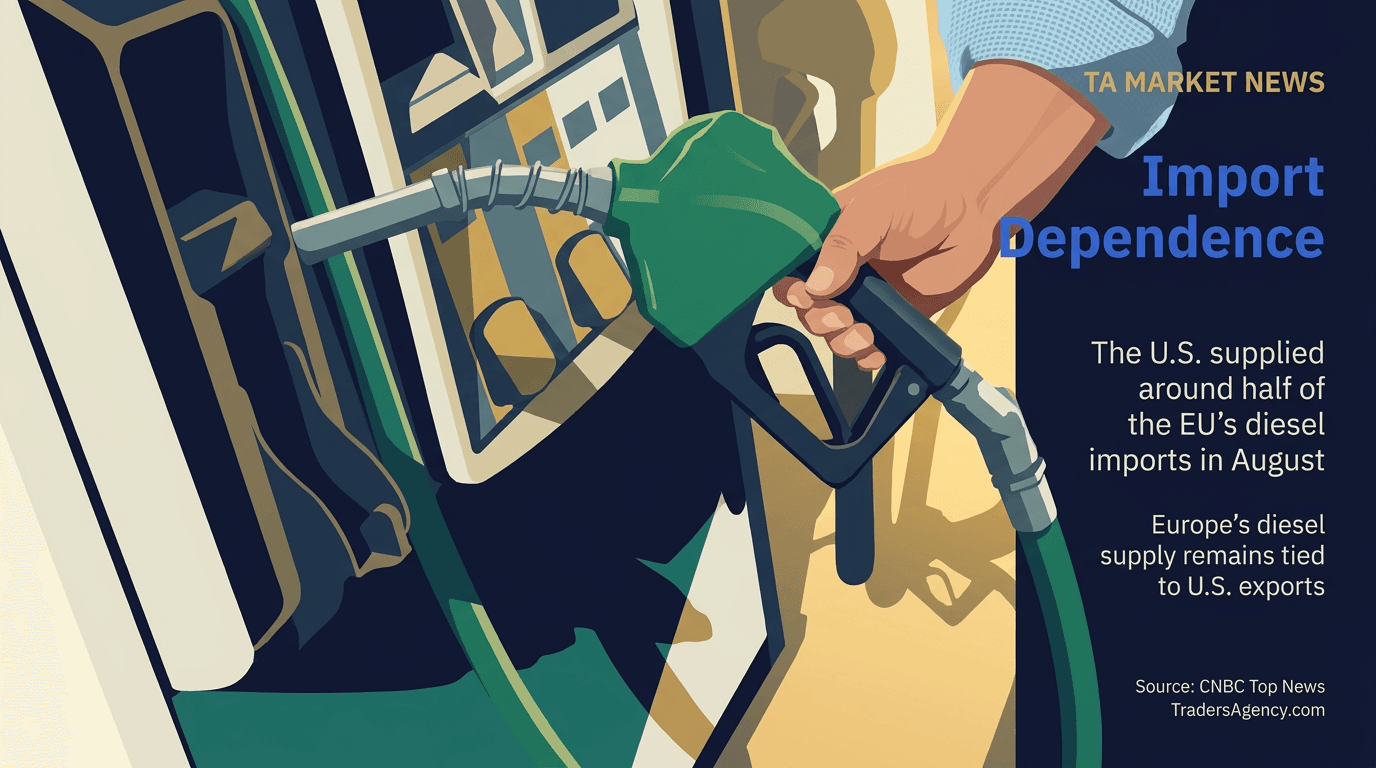
The G7 statement included a pledge among members to "refrain from export restrictions on energy and energy products" and called "on all producers to refrain from imposing bans that could exacerbate market tensions," according to CNBC, effectively rejecting calls from some U.S. Republicans to restrict diesel exports. Trump had floated a possible U.S. diesel export ban as leverage on Europe but appeared to cool on the idea earlier in the week over concerns about gasoline prices, CNBC reported, and the EU said Friday it fully rejected the threat, according to Al Jazeera. The IEA has noted the U.S. supplied around half of the EU's diesel imports in August, a dependence that left Europe exposed to any such ban.
Analysts cited by KSAT warned a U.S. export ban could lower prices in the short term but eventually backfire by reducing gasoline supply, since diesel output cannot be cut without also reducing overall refinery runs. Separately, Michael Lynch, distinguished fellow at the Energy Policy Research Foundation, said the European diesel release might mean fewer U.S. diesel exports, which could lower prices by 25 to 50 cents a gallon after a few weeks, KSAT reported. Jim Krane, energy research fellow at Rice University's Baker Institute, cautioned that drawing down reserves is a short-term fix with longer-term cost: "Draining stocks will reduce retail fuel prices for a while, at the cost of leaving Europe with less emergency cover," he said, adding that with two wars hitting refineries, "it's not the best time to be frittering away your emergency stocks."
Why diesel got this tight
Oilprice.com noted the release puts physical barrels into a market suffering acute shortage but "does not, however, add refinery capacity," leaving the underlying imbalance dependent on getting damaged and idled plants back into service. The squeeze has been driven by Ukrainian drone strikes on Russian refineries and a resulting Russian export ban, Middle Eastern refinery outages and blocked export routes, and Chinese refiners suspending October fuel exports to preserve domestic stocks, according to KSAT and oilprice.com. U.S. diesel inventories hit a record low of 107.9 million barrels as of Sept. 11, Al Jazeera reported, while European diesel futures have traded above $200 a barrel, according to oilprice.com. U.S. retail diesel averaged $6.37 a gallon Friday per AAA, down from a record $6.52 on Sept. 22, a decline of about 2.3% by our calculation (6.37 minus 6.52, divided by 6.52).
Bottom line
The G7's up-to-100-million-barrel release, frontloaded with diesel in the first 20 days, is a real and immediate supply-side response coordinated through the IEA, but multiple outlets flagged genuine uncertainty over whether it represents fresh barrels or the completion of March's unfinished pledge. Early price action was mixed across sources, and analysts warned the relief could be temporary unless refinery capacity, not just inventories, comes back online.
DISCLAIMER: Traders Agency does not offer financial advice. The information provided is for educational purposes only and should not be considered financial advice. Traders Agency is not responsible for any financial losses or consequences resulting from the use of the information provided. Trading carries inherent risks and may not be suitable for all individuals. You are advised to conduct your own research and seek personalized advice before making any investment decisions, recognizing the potential risks and rewards involved.
- CNBC Top News: Oil lower as G7 to release diesel stocks, Saudis plan attack on Houthis · accessed Oct 2, 2026
- CNBC Top News: G7 to release diesel stocks as wars in Europe, Middle East hit supplies · accessed Oct 2, 2026
- www.aljazeera.com: G7 to release 100m oil barrels as Trump hails Europe diesel deal · accessed Oct 2, 2026
- oilprice.com: G7 Moves to Release 100 Million Barrels to Counter Diesel Crisis · accessed Oct 2, 2026
- www.thehindu.com: G7 nations agree to release 100 million barrels of oil, including diesel, boost for Trump · accessed Oct 2, 2026
- www.ksat.com: G7 nations will release 100 million barrels of oil and diesel fuel after prices soar · accessed Oct 2, 2026
- www.toledoblade.com: G7 nations agree to release 100 million barrels of oil, a boost for Trump · accessed Oct 2, 2026
- wwmt.com: G7 nations agree to release 100M barrels of oil, including diesel, a boost for Trump · accessed Oct 2, 2026
- www.iea.org: IEA - International Energy Agency · accessed Oct 2, 2026
- www.iea.org: 2026 Energy Crisis Policy Response Tracker · accessed Oct 2, 2026
See more from Traders Agency on Google
Make us a preferred source and our market analysis will appear more prominently in your Google Search, Top Stories, and AI results.
Add to Preferred Sources