
The Bank of England is examining whether Barclays traders misrepresented illiquid private credit loans in a way that understated their risk, after an insider at the bank raised concerns, the Financial Times reported on Monday 19 October 2026. The newspaper said the complaint was lodged with the Bank's Prudential Regulation Authority (PRA) earlier this year and concerned how Barclays recorded derivatives used to finance private credit loans.
What the complaint alleges
According to the FT's reporting, cited by Euronext and Sharecast, the issue is not primarily about the headline size of Barclays' private credit book but about classification. The complaint centres on Barclays' allocation of total return swaps referencing illiquid private credit loans to its trading book rather than its banking book, where such exposures would ordinarily sit and attract higher capital requirements.
Total return swaps let a bank finance loans for private credit funds while passing the economic performance of those loans to the client for a fee. The FT reported that Barclays traders argued the exposure could be treated as a traded position because it was hedged through a matching, back-to-back swap with another counterparty, despite the underlying loans being illiquid. The complaint further alleged that this treatment breached PRA rules restricting banks from assigning derivatives backed by illiquid collateral to the trading book unless they can supply sufficient evidence to justify it.
The FT did not disclose the size of the specific positions at issue, though people familiar with Barclays' positions told the paper the bank has built up billions of dollars of exposure to private credit loans using these derivatives, according to Sharecast's account of the report.
Why regulators are focused on classification
The supervisory concern, as described in the FT's reporting, is that classifying derivatives linked to illiquid loans as easier-to-trade assets could understate the risk of the underlying exposure and reduce the capital a bank is required to hold against potential losses. Misallocating illiquid assets to the trading book would potentially lower capital requirements and boost reported profitability, Sharecast noted in relaying the report.
The FT also reported, per Sharecast, that the PRA warned banks in a letter to finance directors last year against repackaging illiquid assets as tradeable ones, stating: "We have identified that for certain financing portfolios, banks have adopted an imprudent approach associated with the recognition of collateral for regulatory capital purposes, resulting in a potential undercapitalisation of the risks."
Barclays response and market reaction

The Bank of England declined to comment, according to the reports. Barclays said it "takes seriously its regulatory obligations in markets where it operates", and declined to comment further on its interactions with the regulator. No regulatory findings or enforcement action have been reported.
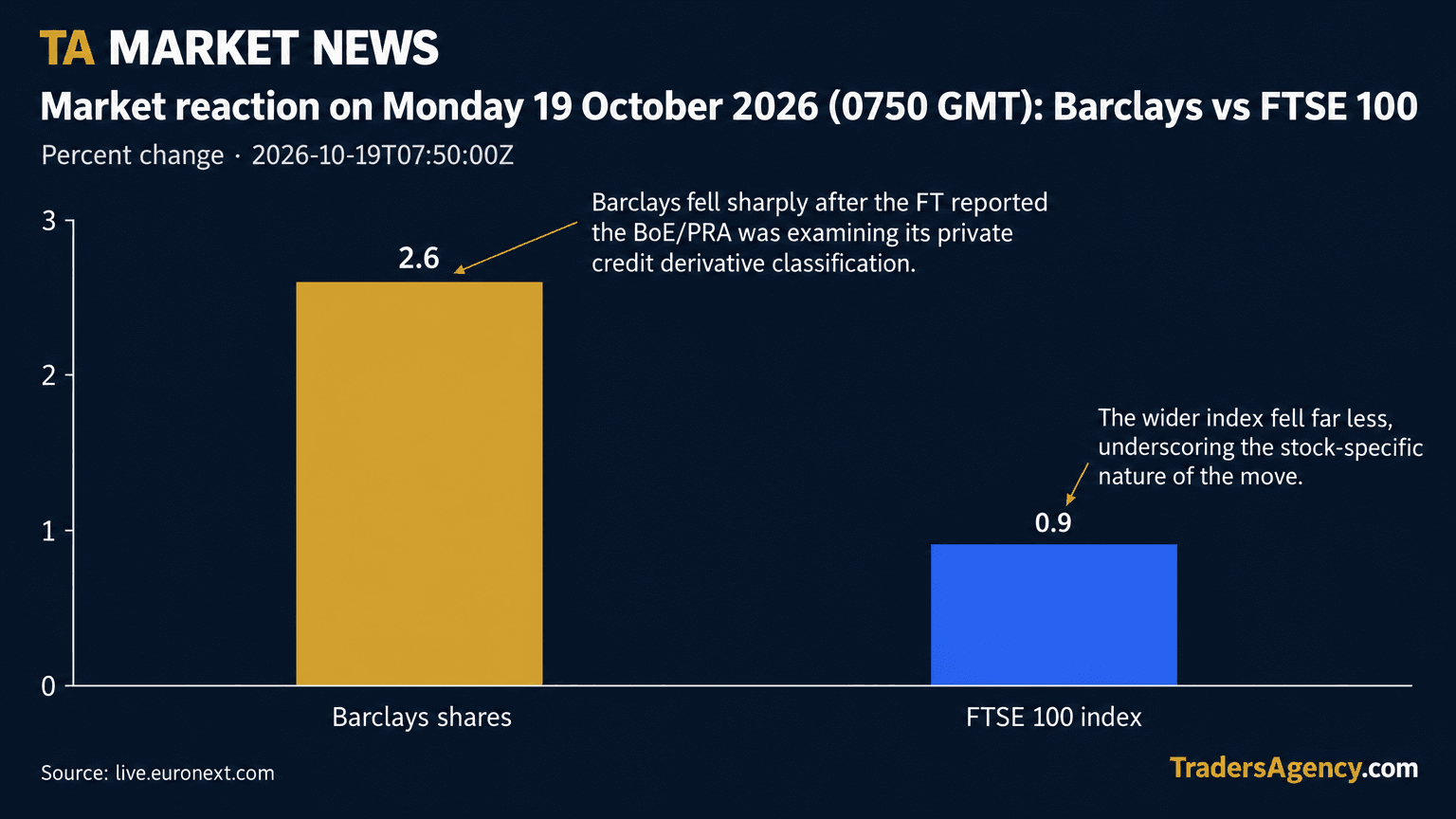
Barclays shares fell on Monday, trading down 2.6% at 421.4 pence at 0750 GMT, according to Euronext's account of the report, and down 2.8% at 420.70p by 1105 BST, per Sharecast, while the FTSE 100 index was 0.9% lower. On those two labelled observations, the Barclays move was 1.7 percentage points wider than the index decline (2.6 − 0.9), an arithmetic comparison rather than a measure of cause. Barclays is due to report third-quarter results on Thursday.
Russ Mould, investment director at AJ Bell, said the market reaction, "while negative, is relatively measured, suggesting markets are in ‘wait-and-see’ mode right now", but added: "on the basis any probe could be extensive, it could remain a cloud hanging over the business for some time to come." Mould described the concerns as "quite technical", relating to how Barclays' exposure to private credit loans had been recorded for accounting purposes and the impact on the capital it must hold as a buffer.
Bottom line: based on the FT's reporting as relayed by Euronext and Sharecast, the matter at issue is the classification of total return swaps referencing illiquid private credit loans, not a disclosed loss. The FT did not disclose the size of the positions, though people familiar with Barclays' positions said the bank has built up billions of dollars of such exposure. Interpretation, tied to those reported facts: because trading-book treatment can carry lower capital requirements, the outcome of the PRA's examination matters mainly for how much capital Barclays must hold against these exposures. The examination also lands amid heightened regulatory attention on the roughly $2 trillion private credit market, where regulators in Europe, the UK and the US have warned that loan valuations and bank-fund linkages could expose lenders to losses in a downturn.
DISCLAIMER: Traders Agency does not offer financial advice. The information provided is for educational purposes only and should not be considered financial advice. Traders Agency is not responsible for any financial losses or consequences resulting from the use of the information provided. Trading carries inherent risks and may not be suitable for all individuals. You are advised to conduct your own research and seek personalized advice before making any investment decisions, recognizing the potential risks and rewards involved.
- live.euronext.com: BoE looks into claim Barclays private credit exposure misrepresented, FT reports · accessed Oct 19, 2026
- bsky.app: @reuters.com on Bluesky · accessed Oct 19, 2026
- hedgeco.net: Bank of England Is Examining Whether Barclays Traders Misrepresented Private Credit Exposures, FT Reported: · accessed Oct 19, 2026
- www.sharecast.com: BoE said to be examining Barclays over private credit reporting · accessed Oct 19, 2026
- news.bloomberglaw.com: Barclays Defends Private Credit Reporting Under BOE Scrutiny · accessed Oct 19, 2026
- www.centralbanking.com: Client Challenge · accessed Oct 19, 2026
- www.linkedin.com: Barclays Reveals £15 Billion Private Credit Exposure · accessed Oct 19, 2026
- www.bankofengland.co.uk: Letter from the Governor to Baroness Noakes · accessed Oct 19, 2026
- shareprices.com: PRESS: BoE probes Barclays over private credit exposure claims - FT · accessed Oct 19, 2026
- home.barclays: Financial calendar, events and presentations · accessed Oct 19, 2026
- ir.huntington.com: Huntington Bancshares Incorporated to Present at the 2026 Barclays Global Financial Conference · accessed Oct 19, 2026
See more from Traders Agency on Google
Make us a preferred source and our market analysis will appear more prominently in your Google Search, Top Stories, and AI results.
Add to Preferred Sources