Barclays downgraded Dell Technologies, Hewlett Packard Enterprise and NetApp to Equal Weight from Overweight on Oct. 14, 2026, saying valuations have run too far and that it sees no meaningful enterprise artificial intelligence inflection yet, according to Yahoo Finance. Dell shares plummeted 11% on Wednesday, dragging down other data center equipment names including Hewlett Packard Enterprise, Oracle and Super Micro, according to CNBC.
New Ratings and Price Targets

Barclays analyst Tim Long cut his price target on Dell to $574 from $603 and on HPE to $77 from $83, while leaving his $219 target on NetApp unchanged, according to Stocktwits. Measured against Tuesday's closing prices, the revised targets imply only modest room left in two of the three names: the $77 HPE target implies 11.9% upside, the $574 Dell target just 0.3% upside, while the unchanged $219 NetApp target implies 8.4% downside, Stocktwits reported.
In premarket trading on Wednesday, HPE stock fell nearly 4% while NetApp and Dell shares each fell nearly 3%, according to the same report. Dell's decline deepened to 11% over the course of Wednesday's session, CNBC reported.
Barclays' Memory-Cost Thesis
At the center of the downgrade is a reinterpretation of why enterprise hardware revenue has been so strong this year. Rather than crediting a surge in AI-driven buying, Barclays attributes the gains to the global memory shortage, saying infrastructure companies have simply passed higher memory prices through to customers, per CNBC.
"There is growing sentiment about enterprise AI adoption creating a hardware refresh," the Barclays analysts wrote, adding that businesses are typically allocating just 5% of their IT budgets to AI. "We believe the strong enterprise revenues are more of a function of memory costs than a move to enterprise AI at this time," CNBC reported. The bank's analysts also found that only about a quarter of total enterprise AI spend is going toward hardware, and said normalizing and eventually declining memory prices could weigh on infrastructure-related revenue, per CNBC.
Long separately told clients, as reported by Yahoo Finance, that much of Dell's share gain reflects how well the company has offset memory cost inflation by raising prices, pointing to Dell's own guidance for just over 100% revenue growth in enterprise servers and mid-teens growth in storage and consumer devices. "As a result, we expect a meaningful deceleration in growth over the next two years and memory price normalize and potentially decline," he wrote, per Yahoo Finance.
Long's note put the broader run-up in context: the seven enterprise-exposed stocks in his coverage are up an average of about 140% this year against a 14% gain for the S&P 500, and the group now trades at roughly 21 times estimated 2027 earnings, well above its five-year average of around 15 times, according to Yahoo Finance.
Where Barclays Still Sees Strength
The downgrade is not a bearish call on Dell's AI server business itself. Long's model has Dell's AI server revenue tripling to $75 billion this fiscal year, and he said he would not be surprised to see upside to his $100 billion estimate for fiscal 2028, even as growth decelerates, according to Yahoo Finance. He also said AI server operating margins are stabilizing at about 5%, and noted Dell has cut operating expenses as a share of revenue from 15.6% in fiscal 2024 to an estimated 8% in fiscal 2027. Long still sees upside to earnings estimates, Yahoo Finance reported, but says "the scale of the beats should become much smaller," which may limit further share gains even as the underlying business keeps growing.
Sector-Wide Reaction
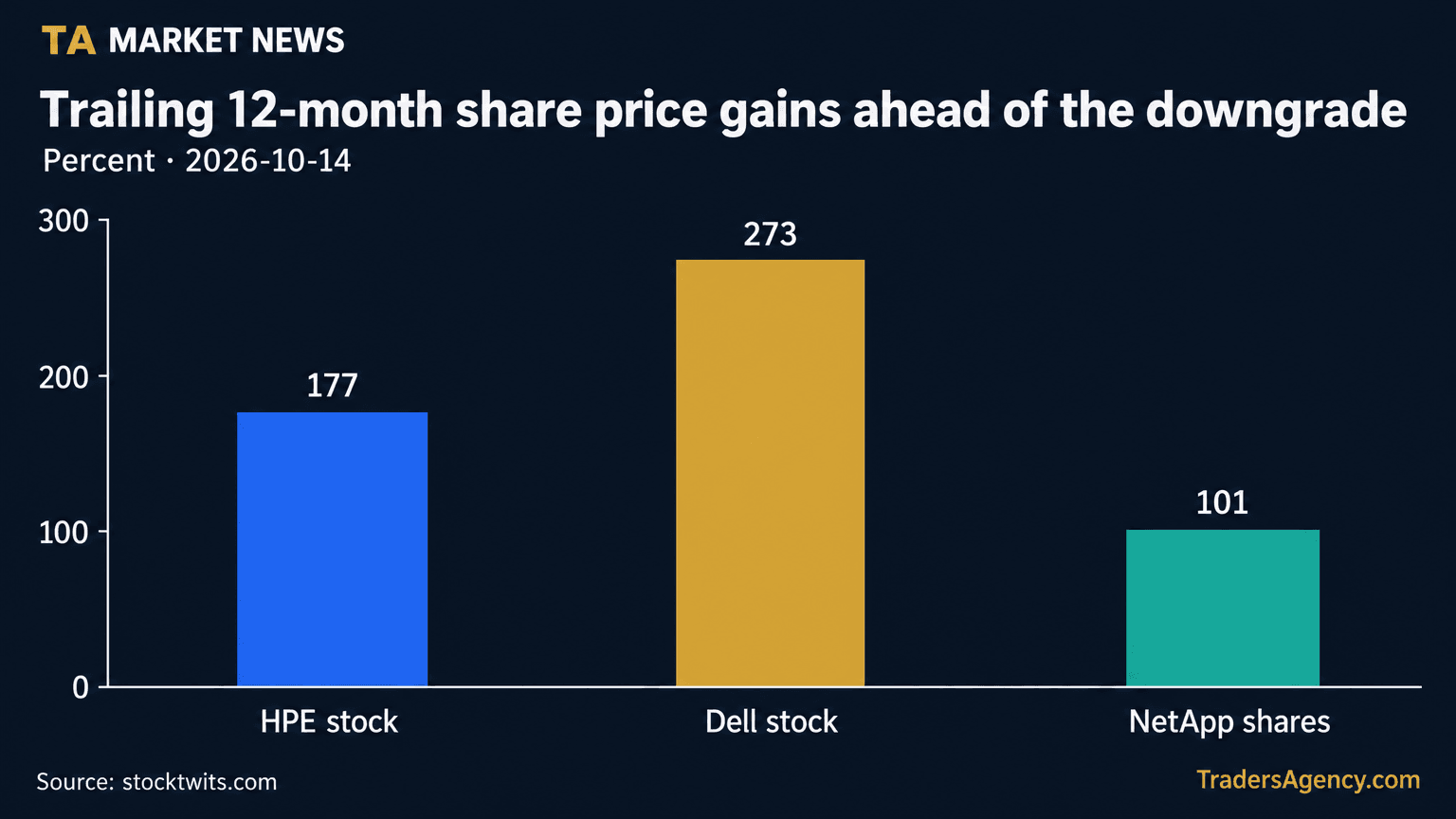
All three stocks had been among the market's biggest winners heading into Wednesday. CNBC counted Dell up more than 300% this year, HPE up about 160% and NetApp roughly doubled. Stocktwits, using a trailing 12-month window, put the gains at about 273% for Dell, 177% for HPE and 101% for NetApp. The two sets of figures differ because they measure different time periods, but both underscore how extended the rally has been regardless of the exact window used.
The selloff extended well beyond the three downgraded names. Oracle, a heavy borrower in the AI buildout, dropped 9% on Wednesday and is now down 33% for the year, while neocloud CoreWeave plunged 15%, wiping out its 2026 gains, according to CNBC. CNBC tied the broader move to concerning revenue figures out of OpenAI and fears that rising interest rates will strain a buildout heavily reliant on debt financing.
Memory suppliers were separately hit this week after China's ChangXin Memory Technologies reported progress on a new chip structure over the weekend. Micron is down 11% for the week, South Korea's SK Hynix has tumbled 13% in U.S. trading, and Western Digital has dropped more than 8%, CNBC reported.
A Reversal From Recent Bullish Calls

Barclays' downgrade runs counter to a wave of recent bullish sell-side calls on Dell. According to GuruFocus, Mizuho had raised its Dell price target to $650 and RBC Capital had initiated coverage with an Outperform rating and a $640 target before Wednesday's downgrade.
The memory-driven dynamic Barclays now frames as a risk was read very differently three months earlier. In July, Dell and HPE shares jumped after IBM pre-announced adjusted earnings of $2.93 per share on $17.2 billion in revenue, with CEO Arvind Krishna saying clients had shifted capital spending toward servers, storage and memory to secure supply-constrained infrastructure ahead of expected price increases, according to StockStory. That same report flagged the risk Barclays is now pricing in, noting the hardware spending surge "may partly reflect short-term panic-buying to front-run price hikes rather than sustainable, multi-year demand."
Bottom Line
Barclays is not disputing that Dell, HPE and NetApp have posted strong revenue growth this year; it is disputing the cause. By the bank's reading, memory-driven price increases, not a broad enterprise shift toward AI hardware, explain most of the gains, and that tailwind should fade as memory pricing normalizes. The firm's own model still points to a tripling of Dell's AI server revenue this fiscal year and possible upside into fiscal 2028, which suggests the call is primarily about valuation and how much further the stocks can re-rate, rather than a view that the underlying AI server business is slowing. On Barclays' numbers, the revised targets leave 0.3% upside for Dell and 11.9% for HPE, while the unchanged $219 NetApp target sits 8.4% below Tuesday's close, Stocktwits reported.
DISCLAIMER: Traders Agency does not offer financial advice. The information provided is for educational purposes only and should not be considered financial advice. Traders Agency is not responsible for any financial losses or consequences resulting from the use of the information provided. Trading carries inherent risks and may not be suitable for all individuals. You are advised to conduct your own research and seek personalized advice before making any investment decisions, recognizing the potential risks and rewards involved.
- CNBC Top News: Dell stock plunges after Barclays downgrade on enterprise AI · accessed Oct 14, 2026
- finance.yahoo.com: Barclays downgrades Dell stock after sharp rally · accessed Oct 14, 2026
- stocktwits.com: HPE, DELL, NTAP Stocks Downgraded, Barclays Sees No ‘Meaningful AI Inflection’ · accessed Oct 14, 2026
- www.gurufocus.com: DELL Downgraded by Barclays -- Price Target Lowered to $574 · accessed Oct 14, 2026
- stockstory.org: Dell and Hewlett Packard Enterprise Shares Skyrocket, What You Need To Know · accessed Oct 14, 2026
- www.investors.com: Stock Market Today: Dow, Small Caps Rise On Surprise Jobs Data; Dell Breaks Out Again, But Palo Networks Hits Key Sell Rule · accessed Oct 14, 2026
- www.indexbox.io: Dell Stock Upgraded by Barclays to Overweight on Strong AI Server Demand · accessed Oct 14, 2026
- www.dell.com: Dell Technologies World 2026 · accessed Oct 14, 2026
- www.dell.com: Computers, Monitors & Technology Solutions · accessed Oct 14, 2026
See more from Traders Agency on Google
Make us a preferred source and our market analysis will appear more prominently in your Google Search, Top Stories, and AI results.
Add to Preferred Sources